

Journalist

Candice Kim김혜준
candicekim1121@ajupress.com
ReporterSamsung Electronics, SK hynix, LG Electronics, Olive Young, Musinsa & Semiconductor, K-Beauty
Candice Kim is a dedicated business and technology reporter specializing in the intersection of high-tech innovation and fast-paced consumer trends. Her core beats span the semiconductor, IT, cosmetics, and retail sectors, where she provides in-depth coverage of industry titans including Samsung Electronics, SK hynix, and LG Electronics, alongside leading consumer brands like Olive Young and Musinsa. Whether analyzing complex silicon supply chains or tracking the latest shifts in beauty and fashion retail, Candice is committed to delivering sharp, accurate reporting that keeps readers informed on the forces shaping today's most dynamic markets.
"Connecting the dots from silicon chips to consumer shifts."
Latest by Candice Kim
-
 CJ Olive Young sees 11-fold jump in repeat foreign shoppers SEOUL, June 22 (AJP) - CJ Olive Young, South Korea's largest beauty retail chain, said on Monday the number of foreign tourists who returned to South Korea to shop during its seasonal sale events has risen 11-fold over the past three years. The company said the figure was based on an analysis of foreign customer data conducted with Global Tax Free, which it described as the country's largest tax refund operator. The analysis compared foreign tourists who visited South Korea during both the March and June sale periods this year with figures from three years earlier. Olive Young said the number of foreign tourists returning to South Korea at least twice a year to coincide with its sale periods has roughly doubled annually on average since 2023. Last year, more than 6,200 foreign tourists visited South Korea three or more times during the company's sale periods, according to the data. The company holds its flagship sale event four times a year, in March, June, September and December, with more than 1,500 beauty brands participating each time. Foreign sales at Olive Young stores outside the Seoul metropolitan area rose 72 percent year-on-year during the June sale period, compared with a 45 percent increase nationwide, the company said. Visits to Olive Young's global online mall rose more than 180 percent year-on-year over the same period, it said. Olive Young said it plans to continue expanding services for foreign tourists, including the introduction of shopping support devices at stores in areas popular with international visitors. "The fact that more foreign customers are returning to Korea during our sale periods shows that Olive Young has become more than just a leading K-beauty brand — it has become a cultural content itself," a company representative said in a statement. "We will continue to enhance satisfaction among foreign tourists and expand the points of contact between K-beauty brands and global customers." 2026-06-22 12:14:24
-
 Samsung Electronics to supply HVAC systems for premium housing project in India SEOUL, June 22 (AJP) - Samsung Electronics will supply air conditioning systems for a premium residential complex in India, as the company seeks to expand its HVAC business beyond commercial buildings into the residential market, the company said on Monday. The South Korean tech giant said it has partnered with Indian real estate developer Central Park to install more than 3,000 units of its residential air conditioning systems across 300 households at "The Orchard," a residential development in Gurugram, a city near New Delhi. Move-in is scheduled to begin early next year. Gurugram, located about 30 kilometers south of New Delhi, is a major hub for startups and global IT companies in India, with a concentration of high-income residents. Summer temperatures in the region can exceed 45 degrees Celsius, driving demand for high-performance cooling systems, according to the company. The project will combine Samsung's DVM S2 outdoor unit, which the company said can connect to up to 64 indoor units, with its "Wind-Free" ceiling cassette units designed for residential use. Samsung said the DVM S2's reinforced frame improves structural durability of internal components by up to 210 percent compared with previous models, and that the unit is designed to maintain operational reliability in earthquakes of up to magnitude 9. The company said the systems include artificial intelligence features such as a mode that learns usage patterns to adjust cooling speed, an energy-saving function that it said can reduce power consumption by about 15 percent based on sensor data, and real-time refrigerant leak detection. Samsung said these performance figures are based on internal testing and may vary depending on real-world conditions. The ceiling cassette units, which stand 135 millimeters tall, are also equipped with a filter that the company said removes ultrafine dust and eliminates 99 percent of captured bacteria. Samsung said the bacteria removal rate was based on testing by a domestic research institute verified by Intertek, an international testing and certification body, and that results may vary depending on usage conditions. The systems can also connect to Samsung's SmartThings platform, allowing users to monitor temperature, humidity and air quality by room, as well as track real-time power consumption through the app. "This will further solidify Samsung's leadership in the global premium residential market through its differentiated HVAC technology and localized lifestyle solutions," Lim Sung-taek, executive vice president of Samsung Electronics' Digital Appliances division, said in a statement. Samsung said India represents one of the most promising growth markets for the global HVAC industry, citing the country's hot climate, rapid urbanization and rising income levels. The company said it plans to use the project to expand its HVAC business — which has centered on offices, shopping malls and hotels — into the premium housing segment, and to strengthen its position as an AI home solutions provider in India and other global markets. 2026-06-22 09:56:38
-
 Shinsegae Duty Free launches K-Beauty exhibition in online upgrade SEOUL, June 19 (AJP) - Shinsegae Duty Free announced that it is continuing its K-beauty ingredient-focused curation exhibition in collaboration with the beauty platform Hwahae. The two companies have been co-hosting exhibitions that link Hwahae's beauty data with duty-free shopping demand since last year. The latest event, themed "What's in my pouch," focuses on ingredients and brands that are currently drawing high customer interest. Under the themes of travel self-beauty and skincare, the exhibition features popular products across various categories, including clean and soothing, long-lasting, lip care, UV protection, self-care, and body, hair, and perfume. Participating K-beauty brands include Sulwhasoo, Jung Saem Mool, Torriden, and Medicube. Representative items range from Medicube's "Booster Pro x2 Pink" and Aestura's "A-Cica 365 Blemish Calming Serum" to Yunjac's "Whole Plant Effect Scented Body Mist". The collaborative exhibitions have demonstrated solid performance. During the event held from March to May, sales to foreign customers increased by 37 percent compared to the same period last year. At the Myeongdong branch, sales to Chinese and Southeast Asian customers rose by 41 percent and 24 percent year-on-year, respectively. Previous iterations of the event also recorded growth rates of 103 percent for the first event, 39 percent for the second, and 85 percent for the third. In addition to the exhibition, Shinsegae Duty Free has introduced new review and short-form video features to its online K-Beauty Specialty Pavilion to enhance the customer experience. A newly added short-form content section at the top of the mobile platform allows customers to view brand and product information more intuitively, which the company plans to use to increase product information delivery and drive traffic to purchase pages. The platform also added a customer review section focused on top-selling items and products tested by trial groups. The company also improved its brand search functionality by introducing a left-to-right swipeable quick menu to help customers browse more brand lineups easily. Furthermore, it added a "See more" feature to help customers conveniently explore themed items, such as Shinsegae-exclusive brands, monthly K-beauty new arrivals, popular bulk-buy items, and products priced under $20. "Recently, K-beauty consumption is becoming more segmented, with customers considering ingredients, efficacy, and reviews alongside brand awareness," said a company official. "We will continue to expand a reliable K-beauty shopping experience for domestic and international customers by advancing data-driven product curation and customer-responsive content". 2026-06-19 15:19:29
-
 SK hynix showcases advanced AI memory portfolio at HPE Discover 2026 SEOUL, June 19 (AJP) - South Korean chipmaker SK hynix showcased its extensive lineup of artificial intelligence (AI) infrastructure memory products, including High Bandwidth Memory (HBM) and server DRAM, at the HPE Discover 2026 IT exhibition in the United States according to the company on Friday. Hosted annually by Hewlett Packard Enterprise (HPE), a U.S. firm specializing in hybrid cloud and data center servers, the global technology conference ran for four days from June 15 to 18 at the Venetian Convention Center in Las Vegas. The event highlighted the shifting landscape and emerging opportunities within IT infrastructure driven by the AI era. During the exhibition, the South Korean chipmaker displayed its 5th-generation HBM3E and 6th-generation HBM4 side-by-side, alongside a structural model of Nvidia's next-generation "Vera Rubin" AI platform. The company's AI infrastructure memory portfolio on display also featured server DRAM, enterprise solid-state drives (eSSD), and Compute Express Link (CXL) Memory Module-DDR5 (CMM-DDR5). SK hynix underscored its strong partnership with HPE by highlighting certified memory products that are actively integrated into HPE servers. Currently, SK hynix supplies HPE with the "PS1010 E3.S" data center eSSD and "64GB DDR5 RDIMM" server DRAM. "At this event, we focused on further solidifying our cooperative relationships with global partners, including HPE, and broadly promoting our technological capabilities across AI infrastructure," SK hynix said. The company added that it plans to continuously expand its role throughout the AI infrastructure sector moving forward. 2026-06-19 15:04:01
-
 Packaging bottleneck to decide winner in Korea's HBM4E race SEOUL, June 18 (AJP) - SK hynix and Samsung Electronics are locking horns to seize an early lead in next-generation AI memory by shipping samples of their 12-layer HBM4E chips to major customers such as Nvidia for future data-center GPUs including Rubin Ultra. But as the race moves beyond raw memory performance, industry watchers say the real bottleneck may lie elsewhere: Taiwan Semiconductor Manufacturing Co.'s advanced packaging capacity. SK hynix said Wednesday it had shipped samples of its 12-layer HBM4E chips to major customers. The new product supports speeds of up to 16 gigabits per second per pin and improves power efficiency by more than 20 percent from the previous generation, according to the company. The Korean chipmaker is Nvidia's primary HBM supplier for AI accelerators. Samsung moved first in late May, announcing shipments of what it called the industry's first 12-layer HBM4E samples to major global customers. Samsung said its chip offers a stable speed of 14Gbps per pin, can scale up to 16Gbps and delivers memory bandwidth of up to 3.6 terabytes per second per stack. On the surface, the race looks like another chapter in the long-running HBM battle between SK hynix, the current front-runner in AI memory, and Samsung, which is trying to regain ground through more aggressive product launches. But HBM4E is not simply another faster memory chip. It is arriving at a point where AI chip performance increasingly depends on how tightly memory, logic chips and packaging technologies are integrated into a single system. That shift could turn TSMC's CoWoS, or chip-on-wafer-on-substrate technology, into one of the most decisive variables of the HBM4E era. CoWoS is used to place AI processors and HBM stacks in close proximity, allowing massive volumes of data to move with lower latency and higher bandwidth. Nvidia Chief Executive Officer Jensen Huang said earlier this year that packaging constraints, though improved from the past two years, remain a bottleneck. Nvidia's Blackwell chips use TSMC's CoWoS-L technology, while Hopper chips continue to rely on CoWoS-S. That matters for Korean memory makers because HBM qualification is no longer a simple test of whether a memory stack functions on its own. The chip must perform inside a customer's entire AI accelerator system, where heat dissipation, power efficiency, base-die design and packaging stability can determine whether a product wins final approval. "Even if the two companies supply products, customers will have to test how they perform when connected with the base die and GPU, including whether heat is managed properly," said Kim Duk-ki, a professor of semiconductor systems engineering at Sejong University. "The two companies take somewhat different approaches, so performance could differ once the chips are actually connected to GPUs and tested in real applications." Kim said the final verdict will likely come from customers' own system-level evaluations rather than memory specifications alone. "As semiconductor technology becomes more customized for each customer, it is difficult for memory suppliers alone to know how the final performance will turn out," he said. "The customer will have to evaluate the products across its own applications." The customer names have not been disclosed. SK hynix and Samsung have only said they supplied samples to major or global customers. Still, industry attention is centered on AI chipmakers such as Nvidia, AMD and custom AI chip designers, whose next-generation platforms are expected to drive HBM4 and HBM4E demand. The packaging issue could complicate the competitive map. SK hynix has built its lead through close ties with Nvidia and strong execution in HBM3E. Samsung, meanwhile, is emphasizing its ability to combine memory, foundry and packaging technologies, including its use of a 4-nanometer logic base die for HBM4E. That turnkey strategy could become more valuable if TSMC's capacity remains tight. But whether Samsung can translate that structural advantage into customer qualification wins remains uncertain. Nor is it clear which supplier will secure the largest allocations for future AI platforms. Professor Kim said TSMC's packaging capacity could emerge as the industry's biggest constraint, even as HBM supply itself remains tight. "TSMC is almost dominant globally in CoWoS technology, so it could become a bottleneck," he said. "If that happens, TSMC could gain more pricing power." The HBM4E race, therefore, may not be decided by who shipped samples first. Samsung may have claimed the early-mover title, while SK hynix followed within weeks with its own shipments. But the more important milestones are still ahead: customer qualification, packaging integration and mass-production readiness. For Korea's two largest memory makers, the fight is no longer simply about stacking more DRAM dies faster. In the AI era, the winner may be the company whose memory not only performs best, but also survives the industry's most unforgiving bottleneck: fitting seamlessly into the world's most advanced AI systems — and securing a place inside TSMC's packaging lines. 2026-06-18 16:30:54
-
 Samsung launches mid-tier Galaxy A37 5G smartphone in South Korea SEOUL, June 18 (AJP) - South Korea's Samsung Electronics Co Ltd said on Thursday it will launch the Galaxy A37 5G smartphone in its domestic market on Friday. The new mid-range model is priced at 598,400 won ($434) and will be available through Samsung's retail stores, its official website, and local mobile carriers. The device will be offered in three colors: lavender, white, and charcoal. The Galaxy A37 5G features a 6.7-inch FHD+ Super AMOLED display with a maximum refresh rate of 120Hz. It is equipped with a 5,000mAh battery capable of reaching a 60 percent charge in 30 minutes when using the company's fast charger, and carries an IP68 rating for water and dust resistance. For its camera system, the device sports a triple-lens rear setup, including a 50-megapixel main sensor with optical image stabilization (OIS) and 1.0-micrometer pixels for improved low-light photography. It also includes an 8-megapixel ultra-wide lens and a 5-megapixel macro lens, along with a 12-megapixel front-facing camera. Samsung is incorporating mobile artificial intelligence features into the device, offering tools such as an AI object eraser for photo editing and voice-to-text transcription capabilities. The smartphone, which runs on Android 16 out of the box, will be supported with up to six operating system upgrades and six years of security updates. "The Galaxy A37 5G is a product that enhances everyday usability with AI capabilities, camera performance, and display features," said Jung Ho-jin, vice president of Samsung Electronics' Korea operations. 2026-06-18 09:42:05
-
 SK hynix samples next-gen 12-layer HBM4E chips, stock at new high SEOUL, June 18 (AJP) - South Korea's SK hynix said on Thursday it has begun supplying samples of its next-generation 12-layer High Bandwidth Memory (HBM4E) chips to major customers, moving to solidify its position in the booming artificial intelligence hardware market. The world’s leading supplier of HBM chips said the new HBM4E product delivers a data processing speed of up to 16 gigabits per second (Gbps) per pin while improving energy efficiency by more than 20 percent compared to the previous HBM4 generation. The improvements are aimed at reducing latency and expanding bandwidth for demanding AI training and inference workloads. The announcement comes amid intense competition among global chipmakers to lock in supply deals with major AI processor designers like Nvidia Corp. SK hynix currently holds a significant lead in the HBM market, but domestic rival Samsung Electronics and U.S.-based Micron Technology are aggressively expanding their own advanced memory portfolios. SK hynix said it utilized an advanced Mass Reflow Molded Underfill (MR-MUF) process to stack 12 DRAM chips, achieving a total capacity of 48 gigabytes (GB). The proprietary packaging method injects a liquid protective material between the stacked chips to improve structural integrity and heat dissipation. According to the company, the HBM4E design reduces thermal resistance by approximately 17 percent compared to the standard HBM4 architecture, a key factor in maintaining operational stability under the intense heat generated by high-performance AI data centers. "Based on our mass-production experience across previous HBM generations, we are working closely with key clients to ensure timely mass production," the company said. Shares of SK hynix rallied on with record climb, adding 3 percent to 2,601,000 won a quarter after opening at 9:00 a.m. Thursday and nearly 24 percent in a week. Analysts note that as AI models grow in complexity, memory bottlenecks have become a critical constraint for data center operators, making thermal control and energy efficiency primary selling points for next-generation hardware. This sampling milestone establishes a foundation for us to sustain our technological leadership," said Ahn Hyun, head of development at SK hynix. "We will continue to address system bottlenecks by working closely with our industry partners to deliver tailored memory solutions. 2026-06-18 09:09:43
-
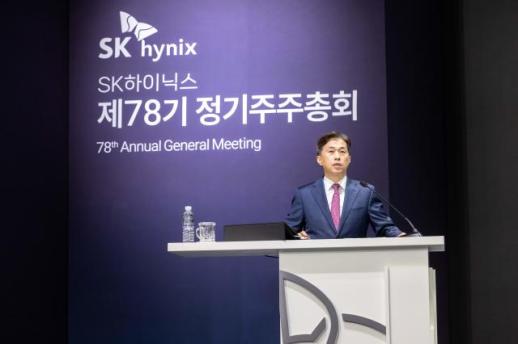 SK hynix confirms U.S. ADR plan, denies 100 trln won shareholder payout SEOUL, June 17 (AJP) - SK hynix confirmed Wednesday that it is actively pursuing a U.S. American Depositary Receipt (ADR) listing to expand its AI-era memory chip capacity, but denied reports that it is preparing a 100 trillion won ($72.5 billion) shareholder reward program to offset concerns about equity dilution. The clarification came after the Korea Economic Daily reported Tuesday that the South Korean chipmaker was preparing a historic fourth-quarter shareholder return package, including a 40 trillion won share buyback, to appease investors worried about dilution from a new U.S. stock issuance. In a regulatory filing, however, SK hynix said it is considering various ways to enhance shareholder value but has not reviewed any specific scale or figures cited in the reports. "We are currently pursuing the ADR listing itself, but we are not in a position to say definitively whether it will take place in July or August," a company official said, adding that the final timetable remains subject to approval by the U.S. Securities and Exchange Commission. The official also dismissed speculation surrounding an unprecedented 100 trillion won payout. "Nothing specific has been finalized. Reports about expanding shareholder returns at year-end reflect the general stance we already announced at our shareholder meeting, so there has been no significant change," the official said. The company first confirmed plans for a U.S. listing during its annual general meeting in March, when management disclosed that it had confidentially filed a Form F-1 with the SEC with the aim of completing the listing in the second half of this year. At the time, Chief Executive Kwak Noh-jung pushed back against mounting retail investor concerns over potential dilution, arguing that the fundraising was strategically necessary to secure more than 100 trillion won in net cash for advanced infrastructure and next-generation AI memory investments. SK hynix has emerged as the biggest beneficiary of the AI-driven memory boom, thanks to its dominance in High Bandwidth Memory chips, where it is estimated to control nearly 60 percent of the global market. The company has become a key supplier to AI chip leader Nvidia, helping propel its market capitalization above 1,600 trillion won this week, compared with about 200 trillion won a year earlier. The stock has been virtually unstoppable this year, trading above 2,512,000 won — more than tenfold its level of 242,000 won a year ago. As of Tuesday, SK hynix was the world's 13th most valuable listed company, just behind Samsung Electronics. The company's surging profitability has also led to hefty employee profit-sharing bonuses, but analysts say management faces a delicate balancing act between rewarding shareholders and funding massive capital expenditure plans. SK hynix is expected to raise about 40 trillion won through the U.S. ADR issuance, with much of the proceeds earmarked for infrastructure investments. That includes the construction of four advanced fabrication plants at the Yongin semiconductor cluster, where projected costs have reportedly ballooned to around 600 trillion won. SK hynix is scheduled to report second-quarter earnings in late July, when executives are expected to provide additional guidance on global financing plans and long-term capital expenditure strategy. 2026-06-17 15:00:18
-
 SK hynix scraps degree requirements in major hiring push for AI era SEOUL, June 17 (AJP) - South Korean chipmaker SK hynix said on Wednesday it has completely abolished educational requirements for its new recruitment drive, shifting its focus to practical skills and growth potential as it gears up for the artificial intelligence era. Starting with its latest rolling recruitment that opened Wednesday, the world's second-largest memory chipmaker has removed the traditional prerequisite of a "four-year bachelor's degree or higher" from its job postings. Under the new system, applicants will be evaluated purely on their experience, job competency, and cultural fit, allowing anyone to apply and be hired regardless of their academic background, the company said in a statement. The structural shift aligns with SK Group Chairman Chey Tae-won's recent vision for talent in the AI era. Chey recently emphasized the importance of three core "muscles" for future employees: a "thinking muscle" to ask questions and probe the essence of problems, an "adaptability muscle" to respond agilely to technological shifts, and an "empathy muscle" for flexible collaboration and understanding diversity. A company official explained that conventional degrees and standard resumes are no longer sufficient to gauge a candidate's potential in the fast-evolving AI sector, prompting the company to revamp its recruitment criteria to find creative problem solvers. In an unusually large move for a rolling recruitment period, SK hynix plans to hire hundreds of new employees for key engineering positions, including semiconductor design, to lead next-generation chip development. The company aims to aggressively recruit high-potential talent to secure future growth engines and solidify its competitive edge in the global AI semiconductor market, while also contributing to broader youth employment. Applications for the current hiring round will be accepted through June 23 via the company's recruitment portal. 2026-06-17 10:38:16
-
 Samsung upgrades Galaxy security to combat surging voice phishing in South Korea SEOUL, June 16 (AJP) - Samsung Electronics is upgrading the security framework of its Galaxy mobile devices to combat a surge in voice phishing and financial fraud in South Korea, introducing pre-emptive blocking measures against malicious applications and messages. Voice phishing remains a severe socio-economic issue in the country. According to data from the National Police Agency, South Korea recorded 23,360 voice phishing cases in 2025, resulting in financial damages totaling 1.25 trillion won. In response to the growing threat, Samsung announced that its upcoming One UI 9.0 operating system—slated for release on new Galaxy devices in the second half of the year—will feature an advanced phishing application alert system. The updated software will not only prevent the installation of known malicious applications by scanning app reputation data, but will also actively block their execution if they are already installed or downloaded via remote control. To maintain an updated threat database, the tech giant is collaborating closely with South Korean government bodies, including the National Police Agency, the National Forensic Service, and the Korea Internet & Security Agency (KISA). Relying on data provided by these agencies, Samsung has deployed a deep-learning artificial intelligence system to filter illegal spam related to gambling, loans, and smishing. The company reported that it has blocked approximately 400 million malicious messages between September 2024 and April 2026. Recent updates have also heavily integrated on-device AI to intercept scams before financial damage occurs. The Galaxy S26 series introduced a "Call Screening" function that summarizes caller information and intent before the user answers, allowing them to reject suspected spam without compromising data privacy. Additionally, an AI-powered voice phishing detection tool analyzes live calls to issue real-time warnings. Samsung noted that this feature, activated by default for enhanced security, is currently in use on approximately 84 percent of eligible devices as of April 2026. 2026-06-16 15:57:27