

Journalist

Candice Kim김혜준
candicekim1121@ajupress.com
ReporterSamsung Electronics, SK hynix, LG Electronics, Olive Young, Musinsa & Semiconductor, K-Beauty
Candice Kim is a dedicated business and technology reporter specializing in the intersection of high-tech innovation and fast-paced consumer trends. Her core beats span the semiconductor, IT, cosmetics, and retail sectors, where she provides in-depth coverage of industry titans including Samsung Electronics, SK hynix, and LG Electronics, alongside leading consumer brands like Olive Young and Musinsa. Whether analyzing complex silicon supply chains or tracking the latest shifts in beauty and fashion retail, Candice is committed to delivering sharp, accurate reporting that keeps readers informed on the forces shaping today's most dynamic markets.
"Connecting the dots from silicon chips to consumer shifts."
Latest by Candice Kim
-
 Nvidia's Huang, SK's Chey solidify AI partnership over chicken and 'somaek' in Seoul SEOUL, June 07 (AJP) - Nvidia CEO Jensen Huang and SK Group Chairman Chey Tae-won (Tony Chey) held a highly public, casual dinner meeting over fried chicken and beer in Seoul on Sunday, a gathering that highlighted the close ties between the AI chip giant and the world's leading high-bandwidth memory (HBM) maker. Arriving at a Kkanbu Chicken branch in southern Seoul's Gangnam district at 6:46 p.m., Huang wore a Doosan Bears baseball uniform—having just thrown the ceremonial first pitch at a local game—alongside his wife, Lori Huang, who sported the same jersey. Chey arrived ten minutes later, exchanging high-fives with Huang before settling at a central table. The executives were joined by key SK leaders, including SK Hynix CEO Kwak Noh-jung, SK Telecom CEO Chung Jae-heon, and SKT AI CIC Head Chung Seok-geun, as well as Nvidia Senior Director Madison Huang and her fiancé. The gathering quickly morphed into an impromptu fan event. Huang and Chey moved around the restaurant, signing autographs for citizens—including a child wearing a custom t-shirt featuring the two executives' faces—and posing for photos. The group shared fried chicken and toasted with "somaek," a popular Korean cocktail of soju and beer. Taking the lively atmosphere to the streets, Huang stepped outside to hand out boxes of fried chicken to reporters and citizens. Chey and the SK executives followed suit, distributing traditional sweet rice beverage (sikhye) and a promotional snack playfully modeled after HBM chips. "I want more HBM!" Huang joked to the crowd as Chey distributed the HBM-themed snacks. Despite the heavyweight corporate lineup, the executives downplayed any immediate strategic discussions. "It wasn't an atmosphere for business talk today; we just engaged in small talk," SK Hynix CEO Kwak said. "We talked about which chicken was delicious." Kwak reportedly picked up the tab for the evening's gathering. The choice of venue was deeply personal for the two leaders. According to Chey, Huang strongly insisted they visit the fried chicken franchise together because Huang had been disappointed that Chey was absent from a similar informal gathering at the same chain last year. "It's not me who was disappointed, it was Jensen," Chey told reporters regarding last year's absence. Following Sunday's casual diplomacy, the executives will shift to official business. Huang is scheduled to visit the SK Seorin Building in central Seoul on Monday morning for further discussions with Chey. On Monday evening, Huang will host the "Korea AI Ecosystem Reception" at the Shilla Hotel to meet with domestic AI partners and enterprises. 2026-06-07 21:22:11
-
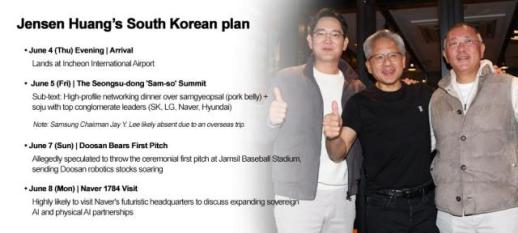 Buzz builds ahead of Nvidia CEO Jensen Huang's Seoul visit SEOUL, June 2 (AJP) - Nvidia CEO Jensen Huang is visiting Seoul this week, and his trip is already generating buzz across local industries and financial markets, with major deals expected across areas including memory chips and artificial intelligence (AI). The excitement follows Huang's announcements Monday at Nvidia's developer conference in Taipei, where he said that the company's next-generation AI chips have entered mass production. "Now in full production - HBM4 memory from Micron, SK hynix and Samsung, the Vera Rubin computer," Huang said, confirming that South Korean memory chipmakers are a key part of Nvidia's supply chain. Huang also pointed out Nvidia's wider partnerships in the region, saying, "Here's Naver Cloud from Korea, Bank of Korea, Hyundai, so many other companies." That had an immediate impact on the South Korean stock market, with Samsung Electronics surging 10 percent and crossing the 350,000 won mark for the first time ever during intraday trading earlier in the week. South Korea's largest internet portal Naver also jumped 16 percent, while LG Electronics, whose executives are scheduled to meet with Huang, surged sharply for a third consecutive trading session. Industry observers say Huang's meetings with key business leaders here could go beyond routine business talks, potentially reshaping the global AI supply chain. In the semiconductor sector, SK hynix maintains its stronghold as a core supplier of high-bandwidth memory (HBM) for Nvidia's AI accelerators. For Samsung Electronics, the visit marks a critical juncture to evaluate its HBM competitiveness and explore further collaboration in foundry operations. The agenda is also expected to focus heavily on physical AI. LG Group chairman Koo Kwang-mo is expected to discuss expanding partnerships in robotics, smart homes, and on-device AI. Talks with Hyundai Motor Group chairman Chung Eui-sun are expected to cover autonomous driving, software-defined vehicles and robotics. There are also high expectations around Naver in the area of sovereign AI, with Huang potentially visiting the company's robot-friendly 1784 headquarters. Doosan Group's robotics and smart factory divisions are also expected to benefit, while Doosan Enerbility is seen as a key player in meeting the growing power demands of AI data centers. Huang is scheduled to arrive at Incheon International Airport on Thursday evening, before meeting with heads of South Korea's largest conglomerates and tech experts the following day including Chung, Koo, SK Group chairman Chey Tae-won, Naver's Lee Hae-jin, and Doosan Group chairman Park Jeong-won. But Samsung Electronics chairman Lee Jae-yong is reportedly likely to miss the gathering this time due to an overseas business trip. Beyond formal meetings, an informal gathering is also expected on Friday evening. Huang is expected to join major tech leaders for samgyeopsal or pork belly with soju at a restaurant in Seoul's hip district of Seongsu-dong, in what analysts say could be an intimate dinner that may strengthen personal ties across the global AI industry. 2026-06-02 17:06:12
-
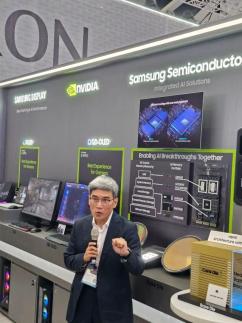 Samsung Electronics unveils HBM5 roadmap, new cooling tech at Computex SEOUL, June 02 (AJP) - Samsung Electronics on Tuesday showcased a mock-up of its next-generation High Bandwidth Memory 5 (HBM5) chips and introduced a new thermal management technology at the Computex exhibition in Taipei. The South Korean tech giant is moving to secure its position in the expanding artificial intelligence (AI) memory sector, following its recent mass production of HBM4 and sample shipments of HBM4E chips. Song Jae-hyuk, Chief Technology Officer of Samsung’s Device Solutions (DS) division, stated at the event that turnkey solutions spanning memory, foundry, logic, and packaging are becoming increasingly critical as AI infrastructure demands higher performance and density. To address overheating issues in advanced AI systems, Samsung introduced its Heat Path Block (HPB) technology for HBM5. The HPB design lowers thermal resistance and improves operational stability by creating additional heat dissipation paths, specifically targeting the physical layer (PHY) of the chip. Samsung noted that it has already implemented and verified the HPB technology in its HBM4E chips to ensure structural and package reliability. The company plans to fully integrate HPB into its upcoming HBM5 lineup, which will also feature a 2-nanometer base die. During the exhibition, Samsung also displayed its HBM4E wafers and chipsets. The HBM4E integrates a 1c-nanometer DRAM core die with Samsung’s own 4-nanometer foundry base die. Having commenced sample shipments on May 29, the HBM4E operates at a pin speed of 14 Gbps, with the capacity to reach up to 16 Gbps, delivering a maximum bandwidth of 4 Terabytes per second (TB/s). Market research firm Omdia projects the global HBM market will more than triple from approximately $58.9 billion in 2026 to $198.3 billion by 2029. Samsung also highlighted its supply chain role for Nvidia Corp's next-generation Vera Rubin AI platform. A Vera Rubin system equipped with Samsung memory was displayed at the pavilion. According to the company, it is currently the only vendor capable of supplying a comprehensive portfolio for the platform, including HBM4, LPCAMM2/SOCAMM2, and PM1763 storage solutions. Samsung's HBM4 chips, which entered mass production in February, achieve a performance rate of 11.7 Gbps, with peak speeds reaching 13 Gbps. "We plan to continuously strengthen our next-generation memory competitiveness through ongoing collaborations with global partners, including Nvidia," Song said. 2026-06-02 16:52:26
-
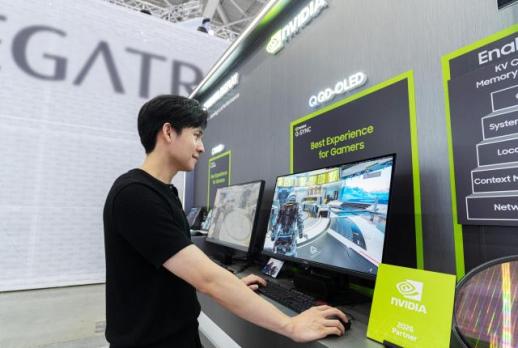 NVIDIA, Samsung Display team up to showcase GeForce RTX 50 performance on OLEDs SEOUL, June 02 (AJP) - Samsung Display has partnered with global AI computing leader NVIDIA to showcase a premium OLED gaming experience at COMPUTEX 2026, Asia's largest IT exhibition, which opened today at the Taipei Nangang Exhibition Center. The collaboration features a visual experience zone where visitors can experience vivid game graphics on Samsung OLED and QD-OLED displays optimized for the latest NVIDIA GeForce RTX 50 Series GPUs. The demonstration utilizes PCs equipped with the NVIDIA GeForce RTX™ 5080, including ASUS' latest ROG Zephyrus G16 laptop and MSI's MPG 322UR QD-OLED X24 monitor, both featuring Samsung Display panels. The experience highlights Capcom's sci-fi action-adventure game PRAGMATA™. The experience is centered on the visual capabilities of the GeForce RTX 50 Series. These GPUs bring realistic graphics to life through path tracing, which calculates light movement in scenes precisely, and NVIDIA DLSS 4.5, an AI-based performance and image enhancement technology. These features are crucial for rendering demanding visuals like light reflecting off metallic surfaces and the deep darkness of outer space, which are characteristics of PRAGMATA™. Youngseok Kim, Vice President and Head of Samsung Display IT Sales, said that differences in display performance become more apparent as real-time light reflection, shadow rendering, and HDR effects become more sophisticated in the latest GPU-powered environments. “Samsung OLED and QD-OLED are displays that best translate advanced GPU performance into the viewing experience,” Kim said. Samsung Display emphasized that its self-emissive OLED and QD-OLED panels are optimized to fully express these high-performance graphics. These displays offer clear picture quality, even in dark scenes, through a high contrast ratio of 1,000,000:1 and perfect black expression. Furthermore, OLED panels offer faster response times than conventional LCDs, allowing them to clearly render hundreds of frames per second with reduced motion blur. The zone allows visitors to compare the same game running on OLED and LCD displays to see which technology most faithfully reproduces the performance of the GeForce RTX 50 Series. 2026-06-02 09:53:37
-
 SK Group chairman attends GTC Taipei to solidify Nvidia partnership, discuss customized AI memory SEOUL, June 1 (AJP) - SK Group Chairman Chey Tae-won attended the GTC Taipei 2026 keynote on Monday, reinforcing the South Korean conglomerate's ongoing artificial intelligence (AI) infrastructure partnership with Nvidia. Accompanied by SK hynix CEO Kwak Noh-jung, Chey observed Nvidia CEO Jensen Huang's presentation, which outlined the U.S. chipmaker's "Vera Rubin" mass production roadmap and future AI platforms. This marks the third major engagement between the two executives this year, following meetings in Silicon Valley in February and at GTC San Jose in March. During his visit to Taiwan, Chey is scheduled to meet with industry partners to discuss SK hynix's strategy for next-generation AI memory. SK hynix, a primary supplier of High Bandwidth Memory (HBM) chips, is shifting its focus from supplying standard products to co-developing customized HBM (cHBM) solutions tailored to specific client architectures. To address the growing processing demands of advanced AI systems, SK hynix also plans to introduce new memory technologies in the future, including High Bandwidth Flash (HBF) and 3D Stacked DRAM on Logic. 2026-06-01 17:35:53
-
 Samsung's shipment of HBM4E samples seen as strategic move ahead of Jensen Huang's Seoul visit SEOUL, June 1 (AJP) - Samsung Electronics' shipment last week of next-generation High Bandwidth Memory 4E (HBM4E) samples is widely seen as a strategic overture to Nvidia, just ahead of chief executive Jensen Huang's visit to South Korea, multiple experts said. In a timed move, Samsung announced last Friday that it has begun shipping the industry's first 12-layer HBM4E samples to global customers. The rollout comes just days before Huang's upcoming visit to Seoul, following his appearance at the weeklong Computex trade show in Taipei, which wraps up on Friday. The Nvidia CEO is expected to meet South Korean technology companies including Naver and LG, during his stay. "I think there is something to the idea that this is a signal timed to Huang's scheduled visit to Seoul," Kim Duk-ki, a professor at Sejong University's Department of Semiconductor Systems Engineering, told AJP on Monday. "It is not bad from Nvidia's perspective at all, as it would encourage competition." Kim said Nvidia stands to benefit from Samsung competing more aggressively with SK hynix, which has dominated HBM supply to the chip designer. As demand for AI infrastructure grows, global tech firms have been scrambling to secure sufficient memory supplies. "Nvidia has every reason to want a competitive dynamic between suppliers," Kim said. "Stable volume is the priority, and competition helps ensure that." The new 12-layer HBM4E component uses Samsung's sixth-generation 10-nanometer-class (1c) DRAM process paired with a 4-nanometer logic base die, boosting performance by more than 20 percent compared with previous-generation HBM4 chips. On the technical side, Kim noted that data movement — rather than computation — consumes the most energy in AI workloads, making memory bandwidth and efficiency a critical bottleneck. HBM addresses this by stacking multiple memory dies to dramatically increase data throughput, driving the exponential growth in demand. "The growth in memory demand has been exponential and continues to accelerate," Kim said. "Samsung is utilizing this window to aggressively position itself for the next-generation supply chain." Huang's Seoul itinerary, later this week or early next week, is also expected to include meetings with South Korean tech executives to discuss hardware supply chains and broader AI partnerships. 2026-06-01 15:59:12
-
 Samsung Electronics' market cap surpasses 2 quadrillion won SEOUL, June 1 (AJP) - Samsung Electronics on Monday became the first South Korean company to top 2 quadrillion won in market capitalization, driven by surging investor enthusiasm over the ongoing AI-driven chip boom. Shares of the tech giant surged 10.25 percent to 349,500 won as of 1:40 p.m. on the benchmark KOSPI, hitting an intraday high and pushing its market capitalization to 2,041.8 trillion won (US$1.51 trillion). Samsung first crossed the 2 quadrillion won mark at around 11:40 a.m., when shares were up 9.31 percent at 346,500 won. The rally then gathered pace through the afternoon, adding more than 16 trillion won to its valuation in just two hours. The surge widened Samsung's lead over closest rival SK Hynix, whose shares rose 1.67 percent to 2,372,000 won, valuing the company at 1,693.38 trillion won (US$1.25 trillion) and leaving it roughly 348 trillion won (US$258 billion) behind Samsung. 2026-06-01 14:25:46
-
 Samsung Display unveils full gaming OLED lineup at COMPUTEX 2026 SEOUL, June 01 (AJP) - Samsung Display Co. announced Monday it is showcasing a comprehensive lineup of 16 gaming-optimized OLED and QD-OLED displays at the COMPUTEX 2026 exhibition, held in Taipei, Taiwan, from June 2-5. The products range from 8.8-inch panels for handheld gaming PCs to 49-inch QD-OLED monitors. A key product debut is a QD-OLED monitor that simultaneously achieves 4K resolution and a 360Hz high refresh rate, a specification the company claims is an industry first for self-emissive monitors. The company is also unveiling its 'Ultra Slim' laptop OLED panel, which reduces module thickness by more than 20 percent compared to its current mass-produced panels while maintaining performance metrics like black expression and rapid response times. The company will also highlight its 'QD-OLED Penta Tandem™' technology, which applies a five-layer blue OLED stack and new organic materials to enhance panel efficiency, lifespan, and luminance. To showcase performance, Samsung Display is running hands-on comparison zones in collaboration with global game developers and publishers, including KRAFTON, Pearl Abyss, Electronic Arts (EA), and NEOWIZ. Dongil Son, Executive Vice President and Head of Large Display Business and IT Business Team at Samsung Display, noted that the technological shift in the high-end gaming display market has "completely shifted from LCD to self-emissive displays." He added that Samsung Display will focus on introducing technologies that improve gaming immersion and drive "innovation in user experiences." 2026-06-01 14:18:12
-
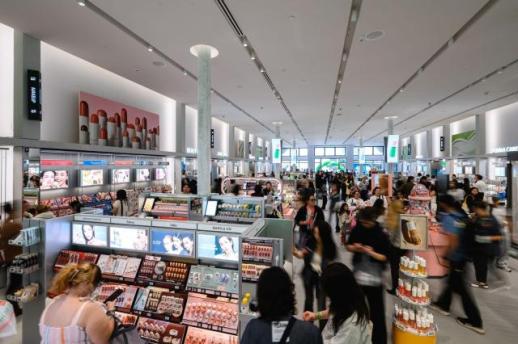 CJ Olive Young's first U.S. store in Pasadena draws large crowds SEOUL, June 01 (AJP) - CJ Olive Young, South Korea's largest beauty retailer, successfully launched its first U.S. brick-and-mortar store in Pasadena, California. According to the company on Monday, it plans to open a second store in Los Angeles this month, located at the Westfield Century City shopping mall. The Pasadena store opening drew significant consumer and media attention. Wait lines began forming the day before the opening on Friday, with a line of approximately 400 meters stretching across four blocks of Colorado Boulevard. Major local broadcasters, including KTLA and ABC, provided live and aerial coverage of the event. Major U.S. media outlets, including CNN and the Wall Street Journal, also visited and covered the opening. Despite limiting entry to around 200 people at a time for customer safety and convenience, the store recorded over 1,000 transactions on the first day, demonstrating high local consumer interest. Skincare products, including sun care, mask packs, and cleansers, accounted for over 60 percent of total sales, followed by makeup categories such as lip products and cushions, indicating local interest in K-beauty color cosmetics. Sales across K-wellness categories, which included hair care, body care, beauty accessories, and food items like bagel chips, sauces, and health foods, suggested that Olive Young’s K-beauty and lifestyle curation strategy resonated with local consumers. The personalized services offered, such as the 'Skin Scan' zone for skin diagnosis and 'THE BEAUTY LAB' for basic K-beauty skincare lessons, also attracted consumer attention, particularly since these consultations are provided free of charge. Social media activity was also high, with over 1,000 pieces of content uploaded to platforms like TikTok and Instagram from May 28 to 30, accumulating over 8 million views. Olive Young CEO Lee Sun-jung said that the Pasadena store "demonstrates the blueprint of the global platform Olive Young pursues" and will serve as a "new milestone for the co-growth ecosystem" of domestic small and medium-sized indie brands on the global stage. Pasadena Mayor Victor Gordo welcomed the company's arrival, noting that Olive Young’s investment is expected to "create new jobs and economic vitality" and "increase the city’s diversity and global competitiveness". The upcoming Century City location is situated in a key commercial area with high traffic from young professionals, high-income consumers, and international tourists. Olive Young stated that while the Pasadena store focused on customers interested in K-culture and experiential shopping, the Century City branch will aim to broaden its reach to a wider premium consumer base and global customers. Market research firm Circana reported that K-beauty held about a 6 percent share of the U.S. mass beauty market in the first quarter of 2026, which Olive Young views as an indicator of future growth potential. The company plans to gradually expand its U.S. presence, beginning with the West Coast, to implement an omnichannel strategy that links online and offline operations. Olive Young ultimately aims to evolve into a 'local beauty retailer' in the U.S., expanding its offerings to encompass lifestyle products, including wellness and food. 2026-06-01 10:53:07
-
 Korea's memory giants hit new ceiling ahead of visit by their biggest client SEOUL, May 29 (AJP) - South Korea's memory-chip giants climbed to fresh records Friday as investors turned euphoric ahead of next week's visit by their biggest customer, Nvidia Chief Executive Officer Jensen Huang, fueling hopes of deeper AI partnerships and new orders for next-generation memory chips. The world's most valuable company's CEO Jensen Huang is set to visit South Korea next week, a trip expected to transform his high-profile camaraderie with the country's conglomerate chiefs into broader business alliances that could reshape parts of the domestic technology sector. According to industry sources, Huang will travel to Seoul following his keynote address at the GTC Taipei 2026 AI conference, which runs from June 1 to 4. The upcoming visit, occurring just seven months after his widely publicized "Gganbu" gathering with South Korean business leaders, signals Nvidia's intent to expand its footprint beyond its existing semiconductor supply chain into broader industrial ecosystems spanning physical AI, cloud infrastructure and industrial automation. Investors wasted little time positioning for that possibility. Samsung Electronics rose 5.5 percent to a record closing high of 316,000 won, lifting its market capitalization to 1,853.3 trillion won ($1.35 trillion), while SK hynix climbed 2.23 percent to an all-time high of 2.34 million won, bringing its market value to 1,662.7 trillion won. Together, the two memory giants were worth more than 3,500 trillion won, accounting for nearly half of the KOSPI's total market capitalization and underscoring how deeply South Korea's stock market has become tied to the global artificial intelligence boom. Market watchers expect Huang to hold a series of strategic meetings with major South Korean business leaders, including LG Group Chairman Koo Kwang-mo and executives from internet giant Naver. Discussions with LG are expected to center on physical AI collaboration, potentially involving affiliates such as LG AI Research, LG Innotek and LG Uplus, combining hardware sensing technologies with AI software capabilities for next-generation industrial applications. The visit also coincides with a critical moment in the race for high-bandwidth memory, a key component powering Nvidia's AI accelerators. Earlier Friday, Samsung Electronics announced shipments of the industry's first 12-layer HBM4E memory samples. Huang is reportedly coordinating a meeting with Jun Young-hyun, head of Samsung's Device Solutions division, a discussion that could directly influence the qualification process and supply timeline for Samsung's next-generation HBM products. Any sign of progress would be closely watched by investors seeking evidence that Samsung is narrowing the gap with SK hynix, Nvidia's primary supplier of HBM chips and one of the biggest beneficiaries of the AI spending frenzy. The industry is also betting on the possibility of a second "Gganbu Meeting" involving Samsung Electronics Chairman Lee Jae-yong, Hyundai Motor Group Executive Chair Chung Euisun and SK Group Chairman Chey Tae-won. Chey is scheduled to meet Huang separately at Computex 2026 in Taiwan before the Nvidia chief's arrival in Seoul, marking their fourth encounter in seven months and highlighting the increasingly strategic relationship between Nvidia and South Korea's corporate elite. Analysts say such high-level networking carries growing economic significance in a technology industry where supply chains, product development and market access increasingly depend on close cooperation among a handful of global leaders. "In a global supply chain where mutual cooperation is essential rather than a single company's monopoly, building closer relationships naturally leads to increased exchanges and stronger partnerships," said Kang Sung-jin, a professor of economics at Korea University. "It gives a positive signal to investors that these companies will cooperate and support one another," Kang added. "These meetings go beyond simple socializing and help reinforce confidence in future business opportunities." 2026-05-29 16:35:41