

Journalist

Candice Kim김혜준
candicekim1121@ajupress.com
ReporterSamsung Electronics, SK hynix, LG Electronics, Olive Young, Musinsa & Semiconductor, K-Beauty
Candice Kim is a dedicated business and technology reporter specializing in the intersection of high-tech innovation and fast-paced consumer trends. Her core beats span the semiconductor, IT, cosmetics, and retail sectors, where she provides in-depth coverage of industry titans including Samsung Electronics, SK hynix, and LG Electronics, alongside leading consumer brands like Olive Young and Musinsa. Whether analyzing complex silicon supply chains or tracking the latest shifts in beauty and fashion retail, Candice is committed to delivering sharp, accurate reporting that keeps readers informed on the forces shaping today's most dynamic markets.
"Connecting the dots from silicon chips to consumer shifts."
Latest by Candice Kim
-
 Samsung foundry gains major traction amid AI bottlenecks SEOUL, June 16 (AJP) - Samsung Electronics has reportedly secured a string of AI-related chip projects from Alphabet's Google and Elon Musk's Neuralink by exploiting manufacturing bottlenecks at Taiwan Semiconductor Manufacturing Co. (TSMC), giving fresh momentum to a foundry business that has long struggled to close the gap with its Taiwanese rival. According to sources familiar with the matter, the South Korean tech giant has won several high-profile silicon design projects from Google and Neuralink. Samsung declined to comment on specific agreements, citing non-disclosure agreements. The shift comes as surging demand for generative AI accelerators pushes TSMC's manufacturing and advanced packaging capacities to their limits, prompting global technology companies to diversify away from a single supplier and adopt multi-vendor sourcing strategies to reduce supply chain risks. In a significant departure from its historical reliance on TSMC, Google is adopting a split-manufacturing architecture for its 10th-generation Tensor Processing Unit (TPU), codenamed "Icefish." Scheduled for mass production in 2028, the project divides manufacturing duties between the two Asian rivals. TSMC will fabricate the core compute processor using its ultra-advanced 1.4-nanometer process, while Samsung has been selected to manufacture the memory input/output die using its 2-nanometer technology. The I/O die acts as a high-speed bridge between logic processors and high-bandwidth memory (HBM) stacks, an increasingly critical function as memory bandwidth emerges as one of the biggest bottlenecks in AI computing. The project would also allow Samsung to offer an integrated manufacturing model by supplying its own HBM chips, producing the I/O die and conducting advanced packaging under a single roof. At the same time, Samsung is reportedly deepening its relationship with Elon Musk's technology ventures beyond electric vehicles. Industry sources said Samsung's foundry division is co-developing a fourth-generation brain-computer interface implant for Neuralink using its 4-nanometer FinFET process. The chip is designed to enable two-way communication between brain tissue and digital devices and would represent a shift away from TSMC, which manufactured Neuralink's previous generations of processors. Samsung aims to deliver functional test wafers in the first half of 2027, with high-volume production targeted for late 2027, according to the sources. The Neuralink project builds upon Samsung's existing partnership with Musk's companies after securing a multi-billion-dollar contract last year to manufacture Tesla's next-generation AI6 autonomous driving chips, which are expected to anchor early production at Samsung's expanding semiconductor facility in Taylor, Texas. Samsung has also recently produced specialized language-processing hardware for AI startup Groq, further broadening its AI customer base. The information also has not been confirmed by Google and Neuralink. As traditional transistor miniaturization becomes increasingly difficult and expensive, competition is shifting toward advanced packaging, memory integration and thermal management technologies. "U.S. Big Tech companies are increasingly striving to develop their own AI accelerators to break away from Nvidia's monopoly, but manufacturing options are limited," said Lee Jong-hwan, a professor of system semiconductor engineering at Sangmyung University. "With TSMC's advanced nodes fully booked, these companies have no choice but to turn to Samsung, and we expect these orders to grow." Lee emphasized that Samsung's unique position as both the world's leading memory producer and a contract chip manufacturer gives it a strategic advantage in the AI era. "Samsung is the only company on the planet capable of offering a comprehensive turnkey service that encompasses supplying HBM, manufacturing the custom logic chip, and handling the advanced packaging," Lee noted. Unlike competitors that rely on multiple suppliers, Samsung can potentially offer customers a unified manufacturing model that combines memory, foundry and packaging services, reducing execution risks and shortening development cycles. "If customer demand for this integrated model continues to rise, it could serve as a crucial catalyst for Samsung to turn its foundry business profitable and narrow the market share gap with TSMC," Lee added. While TSMC remains the dominant force in the global foundry market, the AI boom is beginning to expose the limits of single-supplier dependence. For Samsung, that may finally present the opportunity it has sought for years: transforming itself from a distant challenger into an indispensable second pillar of the global AI supply chain. 2026-06-16 15:44:18
-
 Huang's Taiwan and Korea tour highlights supply chain at the heart of AI era SEOUL, June 14 (AJP) -Every great technological pivot has its symbolic journey. Columbus crossing the Atlantic opened the age of exploration. Deng Xiaoping's Southern Tour set the course of China's economic reform. Steve Jobs unveiling the iPhone launched the smartphone era. Nvidia's chief Jensen Huang's late-May to early-June 2026 sweep through Taiwan and South Korea may well be remembered as a similarly defining moment in the history of the AI industry. Much of the media coverage focused on the optics — Huang browsing night markets in Taiwan, clinking soju glasses over pork belly in Seoul. Understandable. He is a compelling figure. But for those watching the structural shifts in global technology, a very different story was unfolding: the supreme commander of the world's AI empire conducting a strategic inspection of his core production bases and logistics chain. Taiwan: The Manufacturing Empire Behind the AI Revolution At the center of today's AI industry sits Nvidia. And at the center of Nvidia sits Taiwan. The cutting-edge GPUs that power the AI boom are almost entirely fabricated by TSMC. Nvidia's Blackwell and Rubin platforms simply could not exist without Taiwan's advanced semiconductor manufacturing capability. TSMC is not merely a foundry — it is the forge of the global chip economy, serving Apple, AMD, Qualcomm, Broadcom and virtually every major fabless semiconductor company on earth. If Nvidia is the emperor of the AI age, TSMC is the imperial armory. But Taiwan's role extends well beyond silicon wafers. Foxconn, Quanta, Wistron, Inventec and Pegatron — names unfamiliar to most consumers but foundational to the global data center industry — assemble the AI servers that house Nvidia's GPUs. The actual manufacturing floor of the AI revolution is not Silicon Valley. It is Taiwan. Foxconn, notably, has moved far beyond iPhone assembly. It is aggressively expanding into AI servers, robotics and electric vehicles, positioning itself for the physical AI era. Quanta has emerged as one of the world's largest AI server manufacturers. Taiwan, in short, possesses the entire manufacturing ecosystem needed to turn Nvidia's architectural vision into operational hardware. South Korea: The Memory Backbone of AI Korea's role in the Nvidia supply chain is different — but no less critical. If Taiwan supplies the brain, Korea supplies the blood. The country's most strategically vital contribution to the AI stack is High Bandwidth Memory, or HBM — the high-speed interface connecting GPU to data. Without sufficient HBM, even the most powerful GPU cluster cannot function at scale. HBM availability has become one of the most acute bottlenecks in the global AI supply chain. SK hynix currently dominates that market. Huang's visit to SK hynix was not a courtesy call. It was a verification of one of Nvidia's most critical dependencies. As demand for AI data center capacity continues to surge, SK hynix has become among Nvidia's most important strategic partners. Samsung Electronics was equally significant on the itinerary. As the world's largest memory manufacturer by volume, Samsung is locked in intense competition with SK hynix for the next-generation HBM4 market. From Nvidia's perspective, supply diversification is not optional — it is essential. Whether Samsung achieves full qualification and meaningful volume for Nvidia's next platforms will have direct implications for the stability of the entire AI supply chain. The visit to Hyundai Motor Group carried a different kind of signal. Hyundai is a carmaker, but it is repositioning itself as an AI-driven mobility company. Autonomous vehicles, robotics and smart factories are all core domains of physical AI — the frontier where artificial intelligence moves out of data centers and into the physical world. Nvidia is deeply invested in exactly this transition, through its automotive AI platform and its Isaac robotics stack. The Nvidia-Hyundai relationship is less a conventional automotive technology partnership than a joint experiment in building the infrastructure of the next industrial revolution. LG Group rounds out the picture. Across batteries, automotive electronics, smart manufacturing, and data center cooling technology, LG sits at multiple intersections where AI meets the physical world. As AI systems consume more power and generate more heat, the importance of energy, thermal management and sensing technology will only grow. The stop at Naver, Korea's dominant internet platform, added yet another dimension. Korea has established itself as a memory powerhouse, but not yet as an AI platform powerhouse. Naver's HyperCLOVA initiative represents Korea's most serious attempt to build a sovereign large language model capability and compete in cloud and data center infrastructure. Huang's meeting with Naver was not simply a customer visit — it was an assessment of the potential depth of Korea's broader AI ecosystem. Two Roles, One Supply Chain Taiwan and Korea occupy distinct but complementary positions in the Nvidia supply chain. Taiwan is the manufacturing hub; Korea is the memory hub. Taiwan provides the arms and legs of Nvidia's AI infrastructure. Korea provides the circulatory system. But that framing also surfaces the most important strategic question for Korea: will it remain a component supplier, or will it become a co-architect of AI civilization? Taiwan has already locked in control of the full manufacturing ecosystem. The United States owns the platform and software layers. China is pursuing aggressive state-directed AI investment backed by the world's largest domestic market. Korea must now define its own next move. That move, increasingly, points toward physical AI. This is precisely why Huang's Korean itinerary included Hyundai, LG and Naver alongside the memory giants. The next phase of AI development will not play out primarily inside data centers. It will play out in factories, logistics facilities, hospitals, farms, autonomous vehicles and robots. As a manufacturing nation with deep industrial expertise, Korea is in many respects better positioned than the United States to lead in this domain. The Real Story Behind the Optics Jensen Huang's Taiwan-Korea tour in the spring of 2026 was not a celebrity road show. It was a strategic audit — a systematic review of the supply chain architecture that underpins the global AI build-out, combined with an assessment of where the next phase of AI-driven industrial transformation will take root. The cameras captured the night markets and the soju. But Huang was reading something else entirely: HBM roadmaps, server production capacity, robotics pipelines and the emerging geography of physical AI deployment. The AI era's genuine competition is only now beginning. This tour was the first formal question posed to South Korea: can it move from supplier to shaper of the AI future? The answer is not yet written. 2026-06-14 18:58:23
-
 South Korea faces scorching early summer heat amid alerts for sudden showers SEOUL, June 13 (AJP) - An early summer heatwave has gripped South Korea, driving weekend temperatures to near-record highs for the season, with forecasters warning of continued hot weather and sudden showers across the country. On Saturday, daytime temperatures in Seoul hit 31.6 degrees Celsius, marking the first time in ten days the capital has surpassed the 30-degree mark. In Gumi, North Gyeongsang Province, the mercury soared to 32 degrees Celsius, about 4 degrees higher than the seasonal average. The state weather agency advised the public to take precautions, such as using hats or parasols, as the ultraviolet (UV) index is expected to remain "high" to "very high." The heat is expected to persist into Sunday, with forecast highs of 29 degrees Celsius in Seoul, 30 degrees in Daejeon, and 31 degrees in Daegu. Meteorologists also warned of a stark temperature differential, noting that daytime and nighttime temperatures could fluctuate by as much as 15 degrees Celsius. Along with the heat, unstable atmospheric conditions will trigger heavy showers accompanied by gusty winds, lightning, and hail in inland regions from Sunday afternoon through the evening. Precipitation is expected to range between 5 and 50 millimeters in the Seoul metropolitan area, South Chungcheong, and the Jeolla provinces, with some western regions experiencing intense rainfall of around 20 millimeters per hour. Jeju Island is also forecast to receive light rain of less than 5 millimeters on Sunday. The weather agency stated that the daytime heat, with temperatures hovering around 30 degrees Celsius, is projected to continue throughout next week. 2026-06-13 17:44:38
-
 From the stands as BTS kicks off 'ARIRANG' tour in Busan SEOUL, June 13 (AJP) - K-pop sensation BTS performed during the opening night of their "ARIRANG" world tour at the Busan Asiad Main Stadium in Busan, South Korea, on Friday. The highly anticipated concert was held to commemorate the 13th anniversary of the group's debut. 2026-06-13 15:09:01
-
 HYBE apologizes after BTS Busan concert delayed by 75 minutes SEOUL, June 13 (AJP) - The agency behind K-pop sensation BTS issued an official apology after the first day of the group's concert in Busan was delayed by more than an hour due to severe operational disruptions affecting nearly 50,000 attendees. The "BTS WORLD TOUR 'ARIRANG' IN BUSAN" was scheduled to begin at 7 p.m. on Friday but did not start until 8:15 p.m.. Fans faced long waiting times in early summer temperatures reaching up to 28 degrees Celsius, as admission routes overlapped with lines for fan gifts, prompting complaints online. HYBE released a statement on Saturday morning through the fan platform Weverse and official social media channels, apologizing for the inconvenience. "The start of the main concert was delayed due to a combination of confusion in on-site guidance, bottlenecks in the fan gift distribution process, and delays in merchandise collection," the company said. HYBE promised to thoroughly inspect and improve its on-site operations to prevent similar congestion during the second show. Saturday's performance marks the second day of the concert at the Busan Asiad Main Stadium and coincides with the 13th anniversary of the group's debut. The stadium previously hosted the group's last concert before the members began their mandatory military service, which was held to support Busan's bid for the 2030 World Expo. Alongside the concerts, the city is hosting a comprehensive "BTS THE CITY ARIRANG - BUSAN" project, which includes a drone show at Gwangalli Beach and various media facades. 2026-06-13 14:28:25
-
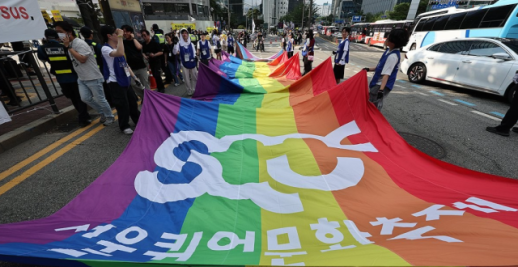 LGBTQ pride festival underway in Seoul amid looming Christian counter-protests SEOUL, June 13 (AJP) - Tens of thousands of LGBTQ rights advocates and conservative Christians are gathering in downtown Seoul on Saturday for rival rallies, marking the city's largest annual face-off over sexual minority rights. The Seoul Queer Culture Festival kicked off at 11 a.m., with organizers operating stages and booths along Namdaemun-ro and Ujeongguk-ro in central Seoul. The festival’s main event, the Queer Parade, is scheduled to begin at 4 p.m. Participants plan to march a 3-kilometer (1.8-mile) route starting from Jonggak Station, passing by Myeongdong Cathedral and Seoul Plaza, and concluding near Euljiro 1(il)-ga Station. Organizers have notified police of an estimated 50,000 attendees. Meanwhile, just 600 meters away from the festival, a Christian group known as the "Holy Breakwater" is set to hold a counter-protest starting at 1 p.m. outside the Seoul Metropolitan Council building. Under the slogan "Marriage between a man and a woman, a healthy South Korea," the group will voice its opposition to homosexuality and a proposed comprehensive anti-discrimination law. The conservative protesters plan to march toward the historic Sungnyemun Gate. The Christian coalition has registered an estimated 30,000 participants with authorities for their rally. 2026-06-13 12:22:25
-
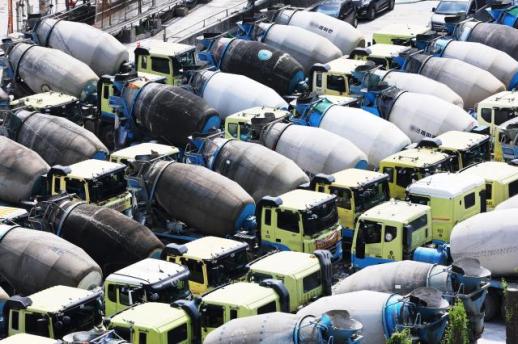 Why a concrete truck strike is threatening South Korea's high-tech chip ambitions SEOUL, June 11 (AJP) - The sprawling industrial belt south of Seoul is the heart of South Korea's semiconductor industry, home to the massive campuses of Samsung Electronics and SK hynix that dominate the global memory chip market powering the artificial intelligence boom. But activity across the region is beginning to slow because of a shortage of one of the most basic construction materials: concrete. A strike by ready-mix concrete truck drivers is exposing a critical vulnerability in South Korea's industrial supply chain, threatening to delay the construction of advanced semiconductor fabrication plants that underpin the country's economic growth strategy. The connection between raw concrete and microscopic silicon is fundamentally structural. Modern chip fabs require enormous, vibration-resistant foundations capable of supporting some of the world's most sophisticated manufacturing equipment. Because ready-mix concrete must be poured shortly after production to maintain structural integrity, even a temporary halt in deliveries can bring construction work to a standstill. Site preparation stops immediately, triggering a domino effect that delays structural work, cleanroom construction and ultimately the installation of chipmaking equipment. "In the long run, these construction delays could severely compromise the precision setup required for advanced microprocessing lines, particularly in critical areas like vibration control and cleanroom integration," said Lee Jong-hwan, a professor of system semiconductor engineering at Sangmyung University. The disruption began Monday when an estimated 8,000 unionized ready-mix truck drivers in Seoul, Incheon and Gyeonggi Province launched an indefinite strike. The walkout has effectively paralyzed much of the capital region's concrete delivery network, which accounts for the overwhelming majority of the country's 11,400 mixer trucks. At the center of the dispute are freight rates. Drivers are demanding higher transportation fees to offset inflation, rising maintenance costs and increased insurance premiums. Manufacturers argue that additional hikes are unsustainable amid a prolonged downturn in South Korea's construction market. Average transportation fees in the capital region have already risen nearly 36 percent over the past four years to 76,100 won ($55) per trip in 2025. For now, Samsung Electronics and SK hynix have largely avoided immediate disruptions by accelerating concrete pouring at key facilities ahead of the strike, including Samsung's massive semiconductor complex in Pyeongtaek. The contingency measures, however, offer only temporary relief. Industry officials warn that a prolonged labor dispute could jeopardize construction schedules at strategic projects including Samsung's next-generation fabrication facilities and SK hynix's semiconductor cluster in Yongin, one of the largest chip manufacturing projects currently under development globally. The urgency of the situation has prompted policymakers to consider extraordinary measures that would have been difficult to imagine only a few years ago. Ready-mix concrete is a highly perishable industrial product. Once mixed, it generally must be poured within about 90 minutes. Because there are virtually no practical substitutes at construction sites, industry officials warn that prolonged supply disruptions could bring work at key national industrial projects to a halt. Any significant delay carries enormous financial consequences. Semiconductor fabrication plants are among the most capital-intensive facilities in the world, with construction schedules closely synchronized with equipment deliveries, customer commitments and technology road maps. Delays can trigger substantial penalty payments, postpone production launches and potentially weaken South Korea's competitive position in the increasingly fierce global race for advanced semiconductors. In response, the government has begun reviewing emergency measures aimed at reducing the industry's dependence on conventional ready-mix supply networks. One option under consideration is easing restrictions on the installation of on-site batch plants — temporary facilities that produce concrete directly at construction sites. Batch plants precisely mix cement, sand, gravel and water to manufacture ready-mix concrete, effectively allowing large industrial projects to bypass traditional delivery systems. Such facilities have historically been subject to strict environmental regulations and complicated permitting requirements because of concerns over noise, dust and emissions. As a result, they have generally been limited to major infrastructure projects such as dams and large-scale civil engineering works. Allowing batch plants inside semiconductor industrial complexes would represent a significant policy shift. It would create a self-sufficient supply route capable of sustaining construction even during transportation disruptions while reducing reliance on regional suppliers and trucking networks. Industry observers say the proposal also sends a strong signal that the government is prepared to challenge longstanding local monopolies held by ready-mix suppliers and transport operators. Officials are also considering reforms to regulations governing mixer-truck registrations. Under the current system, authorities periodically restrict new registrations to balance supply and demand in the sector. The government is reportedly reviewing plans to shorten the adjustment cycle and ease entry barriers, potentially allowing more vehicles and alternative operators into the market during future disruptions. The discussions reflect a broader shift in industrial policy as strategic sectors such as semiconductors increasingly become matters of economic security. The approach echoes the government's hardline response to nationwide truckers' strikes in previous years, when authorities moved aggressively to prevent disruptions to critical supply chains. Policymakers now appear willing to deploy a broader range of regulatory and market-based measures when labor disputes threaten industries considered vital to national competitiveness. Despite the scale of the walkout, some industry observers believe the disruption may not evolve into a prolonged crisis. The strike is being led primarily by drivers affiliated with the Federation of Korean Trade Unions. Drivers belonging to the rival Korean Confederation of Trade Unions, along with non-unionized and directly employed operators, continue to work, helping alleviate some logistical bottlenecks. In an effort to prevent the dispute from escalating into a wider industrial crisis, the Construction Association of Korea has formally asked the Ministry of Land, Infrastructure and Transport to mediate negotiations between manufacturers and labor representatives. Any government intervention – much like its aggressive mediation to stop a Samsung Electronics strike last month - would underscore the strategic importance of semiconductor manufacturing, which has become one of the principal pillars supporting South Korea's export-driven economy. Semiconductors helped make South Korea the world's fifth-largest exporter in the first quarter and have provided a crucial buffer against mounting external risks, including the economic fallout from the prolonged conflict in the Middle East, disruptions to global shipping routes and persistent volatility in energy markets. For Seoul, the dispute is no longer simply about freight rates or concrete deliveries. It has become a test of how far the government is willing to go to safeguard industries deemed essential to the country's economic future — and whether South Korea's ambitions to remain a global semiconductor powerhouse can be derailed by a supply chain bottleneck as basic as concrete. 2026-06-11 10:51:43
-
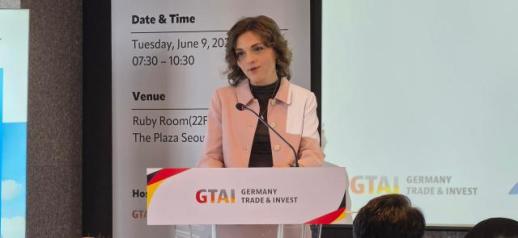 Germany courts Samsung, SK hynix for Eastern Germany semiconductor hub SEOUL, June 09 (AJP) - Germany is actively wooing South Korean semiconductor giants, including Samsung Electronics and SK hynix, to invest in its eastern region, pitching its robust microelectronics and photonics ecosystem as a key to global supply chain resilience. During an investment briefing hosted at The Plaza Hotel Seoul on Tuesday, Elisabeth Kaiser, Minister of State to the Minister of the Federal Ministry of Finance and Federal Government Commissioner for Eastern Germany, emphasized the strategic potential for bilateral synergy. "By establishing modern semiconductor manufacturing in Eastern Germany, we can combine Korea's technological strength with Germany as an industrial and research hub," Kaiser said. Noting that companies like Samsung Electronics, SK hynix, and Samsung Foundry set global standards in process and design technologies, she added that closer cooperation could accelerate the pace of innovation on both sides. The push aligns with Europe's broader goal of achieving technological sovereignty amid growing global uncertainties. Kaiser highlighted that such investments are not only economically attractive but also make a critical contribution to the stability of global supply chains. German officials also underscored the foundational role their domestic optics industry plays in the advanced semiconductor value chain. German Ambassador to South Korea Georg Wilfried Schmidt pointed out the complexities of the supply chain, noting that leading semiconductor equipment manufacturers like ASML rely heavily on German photonics and optical precision components, such as those from ZEISS. Dr. Roman Kleindienst, head of the Microoptics business unit at ZEISS, echoed this sentiment during a subsequent panel discussion. Highlighting current limitations in semiconductor data transfer, Kleindienst stated that the bottleneck "can only be resolved by optics". "Investing in optics and photonics is really investing in resilience and in the future," Kleindienst added. The event, co-hosted by Germany Trade and Invest (GTAI), the State Development Corporation of Thuringia (LEG Thüringen), and the Korean-German Chamber of Commerce and Industry (KGCCI), aimed to showcase Eastern Germany—particularly the state of Thuringia—as a specialized, innovation-driven springboard for Korean high-tech firms seeking to expand their European footprint. 2026-06-09 17:02:38
-
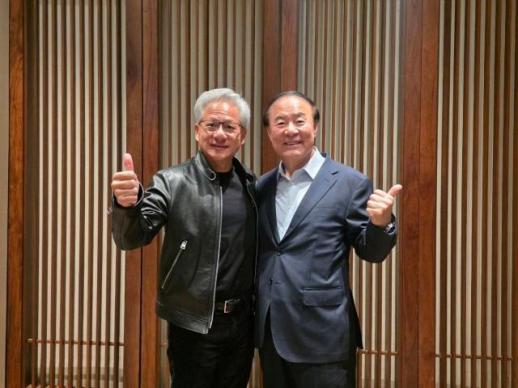 Nvidia's Jensen Huang wraps up visit to Korea with chip deal with Samsung Elec SEOUL, June 09 (AJP) - Nvidia CEO Jensen Huang concluded his official four-day visit to South Korea Monday evening, securing a comprehensive, long-term memory and foundry supply roadmap with Samsung Electronics to power the next generation of artificial intelligence hardware. Huang wrapped up his multi-industry tour with a private meeting with Jun Young-hyun, Vice Chairman and Head of Samsung Electronics’ Device Solutions (DS) Division, at the Shilla Hotel in Seoul. The high-stakes meeting finalized a localized supply chain for high-bandwidth memory (HBM), which acts as the critical bottleneck for scaling advanced AI accelerators. Following the meeting, Vice Chairman Jun expressed strong confidence in the partnership’s trajectory. "I had a lot of good conversations with Jensen, and honestly, although we have been cooperating for a long time, I think we had the best conversation so far today," Jun told reporters. "We comfortably had many good conversations, and we discussed how we will collaborate in the short term on HBM4 and foundry cooperation." The two leaders mapped out both immediate and future supply lines. According to Jun, Samsung is prioritizing the delivery of its 6th-generation HBM4 and Server Low-Power Memory Modules (SOCAMM) to meet current demand. "In the short term, starting this year, we must sufficiently supply HBM4 and SOCAMM," Jun said. "Then, from next year, we talked a lot about long-term cooperation, such as HBM4E, the foundry business, and HBM5." Samsung has already shipped samples of its 7th-generation HBM4E to Nvidia. Beyond memory, Jun confirmed that Samsung and Nvidia are actively expanding their foundry (contract manufacturing) partnerships. "Currently, we are collaborating on autonomous driving chips required for 4-nanometer and 8-nanometer processes, and Nvidia’s accelerator chip called the Groq chip," Jun said, adding that "discussions on next-generation cooperation are also underway." The Samsung meeting served as the capstone to a broader Nvidia initiative to leverage South Korea’s "physical AI" ecosystem. During his doorstep press conference earlier that evening, Huang emphasized the necessity of massive infrastructure and robust supply chains to transition from software-based AI to physical robotics. "The next wave of AI is physical AI where AI can interact with the physical world, Robotics," Huang said, praising the country's unique manufacturing and electronics capabilities. "Korea is in a very unique position in the world of physical AI," Huang said, praising the country's unique manufacturing and electronics capabilities. "Manufacturing, heavy industries, electronics, and software in AI must unite, must fuse together into Robotics." Huang also addressed market concerns about the AI boom, firmly stating that the demand for AI infrastructure is only beginning. "Intelligence is a commodity, which mainly means intelligence plus character is not a commodity," Huang told reporters, crediting the Korean national character—the "ability to suffer" and "resilience"—as a primary driver for his investment in the country. "If you combine that with AI, incredible, incredible things. It is the reason why I'm here today." When asked about Huang’s earlier comment designating SK Hynix as Nvidia’s "largest memory partner," Jun offered a measured, results-oriented response regarding Samsung's competitive position. "We will work hard on our tasks," Jun said. "We will show it through results later." Following the private meeting and press conference, Jun joined other top Samsung semiconductor executives, including Foundry Business President Han Jin-man, at Nvidia's 'Korea AI Ecosystem' reception. The reception, attended by leaders from SK Hynix and LG Electronics, marked the official end of Huang’s visit before his departure. 2026-06-09 14:50:23
-
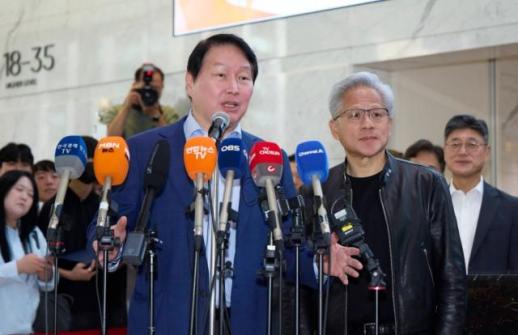 Nvidia CEO reaffirms close alliance with SK hynix, unveils plans for next-Gen robotics chip SEOUL, June 8 (AJP) - Nvidia's CEO Jensen Huang, who has been in Seoul since last Friday, began his day on Monday with a visit to SK Group, where he stressed Nvidia's "deepening, near-exclusive" reliance on the group for the era of artificial intelligence (AI). He praised SK hynix, an affiliate of SK Group, as a major player in global AI development and announced plans to use its memory in Nvidia's next-generation robotics processors. "I’d like to announce a long-term partnership with SK, we've been friends and partners with SK for a very long time," Huang said. "SK is the largest memory department. Without SK's partnership, today's AI would have not developed as wonderfully as it has." SK Group chairman Chey Tae-won said the two companies will jointly build future "AI factories" which includes AI data centers as well as SK hynix's fabrication plants and elevate their collaboration from a simple supplier relationship to a comprehensive, group-wide partnership to meet surging infrastructure demands. Beyond its dominance in AI data centers, Nvidia is aggressively expanding its hardware ecosystem, with Huang highlighting four new products: the Vera Rubin AI supercomputer, the Vera CPU, the RTX Spark for AI PCs, and the Jetson Thor robotics processor. He also confirmed that the tightly bound partnership will extend into this new frontier of physical AI. "We build a processor called Jetson Thor, and Jetson Thor will have SK hynix inside of it," Huang said, putting an end to speculation about hardware partners for Nvidia's push into the robotics sector. He praised South Korea's readiness for this next technological wave, citing the country's robust manufacturing sector and deep pool of AI talent. "The age of physical AI has finally arrived. And no country is prepared for robotics than Korea," he said. But it remains to be seen what impact their closer cooperation will have on other chipmakers. When asked by AJP whether the strengthened partnership with SK implies reduced reliance on other South Korean memory makers, Huang declined to answer. When asked what constitutes South Korea's strongest asset, Huang pointed to the country's comprehensive tech ecosystem, pointing out that its advancement in software and science is so deep that South Korea has become one of the leading contributors to global AI. "South Korea is world class in many factors, but South Korea has many advantages," Huang said. Highlighting South Korea’s rapid technological evolution, he added, "The basic combination creates a perfect environment for South Korea to take advantage of the AI revolution." Monday's meeting between Huang and Chey came just a day after the two mingled at a casual gathering over fried chicken and beer at a franchise restaurant in southern Seoul the previous evening. At the gathering, Huang enthusiastically praised an SK hynix high-bandwidth memory (HBM) chip as "the best," a public endorsement that highlights the formidable alliance between the two and signals potential impacts on the wider semiconductor supply chain. Meanwhile, their growing alliance appears to remain robust, as SK hynix's revenue linked to Nvidia reached about 7.78 trillion won (US$5.66 billion) in the first quarter alone, cementing SK hynix as Nvidia's largest single memory supplier, according to the latest financial data. The high-profile alliance with SK hynix stood in stark contrast to the absence of its rival, Samsung Electronics. Samsung chief Lee Jae-yong, who was on an overseas trip, was unable to attend last night’s reunion gathering, following a similar event last fall. But still Huang is unlikely to overlook the world's largest memory chipmaker. When asked by AJP about plans to meet Samsung's chief and executives, he said, "I'm looking forward to meeting YH tomorrow," referring to Jun Young-hyun, the newly appointed head of Samsung's semiconductor division. According to multiple industry sources, Huang and Jun are reportedly scheduled to have a private meeting at The Hotel Shilla in central Seoul before Huang's departure. 2026-06-08 16:41:26