SEOUL, June 11 (AJP) - The sprawling industrial belt south of Seoul is the heart of South Korea's semiconductor industry, home to the massive campuses of Samsung Electronics and SK hynix that dominate the global memory chip market powering the artificial intelligence boom.
But activity across the region is beginning to slow because of a shortage of one of the most basic construction materials: concrete.
A strike by ready-mix concrete truck drivers is exposing a critical vulnerability in South Korea's industrial supply chain, threatening to delay the construction of advanced semiconductor fabrication plants that underpin the country's economic growth strategy.
The connection between raw concrete and microscopic silicon is fundamentally structural.
Modern chip fabs require enormous, vibration-resistant foundations capable of supporting some of the world's most sophisticated manufacturing equipment. Because ready-mix concrete must be poured shortly after production to maintain structural integrity, even a temporary halt in deliveries can bring construction work to a standstill. Site preparation stops immediately, triggering a domino effect that delays structural work, cleanroom construction and ultimately the installation of chipmaking equipment.
"In the long run, these construction delays could severely compromise the precision setup required for advanced microprocessing lines, particularly in critical areas like vibration control and cleanroom integration," said Lee Jong-hwan, a professor of system semiconductor engineering at Sangmyung University.
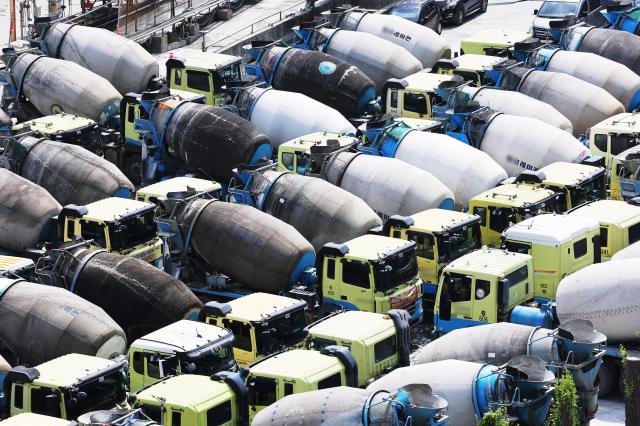
The disruption began Monday when an estimated 8,000 unionized ready-mix truck drivers in Seoul, Incheon and Gyeonggi Province launched an indefinite strike.
The walkout has effectively paralyzed much of the capital region's concrete delivery network, which accounts for the overwhelming majority of the country's 11,400 mixer trucks.
At the center of the dispute are freight rates.
Drivers are demanding higher transportation fees to offset inflation, rising maintenance costs and increased insurance premiums. Manufacturers argue that additional hikes are unsustainable amid a prolonged downturn in South Korea's construction market. Average transportation fees in the capital region have already risen nearly 36 percent over the past four years to 76,100 won ($55) per trip in 2025.
For now, Samsung Electronics and SK hynix have largely avoided immediate disruptions by accelerating concrete pouring at key facilities ahead of the strike, including Samsung's massive semiconductor complex in Pyeongtaek.
The contingency measures, however, offer only temporary relief.
Industry officials warn that a prolonged labor dispute could jeopardize construction schedules at strategic projects including Samsung's next-generation fabrication facilities and SK hynix's semiconductor cluster in Yongin, one of the largest chip manufacturing projects currently under development globally.
The urgency of the situation has prompted policymakers to consider extraordinary measures that would have been difficult to imagine only a few years ago.
Ready-mix concrete is a highly perishable industrial product. Once mixed, it generally must be poured within about 90 minutes. Because there are virtually no practical substitutes at construction sites, industry officials warn that prolonged supply disruptions could bring work at key national industrial projects to a halt.
Any significant delay carries enormous financial consequences.
Semiconductor fabrication plants are among the most capital-intensive facilities in the world, with construction schedules closely synchronized with equipment deliveries, customer commitments and technology road maps. Delays can trigger substantial penalty payments, postpone production launches and potentially weaken South Korea's competitive position in the increasingly fierce global race for advanced semiconductors.
In response, the government has begun reviewing emergency measures aimed at reducing the industry's dependence on conventional ready-mix supply networks.
One option under consideration is easing restrictions on the installation of on-site batch plants — temporary facilities that produce concrete directly at construction sites.
Batch plants precisely mix cement, sand, gravel and water to manufacture ready-mix concrete, effectively allowing large industrial projects to bypass traditional delivery systems. Such facilities have historically been subject to strict environmental regulations and complicated permitting requirements because of concerns over noise, dust and emissions. As a result, they have generally been limited to major infrastructure projects such as dams and large-scale civil engineering works.
Allowing batch plants inside semiconductor industrial complexes would represent a significant policy shift.
It would create a self-sufficient supply route capable of sustaining construction even during transportation disruptions while reducing reliance on regional suppliers and trucking networks. Industry observers say the proposal also sends a strong signal that the government is prepared to challenge longstanding local monopolies held by ready-mix suppliers and transport operators.
Officials are also considering reforms to regulations governing mixer-truck registrations.
Under the current system, authorities periodically restrict new registrations to balance supply and demand in the sector. The government is reportedly reviewing plans to shorten the adjustment cycle and ease entry barriers, potentially allowing more vehicles and alternative operators into the market during future disruptions.
The discussions reflect a broader shift in industrial policy as strategic sectors such as semiconductors increasingly become matters of economic security.
The approach echoes the government's hardline response to nationwide truckers' strikes in previous years, when authorities moved aggressively to prevent disruptions to critical supply chains. Policymakers now appear willing to deploy a broader range of regulatory and market-based measures when labor disputes threaten industries considered vital to national competitiveness.
Despite the scale of the walkout, some industry observers believe the disruption may not evolve into a prolonged crisis.
The strike is being led primarily by drivers affiliated with the Federation of Korean Trade Unions. Drivers belonging to the rival Korean Confederation of Trade Unions, along with non-unionized and directly employed operators, continue to work, helping alleviate some logistical bottlenecks.
In an effort to prevent the dispute from escalating into a wider industrial crisis, the Construction Association of Korea has formally asked the Ministry of Land, Infrastructure and Transport to mediate negotiations between manufacturers and labor representatives.
Any government intervention – much like its aggressive mediation to stop a Samsung Electronics strike last month - would underscore the strategic importance of semiconductor manufacturing, which has become one of the principal pillars supporting South Korea's export-driven economy.
Semiconductors helped make South Korea the world's fifth-largest exporter in the first quarter and have provided a crucial buffer against mounting external risks, including the economic fallout from the prolonged conflict in the Middle East, disruptions to global shipping routes and persistent volatility in energy markets.
For Seoul, the dispute is no longer simply about freight rates or concrete deliveries.
It has become a test of how far the government is willing to go to safeguard industries deemed essential to the country's economic future — and whether South Korea's ambitions to remain a global semiconductor powerhouse can be derailed by a supply chain bottleneck as basic as concrete.

Copyright ⓒ Aju Press All rights reserved.