

Journalist

Candice Kim김혜준
candicekim1121@ajupress.com
ReporterSamsung Electronics, SK hynix, LG Electronics, Olive Young, Musinsa & Semiconductor, K-Beauty
Candice Kim is a dedicated business and technology reporter specializing in the intersection of high-tech innovation and fast-paced consumer trends. Her core beats span the semiconductor, IT, cosmetics, and retail sectors, where she provides in-depth coverage of industry titans including Samsung Electronics, SK hynix, and LG Electronics, alongside leading consumer brands like Olive Young and Musinsa. Whether analyzing complex silicon supply chains or tracking the latest shifts in beauty and fashion retail, Candice is committed to delivering sharp, accurate reporting that keeps readers informed on the forces shaping today's most dynamic markets.
"Connecting the dots from silicon chips to consumer shifts."
Latest by Candice Kim
-
 Samsung, SK pamper Nvidia's Huang in New York SEOUL, September 29 (AJP) -That South Korea’s chip titans and Nvidia are buddies — and codependents — is no secret. So when their customer/friend/indispensable business partner received an award for contributing to Korea-U.S. relations, Samsung Electronics and SK hynix vied to pamper Jensen Huang. Samsung took its congratulations to Times Square, while the leaders of both Korean chip groups turned up in New York for the occasion. Samsung Electronics Chairman Lee Jae-yong attended The Korea Society's annual event in New York on Monday, according to an industry source. SK Group Chairman Chey Tae-won also attended the ceremony, where he publicly highlighted the growing partnership between SK and Nvidia. Samsung ran congratulatory videos for the Nvidia founder and chief executive on Times Square billboards from Sunday evening through Monday following his selection for the 2026 James A. Van Fleet Award. The videos highlighted Huang's leadership and contributions to artificial intelligence under four themes — "Pioneer," "Architect," "Builder" and "Friend." SK used the occasion to emphasize the increasingly intertwined relationship between Nvidia's AI accelerators and SK hynix's memory chips. Speaking at The Korea Society's annual event in New York on Monday, Chey congratulated Huang and summed up the partnership in simple terms. "NVIDIA designs the brain, and SK builds the memory," Chey said. "NVIDIA thinks lightning fast, and SK makes sure it never forgets." Chey also joked about Huang's persistent demands for faster technology. "Every time I met Jensen, his first question is always, 'Can we make it faster?'" Chey said. "Just like ppalli-ppalli in Korean, so we have the same spirit." The displays of goodwill come as both Korean chipmakers deepen their relationships with Nvidia amid surging demand for AI infrastructure. SK hynix has emerged as a key supplier of HBM for Nvidia's AI accelerators, making the U.S. chip designer one of the most strategically important customers in its memory business. The relationship is moving into the next generation of AI hardware. Nvidia's Vera Rubin platform has been displayed with SK hynix's 12-layer 36-gigabyte HBM4 and 96GB SOCAMM2, illustrating how closely advanced memory is being developed alongside AI processors. Samsung works with Nvidia across memory and system semiconductors and has been seeking to broaden the relationship as it expands its presence in advanced AI memory. The Korean electronics giant is also using Nvidia's accelerated computing and digital-twin technologies in its semiconductor operations as part of its push to build an "AI Factory" spanning research, design and production. The simultaneous displays surrounding Huang underscore Nvidia's pivotal position in Korea's semiconductor industry. Samsung and SK hynix compete fiercely in HBM and other advanced memory products, but both have strong incentives to deepen their relationship with the company whose GPUs sit at the center of the global AI infrastructure boom. Chey also cast the relationship within a broader shift in Korea-U.S. cooperation toward AI and advanced technology. "Seventy years ago, General Van Fleet built our alliance on the battlefield," Chey said. "And the front line actually has changed to the data center." He closed with a toast to Huang, his family and the Korea-U.S. alliance. "May our partnership scale even faster than GPU demand," Chey said. The James A. Van Fleet Award is presented annually by The Korea Society to individuals or organizations that have contributed to strengthening ties between South Korea and the United States. Huang was selected for his role in advancing AI and accelerated computing and fostering cooperation between the two countries' AI and semiconductor industries. Samsung's late Chairman Lee Kun-hee received the award in 2006 for his contributions to economic cooperation and bilateral relations. For Samsung and SK, Huang's award offered more than an occasion for congratulations. It provided a stage to showcase relationships that are becoming increasingly consequential as Nvidia sits at the center of the global AI hardware boom. For Korea's two memory giants, staying close to Nvidia is becoming as strategically important as the chips they build. 2026-09-29 17:47:20
 -
 Samsung Q3 income to top $70 bn: consensus SEOUL, September 29 (AJP) - Samsung Electronics is expected to extend its milestone-setting earnings streak in the quarter ended September, eyeing a three-month operating profit of more than 100 trillion won ($70 billion) as the global memory boom rolls on. A recent one-month consensus compiled by financial data provider FnGuide puts July-September operating profit at around 106 trillion won, topping the previous quarterly record of 89.5 trillion won set just three months earlier. Revenue is projected at about 199 trillion won. Estimates vary considerably as analysts adjust their models for memory prices, foreign exchange rates and employee incentive provisions. Citi recently put Samsung's third-quarter operating profit at 104.1 trillion won, down from an earlier forecast of 115.5 trillion won, while Kiwoom Securities expects about 107 trillion won after cutting its estimate from 122 trillion won. A broader FnGuide consensus based on a different collection period stood at 111.4 trillion won as of late September. Analysts broadly expect Samsung to clear the 100 trillion won mark for the quarter, a first for any Korean company and a profit figure exceeding second quarter reported by even the biggest U.S. technology companies, including Nvidia. SK hynix, the world's leading supplier of high-bandwidth memory, or HBM, is also expected to break another quarterly earnings record. Recent FnGuide estimates put its third-quarter operating profit at roughly 74 trillion won on a one-month basis, with broader estimates around 78 trillion won. In the April-June period, SK hynix reported operating profit of 60.5 trillion won on revenue of 79.3 trillion won, giving it an exceptional operating margin of about 76 percent. Together, Samsung and SK hynix are expected to generate nearly 180 trillion won in operating profit in just three months. Samsung will release preliminary figures next week and SK hynix the final figures late October. The two emerge as most visible beneficiaries for their dominance in HBM. Counterpoint Research estimated that SK hynix controlled 50 percent of the global HBM market by revenue in the second quarter, followed by Samsung at 33 percent and Micron Technology at 18 percent. Samsung's share jumped from 21 percent in the first quarter as it ramped up next-generation HBM products, while SK hynix remained the market leader. The boom has spilled far beyond HBM. AI data centers are consuming growing volumes of conventional server DRAM and enterprise solid-state drives, while memory makers' decision to dedicate more manufacturing capacity to AI products has tightened supply elsewhere. TrendForce expects conventional DRAM contract prices to rise another 13 to 18 percent quarter-on-quarter in the third quarter, with NAND flash prices climbing 10 to 15 percent. The research firm said AI server demand remains strong even as consumer electronics demand weakens under the weight of higher component prices. That price environment has been particularly lucrative for Samsung. Its semiconductor Device Solutions division generated 89.2 trillion won in operating profit on 127.5 trillion won in revenue in the second quarter, accounting for virtually all of Samsung's consolidated operating profit. The third quarter could provide another boost from HBM4. Samsung said during its second-quarter earnings call that HBM4 revenue is expected to more than triple sequentially in the third quarter as volume shipments expand. HBM4 is expected to account for more than 60 percent of its HBM revenue in the second half, making the latest quarter an early test of whether Samsung's technological catch-up can translate into earnings and market share. SK hynix began mass shipments of HBM4 in the second quarter and is ramping up production in the second half. It has also completed long-term supply agreements with around 10 major customers as AI companies seek to lock in memory capacity years ahead. Micron offers first look Before Samsung and SK hynix open their third-quarter books, the first major readout on the state of the memory boom will come from the United States. Micron Technology is scheduled to report fiscal fourth-quarter results on Wednesday after the U.S. market closes. Its earnings call begins at 2:30 p.m. Mountain Time on Sept. 30, or 5:30 a.m. Thursday in Korea. Visible Alpha estimates compiled ahead of the release put Micron's quarterly revenue at about $50.95 billion, roughly 350 percent higher than a year earlier, with adjusted earnings expected at $31.63 per share. Those estimates are slightly above Micron's own guidance. The U.S. chipmaker forecast revenue of $50 billion, plus or minus $1 billion, an adjusted gross margin of about 86 percent and non-GAAP diluted earnings of $31 per share, plus or minus $1. That would mark another sharp sequential jump from its fiscal third quarter, when Micron generated $41.46 billion in revenue. Its GAAP gross margin reached 84.6 percent, illustrating just how profitable memory has become as supply struggles to catch up with AI demand. Micron is also shipping HBM4 in high volume for its lead customer's platform and has sent qualification samples to multiple other customers. HBM4E, based on its 1-gamma DRAM process, is scheduled for volume production in 2027. The results will therefore provide an early indication of whether the same forces expected to lift Samsung and SK hynix — higher memory prices, AI infrastructure spending and constrained supply — remained intact through the end of the quarter. Records come with a caveat The size of the expected profits, however, masks signs that the pace of the boom may be beginning to moderate. Memory prices are still rising, but not as quickly as earlier this year. TrendForce's projected 13 to 18 percent increase for conventional DRAM and 10 to 15 percent gain for NAND in the third quarter comes as high component prices increasingly weigh on PCs, smartphones and other consumer electronics. Long-term supply agreements could also temper some of the upside. Such deals give chipmakers greater visibility over volumes and earnings but can prevent suppliers from fully capturing sudden jumps in spot and shorter-term contract prices. Currency movements pose another complication for the Korean chipmakers. Citi cut Samsung's third-quarter operating profit estimate by about 10 percent to 104.1 trillion won, citing the stronger Korean currency as well as additional employee incentive provisions. It lowered its SK hynix estimate to 74 trillion won from 76.7 trillion won on foreign-exchange effects while maintaining its view that underlying memory-market fundamentals remained solid. The durability of AI spending is another question hanging over the industry. Micron's earnings arrive as investors debate how long the extraordinary profit expansion across the memory industry can continue, even as analysts including UBS see supply-demand conditions remaining tight into 2027. That makes the next round of earnings about more than records. Samsung crossing 100 trillion won would provide the headline. Micron's outlook, Samsung's HBM4 ramp and SK hynix's pricing and long-term supply agreements will provide the more important clues to how much longer the memory boom behind those numbers can roll on. AJP Takeaways - Samsung Electronics is expected to top 100 trillion won in quarterly operating profit for the first time, with estimates clustering around 104 trillion won to 111 trillion won. - SK hynix is also headed for another record quarter, putting the two Korean memory giants on track for nearly 180 trillion won in combined operating profit. - Micron's earnings and outlook this week will offer an early test of how long the AI-driven memory boom can last as price growth moderates and supply remains tight. 2026-09-29 14:08:23
 -
 Samsung salutes Huang's Van Fleet Award in Times Square SEOUL, September 29 (AJP) - Samsung Electronics displayed congratulatory videos for Nvidia founder and CEO Jensen Huang in New York's Times Square following his selection as a recipient of the 2026 James A. Van Fleet Award, according to the company on Tuesday. The videos ran on Times Square billboards from 6 p.m. Sunday through Monday, highlighting Huang's leadership and contributions to the artificial intelligence industry under four themes — "Pioneer," "Architect," "Builder" and "Friend." The James A. Van Fleet Award is presented annually by The Korea Society to individuals or organizations that have contributed to strengthening ties between South Korea and the United States. Huang was selected for his role in advancing AI and accelerated computing and fostering cooperation between the two countries' AI and semiconductor industries. Samsung and Nvidia have worked together across memory and system semiconductors and are expanding their partnership in AI. Samsung is also combining Nvidia's accelerated computing and digital twin technologies with its semiconductor manufacturing capabilities as part of its push to build an "AI Factory" spanning research, design and production. Samsung's late Chairman Lee Kun-hee received the Van Fleet Award in 2006 for his contributions to economic cooperation and bilateral relations between South Korea and the United States. AJP Takeaways - Samsung displayed videos in Times Square celebrating Nvidia CEO Jensen Huang's 2026 Van Fleet Award. - Huang was recognized for contributions to AI innovation and South Korea-U.S. cooperation in AI and semiconductors. - Samsung and Nvidia are expanding cooperation from semiconductors to AI-powered manufacturing. 2026-09-29 10:26:04
 -
 Samsung joins AI data center gold rush with $1 billion Helix bet SEOUL, September 29 (AJP) -Samsung Group has joined the global AI data center gold rush by pledging $1 billion to infrastructure company Helix, expanding the South Korean chip powerhouse’s ambitions from supplying semiconductors to building and powering the facilities that run artificial intelligence. Six Samsung affiliates said Tuesday they would jointly invest in Helix Digital Infrastructure, a company established by global investment firm KKR to develop data centers, power systems and connectivity infrastructure for large cloud and AI operators. Samsung Electronics will contribute $500 million. Samsung C&T, Samsung SDS, Samsung SDI, Samsung Life Insurance and Samsung Fire & Marine Insurance will provide the remainder. Shares of Samsung Electronics were up 1 percent and Samsung C&T 0.6 percent while those of others Samsung units fell after the announcement. The commitment adds to more than $10 billion pledged to the Helix strategy at its launch in June by investors including KKR, the Kuwait Investment Authority, Nvidia and U.S. power producer Vistra, according to a separate announcement by Helix and KKR. Helix is led by Adam Selipsky, the former chief executive of Amazon Web Services. It plans to invest in, develop and manage AI infrastructure in North America and other markets. For Samsung, the investment offers a route into a broader share of AI spending, bringing together businesses ranging from memory chips and cooling equipment to construction, batteries and data center operations. Samsung said the investment would help its affiliates expand their role from hardware component suppliers to participants in the development of global AI infrastructure. “Samsung brings unique capabilities that we expect will benefit Helix and its customers, and we look forward to working together to accelerate the deployment of next-generation digital infrastructure for hyperscalers around the world,” Selipsky said. Helix’s model combines data center development and operations with power generation, transmission and distribution infrastructure, as well as fiber-optic networks. The aim is to help hyperscalers — large cloud and technology companies operating vast computing networks — secure the facilities and electricity needed to expand AI services. Samsung identified power availability as the biggest bottleneck in AI infrastructure. Helix plans to secure energy capacity through direct investment and partnerships with energy developers, including Vistra. The investment also creates potential business opportunities across Samsung’s affiliates, although the announcements did not identify specific supply contracts or construction projects awarded to them. Samsung Electronics would bring semiconductor technology alongside cooling systems supplied through FläktGroup, the heating, ventilation and air-conditioning specialist it acquired in 2025. Its cooling portfolio ranges from air systems to coolant distribution units used in liquid cooling. Samsung C&T would contribute engineering, procurement and construction capabilities for data centers and power plants. Samsung SDS designs, builds and operates data centers and has expanded into services that let customers rent access to graphics processing units for AI workloads. Its domestic activities include work on the Korea AI Computing Center. Samsung SDI is seeking opportunities to supply batteries for uninterruptible power systems and backup units, which help keep high-performance servers running around the clock. Helix said it would explore Samsung’s capabilities in technology, construction, energy storage and cooling alongside Nvidia’s AI infrastructure expertise and Vistra’s power business. The arrangement could give participating companies a commercial foothold as well as an investment return. KKR’s announcement said strategic investors may have priority or first-look rights to provide goods and services to Helix investments, without detailing any Samsung-specific rights. Neither announcement disclosed Samsung’s ownership stake, the individual commitments of the five affiliates other than Samsung Electronics, or a timetable for deploying the capital. AJP Takeaways - Six Samsung affiliates will invest a combined $1 billion in Helix, with Samsung Electronics contributing half of the total. - The investment expands Samsung's AI ambitions beyond chips into data centers, power infrastructure, cooling, construction and energy storage. - The partnership could create business opportunities across Samsung affiliates, though no specific supply contracts, ownership stake or investment timeline were disclosed. 2026-09-29 09:42:21
 -
 Why buy when you can subscribe to the whole living room? SEOUL, September 28 (AJP) - Wedding season has long been a peak period for South Korea’s white-goods makers since couples traditionally purchase their first major appliances with money from their dowries or savings. But as consumer habits change, manufacturers are trying to build relationships that extend beyond the initial sale. “I think this may be a first — holding a media event solely for a service, without a product,” Lim Sung-taek, vice president and head of Samsung Electronics’ Korea operations, said Monday as the hardware company unveiled a new service for newlyweds. The message was clear. Selling an appliance is no longer the end of the relationship with the customer. “What Samsung wants to talk about today does not end at the moment a customer purchases a product,” said Kim Yong-ho, who heads Samsung’s consumer electronics sales team in Korea. Samsung wants to add delivery, installation and ongoing management to its AI-equipped appliances to take greater control of the customer experience after purchase, Kim said. Newlyweds are emerging as a key target of that strategy. Samsung on Monday unveiled the “Newlywed Pass” as part of an overhaul of its two-year-old home-appliance subscription business. The service is aimed at couples who typically purchase several major appliances at once while furnishing their first home. Newlyweds have long been an important customer group for Korean appliance makers. Marriage often marks the point at which couples establish a household of their own, bringing with it the tradition of honsu — buying furniture, appliances and other household goods for a new marital home. That can make a wedding one of the few occasions when a household purchases a refrigerator, washing machine, dryer, television, air conditioner and other big-ticket appliances within a short period, rather than replacing them one at a time. Samsung has positioned itself close to that market. Monday’s briefing was held at Samsung Store Cheongdam in southern Seoul, an area known for its concentration of high-end wedding boutiques and luxury shops. Samsung has revamped the store around customers furnishing marital homes, displaying appliances in residential-style settings and offering consultations that cover product selection, installation and interior design. “This is the direction we are heading,” Lim said of the store. Samsung increasingly wants customers to experience appliances not as standalone products, but as connected devices working together throughout the home, he said. The move comes as subscriptions gain traction in Samsung’s domestic appliance business. Roughly one in three customers purchasing major home appliances through distribution channels where Samsung’s subscription program is available now chooses a subscription, the company said. Samsung clarified that the figure covers all such distribution channels, rather than its own stores alone. Awareness of Samsung’s subscription service rose to about 71 percent in July from 43 percent in 2024, while 75 percent of surveyed consumers said they would consider Samsung appliances first when buying through a subscription, according to the company. Samsung launched its AI Subscription Club in December 2024, with more than 90 percent of its initial subscription lineup consisting of AI-equipped products. Nearly two years later, it is dropping “Club” from the name and rebranding the business as “Samsung AI Subscription.” It is also expanding its BluePass service beyond product maintenance. The Newlywed Pass is designed around some of the practical problems that arise after couples buy and install their appliances. Samsung will offer appliance inspections after customers move, restore cabinetry altered during the installation or removal of products such as dishwashers and robot vacuum cleaners, and provide professional cleaning visits during evenings, weekends and public holidays for couples who have difficulty making time during regular working hours. The company has also placed specialized consultants at 160 stores nationwide to provide one-stop advice on wedding preparations, appliance purchases, installation and home interiors. Samsung is offering financial incentives to encourage customers to bundle products. Customers who subscribe to multiple appliances can receive benefits worth up to 6 million won ($4,200) in Samsung membership points. The company has also raised the maximum portion of subscription fees that can be paid upfront to 50 percent from 30 percent. Customers paying 40 percent or 50 percent upfront will receive an additional 5 percent discount on total subscription fees. The subscription business itself is growing rapidly. Samsung’s subscription business is approaching 1 trillion won ($700 million), Lim said, crediting much of the growth to BluePass, a service framework linking installation, maintenance and after-sales support. BluePass includes same-day installation for eligible orders, scheduled installation, SmartThings setup, AI-based alerts that detect signs of potential problems and faster access to after-sales service. Samsung is adding a lower-cost “Visit Care Light” option, which reduces the frequency of professional visits while allowing customers to handle simpler maintenance, such as replacing certain consumables, themselves. Depending on the product, the option can reduce monthly subscription fees by more than 10 percent compared with the company’s full professional-care plan over a six-year contract. Newlyweds are not the only customers Samsung wants to keep connected after a sale. The company introduced an “Easy Care Pass” for senior customers, including regular calls reminding them when consumables need replacing and explaining how to use appliances. A dedicated consultation channel will also help older customers operate AI-equipped products. Samsung is taking the subscription model beyond households with its new B2B Samsung AI Subscription. The program targets public institutions, hotels, hospitals and financial companies, allowing corporate customers to reduce the upfront cost of deploying multiple appliances while receiving up to six years of free after-sales service. B2B BluePass includes maintenance scheduled around a company’s operating hours, service visits within 48 business hours of an after-sales request and designated engineers for individual businesses. Samsung cited hospitals as one example where the model could be useful, since a malfunctioning air conditioner or other appliance can directly disrupt operations. Still, Lim stopped short of describing Samsung AI Subscription as a standalone service platform or a business designed primarily to generate service revenue. Instead, he framed it as part of a broader change in how Samsung expects appliances to be sold and used. “We used to sell products based on their functions and price, and consumers bought them that way,” Lim said. “But gradually, all of these customer experiences — not only after-sales service, but everything beginning before installation and from the consultation stage — are becoming connected.” Samsung is not yet seeking to monetize those services as a standalone platform, Lim said. Rather, it sees connecting previously fragmented services with its products as the direction in which the appliance business is moving. That helps explain why Samsung chose to make Monday’s announcement without putting a shiny new appliance on stage. The company still wants newlyweds to buy the refrigerator and washing machine. Its latest bet is on what happens after they take them home. 2026-09-28 15:30:56
 -
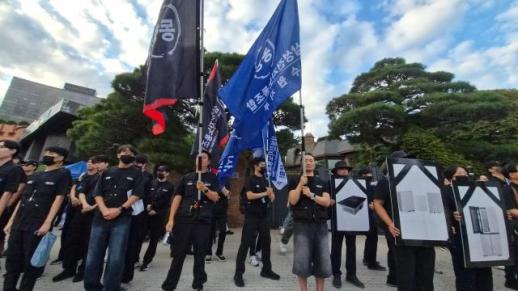 Samsung DX union elects new chief, sets sights on joint bargaining SEOUL, September 28 (AJP) - A union representing workers in Samsung Electronics' Device eXperience (DX) division has elected a new chairman, with its incoming leadership set to push for joint wage bargaining with the company's Device Solutions (DS) division. Son Yong-ho was elected chairman of the Samsung Electronics Donghaeng Union, receiving 9,777 votes, or 54.2 percent of ballots cast, the union said Monday. Ahn Young-deuk was elected senior vice chairman. Voter turnout reached 62.1 percent in the weeklong election that ended Monday morning. The union, whose membership is concentrated in Samsung's Device eXperience division, plans to launch a task force for upcoming wage and collective bargaining negotiations and seek a framework allowing DX workers to negotiate alongside employees in the Device Solutions division. The push comes as the company's unions remain divided over how future bargaining should be structured. The Samsung Group Super-Enterprise Union's Samsung Electronics branch, whose membership is concentrated in the DS division, said in August it did not plan to form a joint bargaining group next year and suggested the DX-focused union pursue separate bargaining instead. The Donghaeng Union has also been staging protests near Samsung Electronics Chairman Lee Jae-yong's residence since Sept. 18, seeking direct talks over wages and what it says is a widening compensation gap between DX and DS workers. The union had 30,935 members as of Sunday, representing about 63 percent of Samsung's DX workforce. AJP Takeaways - Son Yong-ho was elected chairman of Samsung Electronics' DX-focused Donghaeng Union with 54.2 percent of the vote. - The union plans to push for joint wage bargaining between the DX and DS divisions, while the DS-focused union has called for separate negotiations. - Donghaeng Union membership has reached 30,935, or about 63 percent of Samsung's DX workforce, as disputes over compensation between the two divisions continue. 2026-09-28 12:03:59
 -
 AI giants go straight to memory makers SEOUL, September 23 (AJP) - The artificial intelligence boom is beginning to reshape not only how memory chips are used, but who buys them. OpenAI and Anthropic are expected to begin purchasing memory directly from manufacturers in 2027 as leading AI developers take greater control over the chips and data centers that power their models, according to an industry report. The shift could create a new class of direct customers for Samsung Electronics and SK hynix, which have traditionally supplied advanced memory largely through semiconductor companies, cloud providers and system makers. For AI developers, going straight to memory manufacturers could give them greater control over supply, capacity and technical specifications as they build increasingly customized computing infrastructure. For memory makers, it would put them directly across the negotiating table from the companies driving some of the world's fastest-growing demand for computing power. The transition is already taking shape. OpenAI last year signed strategic partnerships with Samsung and SK Group under its Stargate infrastructure initiative, with Samsung Electronics and SK hynix agreeing to sharply expand production of advanced memory for OpenAI's AI infrastructure. Under the partnership, the two Korean chipmakers plan to scale production toward as many as 900,000 DRAM wafer starts a month to support OpenAI's infrastructure requirements. Anthropic has also moved closer to Korea's memory suppliers. Chief Executive Dario Amodei said in July that Anthropic had signed investment and supply agreements with some of the world's largest memory providers, including Samsung and SK Group. The Claude developer has also begun early-stage work on its own AI chip and held talks with Samsung over potentially using the Korean company's 2-nanometer foundry process and advanced packaging technology, according to The Information. Together, those moves point to a broader restructuring of the AI semiconductor supply chain. Much of the first phase of the generative AI boom revolved around Nvidia's graphics processing units. Memory makers supplied high-bandwidth memory, or HBM, alongside those accelerators, leaving Nvidia and other chip vendors as critical customers and intermediaries between memory manufacturers and the companies actually operating AI models. That structure is becoming more complicated as OpenAI, Anthropic and major cloud companies seek greater control over their computing infrastructure. OpenAI and Anthropic are expected to begin buying memory directly from manufacturers next year as model developers become more involved in chip and data-center design, DIGITIMES reported this week. An industry official familiar with the memory market said direct engagement between AI developers and memory suppliers is emerging as a clear industry trend, although it remains uncertain whether that will translate into larger orders for individual manufacturers. "It is difficult to say whether customers will ultimately allocate larger volumes to individual suppliers, but this is clearly the direction the industry is moving in," the official said. "We are likely to see more of it going forward." That does not necessarily mean cutting Nvidia or other accelerator suppliers out of the chain. AI developers remain heavily dependent on GPUs, while HBM is physically integrated with accelerators through advanced packaging. Unlike conventional server memory, it cannot simply be purchased separately and plugged into an existing AI system. The more significant change may come earlier in the supply chain, with AI developers negotiating capacity, specifications and long-term supply directly with memory manufacturers while designing their own chips and data centers. The distinction is becoming increasingly important as memory consumes a larger share of AI infrastructure spending. TrendForce estimates DRAM and NAND flash will account for 47 percent of capital expenditure by major cloud service providers in 2026 and as much as 68 percent in 2027, driven by sharply higher memory prices and heavy procurement demand. HBM and registered dual in-line memory modules, or RDIMMs, used in servers are expected to account for a combined 51 percent of global DRAM bit supply this year. Supply remains tight. TrendForce estimates the global DRAM sufficiency ratio at negative 1 percent to negative 2 percent in 2026 and expects the gap to widen in 2027 as demand growth continues to outpace new production. The scarcity is strengthening the hand of the world's three dominant memory makers — Samsung Electronics, SK hynix and Micron — while encouraging customers to lock in supply years in advance. SK hynix said in its second-quarter earnings announcement that it had finalized long-term agreements with around 10 customers, including key strategic partners, and was discussing additional multi-year contracts with major clients. The company said requests for additional supply continue to mount as major technology companies expand spending on AI infrastructure. Samsung is seeing a similar demand environment. The company said in July that strong AI demand and constrained capacity had pushed its Memory Business to record quarterly revenue and operating profit. It expects demand for server DRAM, enterprise SSDs and HBM to accelerate in the second half of the year. The rise of AI developers as direct memory customers could also change what memory makers are asked to build. As AI companies move beyond standard GPUs toward customized accelerators, memory specifications can increasingly be determined alongside the processor rather than after its design is complete. HBM4 marks an important step in that direction. Its logic base die offers greater scope for customization and tighter integration between memory and the accelerator it serves. But AI infrastructure requires far more than HBM. Large AI servers also consume conventional server DRAM and enterprise SSDs, widening the range of products that could become part of negotiations between model developers and memory manufacturers. TrendForce expects demand growth in 2027 to remain concentrated in HBM and server memory, with next-generation GPUs and customized AI ASICs increasing the amount of memory deployed in each system. For Samsung and SK hynix, that creates an opportunity but also a different customer dynamic. A broader group of large buyers could reduce their dependence on a handful of accelerator vendors and cloud companies. But OpenAI, Anthropic and other AI developers could themselves emerge as powerful customers capable of negotiating directly over capacity, price and product design. How far the procurement model changes will ultimately depend on what "direct purchasing" comes to mean. For HBM in particular, the important shift may be less about who physically takes delivery of the chips than who sits down with Samsung or SK hynix years beforehand to reserve production, determine specifications and decide how memory will be integrated into a future AI system. OpenAI's existing partnerships with Samsung and SK hynix and Anthropic's supply agreements with the Korean groups suggest that process has already begun. The next phase of the AI memory boom may therefore be defined not only by Samsung and SK hynix making more sophisticated chips, but by a new set of customers sitting directly across the negotiating table. AJP Takeaways - OpenAI and Anthropic are emerging as direct memory customers as AI developers take greater control over chip and data-center design. - Direct procurement could give AI developers greater influence over memory capacity, specifications and long-term supply. - The shift could give Samsung Electronics and SK hynix a new class of major customers beyond traditional chipmakers and cloud providers. 2026-09-23 17:32:40
 -
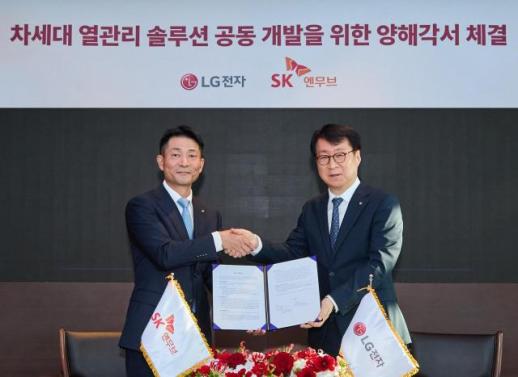 LG, SK Enmove team up on next-generation AI cooling SEOUL, September 23 (AJP) - LG Electronics and SK Enmove are expanding their partnership in thermal management technology, jointly developing next-generation refrigerants and immersion cooling solutions for AI data centers and other high-heat applications. The companies signed a memorandum of understanding Monday to jointly develop refrigerants, refrigeration oils and immersion cooling technologies for home appliances and commercial and industrial systems. Under the agreement, the companies will develop refrigerants with a global warming potential below 150 and without PFAS, as environmental regulations tighten in Europe and North America. SK Enmove will develop and evaluate refrigerant candidates, while LG will assess their use in HVAC products and systems. The two companies will also expand their existing work on immersion cooling, which removes heat by directly submerging servers and other equipment in electrically non-conductive cooling fluid. They plan to explore applications beyond AI data centers, including energy storage systems and electric vehicle components. LG and SK Enmove have previously worked with U.S.-based Green Revolution Cooling on proof-of-concept testing and potential commercialization of immersion cooling systems for AI data centers. AJP Takeaways - LG Electronics and SK Enmove will jointly develop next-generation refrigerants, refrigeration oils and immersion cooling technologies. - The companies are targeting refrigerants with a global warming potential below 150 and no PFAS as environmental rules tighten. - Their immersion cooling partnership will expand beyond AI data centers to explore ESS and EV component cooling applications. 2026-09-23 14:29:36
 -
 Korea looks beyond HBM. Can HBF prove as big? SEOUL, September 22 (AJP) - South Korean memory makers racing to sustain a comfortable lead on the next-generation chip front have their eyes on the next big thing; high-bandwidth flash, or HBF. Six months ago, one prominent chip researcher predicted it would define the AI path. "HBM defined the last decade, but HBF will likely determine the next," Joung-ho Kim, a professor at the Korea Advanced Institute of Science and Technology (KAIST), told AJP in March. The proposition is now acquiring technical specifications — and facing closer scrutiny. SK hynix and Sandisk released the first open HBF specification in August, following the launch of their standardization consortium in February. Google and AI chipmaker Tenstorrent have joined the initiative, giving the technology backing beyond its memory suppliers. But recent research suggests that faster flash alone will not deliver the gains its proponents envision. HBF’s success could depend as much on how AI systems move and manage data as on the performance of the chips themselves. For Korean manufacturers, the challenge is to turn their memory expertise into another major AI business. For customers, the test is more practical: whether HBF can expand capacity and reduce costs without introducing new bottlenecks. HBF is intended to fill the gap between high-bandwidth memory, or HBM, and conventional solid-state drives. HBM uses stacked DRAM chips to feed processors data at extremely high speeds, but its capacity is expensive. SSDs use NAND flash to offer much larger storage volumes at lower cost, but cannot supply data at comparable speeds. HBF aims to bring flash capacity closer to the processor with a much wider data connection. It would complement HBM, adding another tier between high-speed working memory and conventional storage. The need is growing as AI companies expand inference — running trained models to answer questions and complete tasks. Longer conversations, more elaborate reasoning and AI agents performing multistep tasks increase the amount of data systems must retain. Alongside model weights, the parameters learned during training, systems hold key-value, or KV, caches that preserve information from earlier parts of a sequence. Keeping everything in HBM is costly. Moving too much to slower storage can leave expensive processors waiting for data. The SK hynix-Sandisk specification sets out one proposed bridge between the two. It provides for stacks of eight or 16 NAND dies with capacities of up to 512 gigabytes and three bandwidth grades ranging from about 0.4 terabytes per second to 3 TB/s. It also adopts Universal Chiplet Interconnect Express, or UCIe, an open interface intended to connect HBF with different processor types, including GPUs and CPUs. Released through the Open Compute Project, the specification covers electrical characteristics, packaging, reliability and software input-output requirements as well as capacity and speed. A common specification gives chipmakers and system designers a basis for development. It does not establish how much performance finished systems will deliver. NAND presents difficulties that DRAM does not share in the same way. Writing data is slower than reading it, and flash cells can withstand only a finite number of erase-and-write cycles. Workloads that continually rewrite data can therefore create endurance problems as well as performance and thermal constraints. Those trade-offs are emerging in research examining where HBF could help — and where it could disappoint. A study co-authored by Jisung Park, a professor at Pohang University of Science and Technology, or POSTECH, examined HBF across different configurations for serving large language models. Published in IEEE Computer Architecture Letters, “Exploring High-Bandwidth Flash for Modern LLM Inference: Opportunities and Challenges” found potential for larger batches of requests, higher throughput and a reduction in the minimum number of GPUs required. The benefits, however, depended on demanding assumptions. "Realizing these benefits critically depends on sustaining HBM-comparable read bandwidth and requires significant endurance improvements," the researchers wrote. The distinction is between peak speed and usable performance. A flash stack that briefly reaches a bandwidth target may still struggle to sustain it under continuous AI workloads. A separate research team examined a more specific proposition: using HBF as a replacement for SSDs in an existing system that moves KV-cache data out of faster memory. Its paper, “HBF Sucks? A Full-Stack Characterization of High-Bandwidth Flash for KV-Centric LLM Serving,” was first submitted to arXiv in August and revised in September. It remains a preprint rather than a peer-reviewed journal study. Using an extended TokenSim framework, production workload traces and Nvidia H100 and B200 accelerator profiles, the researchers modeled what would happen when HBF was inserted into that architecture. Average end-to-end latency rose to between two and 5.5 times the baseline. The maximum rate of work completed within specified service targets also fell. "The device is fine; the drop-in deployment is not," they wrote. Frequently reused data stayed in faster memory, leaving HBF with a write-heavy workload. The modeled stack encountered thermal limits below peak bandwidth and raised endurance concerns. The authors favored selective use, with data placement based on likely reuse, limits on writes and coordinated thermal management. Their findings concern a particular simulated deployment, not a verdict on all HBF designs or measurements from commercial HBF chips. The two studies approach different uses of the technology, but together point to a central issue: where data resides can matter as much as how quickly a chip can move it. Frequently accessed information may need to remain in HBM. Data suited to repeated reading could make better use of HBF’s capacity. Rapidly changing caches require closer scrutiny because repeated writes can erode the advantages of faster flash. The engineering work therefore extends beyond stacking NAND dies. Memory suppliers, processor designers and software developers must decide together which workloads justify HBF and how to keep them within its operating limits. Kim anticipated that broader requirement in his March interview. "The memory architecture must be fundamentally restructured," he told AJP. Six months later, the research is giving that statement a more concrete meaning. Adding another memory tier also requires changing the decisions that govern it. Other approaches are developing alongside HBF. At FMS 2026 in August, Samsung Electronics displayed a concept model of zNAND-O, a high-performance NAND architecture under development in four- and eight-layer versions. Samsung said it was intended to improve data-transfer performance and reduce latency for real-time, data-intensive edge AI applications. The company also showed zHBM, a concept that places HBM directly above an AI accelerator rather than alongside it, shortening the distance data must travel. Both were presented as architectures under development, not finished commercial products. The competing designs suggest that the next stage of AI memory will involve several approaches to the same problem: supplying processors with enough data, quickly enough, at an acceptable cost and power budget. HBF now has an open specification, industry participants and a growing body of research identifying its possible uses and limits. Whether it becomes a business on the scale of HBM remains unproven. HBM demonstrated how valuable memory can become when it removes an AI bottleneck. HBF’s challenge is to do the same without creating another one. AJP Takeaways - SK hynix and Sandisk are pushing HBF as a new AI memory tier between high-speed HBM and lower-cost, high-capacity storage. - Recent studies show HBF's potential depends on overcoming NAND endurance, thermal and write-performance limits, as well as optimizing how AI systems place data across memory tiers. - HBF now has an open specification and growing industry backing, but whether it can develop into a market on the scale of HBM remains unproven. 2026-09-22 18:02:37
 -
 LG takes AI cooling push up a notch with Nvidia approval SEOUL, September 22 (AJP) - LG Electronics has secured Nvidia's approval for its largest liquid-cooling system for AI data centers, as surging power consumption from increasingly dense AI servers accelerates a shift away from conventional air cooling. LG said Tuesday its 2.5-megawatt coolant distribution unit, or CDU, has been certified as an Nvidia DSX Ready CDU, meeting specifications for equipment used in Nvidia's AI factory infrastructure. Nvidia's DSX Ready designation for CDUs covers large-capacity systems of at least 2.3 MW. The latest certification follows Nvidia approvals for LG's 600-kilowatt and 1-MW CDU systems in July and September, respectively, giving the Korean electronics maker approved products across multiple cooling capacities. LG Energy Solution's battery energy storage system also received DSX Ready approval. CDUs circulate coolant between a data center's cooling infrastructure and server racks, removing heat generated by processors. Their role has become increasingly important as high-performance AI accelerators pack more computing power — and heat — into each rack. LG said the 2.5-MW system is designed to cool groups of high-density server racks rather than individual racks. For example, about 20 Nvidia GB200 NVL72 racks, each rated at roughly 120 kW, would create cooling demand of around 2.4 to 2.5 MW. The shift is creating a new market for electronics and HVAC companies as AI infrastructure expands. TrendForce expects the adoption rate of liquid cooling in AI data centers to rise from 14 percent in 2024 to about 60 percent in 2027. LG has been building out what it calls a "chip-to-chiller" portfolio spanning chillers and computer room air conditioners to CDUs and cold plates that directly remove heat from AI chips. Its CDU lineup now ranges from 600 kW to 2.5 MW. "The Nvidia DSX approval will allow us to begin supplying more reliable and efficient cooling solutions to global Big Tech companies," said Lee Jae-sung, president of LG Electronics' Eco Solution division. AJP Takeaways - LG Electronics' 2.5-MW liquid-cooling CDU has received Nvidia DSX Ready approval, following earlier certifications for its 600-kW and 1-MW systems. - The larger system is designed to cool groups of high-density AI server racks as rising chip power consumption makes conventional air cooling increasingly difficult. - TrendForce expects liquid cooling adoption at AI data centers to jump from 14 percent in 2024 to about 60 percent in 2027, opening a growing market for cooling suppliers. 2026-09-22 14:11:08