
Journalist

Lee Jung-woo, Kim Yeon-jae
cannes2030@ajupress.com, duswogmlwo77@ajupress.com,
-
 Defiant Trump vows to stand firm on tariffs despite Supreme Court ruling SEOUL, February 25 (AJP) - U.S. President Donald Trump on Tuesday signaled he would not back down on tariffs, despite a Supreme Court ruling against his tariff policy last week. "A very unfortunate ruling, but the good news is that almost all countries and corporations want to keep the deal that they already made..... knowing that the legal power that I as president have to make a new deal could be far worse for them, and therefore they will continue to work along the same successful path that we had negotiated before the Supreme Court's unfortunate involvement," he said during his first State of the Union address in his non-consecutive second term. The remarks came just several days after the U.S. Supreme Court struck down his sweeping global tariffs policy, ruling that Trump's use of the International Emergency Economic Powers Act (IEEPA) to impose broad import duties was unlawful. The decision dealt a significant blow to one of the administration's signature economic initiatives. Undeterred, Trump wasted no time resorting to alternative measures such as Section 122 and Section 301 of the Trade Act of 1974 and Section 232 of the Trade Expansion Act of 1962, threatening to reimpose global tariffs of up to 15 percent. He then doubled down further, declaring that import duties could one day replace income taxes even as his administration faces major legal and political obstacles to that vision. "As time goes by, I believe the tariffs paid by foreign countries will, as in the past, substantially replace the modern-day system of income tax," Trump said to applause from Republican lawmakers, claiming that such a shift would "take a great financial burden off the people that I love." "So despite the disappointing ruling, these powerful country saving - it's saving our country the kind of money we're taking in - peace protecting - many of the wars I settled was because of the threat of tariffs I wouldn’t have been able to settle them without - will remain in place under fully approved and tested alternative legal statutes," Trump said, adding that "congressional action will not be necessary." "And therefore, they will continue to work along the same successful path that we had negotiated before the Supreme Court's unfortunate involvement," he said. Trump's unwavering stance leaves uncertainty looming and complicates calculations, as tariff deals are not merely economic matters but are closely linked to national security and defense concerns. Earlier in the day, South Korean Ambassador to the U.S. Kang Kyung-wha said at a press briefing with South Korean correspondents in Washington, D.C., that Seoul has been "closely monitoring" the Trump administration's follow-up moves while supporting upcoming discussions with Washington, aiming to ensure they proceed "in a favorable atmosphere." Washington's trade community has also turned its attention to newly opened investigations under Section 301, with speculation mounting that the U.S. Trade Representative (USTR) could examine potential "discriminatory practices" against U.S. tech and digital platforms, including e-commerce giant Coupang, which claims it suffered unfair treatment during a probe related to its massive data leak late last year. Tuesday's address came after over a year of rapid deregulation, a record number of executive actions, and a turbulent political climate marked by mass layoffs, aggressive immigration enforcement, and a partial shutdown at the Department of Homeland Security. While Trump used the address to project confidence in his economic stewardship ahead of November's U.S. midterm elections, recent polls suggest public opinion remains divided. A PBS News/NPR/Marist survey found that 60 percent of Americans believe the country is worse off than a year ago, compared with 40 percent who say it has improved. 2026-02-25 15:49:54
 -
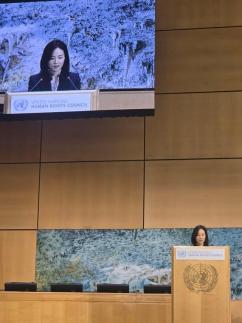 Vice FM Kim pledges inter-Korean dialogue on humanitarian issues at UN rights council SEOUL, February 24 (AJP) - Seoul will pursue inter-Korean dialogue to address humanitarian issues such as family reunions and the return of detainees, Vice Foreign Minister Kim Jin-a said Monday at the United Nations Human Rights Council. In a keynote address to the council’s 61st session in Geneva, Kim said the government would work closely with the international community to achieve “practical” improvements in the human rights of North Korean residents. “It will pursue inter-Korean dialogue to resolve humanitarian issues such as separated families, abductees, detainees and prisoners of war,” the Foreign Ministry said in a statement, quoting Kim. She also reaffirmed South Korea’s commitment to its role as a council member for the 2025–2027 term, pledging to help promote global norms for stronger protection and advancement of human rights. Kim highlighted Seoul’s efforts to narrow social and development gaps arising from new technologies, including artificial intelligence, as well as challenges related to youth, climate change, digital innovation, welfare and healthcare. She voiced support for international action to eliminate conflict-related sexual violence, noting that South Korea remains committed to restoring the honor and dignity of victims of Japan’s wartime sexual slavery. Kim also introduced a recent amendment to the Comfort Women Victims Protection Act, which aims to strengthen protections against the spread of false information about survivors. During her visit to Geneva from Feb. 23 to 25, Kim met with UN Deputy High Commissioner for Human Rights Nada Al-Nashif to discuss cooperation on North Korean human rights and South Korea-led priorities on technology, local governance and human rights. She also held talks with International Committee of the Red Cross Secretary General Pierre Krähenbühl, with both sides agreeing to strengthen cooperation amid growing humanitarian crises linked to global armed conflicts. 2026-02-24 16:41:14
 -
 AI reckoning: when Chinese algorithms start making movies SEOUL, February 23 (AJP) - When clips of Spider-Man crouching on a rain-soaked Shanghai skyline and Deadpool delivering punchlines in fluent Mandarin began circulating on Chinese social media last month, Hollywood C-suite were impressed. Then they panicked. The videos were generated by Seedance 2.0, an artificial intelligence tool developed by ByteDance, the parent company of TikTok. With a short line of text, users could summon short films complete with soundtracks, camera movement and dialogue — often featuring copyrighted characters. Within days, major studios were drafting cease-and-desist letters. It was not the first time generative video technology had unsettled the film industry. Tools such as Sora, Runway’s Gen-3 Alpha and Pika had already previewed a future in which movies could be produced from prose. But Seedance struck a deeper nerve — not only for its technical quality, but for how easily it collapsed the boundary between fandom, piracy and production. When Seedance-generated clips featuring Marvel and Pixar characters went viral, Disney and Paramount accused ByteDance of facilitating copyright infringement. Japan’s Agency for Cultural Affairs soon opened an inquiry after anime-style shorts appeared online without authorization. ByteDance said it was strengthening safeguards. The dispute echoes earlier battles in the West. In 2023, The New York Times sued OpenAI and Microsoft over training data. A year later, Reddit filed suit against Perplexity over unauthorized scraping. Together, the cases expose a growing contradiction: media companies condemn unlicensed data use, even as they quietly integrate AI into their own production pipelines. Disney, according to industry sources, has since signed a licensing agreement with OpenAI’s Sora worth roughly $1 billion. Protest and participation now coexist. Beneath the legal disputes lies a more unsettling question: Is artificial intelligence creating anything at all? “If a user is required to initiate the process, then the AI has not really created the film,” said Gwen Grewal, a philosopher at The New School for Social Research. “It has compiled it. Like a production manager or editor.” Without consciousness, she argues, there is no intention — and without intention, no true authorship. Grewal traces the issue to existential philosophy, from Heidegger to Sartre, which links creativity to human awareness of limits. “People are born into systems they did not choose,” she said. “But they know they can become something more. Does AI have that impulse? Can it reject its own work? Can it care if it fails?” Seedance can generate surprises, even for its engineers. But it cannot “mean” what it produces. That distinction, she suggests, may define the boundary between creation and computation. Not everyone in the film world sees AI as an existential threat. “I don’t think directors have much to fear,” said Shin Haerin, a professor at Korea University’s College of Media and Communication. “What AI cannot replicate is intention,” she said. “That will become more valuable, not less.” She compares the shift to fashion. “As we distinguish between ready-to-wear and haute couture, cinema will divide between automated content and intentional filmmaking.” In this view, AI will dominate fast, disposable entertainment — short clips, personalized stories, viral visuals — while human filmmakers retreat into slower, more deliberate work. Polish will matter less than purpose. That Seedance emerged from Beijing is no accident. Over the past year, China has placed generative AI and robotics at the center of national strategy, investing heavily in chips, automation and algorithms. The rise of Seedance follows the breakthrough of DeepSeek, which became the most-downloaded free app in the U.S. Apple Store in 2025, briefly overtaking ChatGPT. Together, they signal China’s ambition to compete not just in manufacturing, but in cultural technology. For Beijing, AI is also a soft-power tool. By enabling users to generate cinematic content in Mandarin, Cantonese and minority languages, platforms like Seedance could reduce reliance on Hollywood imports and strengthen domestic entertainment ecosystems. What begins as hobbyist creativity may evolve into a parallel film industry. Seedance 2.0 has not ended cinema. Nor has it solved creativity. But it has exposed how fragile the old boundaries have become — between studio and fan, artist and algorithm, inspiration and imitation. In the coming years, the central question may no longer be whether AI can make films. It will be whether audiences still care who made them. 2026-02-23 18:08:18
 -
 Ju-ae or Ju-hae? Name debate over North Korea's young heiress SEOUL, February 23 (AJP) - North Korean leader Kim Jong Un on Sunday was re-elected as general secretary of the ruling Workers' Party of Korea, reaffirming the supreme-leader status he has held since 2012. But what has increasingly drawn international attention is not Kim himself, but his brash, omnipresent teenage daughter. The confident, bubbly-looking girl has frequently appeared at her father’s side in recent years, prompting North Korea watchers to speculate that she could be an unconventional choice as the country’s next ruler — breaking with a succession system that has passed power from father to son for three generations. South Korean intelligence authorities estimate her age at 12 to 13, while foreign analysts put it at around 13 to 14. Now, even her name has become a matter of debate. The girl has so far been widely known as Ju Ae, but some close observers believe her real name may be Ju Hae. According to a senior government official, intelligence agencies are verifying the reports that the young girl is playing an unofficial role comparable to “director of the Missile General Bureau” within the regime. They have been closely following the ninth party congress under way in Pyongyang since Feb. 19 for signs of her growing political presence. Kim Ju Ae — or Ju Hae — has increasingly accompanied her father to key weapons tests, fueling speculation about an emerging hereditary succession plan. One intelligence source said she is believed to be receiving briefings and issuing directions to some officials, in place of Jang Chang-ha commanding the missile bureau. Earlier this month, South Korea’s National Intelligence Service briefed lawmakers that Kim’s daughter had entered what it called the “succession designation stage.” The agency said she has begun expressing views on certain state policies, a possible sign of her rising influence. She first drew international attention in 2013, when former NBA star Dennis Rodman told The Guardian that he had “held baby Ju Ae” during a visit to North Korea. Defector testimonies, including that of former diplomat Ryu Hyun-woo, have also cited “Ju Ae” as Kim’s chosen name for his second child, allegedly meaning “one who is loved by all.” However, alternative versions such as “Ju Ye” and “Ju Hye” have circulated for years, and analysts now believe her name may have been altered after she was designated as a successor. Kim Jong Un himself is known to have changed the Chinese character of his given name in 2009, when his own succession path began. For years, Kim Ju Ae was believed to be the second of Kim Jong Un and his wife Ri Sol Ju’s three children, though neither the total number nor their birth order has ever been publicly confirmed. She remains the only child acknowledged through state media appearances. Since her first official appearance alongside her father at an intercontinental ballistic missile launch in November 2022, she has featured prominently at military parades and official banquets. By early 2023, state outlets began referring to her as the “respected daughter,” an honorific previously used for Kim himself before his leadership was announced. By January 2024, the NIS identified her as the “most likely successor,” while cautioning that “many variables” remain, given Kim’s relatively young age and North Korea’s patriarchal political culture. Her expanding public role — and recent intelligence suggesting her name may be Kim Ju Hae — indicates that Pyongyang may be quietly preparing for a fourth-generation transfer of power under the Kim dynasty. Whether that process will include formally recognizing her new name remains one of the regime’s closely guarded secrets. 2026-02-23 14:40:29
 -
 The heat is on Seoul as Tokyo gets a head start on U.S. investment SEOUL, February 20 (AJP) - Japan has moved swiftly to translate its pledged $550 billion investment commitment to the United States into concrete projects, unveiling an initial $36 billion package centered on energy, infrastructure and critical materials — areas closely aligned with Washington’s strategic priorities — while Seoul remains mired in legislative gridlock. President Donald Trump welcomed the announcement, publicly praising Tokyo’s commitment and reiterating his March 19 invitation to the Japanese leader, whose political authority was recently reaffirmed through a high-stakes snap election. The rollout marks the first major tranche under Prime Minister Sanae Takaichi’s U.S.-focused investment strategy, which links capital deployment directly to diplomatic and trade objectives. Infrastructure-focused investment package At the core of the package is a $33 billion natural gas power plant in Portsmouth, Ohio, led by SB Energy, a subsidiary of SoftBank Group. The 9.2-gigawatt facility is expected to become the largest of its kind in U.S. history and is designed to address surging electricity demand from AI data centers. Additional projects include a $2.1 billion investment in the GulfLink deepwater oil export terminal off Texas, aimed at expanding U.S. crude exports to Asia, and a $600 million synthetic diamond facility in Georgia by De Beers’ Element Six, intended to strengthen U.S. production of industrial materials now dominated by China. Japan’s Economy and Industry Minister Ryosei Akazawa described the selections as “win-win,” noting that more than 16 Japanese companies, including Toshiba, Hitachi and Mitsubishi Electric, are preparing to participate as suppliers and partners. He also pledged close coordination with Washington on a second tranche during Takaichi’s planned visit to the United States in March. The structure of the package reflects Washington’s priorities. As AI expansion strains power grids and geopolitical tensions reshape supply chains, energy infrastructure and critical materials have become central to U.S. economic security. Rather than broad pledges, Tokyo presented projects that directly address these bottlenecks, reinforcing its position as a strategic partner. Korea left behind The fast and systematic move by Tokyo has placed Korea in a laggard position. Seoul has announced plans for large-scale U.S. investments in nuclear power, shipbuilding, energy and advanced manufacturing. However, progress has been slowed by legislative delays and the absence of a comprehensive institutional framework. The National Assembly’s special committee on U.S. investment has yet to complete key groundwork, including passage of a special law to support overseas investment programs. Instead of forging consensus around a national strategy, political wrangling and blame-shifting have continued. Opposition People Power Party lawmaker Kang Seung-kyu criticized the government and ruling party for what he called their unilateral approach. “They cannot blame the People Power Party for the delay of the Special Act on Investment in the United States while they are pushing through other bills on their own,” he said. The ruling party, meanwhile, has repeated that the deal could undermine Korea’s competitiveness, without presenting a concrete strategy for securing favorable terms. “Automobile tariffs directly affect a large number of jobs in Korea,” Lee Un-ju, a Supreme Council member of the Democratic Party of Korea, said. “If Korea faces higher U.S. tariffs than Japan, Korean automobiles will lose competitiveness in the American market.” She added that as many as 1.5 million people depend directly or indirectly on the auto industry, stressing that “further parliamentary deadlock cannot be tolerated.” Washington’s expectations Yet the auto sector is not at the center of the investment framework Washington expects from Seoul. In the investment list posted on the White House website, Korea’s commitments are categorized mainly under energy and environment. Individual companies such as Hyundai Motor Group and Hanwha Ocean are expected to pursue separate manufacturing investments. From Washington’s perspective, credibility increasingly depends on institutional certainty — clear legal frameworks, budget commitments and bipartisan backing — rather than headline figures alone. Japan’s package combines infrastructure development, corporate participation and diplomatic engagement into a single framework. Energy projects resolve immediate bottlenecks, Japanese firms secure long-term roles, and political ties are reinforced. By contrast, Korea’s approach remains fragmented. While Seoul has outlined cooperation in energy, semiconductors and AI, it has yet to consolidate these initiatives into a unified package backed by legislation and long-term financing. U.S. officials have repeatedly emphasized that energy security, export capacity and supply-chain diversification are central to future cooperation. Countries that can deliver these elements in integrated form are better positioned in trade and tariff negotiations. Structure over scale The government has moved to accelerate talks, dispatching a working-level delegation to Washington this week to explore projects in nuclear power, shipbuilding and advanced industries. Ruling party leaders are also seeking ways to pass investment-related legislation despite opposition resistance. However, experts note that without a stable legal and fiscal framework, such efforts may appear provisional. Japan’s advantage lies not only in speed but in structure. Its investment package links public financing, private-sector participation and diplomatic coordination into a single system. For Korea, the challenge is to move beyond ad hoc negotiations and build similar institutional foundations — integrating power infrastructure with AI and semiconductor projects, energy investment with shipbuilding orders, and mineral supply with downstream processing. Stressing the urgency, Lee said, “Since the Special Act on Investment in the United States concerns the national interest, further parliamentary deadlock cannot be tolerated,” warning that “if the People Power Party keeps blocking this bill to the very end and fails to pass it, causing fatal damage to our economy, the party will face harsh judgment from the people in the upcoming local elections.” The legislative impasse, she admitted, is not the sole obstacle. “The Ministry of Land, Infrastructure and Transport and the Ministry of Trade, Industry and Resources are engaged in turf wars and passing the buck, which has stalled progress,” she said. For now, Seoul faces a growing list of homework, while Tokyo continues to earn points — and advance its national interests — in Washington. 2026-02-20 10:19:51
 -
 Korean president flags plan to move HMM to Busan "soon" SEOUL, February 19 (AJP) -The proposed relocation of South Korea’s flagship shipping line HMM to Busan has returned to the spotlight after President Lee Jae Myung reiterated his commitment to the plan despite continued employee opposition. Lee wrote on social media platform X on Thursday that HMM would relocate to Busan “soon,” following the establishment of a maritime court and a state-backed investment corporation focused on Southeast Asian shipping routes. The move forms part of his broader pledge to turn the country’s second-largest city into a regional maritime hub. He also reposted an earlier roadmap by former oceans minister Chung Jae-woo, who is widely rumored to be preparing a run for the Busan mayoral race in June. Relocating HMM’s headquarters from Yeouido in western Seoul to Busan was one of Lee’s major campaign pledges. Although HMM is publicly traded, it remains heavily influenced by the state after receiving government support during the prolonged shipping downturn in the late 2010s. As of Thursday, government-affiliated entities controlled about 77 percent of its shares, including 35.42 percent held by Korea Development Bank, 35.08 percent by Korea Ocean Business Corporation, and 6.51 percent by the National Pension Service. HMM was effectively nationalized in 2016 after its former rival Hanjin Shipping collapsed and entered court receivership. The company returned to profitability in 2020, and privatization efforts began in 2023, but have yet to yield results. Given the government’s dominant stake, industry observers say the relocation could be pushed through if formally raised at a shareholders’ meeting. HMM’s articles of incorporation currently designate Seoul as its headquarters. Any relocation would require a revision approved by a two-thirds majority of attending shareholders at a general meeting. With government-related institutions holding nearly 70 percent of shares, approval would be likely if the agenda is submitted. According to investment banking sources, there are no clear signs yet that the board plans to place a charter revision on the agenda for the March shareholders’ meeting. However, an extraordinary board meeting could still be convened in late February or early March to do so. HMM’s land-based labor union has strongly opposed any relocation without prior consultation, warning of possible collective action. The union argues that moving the headquarters ahead of local elections, without sufficient review of operational efficiency and employee impact, would be unreasonable. About 800 employees currently work at the Yeouido headquarters. With amendments to labor laws scheduled to take effect in March, the possibility of large-scale strikes remains. Supporters argue that relocating HMM would strengthen Busan’s role as a maritime cluster and improve policy coordination among shipping firms, ports and regulators. Busan Port handled 22.95 million TEUs in 2023, ranking sixth globally. Critics counter that Seoul’s financial infrastructure and talent pool are essential for attracting high-value cargo and managing global networks. They point out that Maersk, the world’s second-largest shipping company, is headquartered in Copenhagen, Denmark’s political and financial center. As of the end of last year, more than 1,000 of HMM’s 1,824 employees were based in Seoul, mainly in management, sales and accounting. Shares of HMM ended Thursday up 5.83 percent at 22,700 won. 2026-02-19 16:32:42
 -
 Bonus polarization deepens as Lunar New Year exposes divide in Korean Inc. SEOUL, February 13 (AJP) - As millions of South Korean breadwinners return home for the Lunar New Year, many do so with thinner envelopes and tighter wallets. This year’s Seollal holiday arrives amid an uncomfortable contrast: a red-hot stock market and record-breaking bonus payouts at a handful of corporate champions, even as a growing share of companies scale back seasonal bonuses. According to a survey by the Korea Enterprises Federation, 58.7 percent of companies paid Seollal bonuses this year, down 2.8 percentage points from 61.5 percent last year. The gap is particularly stark by company size. Among enterprises with more than 300 employees, 71.1 percent provided bonuses, compared with 57.3 percent of smaller firms. For workers at small and mid-sized businesses, the strain is palpable. The subdued holiday mood stands in sharp contrast to bonus windfalls at export powerhouses riding boom cycles in semiconductors and defense. Hanwha Ocean made headlines by granting a uniform 400 percent performance bonus based on monthly base salary to both in-house and subcontractor workers — a first for a major Korean shipbuilder. The decision reflects the shipbuilding sector’s resurgence and acknowledges that roughly 60 percent of production processes are handled by subcontractors. Previously, in-house employees received 150 percent bonuses in 2024, while partner workers received 75 percent. The equal payout this year was framed as an effort to strengthen labor-management harmony during a boom period. Kakao followed with bonuses of up to 9 percent of annual salary, slightly higher than last year’s 8 percent. The company posted record 2025 results, reporting 8.99 trillion won in revenue and 732 billion won in operating profit — a 48 percent increase — driven by growth of its KakaoTalk platform. Hanwha Aerospace offered bonuses of up to 700 percent of monthly base pay, varying by division, after three consecutive years of record profits. Its Land Systems division led with 725 percent, while other units exceeded 500 percent. The company reported 2025 revenue of 26.6 trillion won and operating profit of 3 trillion won. SK hynix Reshapes the Bonus Benchmark But it was SK hynix that reset expectations across corporate Korea. The chipmaker announced an unprecedented 2,964 percent performance bonus based on base salary under its excess profit-sharing system. For an employee earning 100 million won annually, that translates into roughly 148 million won in bonus pay alone. The payout follows a 2025 labor-management agreement allocating 10 percent of operating profit to performance sharing, removing the previous 1,000 percent cap. Eighty percent is paid upfront, with the remaining 20 percent distributed over two years. The move simplified a previously complex formula and linked bonuses directly to disclosed profits. With operating margins approaching 50 percent and 2025 revenue reaching 97.15 trillion won, SK hynix has emerged as Korea’s most profitable company — and its transparent profit-sharing model has intensified scrutiny elsewhere. The contrast has fueled unease at rival Samsung Electronics, long considered the gold standard for compensation. Samsung continues to base bonuses on Economic Value Added (EVA), a metric employees often criticize as opaque. Depreciation and capital cost adjustments can reduce payouts even in strong sales years, creating what some workers describe as a “black box.” Frustration has translated into organization. The Samsung Electronics branch of the Super-Large Company Union surpassed 63,000 members by late January 2026, up from 6,300 just four months earlier. Crossing the claimed majority threshold grants exclusive bargaining rights, setting the stage for potentially contentious wage negotiations. The widening compensation gap risks deepening structural imbalances across the labor market. While major exporters distribute record incentives, small and mid-sized enterprises struggle to compete. McKinsey survey data show 49 percent of Korean workers prioritize total compensation when choosing jobs. The average monthly salary at large firms stands at 5.93 million won — nearly double the 2.98 million won average at smaller companies. As talent gravitates toward high-paying conglomerates, smaller firms face what industry groups describe as a “recruitment black hole.” The Lunar New Year has traditionally been a time for shared prosperity and symbolic generosity. This year, however, bonus polarization underscores a broader economic divide — one that risks turning a season of reunion into a quiet reminder of inequality. 2026-02-13 15:57:36
 -
 Korea's science ministry drops titles to loosen bureaucratic culture SEOUL, February 13 (AJP) - What’s in a title? In South Korea, quite a lot — enough to make headlines. Last month, the Ministry of Science and ICT (MSIT) replaced nameplates for more than 900 employees, removing official titles and leaving only first names followed by the universal honorific suffix “-nim.” The change cost about 10 million won ($6,900). The move was ordered by Minister Bae Kyung-hoon, an AI engineer-turned policymaker who also serves as a deputy prime minister. Upon taking office in October, Bae asked ministry officials to abandon formal forms of address such as “deputy prime minister, sir.” The unfamiliar shift became widely known during a televised briefing to the president, when a spokesperson referred to his boss simply as “Kyung-hoon-nim.” Before entering government, Bae worked as a consultant for Naver and LG AI Research. He has sought to apply private-sector management practices to a ministry overseeing science and ICT — sectors where innovation and speed are critical. A Gentler Atmosphere At first, the change felt awkward. But officials say it has gradually softened the atmosphere inside the traditionally rigid bureaucracy. “The organization feels gentler now,” said a director-level official. “We’ve started using colleagues’ first names — even those we worked with for years without ever calling them directly. It feels more personal.” Still, discomfort remains. “I still feel awkward calling my superiors by their first names,” the official admitted. As a compromise, some senior officials have encouraged juniors to use nicknames. First Vice Minister Koo Hyuk-chae, for example, is sometimes called “Ja-ryong-nim,” a reference to the legendary warrior Zhao Yun in Romance of the Three Kingdoms. Efficiency Behind the Experiment Officials say the initiative goes beyond symbolism. “We’re trying to build respect and trust across ranks and improve efficiency,” said a deputy director-level official. The title change has been accompanied by adjustments in daily work practices. After-hours and weekend messaging has been restricted. Monday meetings were moved from mornings to afternoons to ease post-weekend workloads. Briefing materials are now limited to one page. For foreign executives working in Korea, the country’s complex title hierarchy can be bewildering. Honorifics remain central to social life, reflecting Confucian traditions rooted in the Joseon Dynasty (1392–1910), where age, rank and status shaped language and behavior. In government offices, organizational charts typically run from “sajang-nim” (CEO) down to junior staff, and using first names for superiors has long been taboo – practice reinforced under Japanese colonial and military governments in modern history. The removal of titles and the use of the universal honorific “-nim” to show respect for all employees, regardless of status, has long been common in the private sector. Younger employees have largely welcomed the change, while older officials and academics have expressed reservations. Jo Kyung-ho, a professor at Kukmin University, said the move could help modernize public administration. “Korea’s civil service has developed closed, class-like structures,” he said. “Changing titles can be a starting point for cultural reform and more field-oriented governance.” Yoo Sang-yeop of Yonsei University emphasized the distinction between authority and authoritarianism. “Cultures change slowly,” he said. “Small adjustments like this can gradually erode rigid hierarchies, like water wearing down rock. But de-bureaucratization carries risks, since conservatism also protects public value where failure is costly.” Ki Jung-hoon of Myongji University noted that bureaucratic caution stems from accountability and institutional rules, not just habit. “Korea’s context differs from individualistic Western societies,” he said. “Hierarchy is embedded in governance structures.” What matters are results, not rhetoric, observers all agree. “Dropping titles is only meaningful if it leads to improvements in appointments, evaluations and decision-making,” said Rho Seung-yong, a professor at Seoul Women’s University’s Department of Public Administration. “De-bureaucratization cannot be achieved through symbolic gestures alone.” 2026-02-13 09:56:17
 -
 Seoul offers cautious compromise on medical student expansion, satisfies no one SEOUL, February 11 (AJP) - South Korea has proposed adding 668 medical students between 2027 and 2031, limiting the increase to 32 medical schools outside the capital region in a bid to ease doctor shortages without triggering backlash like the 2020 walkout. The cautious approach, however, has drawn criticism from across the spectrum, with both doctors and civic groups arguing that it avoids addressing structural problems in the healthcare system. According to an outline released by the Ministry of Health and Welfare, all additional seats will be allocated to regional universities and placed under a “regional physician” track. Students admitted through the program will receive government support in exchange for a mandatory 10-year service commitment at public medical institutions in provincial areas. Under the phased plan, medical schools will admit 490 more students in 2027 compared with pre-conflict levels of 3,058 in 2024. The increase will rise to 613 additional students in both 2028 and 2029, and then to 813 from 2030, when two new public and regional medical schools are scheduled to open. By 2030, Korea’s annual medical school quota will reach 3,871, up 813 from before the dispute. The ministry estimates the plan will produce 3,342 additional doctors between 2027 and 2031, and another 3,542 between 2033 and 2037. This would cover about 75 percent of the previously projected shortfall of 4,724 doctors by 2037. Health and Welfare Minister Jeong Eun-kyeong said the pace was designed to avoid overwhelming medical schools already coping with overlapping freshman classes from 2024 and 2025. “Considering the current strain on educational capacity, particularly due to the doubled student cohorts, a 75 percent increase is an appropriate step,” Jeong said. “This plan prioritizes the quality of medical education and sustainable physician training.” To prevent excessive concentration at major institutions, the government will impose differentiated caps on enrollment growth. National universities with fewer than 50 students will be allowed to double their quotas, while larger national schools will face a 30 percent ceiling. Private medical schools will be capped at 30 percent for smaller institutions and 20 percent for larger ones. The Ministry of Education will form an allocation review committee to assess each university’s expansion and training plans, releasing a preliminary distribution in March and final quotas in April. The government will also provide funding to upgrade facilities and equipment, and support current students preparing for licensing exams and residency placements. Officials say the expansion aims to address regional healthcare shortages by deploying more doctors to provincial areas, particularly in essential and public medical services. Funding will come from a newly created special accounting system for regional essential healthcare, which will also strengthen safety nets for patients and medical workers. Renewed backlash Despite the compromise, the announcement immediately reignited tensions with the medical community. During Tuesday’s Health and Medical Policy Committee meeting, Korean Medical Association President Kim Taek-woo walked out in protest, accusing the government of prioritizing numbers over reform. “The government’s announcement focuses only on figures, not on real normalization of healthcare,” Kim said at an emergency briefing. “We hold the government fully responsible for any confusion that follows in the medical field.” Civic and patient groups, meanwhile, criticized the government for not going far enough. Nam Eun-kyung of the Citizens’ Coalition for Economic Justice said the modest increase left much of the shortage unresolved. “The government cited educational capacity, but this decision falls short of what’s needed to protect public health,” she said. The Korea Patient Federation also expressed regret, warning that reduced expansion could prolong shortages in essential and regional services. As the government moves forward with its phased plan, South Korea’s long-running dispute over medical workforce policy appears set to intensify once again—leaving the central challenge of balancing access, quality, and sustainability unresolved. 2026-02-11 14:10:13
 -
 Seoul weighs heavier fines for antitrust offenses SEOUL, February 09 (AJP) - South Korea is reviewing a major overhaul of its antitrust penalty system, moving toward fines linked to overall corporate revenue as part of a broader effort to curb repeated violations by large conglomerates. The Korea Fair Trade Commission (FTC) said Monday it has commissioned an external study to redesign its sanctions framework for unfair trade practices, laying the groundwork for tougher legislation later this year. At the center of the reform is a proposal to calculate fines based on a company’s total sales, rather than limiting them to revenue generated in the specific market tied to a violation. Under the new approach, larger firms would automatically face heavier penalties—aimed at preventing major conglomerates, or chaebol, from treating fines as a routine business expense. “Companies often find that the profits gained from violations exceed the penalties imposed,” said Sun Jung-gyu, director-general of the FTC’s Competition Policy Bureau. “The goal is to make collusion and unfair practices economically unviable.” He added that President Lee Jae Myung has repeatedly criticized Korea’s cartel fines as being too lenient by international standards. A System Favoring Large Firms Currently, the FTC calculates penalties based on “related turnover,” or sales linked directly to the offending activity. In practice, this has produced sharply uneven outcomes. A 2020 study by the Korea Institute of Public Finance found that between 2011 and 2017, fines imposed on large corporations averaged just 0.17 percent of their total sales. By contrast, midsize firms paid 0.47 percent, medium enterprises 1.45 percent, and small businesses 3.33 percent. The smallest firms—often penalized for minor violations—shouldered fines equal to more than 22 percent of revenue. Officials argue that this imbalance weakens deterrence and effectively shields dominant players. Learning from Europe The reform draws inspiration from European competition policy, which bases fines on company-wide turnover. In 2024, the European Commission fined Apple €1.84 billion for abusing its dominant position in music streaming. Only €40 million was the base penalty, while the remainder reflected Apple’s global revenue and market power. By comparison, Korean penalties for similar abuses have rarely exceeded a few hundred million won—negligible for firms with trillions of won in annual sales. FTC Chairperson Joo Byung-ki said in January that Korea would follow European and German models by factoring company size into sanctions through new research and a dedicated task force. Introducing a Minimum Floor Regulators are also considering minimum fine thresholds to prevent token penalties. The new system could impose either a fixed minimum amount or a baseline percentage of turnover, ensuring that no major violation results in nominal punishment. Under current rules, “very serious” abuse of market dominance carries a minimum fine of 3.5 percent of sales during the violation period. Officials are reviewing plans to raise that floor by the end of February. The FTC is also reassessing fixed-amount penalties—typically ranging from 500 million won to 4 billion won—used when violations cannot be clearly tied to specific sales. “These static limits fail to reflect corporate gains or social harm,” an FTC official said. “A revised system would allow stronger sanctions even when market impact is hard to measure.” Legislative Push and Corporate Resistance To institutionalize the changes, the FTC plans to submit amendments to the Fair Trade Act in the first half of the year. The bill would raise both maximum and flat-rate penalties, expanding regulatory discretion. Business groups are already pushing back, warning that heavier fines could dampen investment and innovation amid slowing exports and economic uncertainty. “Firms will argue this hurts business activity, while regulators will stress deterrence,” said Professor Lee Hwang of Korea University Law School. “The challenge is balancing discipline with economic dynamism.” Lee also emphasized the legal distinction between administrative surcharges and criminal penalties. “This reform concerns administrative sanctions, not criminal punishment,” he said. “It is about deterrence, not criminalization.” The FTC’s policy blueprint, expected later this year, is likely to present multiple models for scaling fines. Officials say the intent is not to penalize corporate success but to ensure accountability proportional to financial capacity. Supporters argue that scale-sensitive fines will strengthen market discipline and public trust noting that Japan and Australia also employ similar systems. Critics, however, warn that aggressive enforcement could trigger prolonged legal battles and encourage firms to shift profits or operations offshore. Some also fear that minor compliance lapses could be punished too harshly. The reform comes amid rising public frustration over price-fixing scandals and collusion among major conglomerates, making competition policy a politically sensitive issue. For President Lee’s administration, tightening corporate accountability aligns with its pledge to create a “level playing field” for small and medium-sized enterprises. Tensions with business groups have recently intensified. The government sharply criticized the Korea Chamber of Commerce and Industry after it issued a statement claiming wealthy Koreans were fleeing high inheritance taxes. Lee publicly condemned the claim as “fake news,” prompting an official apology from the group, led by Chey Tae-won, chairman of SK Group. The FTC initiative represents one of the most ambitious regulatory shifts since Korea strengthened its competition laws in the late 1980s. If enacted, revenue-based fines would significantly reshape the relationship between the state and big business, marking a decisive move toward tougher enforcement. 2026-02-09 17:52:58