
Journalist

Kim Dong-young
davekim0807@ajupress.com
-
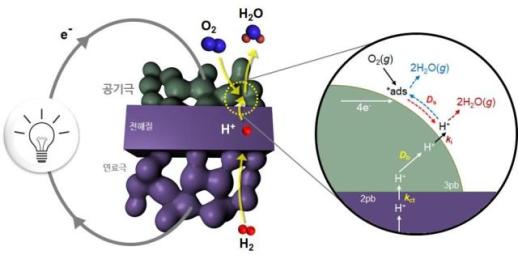 KIST cracks long-elusive reaction mechanism in next-gen hydrogen fuel cells SEOUL, April 08 (AJP) - South Korean researchers have unraveled a reaction mechanism at the heart of next-generation hydrogen fuel cells that had eluded scientists for years, a breakthrough that could accelerate the development of cleaner and cheaper energy systems. A team led by Ji Ho-il at the Korea Institute of Science and Technology (KIST) devised a new analytical protocol that pinpointed for the first time how oxygen reduction reactions unfold inside the cathodes of protonic ceramic fuel cells (PCFCs), the institute said on Wednesday. PCFCs operate at temperatures below 500 degrees Celsius, well under the threshold required by conventional solid oxide fuel cells, which translates into lower manufacturing costs and significantly longer lifespans. The technology has drawn growing attention as a pillar of the global shift toward hydrogen-based energy, yet progress has been hampered by the sheer complexity of the electrochemical reactions occurring at the cathode, where oxygen, electrons and protons collide simultaneously. Previous studies relied on researchers selecting one assumed reaction pathway from hundreds of possibilities — a method prone to decisive bias. Ji's team upended that convention by developing a protocol that identifies the rate-determining step through precision experiments first, then traces the reaction pathway backward without any prior assumptions. When the protocol was applied to two widely studied cathode materials — PBSCF and BCFZY — the team confirmed for the first time that the two materials follow entirely distinct reaction pathways. One material showed a sharp drop in resistance as water vapor increased, while the other remained virtually unchanged, offering direct experimental proof of the divergence. "This study fundamentally reveals why hydrogen fuel cells suffer from low efficiency," Ji said. "We expect it to serve as an important foundation for developing the high-performance fuel cells essential to realizing a clean hydrogen economy." Beyond fuel cells, the researchers said the analytical framework could be applied broadly to other electrochemical devices, including systems that produce green hydrogen by running the cells in reverse to harness solar, wind and nuclear energy. 2026-04-08 14:05:53
 -
 LG Energy Solution sinks deeper into red with second straight quarterly loss SEOUL, April 07 (AJP) - LG Energy Solution posted a widening operating loss for the first quarter of 2026, marking its second consecutive quarterly deficit as a prolonged slump in global electric vehicle demand and a sharp drop in U.S. tax credits eroded profitability at the world's No. 2 battery maker. The company said in a preliminary regulatory filing on Tuesday that it logged a consolidated operating loss of 207.8 billion won ($138.7 million) for the January to March period, swinging from a 374.7 billion won profit a year earlier and deepening from a 122 billion won loss in the preceding quarter. Revenue slipped 2.5 percent on-year to 6.555 trillion won, dragged down by sluggish North American EV sales and production halts at Ultium Cells, the company's joint-venture plants with General Motors, whose first two facilities suspended operations in early January. ‘ A shift in accounting treatment compounded the decline. LG Energy Solution said it began sharing a portion of the Advanced Manufacturing Production Credit proceeds with customers at standalone and formerly joint-venture plants this year, booking only the net figure as other revenue — a change that effectively reduced the recognized subsidy relative to actual production volumes. Rising costs tied to the ramp-up of five North American energy storage system production sites and elevated expenses stemming from the U.S.-Iran conflict also weighed on results. Industry analysts nonetheless expect the first half to mark the trough. Surging demand for grid-scale and data center-linked ESS batteries, fueled by the global build-out of artificial intelligence infrastructure and power grids, is widely seen as the catalyst for a second-half turnaround. LG Energy Solution has been channeling resources toward the segment, aiming to more than triple ESS-related revenue and to expand global ESS battery production capacity to over 60 gigawatt-hours by the end of 2026. "We plan to raise the combined share of ESS and new businesses from about 20 percent today to the mid-40 percent range, building a more stable and balanced portfolio," CEO Kim Dong-myung said at the company's annual shareholders' meeting in late March. Shares of LG Energy Solution closed at 408,500 won, 0.97 percent lower than the day before. 2026-04-07 17:54:06
 -
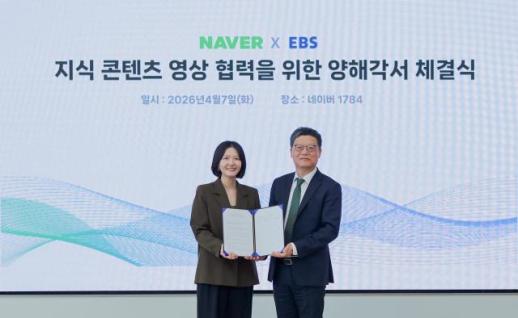 Naver partners with EBS to build trusted knowledge video content SEOUL, April 07 (AJP) - Naver and the Korea Educational Broadcasting System (EBS) signed a memorandum of understanding to jointly produce large-scale knowledge and educational video content, the companies said. Under the agreement, inked at Naver's headquarters on Tuesday in Seongnam, Gyeonggi Province, the two sides will co-produce content spanning health, finance and economics as well as material aligned with South Korea's elementary, middle and high school curricula. The partners plan to steadily expand a knowledge video archive by tapping into a broader range of topics. EBS is South Korea's public educational broadcaster, operating under guidance of the Ministry of Education with a mandate to provide nationwide learning resources across television, radio and digital platforms. The content will be distributed across Naver's search engine, home feed and online encyclopedia services, aiming to help users access more accurate and in-depth information throughout the portal's ecosystem. "High-quality data has emerged as a core competitive edge in the AI era, and the combination of Naver's AI technology and platform capabilities with EBS's proven content production expertise will drive the expansion of a trustworthy knowledge content ecosystem," Naver CEO Choi Soo-yeon said. EBS President Kim Yu-yeol called the agreement "a starting point for innovation that merges EBS's production know-how with Naver's AI technology." He added that, at a time of growing vigilance over AI hallucinations, the broadcaster would work to ensure its credible video content is properly utilized through Naver's AI services, contributing to a more reliable digital environment. 2026-04-07 16:09:54
 -
 Coupang reclaims e-commerce dominance in South Korea as Chinese rivals gain ground SEOUL, April 07 (AJP) - Coupang, South Korea's largest online retailer, has effectively shaken off the fallout from a massive data breach that exposed the personal information of about 33.7 million users late last year, with its monthly active user base and estimated transaction volume rebounding to pre-crisis levels in March. Data from IGAWorks MobileIndex on Monday showed Coupang's monthly active users (MAU) reaching 35.03 million in March, up from 33.64 million in February and 34.01 million in January. The figure marks a decisive rebound from a three-month slide that began after the New York-listed company disclosed the breach in late November 2025. Coupang's estimated monthly payment volume also recovered. The platform's transaction value climbed to about 4.62 trillion won ($3.06 billion) in March, a 12.22 percent increase year-on-year, accumulative transaction value for the whole of the first quarter also rising 11.26 percent to 13 trillion won. Even with the info leak crisis, the gap between Coupang and its domestic competitors still remained vast. The nearest Korean rivals in March were 11st with 8.15 million monthly users, Naver Plus Store with 7.77 million and Gmarket with 6.81 million, according to MobileIndex. Among domestic platforms, Naver Plus Store posted the sharpest gains behind Coupang, with its March MAU hitting a record 7.77 million — a 9 percent jump from 7.1 million the previous month, the shopping app's momentum reported to be bolstered by an AI-powered counterfeit monitoring system and a one-strike seller removal policy. "This is a leading case in which platform self-regulation has simultaneously achieved consumer protection and merchant growth," Naver's user protection committee chairman Kwon Hun-yeong said. Chinese-backed platforms continued to tighten their grip on the market. Temu, operated by PDD Holdings, drew 7.42 million monthly users in March, while Alibaba Group's AliExpress recorded 7.12 million. Their combined user base of about 14.54 million outstripped every individual domestic rival except Coupang. Temu also topped all shopping apps in new installations for a second consecutive month, logging about 749,000 fresh downloads in March, followed by Naver Plus Store at about 674,000. Coupang trailed with 461,000 new installations, a sign that its commanding market share rests more on the loyalty of its existing user base than on fresh customer acquisition. Industry observers said the data underscored an increasingly bifurcated market: Coupang's entrenched logistics network and same-day delivery infrastructure continue to lock in existing users, while Chinese platforms are leveraging ultra-low prices and aggressive marketing to capture price-sensitive newcomers at a pace domestic rivals have struggled to match. 2026-04-07 15:17:01
 -
 Seoul sends envoy to Kazakhstan, Oman, and Saudi on energy mission SEOUL, April 07 (AJP) - South Korea is dispatching a government delegation led by a senior presidential envoy to key energy partners in Central Asia and the Middle East to secure crude oil and naphtha supplies as the country braces for fallout from prolonged disruptions of the Strait of Hormuz. Kang Hoon-sik, chief of staff to President Lee Jae Myung, will depart Tuesday for Kazakhstan, Oman and Saudi Arabia in his capacity as special envoy for strategic economic cooperation, the presidential office said. Speaking at a briefing, Kang said the delegation — which includes officials from the Ministry of Trade, Industry and Energy and representatives from domestic energy firms — will focus on securing additional supplies of crude and feedstock. “The most urgent priority at this point is to ensure stable supply of essential goods for daily life,” Kang said, noting Korea’s heavy reliance on Middle Eastern energy imports. The trip follows a recent agreement with the United Arab Emirates to prioritize shipments of 24 million barrels of crude, with cargoes already arriving at Korean ports. However, Kang stressed that further diversification is needed until the regional conflict stabilizes. “To ensure that high-level talks do not end as empty words, we will work closely with companies and provide all necessary support until shipments safely reach Korean ports,” he said. Seoul is also working to secure safe passage for 26 Korean-flagged vessels currently in or near the Strait of Hormuz, prioritizing crew safety while coordinating with shipping firms and international partners. 2026-04-07 11:58:02
 -
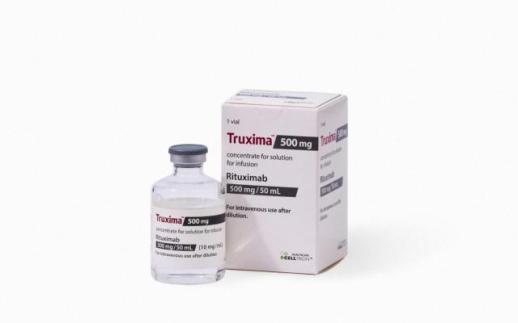 Celltrion's Truxima becomes first South Korean biosimilar to claim top U.S. prescription share SEOUL, April 07 (AJP) - Celltrion's blood cancer treatment Truxima has become the first South Korean biosimilar to capture the largest prescription share in the United States, marking a milestone for the country's biopharmaceutical industry at a time when Washington is actively championing lower-cost alternatives to branded drugs. Truxima, a biosimilar of Roche's blockbuster Rituxan, secured a 35.8 percent share of U.S. prescriptions by volume in February, according to data from market research firm IQVIA. The achievement comes about six years and three months after the drug's U.S. launch in November 2019, overtaking both the original medicine and rival products to become the most-prescribed rituximab treatment in the country. The milestone lands in a favorable policy climate. President Donald Trump signed an executive order in April 2025 calling on the FDA to recommend ways to accelerate approval of biosimilars, and his administration's Section 232 pharmaceutical tariffs announced on April 2 this year explicitly exempted biosimilar products and their ingredients, while imposing levies of up to 100 percent on patented drugs. South Korea is among the countries whose patented drug exports face a reduced 15 percent tariff under existing trade deals, but the full exemption for biosimilars gives companies like Celltrion a distinct competitive edge. The prescription gains have translated directly into revenue. Truxima generated more than 300 billion won ($198.8 million) in sales across North America last year, a year-on-year increase exceeding 40 percent. Celltrion's flagship autoimmune treatment Inflectra, the U.S. brand name for infliximab biosimilar Remsima, also held the highest biosimilar prescription share in its category at 30.5 percent, while prescriptions for subcutaneous formulation Zymfentra more than tripled in January from a year earlier. Newer high-margin products are also gaining traction. Steqeyma, a biosimilar of Stelara launched in March last year, has already captured 10.2 percent of prescriptions after securing preferred formulary status with major pharmacy benefit managers. Avtozma (tocilizumab) and Stoboclo-Osenvelt (denosumab), both launched in the second half of last year, are steadily expanding their reimbursement coverage through PBM contracts. "As both our legacy and newly launched products continue to deliver strong results across global markets, including the United States, we are confident of meeting our full-year earnings targets," said a Celltrion spokesperson. 2026-04-07 09:03:49
 -
 GM Korea signals full turnaround as it pays out first regular dividend SEOUL, April 06 (AJP) - General Motors Korea said it will pay its first regular dividend to shareholders, marking the clearest sign yet that the once-ailing Korean unit of the U.S. automaker has completed a turnaround eight years after its Gunsan plant was shuttered and billions of dollars in public and private capital were mobilized to prevent its collapse. The automaker's board approved an interim dividend on April 3, though the company did not disclose the payout's size in its public filing on Sunday. Industry observers estimate the distribution could run into trillions of won, given that GM Korea's unappropriated retained earnings exceeded 4 trillion won ($2.64 billion) after the company converted capital surplus reserves into distributable earnings. The dividend caps a rescue that began in 2018 when General Motors' Korean unit was on the brink of bankruptcy, weighed down by complete capital erosion and mounting losses. The closure of its Gunsan factory in North Jeolla Province sent shockwaves through the domestic auto supply chain and raised fears that the Detroit parent would abandon the Korean market altogether. Under a bailout agreement finalized that year, GM converted about $2.8 billion in loans to equity and committed fresh capital, while the state-run Korea Development Bank injected $750 million in preferred shares. In return, GM pledged to maintain its stake and allocate two new vehicle models to its remaining plants in Bupyeong, west of Seoul, and Changwon in the southeast. Those models — the Trailblazer and the Trax Crossover — proved pivotal. By concentrating production on compact SUVs aimed at North American buyers, GM Korea swung to a profit in 2022 and posted operating income exceeding 1 trillion won in both 2023 and 2024, according to the company's press release. The Korean unit sold about 462,000 finished vehicles last year, with 96.8 percent shipped overseas. Ahead of the dividend, GM moved to preempt any revival of speculation that it might be laying the groundwork for an exit. The company announced in March that it would invest $600 million in its Korean plants to upgrade press machinery and modernize production lines, building on an earlier commitment made in late 2025. GM Korea President and CEO Hector Villarreal said the investment reflects the company's confidence in its local workforce and operations. "We have a strong foundation, and this investment is a sign of confidence in our operations," he said. The capital restructuring that paved the way for the dividend — shifting reserves from a capital surplus account to retained earnings — is a well-established practice under Korea's Commercial Act and has been employed by other major Korean firms to expand shareholder returns. The move is not legally contentious, as the law permits companies to reduce capital reserves through a shareholder resolution and redirect the funds toward dividends. The government and KDB are unlikely to publicly oppose the payout as restricting a foreign-invested company from distributing profits could invite accusations of discriminatory treatment a 2026-04-06 11:02:45
 -
 HD Korea Shipbuilding issues $1.57 bn in exchangeable bonds, sparking valuation re-rating hopes SEOUL, April 03 (AJP) - HD Korea Shipbuilding & Offshore Engineering has launched a 2.37 trillion won ($1.57 billion) exchangeable bond issuance targeting shares of its flagship subsidiary HD Hyundai Heavy Industries, a move analysts say could dismantle the holding company discount that has long weighed on its stock. The company disclosed the EB issuance on March 31, later revising the total from an initially announced 3.03 trillion won. The bonds are exchangeable into a 4.3 percent stake in HD Hyundai Heavy Industries at a conversion price of 523,125 won per share, with exchange requests eligible from June 14. The offering crystallizes a plan first floated at a January management briefing, where executives acknowledged that HD Hyundai Heavy Industries' thin free float had become a bottleneck for unlocking shareholder value. "The company had announced it had no plans to sell its stake, but by issuing exchangeable bonds, it has effectively liquidated its HD Hyundai Heavy Industries holdings in a way that minimizes market shock," said Kim Yong-min, an analyst at Yuanta Securities. By opting for exchangeable bonds rather than a block deal, the shipbuilder chose to cushion the market from a sudden supply shock. Instead of offloading a large tranche of shares in one sweep, the structure allows a gradual expansion of circulating stock as bondholders exercise their conversion rights over time. For HD Korea Shipbuilding, monetizing a long-dormant subsidiary stake could serve as a springboard for valuation re-rating, with the parent's standalone net cash position projected to swell to nearly 5 trillion won. HD Hyundai Heavy Industries, by contrast, faces near-term headwinds on the supply side. EB investors are widely expected to engage in hedge trading — shorting the underlying shares to manage risk — which could exert downward pressure on the stock in the coming weeks. Market attention has now turned squarely to how the war chest will be deployed. Given that both companies already sit on ample liquidity, analysts view the fundraising as a preemptive move to finance large-scale strategic investments rather than a routine cash buffer. Potential targets include establishing a naval defense foothold in the United States and pursuing mergers and acquisitions in next-generation green maritime technology, particularly as Washington has signaled its desire to deepen cooperation with South Korean shipbuilders. No concrete spending plans have been finalized, however, leaving a degree of uncertainty. "This fundraising will give HD Korea Shipbuilding's overseas expansion and M&A pursuits significant momentum. It could serve as a catalyst for narrowing the valuation gap with rival shipbuilders," said Jeong Dong-ik, an analyst at KB Securities. As of 11:20 a.m. Friday, KOSPI-listed HD Korea Shipbuilding traded 7.42 percent up at 376,500 won per stock. 2026-04-03 11:22:44
 -
 Nexon opens 'Maple Island' permanent theme zone at Lotte World Adventure SEOUL, April 03 (AJP) - South Korean gaming giant Nexon has officially opened "Maple Island," a permanent story-themed attraction at Lotte World Adventure in Seoul's Jamsil district, bringing the beloved "MapleStory" franchise off the screen and into the real world. The roughly 2,000-square-metre zone, built within the outdoor section of the park, immerses visitors in the iconic landscapes of the MapleStory universe — including fan-favourite regions Henesys, Ludibrium and Arcana — and challenges them to solve hidden quests alongside the game's signature cast of monsters. The attraction features four rides, three of which are entirely new. Stone Express, a roller coaster, sends riders on a high-speed hunt for stone spirits, while Arcana Ride guides guests through a story of restoring life to an enchanted tree. Eos Tower propels visitors up and down at full speed toward the fan-favorite character Pink Bean, and the existing Gyro Spin attraction has been refitted with full Maple Island theming. Beyond the rides, visitors can shop for branded merchandise at Maple Store and stop at Maple Sweets for in-universe food and beverages such as "Red Potion" and "Blue Potion" drinks modelled on in-game items. The opening is part of a broader three-month seasonal collaboration, "MapleStory in Lotte World," launched on March 14 and running through June 14. The wider event spans the entire park and includes character interaction zones, Magic Castle projection mapping and themed parades. 2026-04-03 09:18:36
 -
 Seoul forced to swallow Trump's call, increase US share in energy SEOUL, April 02 (AJP) - South Korea is scrambling to shore up dwindling energy supplies and diversify away from the Middle East after U.S. President Donald Trump ruled out an immediate end to the Iran war, vowing instead to hit Iran "extremely hard over the next two to three weeks." In a primetime address from the White House on Thursday, Trump made clear the operation would last through April, destabilizing not just Iran's military infrastructure but also the core Middle East shipping pipeline — and, by extension, the global energy market. For South Korea — Asia's fourth-largest economy, which imports over 90 percent of its energy from abroad — the message was blunt. Rather than pledging to reopen the chokepoint through which about 20 percent of the world's oil and liquefied natural gas flows, Trump offered fuel-starved nations two options: buy American oil or secure the strait themselves. The remarks are reinforcing a structural shift already underway in Seoul's energy sourcing, with U.S. crude emerging as a key alternative. A senior trade official said domestic refiners are "scouring global markets" to secure replacement cargoes, adding that U.S. oil is taking up a growing share of substitute supply. The United States has rapidly gained ground in Korea's import mix, rising from just 0.2 percent in 2016 to over 16 percent last year, as Seoul has pushed to diversify away from Middle Eastern dependence. Industry sources say refiners including GS Caltex, HD Hyundai Oilbank and SK Energy are actively expanding U.S. procurement. Trump has been blunt in his message to allies that failed to support the U.S. war effort and are now grappling with supply disruptions. "So to those countries that can't get fuel, many of which refused to get involved in the decapitation of Iran, I have a suggestion," Trump said. "Number one, buy oil from the United States of America. We have plenty. And number two, build up some delayed courage. Go to the Strait and just take it, protect it, use it for yourselves." Seoul sources roughly 70 percent of its crude oil and 20 percent of its LNG from the Middle East, with virtually all of it transiting the now-blocked strait. Brent crude surged back above $105 a barrel after the speech, up from about $70 before the conflict erupted on Feb. 28. The Korean won hovered near 1,510 per dollar on Thursday, close to its weakest since 2009. The cascading damage to South Korea's industrial base is already severe. Naphtha, the petrochemical feedstock used in everything from plastics to automotive parts, has surged about 60 percent since February, while ethylene costs have doubled. Several naphtha crackers have gone into shutdown, requiring weeks to restart. Following shortages, Seoul has imposed a temporary ban on naphtha exports and designated the material as an "economic security" item. "Supply itself has been cut off, halting production entirely," said Jung Jun-hwan, a senior researcher at the Korea Energy Economics Institute. "Shutdowns could cascade across manufacturing sectors where raw material costs account for a large share of total expenses." The government has responded with a 26.2 trillion won ($17.2 billion) supplementary budget targeting fuel price caps, expanded subsidies, cash handouts for about 70 percent of the population and industrial support. Seoul has also lifted the 80-percent operating cap on coal-fired power plants, raised nuclear utilization rates above 80 percent and pledged to release 22.46 million barrels from its strategic petroleum reserve in coordination with the International Energy Agency. Officials said alternative supply is being secured at a pace that could cushion the immediate shock, albeit below normal levels. "Alternative supply for April is estimated at around 50 million barrels, and a significant volume for May is also being secured," Yang Ki-wook, deputy minister for energy security at the Ministry of Trade, Industry and Energy, said at a briefing on Thursday. That compares with a typical monthly import level of around 80 million barrels, but Yang stressed that the gap is manageable under current demand conditions. "The 80 million barrels is a normal benchmark, not an absolute requirement," he said, noting that lower refinery utilization and demand management measures limit the immediate impact. He added that remaining shortfalls can be bridged through stockpile swaps, allowing refiners to draw on government reserves before incoming cargoes arrive. With Russian crude emerging as a stopgap — made possible by a U.S. sanctions waiver issued in mid-March — Seoul is exploring supply routes it had abandoned after the invasion of Ukraine. However, industry experts say most Russian crude already has committed destinations and imports carry various restrictions, dimming the option. Even if the Strait of Hormuz were to be reopened tomorrow, experts say industry recoveries would come slowly. "Fully loaded tankers must first pass through, and empty vessels must then enter and drain the stockpiles before oil-producing states can resume output," said Yoon Jae-sung, an analyst at Hana Securities. "Given that a voyage to Asia takes four weeks and that 30 to 40 percent of Gulf refining capacity has been damaged — with normalization expected to take at least three months — restoring the supply chain will require considerable time. Crude oil and gas would take priority, pushing petrochemical products and naphtha further down the queue." 2026-04-02 16:25:57