

Journalist

Ryu Yuna
ellenshs@ajupress.com
-
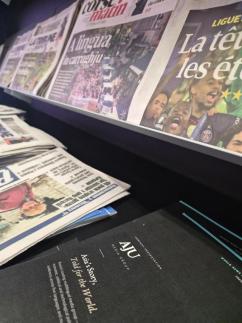 The Gap in Questions, Not Technology, at the World News Media Congress At the 77th World News Media Congress (WNMC) held in Marseille, France, the most significant realization was not a technological gap but a gap in questions. As the director of the English news agency AJP under Aju Media Group, I presented examples of artificial intelligence (AI) utilization in South Korea. The country is among the fastest in the world to adopt AI, actively integrating it into newsrooms for translation, automation, and content productivity enhancement. Aju Economy is also preparing agent-based services, liquid content, and predictive user experiences. However, the concerns faced by global media at the congress were different. While South Korean media is still asking, "What can we automate with AI?" leading global outlets are questioning, "What should journalism become in the AI era?" Throughout the three days of presentations and discussions, the focus shifted away from prompt engineering, article summarization, and translation automation. Instead, participants discussed user experience, personalization, agents, information structuring, trust, and the value of original reporting. AI remained a central topic, but the core of the discussions was not technology; it was journalism. The most impressive change was the dismantling of article-centric thinking. The Indian newspaper The Hindu was reconstructing a single article into multiple formats. Readers could view the same article as a 200-character summary, read it in a Q&A format, or listen to an audio explanation. The key was not the article itself but the format preferred by the reader. Sweden's Bonnier News was transforming its decades-old article archive into an interactive service. Instead of entering keywords into a search box, readers posed questions, and the media's articles provided the answers. Search was evolving into conversation. India's Scroll.in took it a step further. They did not view articles merely as reading material but were building a research platform using AI to provide timelines, knowledge graphs, relationship maps, event clusters, and automatically generated Q&A. Their goal was to create a workspace for scholars and researchers to delve deeply into specific issues. Germany's Ippen Digital showcased an example where over 4,000 articles were automatically produced in a single day during local elections. However, the focus was not on production volume but on personalized news tailored to regions, communities, and ultimately individuals. Global media were no longer competing in article production. They were competing in reader experience. One of the most striking examples at the congress was from the German news agency dpa. dpa's strategic director Astrid Meyer stated, "News output is not the end; it is the beginning." The dpa IQ they unveiled represented a completely different concept from traditional news services. While traditional news agencies supply articles, dpa was structuring facts, contexts, relationships, and data within articles in a way that AI could directly utilize. AI agents could access dpa IQ to request timelines of specific events and retrieve related individuals, past articles, and real-time updates. It was about facts, not articles. While many media outlets were contemplating how to produce content using AI, dpa was pondering what journalism should become in the AI era. A reliable information infrastructure. Perhaps that is the closest vision for the future of the news industry in the AI era. Austria's Kleine Zeitung took it even further. Digital director Sebastian Krause argued that AI should be viewed as a new reader. For the past 15 years, media have optimized content for Google, fixating on search engine optimization (SEO) and competing for clicks. But now, ChatGPT, Perplexity, Copilot, and Google AI mode are reading, summarizing, and reconstructing articles. AI has already become a reader. As he expressed, there may soon be separate sites for humans and agents. What they are discussing goes beyond SEO to answer engine optimization (AEO) and generative engine optimization (GEO). The goal is no longer to rank high in search results. What information AI cites and which media it trusts is becoming the new competition. Conversely, as AI advances, the essence of journalism is paradoxically emphasized. The most applauded speech at the congress was by A.G. Sulzberger, publisher of The New York Times. Sulzberger did not oppose AI; rather, he advocated for its active use. However, he reminded attendees that AI companies ultimately grow based on the reporting produced by journalists. "Most of the facts we know start from someone's original reporting," he said. Witness testimonies from people met on the ground. Documents obtained by reporters. Facts verified through on-the-ground reporting. AI can summarize that. It can rearrange it. But it cannot produce it. The repeated message throughout the congress was clear. AI is not a technology to replace journalists. It is a technology that enables journalists to conduct more reporting. As AI proliferates, facts become more important. As synthetic content increases, on-the-ground reporting becomes more crucial. As information floods in, trust becomes more valuable. Returning from Marseille, the conclusion I reached was surprisingly simple. South Korea remains one of the fastest countries to adopt technology in the world. However, rapid adoption does not equate to leadership. Global media are already discussing the next stage of automation. From articles to experiences. From search to conversation. From content to knowledge. From readers to agents. And from automation back to journalism. As Ezra Eman said, no one has a map right now. But at least the direction global media is heading is visible. That direction is not toward AI but toward people. It is about asking what readers want, how they experience news, and why journalism is still necessary. Perhaps these are the same questions South Korean media should be asking now—not what to automate with AI, but what more can we report thanks to AI.* This article has been translated by AI. 2026-06-04 17:33:00
 -
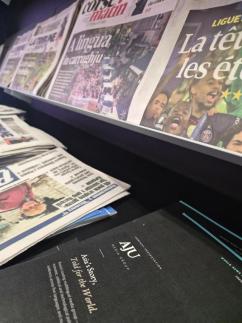 WNMC 26: Journalism's AI debate has moved on MARSEILLE, June 4 (AJP) — One theme emerged repeatedly during the 77th World News Media Congress in Marseille: the global news industry has largely moved beyond debating whether artificial intelligence should be used in journalism. The discussion has shifted to a more fundamental question. What role will journalism play when AI increasingly mediates how information is discovered, consumed and distributed? That shift was visible across presentations from publishers, news agencies and technology executives throughout the three-day congress. Two years ago, much of the industry's attention focused on newsroom automation, content generation and workflow efficiencies. Those topics remain important. But in Marseille, the most consequential discussions centered on user experience, personalization, knowledge architecture, audience loyalty and the relationship between journalism and AI agents. The focus was no longer on how AI could help create content. It was on how audiences would experience journalism in an AI environment. The Hindu Group in India provided one example of this transition. The company has been experimenting with presenting the same journalism in multiple formats, including AI-generated summaries, question-and-answer formats, audio explainers and alternative article lengths. The objective is not simply greater efficiency but greater accessibility and discoverability. Sweden's Bonnier News is pursuing a similar goal through conversational archives. Rather than relying on traditional search, readers can query decades of reporting through natural-language interfaces. The shift is from retrieval to conversation. At Scroll.in, the focus is on contextual understanding. The publisher is developing AI-powered workspaces that combine timelines, event clusters, knowledge graphs and dynamic FAQs, particularly for researchers and specialist audiences seeking comprehensive understanding of complex topics. Different organizations are pursuing different approaches, but they share a common assumption: the article is no longer the only product. User experience is becoming a strategic differentiator. The most forward-looking example presented in Marseille may have come from Germany's dpa. Astrid Maier, chief deputy editor and head of strategy, introduced dpa IQ, a system designed to make journalistic information directly accessible to AI agents and workflows. "The news artifact is not the end. It's only the beginning," she said. The premise behind dpa IQ is that journalism can be structured as machine-readable knowledge rather than distributed solely as articles. AI systems can retrieve facts, timelines, contextual information and archived reporting through APIs and agent frameworks. The significance of the project extends beyond technology. It represents a different understanding of what a news agency might become in an AI ecosystem: not merely a distributor of articles, but a provider of trusted information infrastructure. Austria's Kleine Zeitung offered another perspective on the changing media environment. Sebastian Krause, the publisher's head of digital, argued that publishers must begin thinking about AI systems as a new category of audience. For years, publishers optimized content for search engines. Increasingly, however, AI assistants are reading, summarizing and retrieving information on behalf of users. This shift has prompted discussions about Answer Engine Optimization (AEO) and Generative Engine Optimization (GEO), reflecting the growing importance of visibility within AI-generated responses. The implication is significant. As AI systems become intermediaries between publishers and audiences, the strategic challenge is no longer simply generating traffic. It is maintaining visibility, attribution and commercial value in environments where users may never visit the original source. Yet for all the discussion surrounding AI, one of the strongest messages of the congress concerned journalism itself. The most widely discussed speech of the week came from New York Times publisher A.G. Sulzberger. Sulzberger argued that while AI companies can organize, summarize and distribute information, they remain dependent on journalism's most fundamental contribution: original reporting. Facts do not appear spontaneously in AI systems. They originate from reporting in the field, interviews, documents, investigations and verification. As AI-generated content becomes increasingly abundant, speakers throughout the congress repeatedly returned to the same conclusion: trust, verification and firsthand reporting become more valuable, not less. This may prove to be one of the central paradoxes of the AI era. The more powerful AI becomes, the more important journalism's uniquely human functions appear. For South Korea, where AI adoption is among the fastest in the world, the discussions in Marseille offered an important reminder. Automation, translation and workflow efficiencies are necessary developments. But they are not, by themselves, a strategy. The organizations shaping the industry's future are increasingly focused on audience relationships, user experience, information architecture and trust. The debate is moving beyond how AI can improve newsroom operations. It is moving toward how journalism itself must evolve. As WAN-IFRA AI lead Ezra Eeman observed during the congress, "There is no map." That remains true. But the direction of travel is becoming clearer. The conversation is moving from content to experience, from search to interaction, from distribution to loyalty, and from information abundance to trusted verification. In that sense, the most important discussions in Marseille were not ultimately about artificial intelligence. They were about the future value of journalism. 2026-06-04 14:39:04
 -
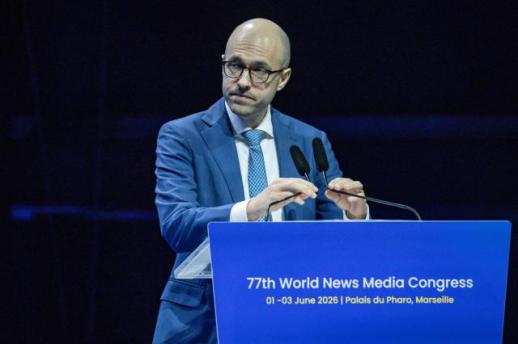 WNMC 26: NYT chair delivers a rallying cry for journalism in the AI age MARSEILLE, June 02 (AJP) - For 40 minutes, A.G. Sulzberger stood before an audience of more than 1,300 editors, publishers and journalists from around the world and delivered what many attendees would later describe as one of the defining speeches of the World News Media Congress. The New York Times chairman and publisher did not simply warn about artificial intelligence. He mounted a sweeping defense of journalism itself — arguing that AI companies are building trillion-dollar businesses on the back of original reporting while simultaneously threatening the economic foundations that make that reporting possible. After Sulzberger concluded his keynote, the audience responded with sustained applause. Moments later, BBC journalist and conference moderator Ros Atkins offered his own assessment. "One of the most impressive addresses I've heard on journalism in the age of AI," Atkins told the audience. The reaction reflected the mood in the room. While many discussions at WNMC 2026 focused on how publishers can adapt to AI, Sulzberger focused on a more fundamental question: what happens if the institutions that produce reliable information are weakened in the process? 'Original reporting is how you know what you know' Speaking on the theme "AI Journalism and the Uncertain Future of the Public Square," Sulzberger made clear he was not arguing against artificial intelligence itself. "The New York Times has a long record of embracing technology to advance the mission of independent journalism," he said. "We had a history of respectful partnerships with tech companies." He noted that Times journalists are already using AI tools "responsibly, ethically and with humans making the decisions," adding that "holding a powerful new technology at arm's length is a recipe for failure." Yet the speech repeatedly returned to a central argument: AI systems ultimately depend on journalism. "AI models are made of four basic ingredients," Sulzberger said. "Talent, compute, energy and data." The first three, he noted, are paid for. "In contrast, AI companies take data without consent or compensation." What technology companies call "data," he argued, often means something far more specific: journalism, books, music, films and other copyrighted creative works. "What might more accurately be called copyrighted content." The heart of the speech came when Sulzberger described the unique role of journalists in creating information that does not previously exist. "Reporters are the ones enriching the public record with previously unknown information," he said. "That surprising fact, that telling detail, that quote from an eyewitness, that secret document." Then came a line that many attendees later cited as the keynote's defining message. "Original reporting is very often how you know what you know." The value behind the headlines To illustrate the scale of that work, Sulzberger pointed to The New York Times' own investment in journalism. Last year alone, he said, the Times produced nearly half a million pieces of journalism — articles, photographs, videos and podcasts — at a cost of more than $2 billion. The organization deployed journalists across all 50 U.S. states and in 155 countries. In Ukraine alone, more than 70 journalists and support staff worked on the ground during 2025. "This original work is valuable," Sulzberger said, "because it's been carefully written and edited, independently verified, held to the highest standards of fairness and accuracy." Yet, he argued, many AI companies have treated that work as a free resource. "OpenAI confessed that it would be impossible to train today's leading AI models without using copyrighted materials," he said. And while AI companies pay engineers, purchase chips and build massive data centers, "AI companies take data without consent or compensation." 'We cannot sit by' The most forceful portion of the address came when Sulzberger called on publishers to stop being passive. "Our profession has been too quiet, too passive and too fragmented in the face of abuses by the companies leading the AI revolution," he said. "We cannot allow AI cheerleaders to dominate the public conversation." Nor, he said, can publishers remain silent while their content is used to create products that compete directly with them. "We cannot sit by as this work is used to build replacement products that undermine our ability to earn the audience and revenue necessary to continue reporting the news." The audience responded with one of the keynote's strongest rounds of applause. A threat beyond journalism Sulzberger argued that the stakes extend far beyond the news industry. Creative industries worldwide employ millions of people and generate trillions of dollars in economic value annually. The erosion of intellectual property protections, he warned, would weaken not only journalism but books, film, music and research. But his deepest concern centered on public trust. As AI-generated content proliferates online, distinguishing truth from fiction becomes increasingly difficult. "It is becoming harder and harder to know where things came from and whether they are true," he said. This dynamic, he warned, risks producing a culture in which people no longer trust anything. "The effect isn't just that people believe untrue things." "It's that they no longer believe true things." According to Sulzberger, that loss of trust is already encouraging many people to disengage from public life altogether. Four calls to action Rather than ending with a warning, Sulzberger closed with a challenge to the industry. His first message was blunt. "Stand up for your rights." "Intellectual property rights must hold if our profession is to have a path forward." Second, he urged publishers to negotiate carefully with AI companies. Third, he called on news organizations to push lawmakers to strengthen protections for journalism and intellectual property. And fourth, he encouraged publishers to work together. "The news industry's only path to counteracting that influence is by working together." At the same time, he argued that newsrooms must embrace AI responsibly rather than reject it. "Use AI the right way." And perhaps most importantly, he urged publishers to build direct relationships with audiences rather than relying on platforms. "Be a destination first." 'Information is valuable. Journalism is valuable.' As the address drew to a close, Sulzberger returned to a phrase that echoed throughout the hall. Decades ago, Silicon Valley popularized the idea that "information wants to be free." But, he said, many people forgot the second half of Stewart Brand's famous observation. "Information wants to be expensive because it's so valuable." Then came the line that served as both a warning and a defense of journalism's future. "Information is valuable. Journalism is valuable." In a digital environment increasingly crowded by bots, synthetic content and misinformation, Sulzberger argued that trusted journalism may become more important, not less. "News organizations should stand up as the reliable alternative to this mess." As delegates rose from their seats and applauded, the message appeared to resonate. For many in Marseille, the speech was not simply about AI. It was about whether journalism can preserve the economic and civic foundations necessary to continue producing the original reporting on which both democracy — and increasingly AI itself — depend. 2026-06-02 09:27:34
 -
 Seoul conveys concerns to Washington over Brunson's 'dagger' remarks SEOUL, May 30 (AJP) -South Korea has conveyed its position to Washington over U.S. Forces Korea Commander Gen. Xavier Brunson's controversial description of the Korean Peninsula as "the dagger in the heart of Asia," presidential officials said Saturday, after the remarks drew a diplomatic protest from China and reignited debate over the evolving role of the U.S.-South Korea alliance. National Security Adviser Wi Sung-lac, the defense ministry and the foreign ministry delivered Seoul's position through diplomatic and security channels, according to Cheong Wa Dae. While officials declined to disclose the contents of the message, security observers said Seoul likely expressed regret over remarks that risked unnecessarily complicating relations with Beijing at a time when the Lee Jae Myung administration is seeking to stabilize ties with both Washington and China. The controversy stems from comments Brunson made during a recent podcast hosted by the U.S. Army War College, where he described South Korea as "the dagger in the heart of Asia" while discussing the region's strategic geography. The remarks quickly drew criticism from China's Embassy in Seoul, which accused the U.S. general of "crossing the line" and exposing a confrontational posture toward China. Beijing argued that the comments reflected a Cold War mentality and warned against turning regional security cooperation into geopolitical confrontation. The episode has highlighted growing sensitivities surrounding the future mission of U.S. Forces Korea as Washington increasingly emphasizes strategic competition with China alongside its longstanding objective of deterring North Korea. While Seoul and Washington officially maintain that the alliance's primary mission remains defending the Korean Peninsula, U.S. military planners have increasingly described South Korea as a critical hub within a broader Indo-Pacific security architecture. Analysts say Brunson's remarks touched a diplomatic nerve because they appeared to frame South Korea not only as a frontline state against North Korean threats but also as a strategic position in the wider U.S.-China rivalry. Asked about the controversy during the Shangri-La Dialogue security forum in Singapore on Saturday, Brunson said his comments were intended to describe the region's operating environment rather than signal a change in military policy. "What I said was trying to describe the operating environment because what's incredibly important is being able to describe the environment where we're working in," he said. Brunson said the remarks were made in the context of viewing regional geography from a different strategic perspective based on an "east-up" map orientation. "By changing our perspective, we take into account how others might see us in the region," he added. Also speaking at the Singapore forum, U.S. Defense Secretary Pete Hegseth praised South Korea's efforts to assume greater responsibility for its own defense and welcomed Seoul's desire to regain wartime operational control of its military. "I think we have to find the balance of where our military plans and the responsibilities that U.S. uniformed members have had for decades now are honored, as we phase over to wartime OPCON transfer for the Republic of Korea," Hegseth said. The comments came as Seoul seeks to complete the transfer of wartime operational control, or OPCON, before President Lee's five-year term ends in 2030. Hegseth described South Korea's push to reclaim wartime command authority as a "breath of fresh air" and said Washington supported allies taking greater responsibility for their own defense. "It is an instinct we want to continue to incentivize," he said. The defense secretary also reaffirmed U.S. support for South Korea's efforts to strengthen its military capabilities, including plans to develop conventionally armed nuclear-powered submarines. "We applaud the pragmatism and leadership demonstrated by Seoul," he said. "The region will be far more stable and more secure when other allies and partners follow that path." 2026-05-30 16:27:20
 -
 Korea and Japan among hardest hit from Hormuz disruption SEOUL, May 30 (AJP) - South Korea and Japan have emerged as the biggest casualties of the disruption to Middle Eastern energy supplies following the U.S.-Iran conflict, with crude imports plunging as exports from the Gulf nearly halved amid months of turmoil around the Strait of Hormuz. Middle Eastern crude shipments between March and May are projected to fall 48 percent from a year earlier, according to shipping data compiled by Kpler and reported by Japan's Nikkei newspaper on Friday. The disruption follows the de facto closure of the Strait of Hormuz, a critical maritime chokepoint through which roughly a fifth of global oil supplies normally pass. Among major exporters, crude shipments from Kuwait and Iraq are expected to decline by more than 90 percent during the three-month period, while exports from the United Arab Emirates are projected to fall 33 percent and those from Saudi Arabia 29 percent. Iran, which controls the northern side of the strait, initially maintained export volumes in March and April at levels similar to a year earlier. However, shipments are expected to plunge 87 percent in May after Washington intensified maritime interdiction efforts against Iranian oil exports. The collapse in Gulf supplies has hit Northeast Asia particularly hard because of its heavy reliance on Middle Eastern energy. Japan's crude imports are projected to fall 47 percent between March and May from a year earlier, the steepest decline among the world's 10 largest crude-importing nations. South Korea is expected to post the second-largest drop, with imports falling 31 percent. Before the outbreak of the conflict, Japan sourced about 90 percent of its crude imports from the Middle East, while South Korea relied on the region for roughly 70 percent of its oil needs. China has been relatively insulated. With Middle Eastern crude accounting for about 40 percent of its imports, China's crude purchases are expected to decline by a comparatively modest 18 percent during the same period. Japanese refiners have moved aggressively to replace lost Gulf supplies with U.S. crude. American oil accounted for just 2 percent of Japan's imports in February but had risen to more than 20 percent by early May. South Korea has also accelerated efforts to diversify supply sources. According to recent data released by the Korea International Trade Association, South Korea imported 4.49 million tons of crude oil from the Middle East in April, down 37.3 percent from a year earlier. Total crude imports fell 22.8 percent to 8.46 million tons. As a result, the Middle East's share of South Korea's crude imports dropped to 53.1 percent in April from 65.2 percent a year earlier. Imports from Saudi Arabia, traditionally South Korea's largest supplier, fell 37.6 percent to 2.14 million tons. In contrast, crude imports from the United States rose 13.4 percent to 2.14 million tons, putting U.S. supplies on par with Saudi volumes for the first time in recent years. Since the war, Seoul has dispatched special envoys to the Middle East and Central Asia in April to secure alternative supply routes and reduce dependence on Hormuz-linked shipments. Crude imports from Australia surged 89 percent from a year earlier in April to 440,000 tons, while imports from Canada more than doubled to 240,000 tons. Shipments from Africa rose sharply to 400,000 tons from just 60,000 tons a year earlier. The supply shock has extended beyond crude oil. Global naphtha exports are expected to decline 23 percent between March and May as Middle Eastern shipments contract sharply. Exports from the UAE are projected to plunge 87 percent, while Saudi shipments are expected to fall 27 percent. The supply disruptions come as uncertainty continues to surround the future of the Strait of Hormuz despite ongoing negotiations between Washington and Tehran. U.S. President Donald Trump on Friday emerged from a two-hour Situation Room meeting without approving a proposed framework that could extend the current ceasefire and eventually reopen the strategic waterway. Trump had earlier suggested he was prepared to make a "final determination" on a possible agreement with Iran, but administration officials said no decision was reached. The proposed arrangement would reportedly include reopening the Strait of Hormuz, restrictions on Iran's nuclear activities and a phased easing of U.S. maritime pressure on Iranian shipping. Tehran, however, has publicly rejected several of Washington's conditions and insists current negotiations are focused on maintaining the ceasefire rather than its nuclear program. Meanwhile, small numbers of oil tankers and LNG carriers have continued transiting the strait using a combination of covert navigation and U.S. military assistance. Some vessels have sailed "dark," switching off automatic identification systems and navigation lights to reduce the risk of Iranian interception, according to the Wall Street Journal. Vessels moving through the area remain in close communication with American naval forces, which use drones, radar and surveillance assets to guide ships through relatively safe corridors cleared earlier by U.S. mine-countermeasure operations. Iran's Revolutionary Guard Corps has continued asserting control over the waterway and has reportedly attempted to lay sea mines and launch drone attacks against commercial shipping. U.S. Central Command says American forces have responded by destroying mine-laying vessels and striking missile and drone sites while maintaining that the broader ceasefire remains intact. A South Korean-operated commercial vessel was among ships damaged during Iranian missile and drone attacks near the Gulf shipping lanes. 2026-05-30 15:32:47
 -
 BTS rides sold-out North American tour and AMA wins into Busan homecoming SEOUL, May 30 (AJP) -BTS is bringing home a winning streak. The group wrapped up the first North American leg of its "ARIRANG" world tour after drawing 840,000 fans to 15 sold-out stadium concerts, while collecting three trophies at the 2026 American Music Awards in Las Vegas, setting the stage for a highly anticipated homecoming concert in Busan next month. BigHit Music said Saturday that BTS attracted 840,000 concertgoers across five cities — Tampa, El Paso, Stanford, Las Vegas and Mexico City — with every show sold out. Additional dates added in Tampa, Stanford and Las Vegas due to overwhelming demand were also fully booked. The North American run marked a milestone in the group's first full-scale world tour since all seven members completed their mandatory military service and resumed activities as a full group earlier this year. BigHit said BTS performed songs from its comeback album "ARIRANG" alongside many of its signature hits, with fans singing Korean lyrics throughout the concerts. The company highlighted the audience-wide singalong of the Korean folk song "Arirang" during the performance of "Body to Body" as one of the defining moments of the tour. The tour's momentum carried into a successful awards week in Las Vegas, where BTS won three honors at the American Music Awards, including Artist of the Year — the group's second victory in the show's top category. BTS also took home Song of the Summer for its Billboard Hot 100 chart-topper "Swim" and Best Male K-Pop Artist. The group attended the ceremony at the MGM Grand Garden Arena while in the middle of its Las Vegas stadium residency. he wins underscored the staying power of BTS' global fanbase following a nearly four-year hiatus that included military service obligations. The group's commercial performance has matched its awards success. According to Billboard, BTS generated $76.2 million in revenue and sold 417,000 tickets from eight concerts held in Goyang, Tokyo and Tampa during April, making it the world's top-grossing tour for the month. Tampa's three stadium concerts ranked as April's highest-grossing engagement at a single venue, while average revenue per show in Tampa and El Paso climbed roughly 64 percent from BTS' previous U.S. performances. The comeback album "ARIRANG" debuted at No. 1 on the Billboard 200 in March with 641,000 equivalent album units in its opening week, giving BTS its seventh chart-topping album in the United States. Attention now shifts to Busan, where BTS will perform at Busan Asiad Main Stadium on June 12 and 13. The June 13 concert coincides with the 13th anniversary of the group's debut, making the stop one of the most symbolic and anticipated dates of the world tour. Following Busan, BTS will launch its European leg in Madrid on June 26 before returning to North America for a second stadium run beginning in August. The second North American leg will take the group to East Rutherford, New Jersey (Aug. 1-2), Foxborough, Massachusetts (Aug. 5-6), Baltimore, Maryland (Aug. 10-11), Arlington, Texas (Aug. 15-16), Toronto (Aug. 22-23), Chicago (Aug. 27-28) and Los Angeles (Sept. 1-2 and Sept. 5-6), extending the momentum of a comeback tour that has already filled stadiums across Asia and North America. Billed as BTS' largest tour to date, the "ARIRANG" world tour spans 85 concerts in 34 cities across 23 countries through March 2027. Future stops include Melbourne, Sydney, Kaohsiung, Bangkok, Kuala Lumpur, Singapore, Jakarta, Hong Kong and Manila as BTS continues what is shaping up to be one of the biggest global tours ever mounted by a K-pop act. 2026-05-30 13:02:16
 -
 Hegseth touts South Korea as model ally as U.S. presses Asia on defense spending SEOUL, May 30 (AJP) -U.S. Defense Secretary Pete Hegseth on Saturday held up South Korea as a model ally for taking greater responsibility for its own defense, while urging Asian partners to sharply increase military spending and warning China against seeking regional hegemony. Speaking at the annual Shangri-La Dialogue security summit in Singapore, Hegseth said Washington was pursuing a "strong, quiet and clear" alliance strategy aimed at maintaining a stable balance of power in the Indo-Pacific while ensuring allies shoulder a larger share of the defense burden. "The security of this region has rested disproportionately on American military power for too long," Hegseth said, repeating the Trump administration's call for allies and partners to raise defense spending to 3.5 percent of gross domestic product. He singled out South Korea for praise, describing Seoul's commitment to higher defense spending and greater operational responsibility as "a breath of fresh air." The remarks reinforced a message Hegseth delivered earlier this month during talks at the Pentagon with South Korean Defense Minister Ahn Gyu-back, where he praised Seoul's efforts to assume greater responsibility for the defense of the Korean Peninsula and cited burden-sharing as the foundation of a resilient alliance. "As I noted during my visit to Seoul last November, the Republic of Korea's commitment to increase defense spending and your leadership in assuming primary responsibility for the security of the Korean Peninsula is very important," Hegseth told Ahn during their May 11 meeting. The Pentagon chief's speech reflected the Trump administration's broader effort to reshape alliance relationships around greater military contributions from partners while concentrating U.S. resources on deterring China. Hegseth warned that Beijing's military buildup and expanding regional activities were generating "rightful alarm" across the Indo-Pacific. "What we seek is a favorable but durable balance of power in which no state, including China, can impose its hegemony," he said. "America is a Pacific nation, and we insist that China respect our longstanding position in the region." He also emphasized the strategic importance of the so-called First Island Chain stretching from Japan through Taiwan and the Philippines, underscoring Washington's continued focus on deterring Chinese military expansion despite recent efforts by President Donald Trump and Chinese President Xi Jinping to stabilize bilateral ties. South Korea used the summit to present its own vision for regional security. Defense Minister Ahn, attending the three-day gathering in Singapore, was scheduled to deliver a keynote address titled "Regional Security Challenges and South Korea's Strategic Response," outlining Seoul's defense strategy amid a rapidly evolving security environment. On the sidelines, Ahn was expected to hold bilateral meetings with congressional delegations from the United States and defense leaders from Japan, Australia, Norway, the Philippines and Thailand to discuss expanding defense cooperation and arms industry partnerships. The annual Shangri-La Dialogue, organized by the International Institute for Strategic Studies, has become Asia's premier security forum, bringing together defense ministers, military officials and strategic experts from across the Indo-Pacific and Europe. This year's gathering opened amid renewed concerns over Taiwan, the aftermath of the Middle East conflict and questions about the future shape of U.S. security commitments in Asia. 2026-05-30 11:17:33
 -
 Early vote surge clouds DP landslide hopes as Korea heads into June 3 local elections SEOUL, May 30 (AJP) - South Korea’s June 3 local elections are no longer looking like the ruling Democratic Party’s walkover, as record early voting and tightening battleground races raise the odds of a more contested outcome than President Lee Jae Myung’s party had expected. Early voting reached 12.11 percent as of 7 a.m. Saturday, with 5.41 million of 44.65 million eligible voters casting ballots, according to the National Election Commission. The figure was 1.45 percentage points higher than the same point in the 2022 local elections, underscoring heightened voter interest in the first nationwide test of the Lee administration since it took office last June after former President Yoon Suk Yeol’s ouster over his failed martial law bid. The DP had once floated hopes of a near-sweep, possibly taking 15 of 16 metropolitan mayoral and gubernatorial posts, excluding only North Gyeongsang Province. But a JoongAng Sunday analysis of 382 opinion polls registered between March 1 and May 29 now projects the DP winning 9 to 14 regions, the People Power Party 2 to 7 and an independent up to one. The forecast suggests the election has shifted from a referendum punishing the conservative bloc over the martial law crisis into a more complex test of whether Lee can convert high approval ratings into local power. Seoul remains the symbolic prize. DP candidate Chong Won-o is narrowly ahead of incumbent PPP Mayor Oh Se-hoon, with JoongAng Sunday estimating a 3.4 percentage-point gap and a 62 percent winning probability for Chong. A DP win in Seoul would give Lee a powerful mandate in the capital; an Oh comeback would give conservatives their clearest platform for recovery. Daegu is another key test. PPP candidate Choo Kyung-ho is leading DP heavyweight Kim Boo-kyum by 4.3 percentage points, suggesting the conservative heartland may still resist the DP’s post-martial-law offensive. Busan is also being closely watched, with DP candidate Chun Jae-soo challenging incumbent PPP Mayor Park Heong-joon. In the Busan Buk-A parliamentary by-election, independent Han Dong-hoon, former PPP leader, is running neck and neck with DP candidate Ha Jung-woo, while former PPP lawmaker Park Min-shik trails. The Pyeongtaek-B by-election has become another high-profile fight, with Cho Kuk of the Rebuilding Korea Party, DP candidate Kim Yong-nam and PPP candidate Yu Eui-dong locked in a three-way race. High early turnout does not automatically mean higher final turnout, as early voting increasingly replaces election-day voting. But the regional pattern is politically telling. Turnout was highest in South Jeolla and North Jeolla, including areas where the DP faces internal or independent challenges, while Daegu posted the lowest figure. For the DP, the question is whether early voting reflects organized liberal turnout strong enough to preserve a double-digit regional sweep. For the PPP, the goal is narrower but urgent: defend conservative strongholds, hold Seoul if possible and use by-election gains to show the party can rebuild after the Yoon crisis. A DP victory in 12 or more regions would still be read as a governing-party win. But anything closer to single digits would mark a sharp retreat from the landslide narrative and give the opposition room to claim that the Lee administration’s honeymoon is fading faster than expected. 2026-05-30 08:53:05
 -
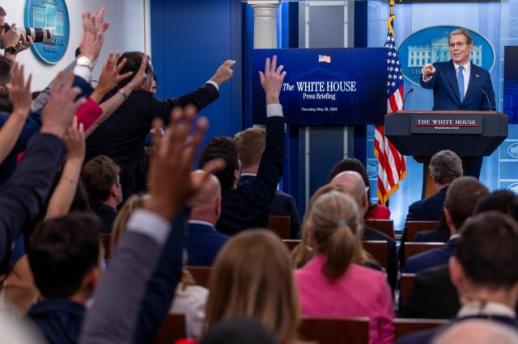 U.S. and Iran are "within reach" of a deal, news that may uplift Asian markets SEOUL, May 29 (AJP) -The United States and Iran are “within reach” of an agreement to end the three-month war that has rattled global energy markets, and the prospect of a reopening of the Strait of Hormuz may help lift Asian stocks Friday after a broad retreat the previous session. U.S. Treasury Secretary Scott Bessent said Washington and Tehran “perhaps have the makings of a deal,” with negotiations centering on a 60-day framework that would gradually unwind blockades in the Strait of Hormuz, reopen one of the world’s most critical oil chokepoints and set the stage for broader nuclear negotiations. Asian markets had pulled back Thursday amid renewed military exchanges between the two sides and uncertainty over whether President Donald Trump would approve the framework. But investors are expected to welcome any sign that Gulf energy flows may stabilize after nearly three months of disruption. The prospect of easing oil prices and lower geopolitical risk helped Wall Street benchmarks return to record highs overnight, led again by AI and technology shares. That may lift the market sentiment in Seoul, dampened by rate hike signal from the central bank. In addition, Nvidia CEO Jensen Huang is expected to visit South Korea next week after attending GTC Taipei 2026, sparking expectations of another round of high-level talks with Samsung Electronics, SK hynix and major Korean conglomerates over high-bandwidth memory (HBM), AI accelerators, foundry cooperation and physical AI ecosystems. The visit comes at a critical moment for Korea’s semiconductor sector as Nvidia’s AI dominance increasingly shapes the fortunes of Asian chipmakers. SK hynix, currently Nvidia’s key HBM supplier, has emerged as one of the biggest beneficiaries of the global AI boom, and chasing closely Samsung Electronics in top market valuation after joining the $1 trillion club earlier this week. Huang is also expected to meet LG Group Chairman Koo Kwang-mo to discuss expanding cooperation in physical AI, cloud infrastructure and robotics, while possible meetings with Samsung Chairman Lee Jae-yong, SK Group Chairman Chey Tae-won and Hyundai Motor Group Chairman Chung Euisun are drawing attention from investors seeking new AI partnerships. The upside from the Gulf remains fragile. Iran and the United States exchanged strikes again this week, including Tehran’s ballistic missile launch toward Kuwait and fresh U.S. attacks on Iranian drone infrastructure. 2026-05-29 07:36:12
 -
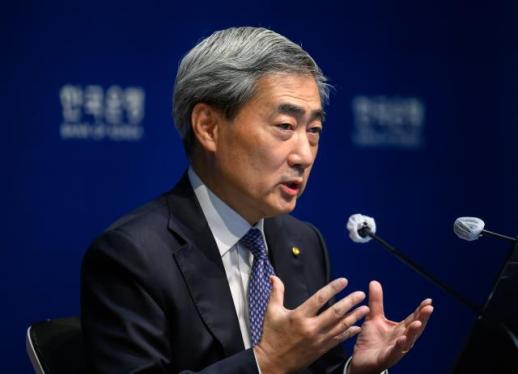 A siren song from the BOK: the leverage party is over SEOUL, May 28 (AJP) -For a full year, the Bank of Korea sat motionless on a 2.50 percent benchmark while the KOSPI staged the most spectacular rally on the planet — up more than 93 percent since year-end, briefly flirting with 8,450 before Wednesday's close. On Thursday, the central bank's new governor finally said out loud what the bond market had been bracing for: the only questions left are when, how fast, and how far rates rise. A plain-spoken siren to the leverage crowd. New governor Shin Hyun-song could hardly have been blunter in his first rate-setting meeting and media briefing. "All the signs — price pressure, the growth trajectory, the exchange rate and the real estate market — point in one clear direction," he said, calling the case "exceptionally clear." A new governor living up to a hawkish reputation on day one is, in itself, a market event. But the substance behind the posture is what should sober up a frenzied retail base. The freshly released six-month dot plot tells the story with unusual candor. Ten of the 21 projected policy-rate dots now cluster at 3.00 percent, seven at 2.75 percent, and two reach 3.25 percent — leaving only two laggards still betting on a hold at 2.50. The board's center of gravity has shifted to two more quarter-point hikes, with a credible tail toward a third. Rewind to February, when 16 of 21 dots saw no change and four saw a cut, and the reversal is nothing short of dramatic. The BOK simultaneously revised up both growth and inflation forecasts, citing stronger-than-expected chip demand, the prolonged Gulf crisis, and an extraordinary terms-of-trade windfall that lifted first-quarter gross domestic income 12.3 percent year on year. Here is the uncomfortable part Shin was unusually willing to name: the boom is feeding on itself. Earnings and stock gains are spilling into wages and bonuses, adding to price pressure — and the rally has been bankrolled, dangerously, on leverage. Margin trading balances stood at 36.7 trillion won, up a startling 34 percent since the start of the year. "The capital losses from highly leveraged, debt-fueled trading are ultimately borne by market participants who do not carry debt," Shin warned. "This behavior distorts the normal economic demand curve." Translated from central-bank diction: the party financed on credit will hand the bill to everyone, and the BOK would rather deflate the foam now than clean up after it bursts. And the data show that bill is already coming due for the most over-extended traders. According to a think tank affiliated with the Korea Financial Investment Association, the forced-liquidation ratio — the share of margin debt that ends up dumped onto the market when investors fail to meet collateral calls — breached its 2 percent warning line on 20 of the 122 trading days between Nov. 22 and May 22. In stable conditions that ratio hovers near 1 percent; that retail investors were force-sold on roughly one of every six sessions is a sign the leverage has turned from accelerant into liability. The damage clustered in March and May, with nine days above the threshold in March and seven in May. The ratio blew through the severe 4 percent level five times, peaking at 7.6 percent on May 20 — when 145.8 billion won of stock was liquidated against 1.64 trillion won in outstanding margin credit — followed by 6.5 percent on March 5, 6.0 percent on May 18, 5.4 percent on May 11 and 4.6 percent on May 19. The deterioration is stark against history. In the six months to November 2024 the ratio topped 2 percent just three times; in the half-year before that it never did, peaking at a mild 1.8 percent. Now the average daily ratio has nearly doubled to 1.45 percent, from a prior 0.6-to-0.8 percent range, while average daily forced liquidations have tripled to 17.33 billion won from 5-to-8 billion won. And those figures capture only brokerage margin credit — they exclude margin loans, stock loans and contracts for difference. Brokerage margin loan balances alone have nearly doubled to about 36 trillion won as of Wednesday from 18.5 trillion a year ago; stock-collateralized loans have climbed to 25.7 trillion won. The true exposure to a forced-selling cascade is almost certainly larger than the headline numbers suggest. The market got the message in real time. Bond prices collapsed — the three-year government yield jumped 5.5 basis points to 3.766 percent and the ten-year rose 4.5 to 4.147 percent, both at roughly 15-year highs not seen since the 2011 eurozone crisis. Equities convulsed: the KOSPI plunged more than 4 percent intraday, briefly breaching the psychologically critical 8,000 line, before clawing back to close at 8,185.29, down just 0.53 percent on bets that a "healthy" hike won't derail the chip story. The KOSDAQ, with thinner semiconductor cover, found no such floor, shedding 2.54 percent to 1,104.36 after diving more than 5.7 percent at its worst. The won slid 5.1 to 1,507.10 per dollar — and Shin made clear he "will not tolerate disorderly herd behavior" there either. That split-screen — bonds breaking, stocks half-recovering on chip faith — is precisely the imbalance worth worrying about. The rally has never been broad. On Wednesday, with the index near a record 8,330, decliners crushed gainers 826 to 75. A market this narrow, this concentrated in Samsung Electronics and SK hynix (whose combined weighting topped 50 percent intraday), is structurally fragile, and the leverage layered on top makes it brittle. And that leverage keeps finding new outlets. Just this week, sixteen single-stock leveraged and inverse ETFs tied to the two chip giants debuted to roughly 10.4 trillion won in first-day turnover, pushing Korea's total ETF market past 500 trillion won for the first time. Investors who watched the chip rally from the sidelines are now chasing it with amplified, FOMO-driven exposure — even as a record 258.65 trillion won sits parked in money market funds and the VKOSPI clings to panic-adjacent territory above 70. That is the psychology of a market simultaneously greedy and terrified: a textbook late-cycle signature. As one Korea Investment & Securities analyst warned, when leverage accumulates this far, "massive volumes of forced liquidations can hit the market with a time lag" — amplifying volatility precisely when investors can least afford it. None of this means the chip thesis is wrong. Samsung and SK hynix posted combined operating profits north of 90 trillion won, and Nomura and others have lifted KOSPI targets toward 10,000 and beyond. But valuation built on real earnings is one thing; a record index propped up by borrowed money and 5-to-6 percent daily swings is another. Shin's hawkish turn is, at bottom, an attempt to normalize asset prices before the foam hardens into a bubble — and bubbles, unlike rallies, do not get to choose how they end. The governor framed the dissent on his board as "strategic — about timing rather than direction." That is the whole point. Direction is no longer in doubt. The dots have moved, the bonds have repriced, and the man holding the gavel has shown his hand on his very first day. For the leveraged longs still dancing to the chip rally's tune, this was the clearest reality check yet: it is simply a matter of time. *The author is the managing editor of AJP. 2026-05-28 18:56:53