
Journalist

Park ki-rock
kirock@ajunews.com
-
 Public Agencies Hired 27,000 in 2025 as Debt Ratio Fell 6.4 Points Public agencies hired about 27,000 new employees last year, a sharp increase, while their debt ratio fell, indicating improved financial health. The Finance and Economy Ministry said Wednesday it disclosed management data for 342 public agencies through the public-sector information system ALIO. New hiring totaled about 27,000, up about 7,000 people, or 34.5%, from a year earlier. The rebound followed two straight years of declines, driven in part by expanded staffing in public health care and a wider rail shift system. Hiring aimed at social equity also improved. Youth hiring reached 6.2% of authorized staffing, hiring of people with disabilities was 4.2% of regular employees, and hiring of talent from relocated regions was 40.8% of the mandatory target, all above legal standards. Financial indicators also improved. Public agencies’ debt rose 27.1 trillion won from a year earlier to 768.6 trillion won, but the debt ratio fell 6.4 percentage points to 174.1% as assets grew faster than liabilities. Assets increased 58.1 trillion won to 1,210.3 trillion won, and net profit rose 5.2 trillion won to 13.3 trillion won. Total authorized staffing stood at 429,000, up about 5,000. Welfare and benefits spending rose 5.6% to 864.8 billion won. Work-family balance indicators improved as well. The number of employees taking parental leave rose 15.6% to 29,379, and male parental leave increased 38.7%. Average pay for heads of public agencies rose 4.5% to 199 million won, while average employee pay increased 3.0% to 74 million won.* This article has been translated by AI. 2026-04-30 15:03:07
 -
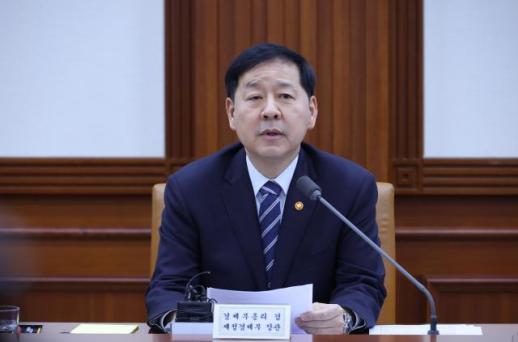 Finance Minister Koo to Extend Fuel-Linked Subsidies 2 Months, Unveil Foreign Worker Roadmap in June Deputy Prime Minister and Finance Minister Koo Yun-cheol said the government will extend fuel price-linked subsidies to ease the burden of high oil prices and will draw up a roadmap by June to overhaul overall foreign labor policy. Chairing an emergency economic meeting and a joint meeting of economy and external economic relations ministers at the Government Complex Seoul on April 30, Koo said, “Following this week’s payment of high oil price damage support funds, we will also extend by two more months through June the fuel price-linked subsidies that are being paid at a temporarily increased rate (50→70%).” The program supports bus, taxi, freight truck and coastal cargo ship operators when diesel and compressed natural gas prices exceed benchmark levels. It covers 70% of the amount above 1,700 won per liter for diesel and 50% of the amount above 1,330 won per cubic meter for CNG. The cap is 183.21 won per liter or cubic meter. Koo said the government will prepare an “integrated support roadmap” for foreign workers by June to revamp policy in line with demographic changes. “We will manage the entire process of employing foreign workers in an integrated way, from recruitment to protection of working conditions and job changes,” he said. On the economy, Koo said March all-industry output rose 0.3%, “once again confirming the solid recovery trend,” but warned that as negotiations over the Middle East war drag on, economic strains are becoming more visible, including weaker consumer sentiment and supply chain effects. The government said it will push ahead with measures to promote “eco-friendly green consumption and tourism” and a “youth New Deal” plan, while also pursuing contingency responses and structural reform tasks. The meeting also reviewed the government’s response to the Middle East war and major labor issues. The government said it will encourage the public sector to serve as a model employer under the revised union law and will continue discussions, centered on the Economic, Social and Labor Council, on structural changes such as AI transition and youth jobs. To boost consumption and tourism during the holiday period, the government said it will expand operations of mass transit such as rail, air and buses, and pursue domestic demand measures including free admission to national cultural facilities and vacation support for workers. * This article has been translated by AI. 2026-04-30 14:52:46
 -
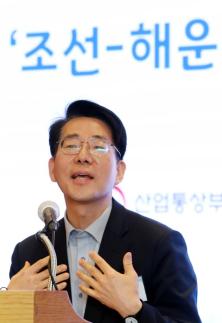 HMM Reaches Labor-Management Deal on Headquarters Move to Busan; Oceans Minister Pledges Support HMM’s labor-management dispute over relocating its headquarters to Busan ended with an agreement, prompting the Ministry of Oceans and Fisheries to pledge full support for the move. Oceans Minister Hwang Jong-woo attended the signing ceremony for the labor-management agreement on HMM’s headquarters relocation, held April 30 at the Kensington Hotel in Seoul’s Yeouido district. HMM and its union had been in talks since the second half of last year but failed to reach a deal, and tensions recently escalated as the union warned of a possible strike. The sides ultimately produced an agreement after weighing concerns that a war in the Middle East could disrupt global logistics. Under the agreement, HMM plans to hold an extraordinary shareholders meeting on May 8 and seek to amend its articles of incorporation to change the company’s registered headquarters location. It also agreed to proceed step by step with related procedures, including relocation registration. “I deeply appreciate the decision by labor and management,” Hwang said, calling the agreement “a symbolic and hopeful message” for developing a maritime hub in the country’s southeast. He added that the ministry “will provide maximum support” to ensure the relocation proceeds smoothly.* This article has been translated by AI. 2026-04-30 14:37:31
 -
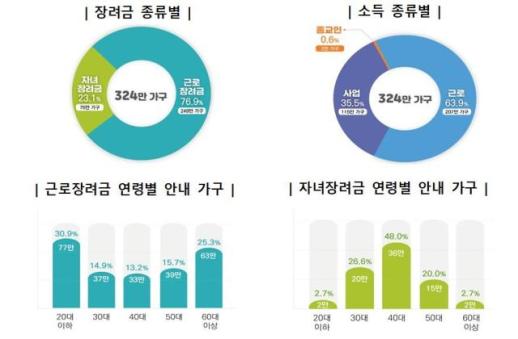 South Korea Tax Agency: Apply for Work, Child Tax Credits by June 1; Up to 3.3 Million Won The National Tax Service said Wednesday it will accept regular applications for 2025 earned income and child tax credits from May 1 through June 1 to support the living stability of low-income households. The agency said 3.24 million households with wage, business or clergy income in 2025 are eligible. It will send guidance in stages via mobile notifications (including government digital assistant alerts, KakaoTalk, Naver and text messages) and by mail. Payments will be made on Aug. 27 after reviews of income and asset requirements, more than a month earlier than the legal deadline at the end of September. Earned income credit amounts vary by household type: up to 1.65 million won for single-person households, 2.85 million won for one-income households, and up to 3.3 million won for dual-income households. The child tax credit pays 500,000 to 1 million won per dependent child under 18. To qualify for the earned income credit, combined spousal income must be below 22 million won for single-person households, 32 million won for one-income households, and 44 million won for dual-income households. For the child tax credit, combined spousal income must be below 70 million won. Total household assets must be below 240 million won as of June 1, 2025, with debts not deducted. If assets are 170 million won or more but below 240 million won, only 50% of the calculated credit will be paid. Recipients of the guidance notice can apply through SonTax using a QR code or mobile link, or through an automated phone service. Older adults and others who have difficulty using mobile devices or PCs can get help through the tax credit call center. Those who did not receive a notice can still apply directly through HomeTax if they meet the requirements, but must submit supporting documents such as income verification. Starting with this regular application period, the automatic application system has been expanded. The NTS said 1.55 million households — 47.8% of the total — that previously agreed to automatic applications will be processed without additional steps. Those who consent during this application period will be able to receive credits for a set period without reapplying. The agency also introduced a mobile electronic braille service so visually impaired users can access guidance materials in braille. Beginning May 1, it will pilot a generative AI chatbot service offering 24-hour consultations. Households that miss the regular deadline can apply through Dec. 1, but will receive only 95% of the calculated amount. Households with only wage income that already completed a semiannual application do not need to file a regular application; additional payments or repayments will be handled through a settlement on June 25. The NTS warned of scams impersonating the credits and asking for fees or bank account passwords. "The National Tax Service never asks for money transfers under any circumstances," it said, urging the public to be vigilant against financial fraud.* This article has been translated by AI. 2026-04-30 12:04:28
 -
 March National Tax Revenue Up 5.5 Trillion Won on Income, Stock Transaction and Corporate Taxes National tax revenue in March rose 5.5 trillion won from a year earlier, led by gains in income tax, stock transaction tax and corporate tax. The Ministry of Economy and Finance said Thursday that March national tax revenue totaled 37.8 trillion won, according to its report on March 2026 collections. By category, income tax posted the largest increase, up 2.2 trillion won. The ministry cited higher wage income tax as performance bonuses expanded, and higher capital gains tax as home transactions increased. Stock transaction tax rose 800 billion won on higher trading value and a tax rate increase. The rural special tax increased 1 trillion won, helped by larger KOSPI trading value, the ministry said. Corporate tax increased 900 billion won on improved corporate results. Value-added tax rose 300 billion won, reflecting increased payments tied to extended filing deadlines. Inheritance and gift tax and the transportation, energy and environment tax each increased 100 billion won, while individual consumption tax and tariffs were roughly unchanged from a year earlier. Cumulative national tax revenue through March totaled 108.8 trillion won, up 15.5 trillion won from the same period last year. The collection progress rate was 26.2%. On a cumulative basis, increases were led by income tax (up 4.7 trillion won), value-added tax (up 4.5 trillion won) and stock transaction tax (up 2 trillion won). Corporate tax was up 900 billion won. * This article has been translated by AI. 2026-04-30 11:03:29
 -
 Budget Office to Roll Out AI Budget Assistant for Government Work in May 2027 The Ministry of Planning and Budget will introduce artificial intelligence across budget work, including budget formulation and spending restructuring. The ministry said it held an “AI Budget Assistant introduction review meeting” chaired by Park Chang-hwan, director general for budget review and coordination, on April 29 to discuss progress and next steps. The AI Budget Assistant is designed to provide tailored information based on extensive fiscal and program data when budget staff enter questions. The ministry plans to begin procurement in early May and start using the system in day-to-day budget work from May next year. To support the rollout, the ministry will adopt a large language model dedicated to budget operations and train it on accumulated materials, including past budget requests, fiscal statistics, program briefing documents and internal review files. Officials expect it to reduce repetitive work such as searching and compiling past records, allowing staff to focus on policy judgments. To secure higher-quality data, the ministry will build an integrated data platform and move to collect documents scattered across personal computers and messaging services. It also plans to convert existing Hangul Word Processor (HWP) files into an AI-trainable format (HWPX) to improve data usability. The government, aiming to become one of the world’s top three AI powers, tripled this year’s AI budget from 3.3 trillion won to 9.9 trillion won. It plans to use the new system to improve both the accuracy of fiscal management and work efficiency. The ministry said it will start procurement in early May and try to move up the introduction schedule as much as possible. “By introducing the AI Budget Assistant as early as possible compared with the original plan, we will maximize both the accuracy of national fiscal management and work efficiency,” Park said. * This article has been translated by AI. 2026-04-30 09:10:33
 -
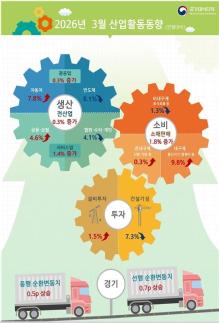 South Korea’s March Output, Spending and Investment Rise Together for First Time in Six Months In March, production, consumer spending and facility investment all rose, marking a “triple increase.” It was the first time the three indicators climbed together since September last year. According to the National Data Agency’s “March 2026 Industrial Activity Trends” released on the 30th, all-industry output rose 0.3% from the previous month, led by gains in services (up 1.4%) and mining and manufacturing (up 0.3%). All-industry output increased 1.2% in December, fell 0.8% in January, rebounded 2.1% in February, and extended the rise in March. Mining and manufacturing output rose 0.3% as increases in autos (up 7.8%) and other transport equipment (up 12.3%) offset a drop in semiconductors (down 8.1%). The agency said the semiconductor decline reflected base effects after a 28.2% surge the previous month, while overall conditions remained favorable. Services output climbed 1.4%, driven by finance and insurance (up 4.6%) and transportation and warehousing (up 3.9%). Still, the impact of the Middle East war was visible in some industries. Petroleum refining output fell 6.3% from the previous month, and chemicals slipped 0.3%. The agency cited a combination of war-related uncertainty in crude supply and seasonal factors such as scheduled maintenance. Consumption continued to recover. Retail sales rose 1.8% from the previous month, led by higher sales of durable goods such as communications devices and computers, supported by new smartphone launches and stronger back-to-school PC demand. Facility investment increased 1.5% from the previous month on expanded investment in transport equipment, including aircraft purchases. Construction investment remained weak. Construction completed fell 7.3% from the previous month as civil engineering (down 13.7%) and building construction (down 4.5%) both declined. Business-cycle indicators improved. The coincident composite index (cyclical component) rose 0.5 point from the previous month, and the leading composite index (cyclical component) gained 0.7 point. A National Data Agency official said March data appeared to reflect the Middle East war only in a limited way, adding that the impact could become more pronounced after April in related industries and would require further monitoring. For the first quarter, all-industry output rose 1.7% from the previous quarter, supported by gains in mining and manufacturing (up 2.7%) and services (up 1.2%). Consumption and investment also improved: retail sales rose 2.4%, and facility investment jumped 12.6%. Construction completed increased 1.2%, returning to growth. The government said the figures showed a broadly based recovery across production, consumption and investment, consistent with the first-quarter gross domestic product growth rate of 1.7% announced last week. It said the recovery that has continued since the second half of last year was again confirmed in the industrial activity data. The government added that despite the external shock of the Middle East war, measures to support the domestic recovery and invigorate capital markets, along with a price cap system, helped limit the impact. It said it would step up efforts to sustain the recovery by minimizing the war’s economic spillover effects. It also said it would swiftly execute supplementary budget programs, including support payments for damage from high oil prices, and push initiatives such as an “eco-friendly green consumption and tourism boost” and a “youth New Deal implementation plan,” while preparing additional measures, including an economic growth strategy for the second half of the year. 2026-04-30 08:37:46
 -
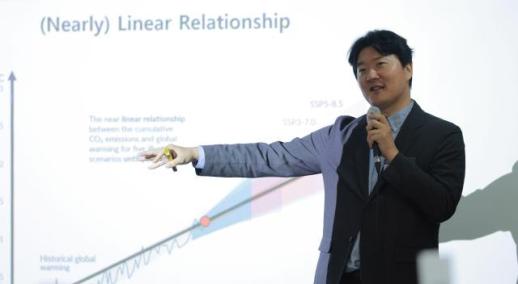 Energy Forum: Middle East shock puts energy security in focus; Korea urged to redesign grid and energy mix Energy supply-chain shocks triggered by war in the Middle East are rattling the global economy and elevating energy security as a key factor in national resilience. Disruptions in crude oil supply and sharp price increases have rippled through inflation, interest rates and exchange rates, quickly affecting household budgets and corporate operations. South Korea, which relies on imports for most of its energy, is among the countries most exposed to external shocks, analysts say. Experts warn the current turmoil is not a temporary price swing but a turning point in which supply-chain instability becomes structural, meaning similar shocks could recur whenever geopolitical tensions flare. That has renewed calls to treat energy security as a top-tier economic strategy and to diversify supply while reshaping the power-generation structure through an “energy mix” that balances renewables, nuclear power and other sources to spread risk and maintain stable supply during crises. At the “2026 Aju Economic Daily 2nd Energy Forum,” hosted by Aju Economic Daily on Tuesday at the Korea Press Center in central Seoul, Kim Hyeong-jun, a chair professor at KAIST’s Moon Soul Graduate School of Future Strategy and Department of AI Futures Studies, said climate change is “not simply an environmental issue but a complex system problem involving energy, water and the economy.” He added, “If we do not change the energy structure, the damage will grow.” Kim said the economic gap widens sharply between limiting temperature rise to within 1.5 degrees Celsius above preindustrial levels and allowing warming to intensify without action. If warming is left unchecked, he said, global damage could reach about $2,300 trillion (about 300 quadrillion won) by 2100, but managing warming at about 1.5 degrees could cut the damage roughly in half. “An era is coming when carbon emissions will be tracked beyond the national level to the corporate level,” Kim said, adding that “a structure is forming in which the cost burden grows if emissions are not reduced.” In the second keynote, Kwak Eun-seop, head of grid planning at Korea Electric Power Corp., said the spread of artificial intelligence is driving a surge in data-center electricity demand, making grid expansion an urgent task. Citing the International Energy Agency, Kwak said global electricity demand is projected to rise from 28,200 terawatt-hours last year to 33,600 TWh by 2030 as the AI industry grows. Over the same period, power consumption by AI data centers is expected to roughly triple. However, shortages in transmission lines, transformers and grid connections are emerging as major bottlenecks, he said. In Texas, he noted, applications waiting for data-center grid connections exceed 150 gigawatts — more than one-fifth of total U.S. peak load — underscoring the strain facing major economies. South Korea faces similar pressures, Kwak said. With the expansion of semiconductors and AI, peak power demand is projected to rise about 28% by 2038, requiring an estimated additional 2.2 gigawatts of supply each year. Demand is concentrated in the Seoul metropolitan area while generation facilities are spread across other regions, worsening regional imbalances. “Building transmission networks typically takes more than 10 years, while new demand such as data centers can surge within two to three years, making mismatches more likely,” Kwak said. He urged parallel mid- to long-term steps, including grid expansion, greater capacity to integrate renewable energy, adoption of virtual power lines (VPL), and development of a more distributed power system. 2026-04-29 16:16:36
 -
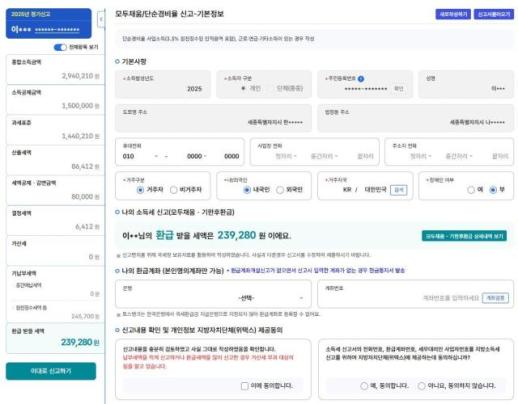 South Korea Tax Agency: 13.33 Million Must File May Income Tax Returns; 2.65 Million Get Automatic Extension The National Tax Service said Tuesday that May is the month to file and pay comprehensive income tax and local income tax, and that individuals with comprehensive income in 2025 must report and pay by May 1. The agency said 13.33 million people are required to file this year. Since April 25, it has been sending filing notices by mobile message, including KakaoTalk, Naver electronic documents and text messages. The filing period runs from May 1 to June 1. Taxpayers subject to the “faithful filing confirmation” requirement must file and pay by June 30. Those who receive mobile notices can file immediately through SonTax or the automated phone system, and Hometax will provide a personalized filing screen after login. The tax agency said it improved convenience by revamping Hometax and SonTax and simplifying the automated phone system. Taxpayers who receive auto-fill notices can complete filing using the “file as is” function, and the phone system will automatically enter contact information and refund account details. The auto-fill service has been expanded to 7.17 million people. Of those, 4.6 million eligible for refunds can receive payments starting June 5 — 25 days earlier than the statutory deadline — if they submit the notice without changes. The agency said it will, for the first time, provide taxpayer-specific tax-saving benefits and reference materials related to tax audits to improve filing accuracy. It also said it will automatically extend the payment deadline to Aug. 31, without a separate application, for 2.65 million small taxpayers, including those in oil price-sensitive industries facing difficulties due to weak domestic demand and high oil prices and interest rates. Returns, however, must still be filed by June 1. When filing comprehensive income tax, taxpayers can also file local income tax in one step, as Hometax automatically links to Wetax. A customized tax guidance service will also be available through the government’s “National Secretary” notification system. * This article has been translated by AI. 2026-04-29 12:07:19
 -
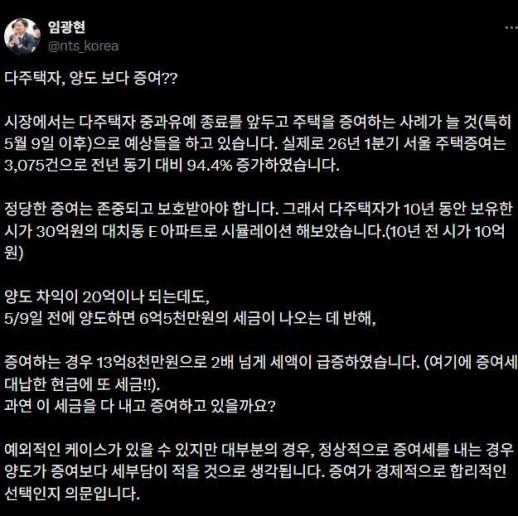 NTS chief warns multi-homeowners gift tax can top capital gains tax as surcharge break ends Lim Gwang-hyeon, commissioner of South Korea’s National Tax Service, warned multi-homeowners not to rush into gifting homes ahead of the end of a temporary suspension of heavier capital gains taxes, saying the tax burden is often higher for gifts than for sales. In posts on X (formerly Twitter) and Facebook on Tuesday, Lim said the market expects more home gifts before the suspension ends, but “when you calculate the actual tax burden, gifting is often more disadvantageous.” He added that people should not consider “schemes” aimed at avoiding taxes. Home gifts in Seoul totaled 3,075 cases in the first quarter of this year, up 94.4% from a year earlier. Lim cited a simulation: For an apartment in Seoul’s Daechi-dong with a market price of 3 billion won that has been held for 10 years and was bought for 1 billion won, a sale before May 9 would generate about 650 million won in taxes. A gift, he said, would result in about 1.38 billion won in taxes — more than double. He also cautioned that if someone else pays the gift tax on the recipient’s behalf, additional taxation may apply. Assuming taxes are paid properly, he said, taxpayers should consider whether gifting is economically reasonable. Lim warned against improper gifting practices, including gifting a home with a loan and then having parents repay it, or undervaluing a property below market price. Such actions could amount to tax evasion, he said, adding that the NTS plans to conduct a full review. In those cases, he said, penalties of up to 40% could be imposed on top of the original tax due. “Tax justice is a very important value,” Lim said, adding that the agency will provide guidance and consultations so taxpayers can make reasonable decisions before the suspension ends. * This article has been translated by AI. 2026-04-29 09:15:18