


Latest by
-
 Park Ji-won: Song Young-gil Discusses Unification with Kim Min-seok Park Ji-won, a member of the Democratic Party of Korea, stated on June 24 that "former party leader Song Young-gil conveyed during a dinner with President Lee Jae-myung that he is considering unification with Prime Minister Kim Min-seok regarding the upcoming August 17 party convention, which could lead to a consolidation of votes in a runoff election." During an appearance on CBS Radio's "Park Seong-tae's News Show," Park mentioned, "I spoke with former leader Song yesterday," adding that he heard President Lee responded positively, encouraging him to do well. Song reportedly had a private dinner with President Lee at the presidential residence in Hannam-dong last week. Park further explained, "Song indicated that he would also run if Jung Cheong-rae decides to enter the race, and if unification occurs in a three-way contest, it is conceivable that Song could be elected. The outcome of a three-way race is uncertain." Meanwhile, Jung Cheong-rae announced his resignation during a Supreme Council meeting held earlier that morning. The Democratic Party has transitioned to a leadership structure led by acting floor leader Han Byeong-do. In expressing his resignation, Jung stated, "I am a political partner of President Lee Jae-myung," emphasizing his role as the chair of the Legal Affairs Committee during the December 3 emergency martial law, which led to the impeachment of former President Yoon Suk-yeol. His appeal for support at the party convention is interpreted as leveraging his connections with President Lee, who was the party leader at that time.* This article has been translated by AI. 2026-06-24 12:48:00
 -
 Number of Holding Companies Decreases to 173, Venture Investments Decline The number of holding companies decreased by four last year, totaling 173, according to the Fair Trade Commission. Additionally, venture investments by corporate venture capital (CVC) firms associated with general holding companies fell to 193.9 billion won, a decline compared to the previous year.On June 24, the Fair Trade Commission released data on the status of holding companies and CVCs under the 'Monopoly Regulation and Fair Trade Act.'As of the end of December last year, the number of holding companies stood at 173, down from 177 the previous year. However, the overall trend shows an increase in the number of holding companies, with figures of 164 in 2020, 168 in 2021, 174 in 2023, and 177 in 2024.Among the publicly disclosed business groups, the number of groups with holding companies rose by one to 51, compared to 50 the previous year. A conversion group is defined as a business group where the total assets of the holding company and its subsidiaries exceed half of the total assets of the entire group.Specifically, Daemyung Chemical, Kolmar Korea, Orion, and Heesung were designated as large business groups with holding companies. Samsung Biologics' biosimilar division was spun off to establish a new holding company, Samsung Epise Holdings. Conversely, Shinsegae's holding company, Emerald SPV, was merged into E-Mart and ceased to exist, while Forever was excluded from the large business group.As of the end of last year, the average total assets of holding companies reached 31.754 trillion won, an increase of 1.589 trillion won from the previous year's 30.675 trillion won. The average debt ratio decreased by 4.4 percentage points to 39.3%, down from 43.7% the previous year.The total number of subsidiaries under all holding companies was 2,357, indicating an average of 13.9 subsidiaries per holding company. The average ownership stakes in subsidiaries and their subsidiaries were 73.7% (42.0% for listed companies and 87.0% for unlisted) and 84.5% (46.1% for listed and 86.8% for unlisted), respectively.The Fair Trade Commission also disclosed the status of CVCs under general holding companies. Last year, the number of CVCs decreased by one to 13, down from 14 the previous year, largely due to Doosan's exclusion from the holding company structure. Among the 13 CVCs, 10 (76.9%) were newly established since the introduction of the CVC system.The 13 CVCs managed a total of 85 investment funds, an increase of 15 from the previous year. The committed amount for these funds reached 394.5 billion won, up 61.5 billion won from 333 billion won the previous year. The average committed amount for the 15 newly established funds was 26.3 billion won, which is 64.4% higher than the average of 16 billion won for funds established by South Korean venture capital firms.In terms of investment activity, the 13 CVCs executed 151 venture investments totaling 193.9 billion won. While this represents a decrease from 245.1 billion won the previous year, it is an increase compared to 176.4 billion won in 2023. The Fair Trade Commission views venture investments through CVCs as steady.The distribution of investment by the age of target companies shows an increasing focus on early-stage and mid-sized companies. Investment in early-stage companies remained at 27.1 billion won, but their share of total investments rose to 14.0%, up from 11.1% the previous year. Investment in mid-sized companies totaled 77.7 billion won, accounting for 40.1%, which is an increase of 22 billion won and 9.3 percentage points from the previous year.A Fair Trade Commission official stated, "In the second half of this year, we will disclose the ownership and investment structures of large business groups and their internal transaction statuses to encourage voluntary improvements in their behaviors. We plan to develop a 'business group soundness evaluation index' that will provide a comprehensive view of the soundness of ownership, governance, and transaction structures, ensuring that more substantial information is supplied to the market and stakeholders."Meanwhile, there are expectations that the presence of CVCs will grow as the Yoon Suk Yeol administration focuses on revitalizing productive finance. The Fair Trade Commission previously announced in November that it would improve the CVC system for general holding companies to promote venture investments.* This article has been translated by AI. 2026-06-24 12:48:00
 -
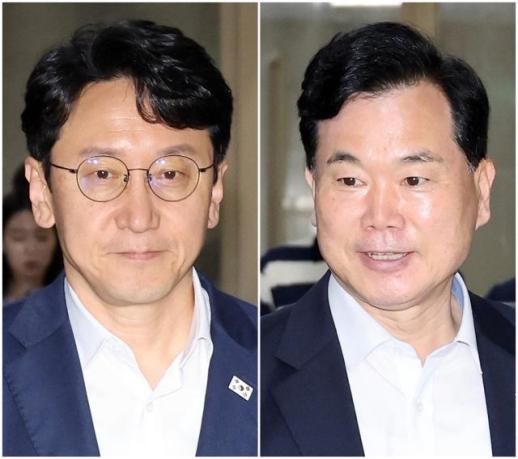 Negotiations Fail to Yield Results Ahead of Deadline for Committee Member Submissions On June 24, ahead of the deadline set by National Assembly Speaker Cho Jung-sik for submitting the list of standing committee members, the Democratic Party and the People Power Party held a meeting but ended without any progress. Both parties plan to continue negotiations for the formation of the National Assembly even if they miss the deadline. Cheon Jun-ho, Deputy Floor Leader of the Democratic Party, and Kim Seung-soo, Deputy Floor Leader of the People Power Party, met at the National Assembly on the morning of June 24 to discuss the formation negotiations. However, the talks broke down after about ten minutes due to unresolved differences over the chairmanship of the Judiciary Committee. Cheon stated, "According to the National Assembly Act, there is a basic legal deadline for the formation of the second half of the National Assembly, which was set for May 29. It has been quite some time, and the fact that we have not reached an agreement means that the National Assembly is effectively paralyzed." He added, "The Democratic Party plans to submit the list of standing committee members by noon today, as suggested by the Speaker. We have requested the People Power Party to submit their list as well. It is important to take steps forward, so I believe we can submit the lists and continue discussions afterward." However, Kim responded, "In reality, the negotiations for the formation have only been ongoing for about a week. Given that there has been no progress on the Judiciary Committee, the Speaker's request to submit the list by a set deadline feels like pressure." He continued, "The People Power Party also wants the formation negotiations to conclude quickly, but it is difficult to submit the list of standing committee members without any agreement on the Judiciary Committee. We plan to meet later in the afternoon to advance the discussions." Meanwhile, Speaker Cho urged the leadership of both parties on June 22 to submit the list of standing committee members by noon on June 24 for the formation of the National Assembly.* This article has been translated by AI. 2026-06-24 12:48:00
 -
 South Korea Plans Agricultural and Rural Vision for 2045 by Year-End The South Korean government is set to develop a vision for agriculture and rural areas by 2045 by the end of this year.On June 23, the Ministry of Agriculture, Food and Rural Affairs held a kickoff meeting for the 'Agriculture and Rural 2045 Strategy' at the Government Sejong Center.The meeting aimed to assess the impact of major agricultural policy changes since the end of Japanese colonial rule, as well as megatrends such as climate change and agricultural markets on the nation’s agriculture and rural sectors.During the meeting, the ministry announced plans to present a future vision for agriculture and rural areas by year-end and to specify key tasks that will serve as a basis for setting medium- to long-term policy directions.To achieve this, a task force (TF) will be established, led by Vice Minister Kim Jong-gu. The TF will consist of three teams focusing on macro agriculture, agricultural innovation, and rural environment, with participation from relevant departments and the Korea Rural Economic Institute (KREI). Additionally, a separate 'Future Communication Team' composed of private experts, organizations, and industry representatives will be formed to gather input.The 2045 strategy is expected to reflect key national policy tasks in the agriculture and rural sectors under the administration of President Lee Jae-myung. These tasks include fostering agriculture as a national strategic industry responsible for food security, transitioning agricultural policy to strengthen national responsibility, leading balanced growth and energy transition in rural areas, and creating a society where people and animals coexist happily.Vice Minister Kim stated, "The establishment of the 'Agriculture and Rural 2045 Strategy' aims to reflect on the journey of our agriculture and rural areas since liberation and prepare for the next 20 years. We will present a new blueprint that encompasses the vision and execution direction of future agricultural policies, leading to sustainable changes in rural areas in collaboration with the public."* This article has been translated by AI. 2026-06-24 12:12:00
 -
 Government Seeks Public Ideas to Reduce Daily Plastic Waste of 21,000 Tons 국내에서 하루 평균 2만1000여t의 플라스틱이 버려지는 가운데 정부가 불필요한 플라스틱 사용을 줄이고 재활용률을 높이기 위한 국민 아이디어 발굴에 나선다. 기후에너지환경부는 오는 25일부터 국민생각함을 통해 '불필요한 플라스틱 및 재활용 걸림돌 개선 아이디어 공모'를 상시 접수한다고 24일 밝혔다. 이번 공모는 생활 속 제품과 포장재에서 발견되는 과도한 플라스틱 사용 사례와 재활용을 어렵게 하는 요소를 발굴해 실제 정책에 반영하기 위해 마련됐다. 공모는 불필요한 플라스틱 사용을 줄이거나 종이·목재 등 다른 소재로 대체하는 방안과 분리배출 및 재활용을 방해하는 요소를 개선하는 방안 등 두 분야로 진행된다. 정부에 따르면 국내에서 배출되는 플라스틱은 포장재와 생활용품 비중이 큰 것으로 나타났다. 플라스틱은 적절히 회수되지 않을 경우 미세플라스틱 문제를 유발하고 소각·매립 과정에서 온실가스를 배출하는 등 환경 부담을 키우는 요인으로 지목된다. 최근 자원안보와 공급망 안정성의 중요성이 커지면서 플라스틱 사용량 감축과 재활용 확대는 환경정책을 넘어 경제·산업 측면의 과제로도 주목받고 있다. 순환경제 체계 구축을 위해서는 국민이 일상에서 느끼는 불편과 개선 의견을 정책에 반영하는 과정이 중요하다는 지적도 나온다. 접수된 아이디어는 전문가 심사를 거쳐 선정되며, 산업계 협의를 통해 포장재 재질·구조 평가제도와 순환이용성 평가제도 등에 반영될 예정이다. 정부는 반기별로 우수 아이디어 9건을 선정해 포상하고, 실제 제도 개선으로 이어질 수 있도록 후속 검토도 추진할 계획이다. 김고응 기후부 자원순환국장은 "국민들이 일상에서 느낀 불편과 개선 아이디어가 실제 정책으로 이어질 수 있도록 적극 검토하겠다"고 말했다.* This article has been translated by AI. 2026-06-24 12:08:00
 -
 Measures to Prevent Fraud in Used Goods Transactions: Restrictions on Savings Accounts The Financial Supervisory Service (FSS) is tightening regulations on savings accounts that can be exploited for online fraud in used goods transactions. On June 24, the FSS announced improvements to the savings account system at banks and small financial institutions to protect consumers from online transaction scams. This move comes in response to a rise in fraudulent activities where scammers exploit the ability to open multiple savings accounts quickly and remotely. Currently, individuals can open only one demand deposit account across all financial institutions within 20 business days, but there are no limits on the number of savings accounts. This loophole has allowed fraudsters to post fake sales listings on online marketplaces, receive payments into multiple savings accounts, and then withdraw cash by prematurely closing those accounts. In one case, a scammer opened 32 savings accounts within three days and defrauded 126 victims of approximately 1.2 billion won (about $1 million). Another fraudster created 13 accounts in two days, swindling 80 victims out of around 700 million won (about $530,000). As a result, the FSS will now limit individuals to a maximum of three savings accounts per financial institution per quarter. This limit includes accounts that are closed early. Consumers wishing to open additional accounts will need to visit a branch in person. The account cancellation process will also be strengthened. If a savings account is closed within three business days of opening, customers will be required to visit a branch to complete the cancellation instead of doing it online. However, to minimize inconvenience for consumers, products with a monthly contribution limit of 1 million won or those that allow contributions only from the account holder's existing accounts will still be freely opened and closed as before. According to the FSS, 87.2% of savings accounts in the banking sector and 85.3% in the small financial sector fall under this category. The FSS plans to enhance internal controls for anti-money laundering in banks and savings banks to ensure that customer verification and suspicious transaction reporting are strengthened if savings accounts are suspected of being misused for fraud. Financial institutions are expected to implement these measures by the third quarter of this year after updating their operational procedures and systems.* This article has been translated by AI. 2026-06-24 12:08:00
 -
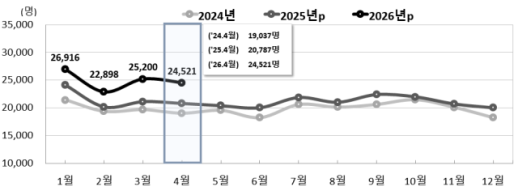 Birth Rate Increases for 22 Consecutive Months, But Natural Population Decline Continues with Total Fertility Rate at 0.93 The number of births has been on the rise for nearly two years, yet the total fertility rate remains in the 0.9 range, indicating a continued natural population decline, according to the National Data Agency's "April 2026 Population Trends" report released on June 24. In April 2026, the number of births increased by 3,734, or 18.0%, compared to the same month last year, totaling 24,521. This marks the 22nd consecutive month of rising birth rates since July 2024. The total fertility rate, which represents the average number of children a woman is expected to have in her lifetime, rose to 0.93, an increase of 0.13 from the previous year. Births increased across all regions for three consecutive months. The composition of births by order showed that the percentage of first and second children increased by 0.3 percentage points each compared to last year, while the share of third children and beyond decreased by 0.7 percentage points. In April, the number of deaths was recorded at 28,405, a decrease of 386, or 1.3%, from April of the previous year. While deaths increased in four regions, including Busan and Incheon, they decreased in 12 regions, including Seoul and Daegu, with Gyeongnam remaining stable. The overall population, after accounting for deaths, saw a natural decline of 3,884. This marks the 78th consecutive month of natural population decline since November 2019. During this period, the number of marriages increased by 1,703, or 9.0%, to 20,622 compared to the same month last year. In the same month, divorces totaled 7,829, an increase of 531, or 7.3%. Last month, the number of movers was 466,000, a decrease of 7,000, or 1.5%, from the previous year. Among the total movers, 65.0% relocated within the same region, while 35.0% moved between regions. The population mobility rate, which indicates the number of movers per 100 people, was 10.8%, down 0.2 percentage points from May of last year. Net migration varied by region, with Gyeonggi (2,433), Chungnam (1,284), and Incheon (1,237) experiencing net inflows, while Seoul (-4,221), Gyeongbuk (-663), and Ulsan (-646) faced net outflows.* This article has been translated by AI. 2026-06-24 12:08:00
 -
 Ministry of Gender Equality and Police Agency Launch Joint Task Force to Combat Violence Against Women The Ministry of Gender Equality announced on June 24 that it will establish a policy task force with the Police Agency to strengthen responses to violence against women, including stalking and dating violence. The first meeting will take place on June 25 at the Government Seoul Building. Previously, the Ministry and the Police Agency had engaged in discussions on a case-by-case basis as needed. However, due to the increasing instances of stalking and dating violence leading to serious crimes such as murder, and the evolving nature of violence against women, they decided to implement a regular policy task force for more proactive and systematic responses. Earlier, Minister of Gender Equality Won Min-kyung stated during a press briefing on June 11 at the Government Seoul Building that they are working with the Ministry of Justice, the Supreme Prosecutors' Office, and the Police Agency to enhance the response and protection system for victims of stalking crimes. The policy task force will hold biannual meetings chaired by the Vice Minister and quarterly practical meetings at the director level, with additional meetings convened as necessary in response to significant incidents. Previously, discussions were held with police personnel each time an incident occurred. Now, the goal is to establish a continuous cooperation system to share information and respond more effectively. The first meeting, chaired by Vice Minister Jeong Gu-chang, will focus on strengthening cooperation in the overall response system to violence against women, including stalking and dating violence, with participation from both agencies at the director level. Key agenda items will include: enhancing protective measures for victims, promoting awareness of high-risk indicators for stalking and dating violence (red flags), strengthening on-site capabilities reflecting the characteristics of intimate partner violence, and improving support for victims of prostitution and human trafficking. Vice Minister Jeong stated, "Close cooperation among related agencies is essential to effectively respond to violence against women, such as stalking and dating violence. Through this policy task force, the Ministry of Gender Equality and the Police Agency will continuously review and strengthen victim protection and support, as well as on-site response measures, to create a social safety net that assures the public."* This article has been translated by AI. 2026-06-24 12:08:00
 -
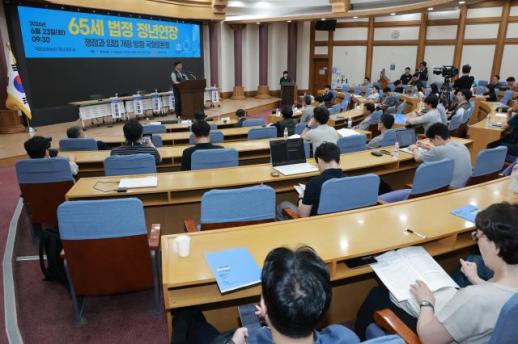 Eight in Ten Companies Selectively Rehire Older Workers Amid Concerns Over Age Limit Extension Among companies rehiring older workers, 80% are adopting a selective rehiring approach based on job performance and other evaluations. Additionally, more than half of these companies predict that extending the legal retirement age to 65 will necessitate adjustments such as changes to wage structures or reductions in new hiring. On June 24, the Korea Employers Federation released the results of a survey conducted among 500 companies with more than 30 employees that operate a post-retirement rehiring system. The survey found that 80.4% of responding companies utilize a selective rehiring method that considers the necessary workforce size and candidate qualifications, while only 19.6% indicated they would rehire all interested individuals. The most critical factor in selecting candidates for rehiring is job performance and work results, cited by 59.5% of respondents. Other important considerations include the rarity of skills and knowledge transfer needs (44.8%) and the physical and mental health status relevant to job performance (43.8%). Regarding wages for rehired workers, 59.0% of companies reported that pay remains the same as before retirement. Conversely, 34.2% indicated that wages would decrease, with larger companies more likely to report reduced pay levels. The average wage reduction reported was 20.6%. Companies identified the potential for legal disputes during the rehiring process as their greatest concern. The highest percentage, 47.1%, cited legal risks associated with adjusting wages and working conditions, while 39.2% expressed worries about disputes during contract termination and re-signing. If the legal retirement age is uniformly extended to 65, 52.4% of responding companies believe additional institutional responses will be necessary. The most common response anticipated is the restructuring of wage systems (34.4%), followed by reductions in new hiring and the scaling back or elimination of rehiring programs, as well as voluntary retirement options. Lee Sang-cheol, head of the Employment and Social Policy Department at the Korea Employers Federation, stated, "In an ultra-aging society, it is necessary to shift the labor market paradigm to utilize workers based on job roles and productivity rather than age." Meanwhile, at a forum hosted by the Korean Confederation of Trade Unions and the Korean Federation of Trade Unions on June 23, a proposal was made to gradually extend the retirement age from 2028 to 2032, ensuring that those born in 1972 and later would have a guaranteed retirement age of 65.* This article has been translated by AI. 2026-06-24 12:04:00
 -
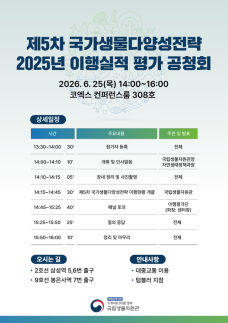 Government Evaluates Implementation of Biodiversity Policy with 365 Projects The government is taking steps to enhance the effectiveness of its biodiversity conservation policies by reviewing the implementation status of the National Biodiversity Strategy. The National Biodiversity Institute announced on June 24 that it will hold a public hearing on June 25 at the COEX Conference Hall in Gangnam, Seoul, to discuss the achievements from the past year and future tasks related to the '5th National Biodiversity Strategy (2024-2028).' This public hearing is being organized in response to the international community's shift to a common indicator system for evaluating biodiversity policy outcomes following the adoption of the Kunming-Montreal Global Biodiversity Framework (GBF). South Korea has been implementing the 5th National Biodiversity Strategy since last year, which is set to run until 2028. This year marks the second year of the strategy's implementation, and the review of the first year's results will take place. The National Biodiversity Strategy serves as the country's top-level plan for biodiversity conservation and sustainable use. As the international monitoring system strengthens, the importance of systematic evaluation and monitoring domestically is also increasing. During the public hearing, the implementation status of 365 projects being carried out by 13 relevant ministries, including the Ministry of Climate, Energy and Environment, will be shared along with the results of the second-year evaluation. Notably, this year's evaluation will not only include a self-assessment by the government but also involve a cross-verification process by a 41-member evaluation team composed of representatives from central and local governments, civil society, youth representatives, and experts involved in the strategy's formulation, enhancing objectivity and reliability. Biodiversity conservation is recognized as a key task for responding to the climate crisis and ensuring ecosystem resilience. The government plans to incorporate feedback from the public hearing to improve the implementation system of the National Biodiversity Strategy and enhance the effectiveness of policy initiatives. The discussions and evaluation results from the public hearing will be reflected in the 2025 implementation report, which is scheduled for publication in December of this year. Yoo Ho, Director of the National Biodiversity Institute, stated, "Restoring biodiversity is a task that requires participation not only from the government but also from local governments, civil society, and future generations. Through this public hearing, we aim to strengthen a practical implementation system that expands participation across society."* This article has been translated by AI. 2026-06-24 12:04:00