
Journalist

AJP
-
 Eileen Gu Wins Big Air Silver for Fifth Career Olympic Medal Eileen Gu of China, one of the biggest stars heading into the 2026 Milan-Cortina Winter Olympics, added a milestone even without gold: She became the first woman in freestyle skiing to win five career Olympic medals. Gu scored 179 points to take silver in the women’s freestyle skiing big air final at Livigno Snow Park in Italy on Feb. 17 (Korean time). Canada’s Megan Oldham won gold with 180.75. “I’m really proud to have won five medals. It feels special,” Gu said afterward. Gu was the inaugural Olympic champion in women’s big air when the event debuted at the 2022 Beijing Games, but she fell short of a second straight title this time. After winning two golds and a silver in Beijing, she has two silvers so far at this Olympics with two of three events completed. Born to an American father and a Chinese mother, Gu competes for China and is known as the highest-earning athlete in the field over the past year. Forbes estimated her annual income at $23 million. The final was delayed by more than an hour because of heavy snow. In the last practice run, Gu hit her head hard enough to break her helmet. “I’m glad the competition was delayed. I had time to calm down while icing my head,” she said. “If it hadn’t been postponed, I don’t think I would have gotten this kind of result.” With the silver, Gu now has two golds and three silvers in her Olympic career. That ties Canada’s Mikael Kingsbury for the most Olympic medals in freestyle skiing and gives Gu the outright women’s record. Gu will compete in the halfpipe starting Feb. 20, seeking another medal and aiming for a second straight Olympic title in that event after Beijing.* This article has been translated by AI. 2026-02-18 00:54:00
 -
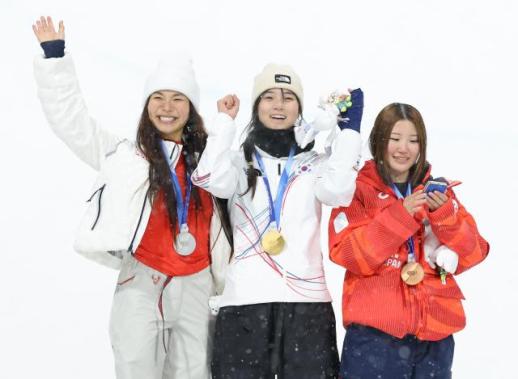 NBC Ranks Choi Ga-on’s Comeback Halfpipe Gold Over Chloe Kim Among Top Milan Highlights Choi Ga-on’s comeback win in the women’s snowboard halfpipe at the 2026 Milan-Cortina Winter Olympics was named one of NBC’s top 10 moments from the first half of the Games. On Feb. 17 (local time), NBC, the U.S. Olympic rights holder, posted its “top 10 moments” list covering the first 10 days after the opening of the Olympics. Choi’s gold medal was ranked No. 8. In an article headlined, “Choi Ga-on beats Chloe Kim (USA) to win halfpipe gold,” NBC wrote that Kim “seemed certain” to complete a three-peat in Milan-Cortina, but said the only athlete who could stop her was South Korea’s 17-year-old newcomer, Choi. NBC added that it was “like a student beating the teacher,” and said it was striking to see Choi and Kim celebrating together. NBC’s top pick was the 18-month-old baby of Swiss mixed doubles curling players Briar Schwaller and Yannick Schwaller, who drew attention by mimicking curling while the parents competed. NBC ranked, from No. 2 to No. 7, American alpine skier Breezy Johnson’s women’s downhill title; Norway’s Johannes Klaebo setting a record with nine career individual Winter Olympic gold medals; Lucas Pinheiro Braathen winning Brazil’s first Winter Olympic gold (alpine skiing); Kazakhstan’s Mikhail Shaidorov winning men’s figure skating singles gold; Ilia Malinin’s figure skating team event gold; and U.S. women’s hockey defenseman Laila Edwards. Italian alpine skier Federica Brignone, who won two gold medals on home courses, was No. 9. American cross-country skier Jessie Diggins, who won bronze in her retirement season, was No. 10. Choi’s comeback victory also made The Athletic’s list of the first half’s “seven best moments” a day earlier, drawing international attention.* This article has been translated by AI. 2026-02-17 20:12:00
 -
 Lee Ho-seon Quits Disney+ Variety Show 'Fate War 49' After One Episode Counseling expert and TV personality Lee Ho-seon said she left the Disney+ variety show “Fate War 49” after just one episode. In a post on social media on the 16th, Lee wrote, “No matter what anyone says, I am a Christian for life,” adding that she has done counseling “for a long time, though shorter than that.” She also shared a photo bearing the phrase “jagoejisim,” a term meaning self-reproach. Lee wrote that she is always mindful of “God’s gaze” and prays for the people she counsels. She added that many clients, carrying anxiety, move between fortune-telling shops, religious institutions and counseling sessions, and that she studies the differences between counseling and shamanism. She said she has tried to avoid losing her identity while researching “whether it reads fate or stamps fate,” and how counseling differs from shamanistic practices. Lee said she stepped down after one episode because “only after it started did I realize it wasn’t my path.” She added that she learned she must be more careful about the road ahead and said she would turn back from the path she entered and “live with a clear head.” After her departure, actor Park Ha-seon was brought in as a replacement. Online commenters responded with messages such as, “It takes courage to appear, but it also takes courage to step down,” and “I completely understand how you feel.” “Fate War 49” is a survival show in which 49 fortune tellers test their fate through a series of missions. The cast includes shamans and tarot readers, among other practitioners. The show also features broadcaster Park Na-rae, who has faced allegations of abusing her manager and controversy over an alleged violation of medical law. Park withdrew from all broadcasts after the controversy surfaced in December, but “Fate War 49” was preproduced and has aired her appearances without edits. Producers have said the show’s core is competition among a large cast and that Park appears as one of several panelists, maintaining their stance that there will be no editing. The decision has sparked debate online. 2026-02-17 19:36:00
 -
 Snowboarder Lee Chae-woon reflects after landing historic trick but finishing sixth at Milan Olympics South Korea’s Lee Chae-woon, who finished sixth at the Milan-Cortina Winter Olympics despite landing a world-first trick, shared a measured reaction in a social media post. Lee wrote on his SNS account on Feb. 17 that he had returned to South Korea after “the huge dream stage called the Olympics,” adding, “I thought about a lot of things.” “Even though I landed the world’s first frontside triple 1620, I still don’t know why I got 87.50 points and ended in sixth,” he wrote. “But I don’t want to hold on to regret or lingering feelings.” He said what mattered was that he delivered everything he had. “To the question, ‘Did you really pour out everything you have?’ I can say confidently that I did,” he wrote. Lee added that the pressure was heavy before his third run after falling on his first two. He said he rode with his parents cheering below and fans supporting him regardless of nationality, adding that it would not be an exaggeration to say he “put his life on the line” as he tried to do everything he could. “Now what I can do is break through that wall and make other athletes feel a wall from me,” he wrote, adding that while he believed he had worked hard, he “may have been lacking” against “the wall of the world.” He later added, “I’m not alone,” and said he would repay the support “in a bigger way.” Online commenters responded with messages such as “You worked hard,” “Thank you for a great performance,” and “For us, it was a gold medal.” Lee placed sixth with 87.50 points in the men’s snowboard halfpipe final on Feb. 14 at the 2026 Milan-Cortina d’Ampezzo Winter Olympics, despite landing the world-first trick. Lee, the 2025 Harbin Asian Games slopestyle gold medalist, showed top-level form on the Olympic stage. He is viewed as part of a rising generation in South Korean snowboarding alongside Choi Ga-on, who won gold in women’s snowboard halfpipe at the same Olympics, and Yoo Seung-eun, who took bronze in women’s snowboard big air. Attention is also on whether Lee can rebound at the 2030 Alps Winter Olympics in France. 2026-02-17 19:15:00
 -
 South Korea’s Mini-Car Sales Hit Record Low in 2025, Show Early 2026 Uptick Domestic sales of new mini cars in South Korea fell to about 70,000 units last year, the lowest level on record, data showed. According to Kaizu Data Research Institute on Monday, 74,600 new mini passenger cars were sold domestically last year, down 24.8% from a year earlier. It was the first time in the past 20 years that mini-car sales dropped into the 70,000 range, and the lowest figure since domestic sales by vehicle class began being tallied. Data from the Korea Automobile Manufacturers Association show mini-car sales peaked at 216,221 units in 2012, then slid to 146,722 in 2017. The decline continued to 134,333 in 2018, 121,307 in 2019 and 103,983 in 2020, before falling below 100,000 in 2021 at 98,781. Sales rebounded to 134,294 in 2022 after Hyundai introduced its first mini SUV, the Casper, in September 2021. In 2023, sales totaled 124,080 following the launch of the Ray EV equipped with a lithium iron phosphate, or LFP, battery. But sales fell back below 100,000 starting in 2024 and dropped to a record low last year. Analysts cited factors including a lack of new models and production delays. In South Korea, no new mini-car model has been launched since the Casper in 2021 and the Ray EV in 2023. The discontinuation of the once-popular Chevrolet Spark and a stronger consumer preference for SUVs as camping and other leisure activities spread also weighed on demand. Still, sales are trending higher this year as high interest rates and inflation, along with rising vehicle prices, push more buyers toward smaller cars. Mini-car sales in January totaled 8,211 units, up 10.9% from the same month a year earlier. With production delays persisting, demand appears to be shifting to the used-car market. Kaizu Data Research Institute said four mini cars were included in its top 10 list for used-car transactions in January. The Kia Morning ranked No. 1 with 3,841 transactions, followed by the Chevrolet Spark (3,149; No. 3), the Kia New Ray (2,877; No. 4) and the Ray (2,044; No. 8). * This article has been translated by AI. 2026-02-17 17:03:00
 -
 Korean President vows to correct housing "fantasy" in Lunar New Year message SEOUL, February 17 (AJP) -South Korean President Lee Jae Myung on Tuesday underscored his core governing goal — to correct what he called the nation’s “housing fantasy” and build a safe and peaceful society grounded in fairness, reason, growth and shared prosperity. In his Lunar New Year message posted on social media platform X, Lee said he never sought political power for personal ambition, but to gain the authority needed to confront structural injustice, widening inequality and speculative excess in the real estate market. “Power is not the goal,” he wrote. “It is the means to do what must be done.” Reflecting on his childhood in poverty, Lee said his lifelong aspiration has been to build a society in which no one is forced to bear unfair burdens or deprived of opportunity. “My wish has always been that no one — my family, my neighbors, or any citizen — would suffer from injustice,” he said. He traced this vision back to his first mayoral campaign in Seongnam two decades ago, arguing that his political career has been guided by a consistent commitment to social equity. After “crossing countless obstacles and moments close to death,” Lee said he has now been given a historic opportunity to reshape the country. “Now that I have the chance, how can I remain still?” he wrote. A central theme of the message was housing reform he has been consistently emphasizing. Lee pledged to confront what he described as a deeply rooted speculative culture that treats homes as financial instruments rather than basic necessities. He said dismantling the “housing fantasy” — the belief that property prices will endlessly rise — is essential to restoring economic balance and social mobility. “Real estate must return to its original purpose: a place to live, not a tool for enrichment,” he said.Lee also promised to pursue policies aimed at stabilizing housing prices, expanding affordable supply and curbing market manipulation, while promoting balanced national development. Beyond housing, the president outlined broader goals, including strengthening public safety, narrowing income gaps and fostering sustainable growth. “Overcoming inequality, building a safe and peaceful nation, and creating a fair and rational society — I will devote myself fully, without fear,” he said. He credited public support for enabling his rise to the presidency and pledged to govern with urgency and humility. “Thanks to the people, I have fulfilled my wish,” he wrote. “Now, only determination remains.” Lee concluded with a call for unity and collective responsibility, urging citizens to participate in building a more inclusive society. * This article, published by Aju Business Daily, was translated by AI and edited by AJP. 2026-02-17 16:59:01
 -
 Hyundai, Kia Aim to Top 1 Million Cumulative EV Sales in Europe in First Half Hyundai and Kia are expected to surpass 1 million cumulative electric-vehicle sales in Europe in the first half of this year, as the region accelerates its shift to electrification. The milestone would come about 12 years after the brands launched their first EV in Europe, the Soul, in 2014. According to the European Automobile Manufacturers’ Association, battery-electric vehicle sales in Europe totaled 217,898 in December, up 51% from a year earlier. BEVs took a 22.6% market share in December, edging gasoline cars at 22.5% for the first time on record. While changes in the EU’s mid- to long-term clean-vehicle policies remain a variable, the industry expects the EV slowdown to keep easing. Hyundai and Kia said their cumulative EV sales in Europe from the 2014 launch of the Soul EV through last year reached 915,996 vehicles, putting them within reach of 1 million this year. The two brands sold 135,408 EVs in Europe in 2021, topping 100,000 for the first time. Sales rose to 143,460 in 2022 and 147,457 in 2023. In 2024, sales slipped to 121,705 as major markets such as Germany reduced EV subsidies, but rebounded last year to a record 183,912 on new-model momentum including the Ioniq 9, EV4 and EV5, up more than 50% from a year earlier. Tucson was the best-selling eco-friendly model in Europe last year with 76,101 units, followed by the EV3 (65,202), Kona (64,211), Niro (46,534), Inster (Casper Electric, 26,851) and EV6 (16,218). With Hyundai and Kia averaging about 15,000 EV sales a month in Europe, the companies are likely to reach 1 million cumulative sales in the first half, the automakers said. “As Europe’s shift to electrification accelerates, competition among global auto brands in EVs is intensifying,” a Hyundai-Kia official said. “We will expand our share by launching a wider range of EVs that meet consumer needs.”* This article has been translated by AI. 2026-02-17 16:03:00
 -
 EDITORIAL: Asia's moment written in tears — Japanese skaters' golden triumph When the scores were announced, time seemed to pause. For a brief moment, the arena held its breath. Then came the roar — and then, more quietly, the tears. On the ice of Milan, Riku Miura and Ryuichi Kihara did not celebrate like conquerors. They collapsed into each other’s arms, trembling, overwhelmed, as if the weight of years had suddenly fallen away. Their sobs were not only of joy. They were the release of doubt, of fear, of nights spent wondering whether the summit was truly within reach. It was in those tears that Asia’s golden moment was most clearly written. The Olympics has never been merely a contest of records. It is, at its heart, a festival of spirit — of fairness, perseverance and shared humanity. Yet history has been uneven. In winter sports, in swimming, in athletics, dominance has long belonged to the West, supported by capital, infrastructure and generations of accumulated advantage. Against that backdrop, the ascent of a Japanese pair to the highest step of the podium in figure skating — once considered foreign terrain for Asia — is more than a sporting achievement. It is a shift in the geography of possibility. They rose not by accident, but by resilience. After stumbling in the short program, they returned with calm intensity. Their free skate was not merely technically sound; it was composed, mature, fearless. Every jump carried intention. Every landing spoke of discipline. It was a reminder that victory is rarely decided in moments of brilliance alone, but in the character revealed after failure. In that performance, Asia announced — quietly but firmly — that it no longer stands at the margins. For decades, winter sports were seen as the privilege of cold climates and long traditions. Track and swimming were treated as Western strongholds. But globalization, scientific training and data-driven coaching have begun to loosen old hierarchies. Doors once closed are now ajar. Miura and Kihara did not merely pass through that door. They pushed it wider. Yet celebration is only the beginning. A single gold medal, however luminous, does not make a sporting culture. If Asian youth are to compete with confidence across all disciplines — from football to gymnastics, from ice rinks to swimming pools — societies must think beyond ceremonies and headlines. Sport is not an event. It is an ecosystem. It requires healthy school programs, vibrant local clubs, transparent selection systems and sustained public investment. It demands patience across generations. Medals are outcomes; integrity is the foundation. Without fairness, success corrodes. The Olympic spirit does not glorify victory alone. It honors respect for opponents, acceptance of defeat, and fidelity to rules. Shortcuts, favoritism and obsession with immediate results weaken trust. Sport, like governance, reflects a nation’s moral architecture. Only achievements built on justice endure. Sport also educates the soul. It teaches young people to endure pressure, to subordinate ego to teamwork, to rise after collapse. These virtues travel far beyond stadiums. They become social capital — shaping industries, institutions and civic life. In an age of technological rivalry and economic competition, sport still asks an ancient question: Can you discipline your body, steady your mind, and honor others in the process? Asia’s answer is still being written. Japan’s triumph belongs, in spirit, to the entire region. In Korea, in China, in Southeast Asia, in South Asia, young athletes watched that night and quietly adjusted their dreams. Borders remained, but imagination crossed them. If those dreams are nurtured — with resources, fairness and patience — this gold will not stand alone. It will become a reference point. Opportunity favors the prepared. Sweat shed on school tracks, in neighborhood gyms, on frozen rinks and empty swimming lanes is the real infrastructure of future success. Governments and societies must protect and expand that invisible network. Long-term vision, scientific support and ethical governance must move together. Only then does victory become a pattern, not an exception. The comeback of Miura and Kihara was not an ending. It was an opening chapter. Their tears were not weakness. They were testimony — to effort, vulnerability and faith in process. In them, Asia saw its own reflection: talented, striving, still unfinished. To pursue excellence without arrogance. To compete fiercely without losing grace. To build systems where talent, not privilege, determines destiny. Sport is power — the power to shape bodies, minds and societies. It is time to take that power seriously. 2026-02-17 14:38:07
 -
 A long ride back to Seoul as holiday winds down SEOUL, February 17 (AJP) -Heavy traffic clogged major highways across South Korea on Tuesday as millions of holiday travelers began returning to Seoul as the long Lunar New Year holiday ends on Wednesday. According to the Korea Expressway Corp., travel times to Seoul as of noon had lengthened sharply, with trips from Busan taking up to 10 hours, Ulsan 9 hours and 40 minutes, Daegu 9 hours, Mokpo 9 hours and 20 minutes, Gwangju 8 hours and 50 minutes, and Daejeon 4 hours and 40 minutes. Return trips were running two to three hours longer than estimates made earlier in the morning. Southbound traffic from Seoul was comparatively lighter but still slowed, with travel times of about 7 hours to Busan, 6 hours and 40 minutes to Ulsan, 6 hours to Daegu, 4 hours and 40 minutes to Mokpo, 4 hours and 30 minutes to Gwangju, 3 hours and 10 minutes to Gangneung, and 3 hours and 10 minutes to Daejeon. Major bottlenecks were reported on the Gyeongbu Expressway toward Seoul, including sections near Yangsan Junction, Geumho Junction, Daejeon–Jukam Service Area, Cheongju, and Cheonan–Anseong, where traffic moved at a crawl. Congestion was also seen in the Busan-bound lanes near Singal Junction, Manghyang Service Area, and parts of Daejeon. On the Seohaean Expressway, slowdowns were reported in multiple stretches toward both Seoul and Mokpo, while the Jungbu Naeryuk Expressway also experienced heavy congestion on northbound sections. The expressway operator forecast that about 6.15 million vehicles would be on the roads nationwide on Tuesday, more than 1 million higher than the previous day. An estimated 470,000 vehicles were expected to travel from regional areas to the capital region, while about 440,000 were heading in the opposite direction. Traffic congestion on return routes was projected to peak between 3 p.m. and 4 p.m. and ease gradually from around 3 a.m. to 4 a.m. the following day. Outbound traffic was expected to be heaviest between 1 p.m. and 2 p.m., with conditions improving after 8 p.m. 2026-02-17 14:04:50
 -
 ASIA INSIGHTS: India's AI summit and Asia's quiet inflection point Global leaders and technology executives gathering in New Delhi this week for India’s artificial intelligence summit are not simply attending another diplomatic forum. They are meeting at a moment when the direction of technological change feels unusually consequential. The summit, attended by more than 20 heads of state including Emmanuel Macron and Luiz Inácio Lula da Silva, and hosted by Indian Prime Minister Narendra Modi, reflects how deeply artificial intelligence has entered the domains of economic policy, industrial strategy and national security. Earlier AI gatherings focused primarily on safety and ethics. Those questions remain important. But the conversation has broadened. Manufacturing capacity, supply chains, talent pipelines and regulatory design are now central to the discussion. AI is no longer treated solely as software innovation; increasingly, it is viewed as infrastructure. India’s Strategic Positioning For India, hosting the summit carries symbolic and practical weight. As the world’s most populous country and one of its fastest-growing digital markets, India has sought to position itself as a bridge between advanced economies and the Global South. Its experience building large-scale digital public infrastructure — national identity systems, payment platforms and broadband connectivity — has demonstrated that technology can be deployed at scale and relatively low cost. Now New Delhi is looking to extend that model to AI. By convening executives from Google, Microsoft and OpenAI, India signals its intention to participate not just as a consumer market, but as a contributor to the evolving AI ecosystem. The aim is not to replace existing centers of innovation, but to ensure that the benefits and standards of AI development are shaped more broadly. The next phase of artificial intelligence is likely to extend well beyond chatbots and data analytics. Increasingly, attention is turning to what some describe as “physical AI” — systems embedded in robots, manufacturing equipment, logistics networks, vehicles and medical devices. In this realm, intelligence must interact with materials, sensors and real-world constraints. Software remains crucial. But industrial context matters just as much. Here, countries with deep manufacturing experience may find themselves better positioned than is often assumed. AI-driven factories require not only code, but decades of accumulated process knowledge. Autonomous systems must be trained in real production environments. Industrial robots must integrate seamlessly with supply chains and safety standards. Korea’s industrial development since the 1960s — spanning steel, shipbuilding, automotive production, semiconductors and batteries — has produced more than economic growth. It has generated institutional memory and engineering expertise that are difficult to replicate quickly. These assets may become increasingly valuable as AI moves from the cloud into the factory floor. Korea’s digital infrastructure offers another advantage. Following the 1997 financial crisis, the country invested heavily in nationwide broadband and mobile networks. Today, high-speed connectivity is nearly universal. This provides a practical foundation for deploying AI systems across logistics, mobility and manufacturing. Often summarized as “ppalli-ppalli” culture, Korea’s emphasis on rapid implementation reflects experience navigating industrial transitions under time pressure. In technology cycles that evolve quickly, the ability to align policy, capital and research in short order can be a meaningful strength. None of these factors guarantee leadership. But they create optionality. The broader AI race remains dominated by the United States and China. American firms control much of the global platform infrastructure, advanced chips and cloud computing capacity. China combines state-backed investment, large-scale data and industrial coordination. For many Asian countries, the challenge is not overt competition with these powers, but avoiding technological dependence. History suggests that industrial revolutions often create hierarchies. Countries that set standards and control core technologies shape the ecosystem. Others adapt within it. The current AI transition presents both risks and opportunities. Cooperation as Leverage In this context, regional cooperation could be more consequential than headline rhetoric. India brings software talent and scale. Korea contributes manufacturing expertise and hardware integration capabilities. Together, they could explore complementary strengths in robotics, smart factories and mobility systems. Such cooperation need not be framed as a bloc or counterweight. It could instead focus on joint research, shared testing environments and alignment on technical standards. Fragmentation would likely weaken Asia’s position in the long term. Coordination, even if incremental, could strengthen it. Artificial intelligence also raises legitimate concerns — about employment displacement, security vulnerabilities and ethical boundaries. International efforts, including at the United Nations, are attempting to build consensus on risk management. Researchers such as Yoshua Bengio have warned of systemic risks in advanced systems. The regulatory challenge is to avoid extremes. Overregulation may discourage experimentation. Underregulation may erode trust. Stable rules, transparency and accountability frameworks can help markets develop sustainably. The question is less whether to regulate than how to do so in ways that preserve innovation. India’s AI summit may not produce binding agreements. Most such gatherings conclude with non-binding declarations. Yet the symbolism is meaningful. The geographic rotation of AI summits — from the United Kingdom to Korea, France and now India — reflects a gradual diffusion of influence in global technology governance. Asia’s role in this process is still evolving. For Korea, the opportunity lies not in dramatic gestures but in steady investment: in research, in industrial integration and in regional partnerships. Manufacturing depth, digital infrastructure and operational agility provide foundations. Whether they translate into durable influence will depend on consistency rather than rhetoric. The summit in New Delhi is unlikely to define the future of AI on its own. But it does highlight a broader shift: artificial intelligence is becoming a core element of economic strategy. Countries that approach it as such — pragmatically, cooperatively and with institutional patience — may be better positioned in the years ahead. The question is not whether Asia will participate. It is how deliberately it chooses to shape its participation. *The author is a columnist for AJP. 2026-02-17 13:36:48