
Journalist

AJP
-
 Olive Young draws crowds at Milano Olympics Korea House with K-beauty booth SEOUL, February 14 (AJP) - CJ Olive Young has opened a promotional booth at the Korea House during the 2026 Milano–Cortina Winter Olympics, showcasing K-beauty products and supporting South Korea’s national team. According to the company on Saturday, Olive Young has been operating a “Lip Touch-Up Bar” since Feb. 6 at the Korea House in Milan, allowing visitors to experience K-beauty products firsthand. The booth, featuring color cosmetics from Olive Young’s private label brand Colorgram, has drawn heavy foot traffic, at one point prompting temporary crowd control measures due to overwhelming demand. Visitors have reportedly flooded staff with inquiries about where the featured products can be purchased. Olive Young has also provided South Korea’s Olympic athletes with travel-sized “K-beauty kits” comprising 18 items. The kits include six skincare products covering the full K-beauty routine from cleansing to masks, six snack items, and travel-size hair, body and dental care products. The company said the kits were designed with athletes’ extended overseas stay in mind. The growing popularity of K-beauty was also evident during the 2025 Asia-Pacific Economic Cooperation (APEC) summit held in Gyeongju last October, when Olive Young saw a surge in sales at its Hwangridan-gil store. At the time, White House Press Secretary Karoline Leavitt posted photos on social media of 13 Korean cosmetic products she purchased at Olive Young, describing them as “South Korea skincare finds.” The items included sheet masks, cleansing products and lip balms. Diana Carney, spouse of Canadian Prime Minister Mark Carney, also said she received a shopping list from her daughter, who has a strong interest in Korea and specifically requested K-beauty products from Olive Young. Last month, Olive Young signed an official partnership with Sephora, the world’s largest beauty retail chain, accelerating its global expansion. In the second half of this year, the company plans to launch curated “K-beauty zones” across six regions, including the United States and Canada in North America, as well as major Asian markets, through Sephora’s online and offline channels. Olive Young currently operates a global online mall and plans to open its first U.S. offline store in May, followed by additional overseas locations. “The booth was designed to raise the visibility and status of K-beauty at the Olympic stage,” an Olive Young official said. “We will continue efforts to ensure that customers around the world can easily experience and access a wide range of brands.” 2026-02-14 12:58:50
 -
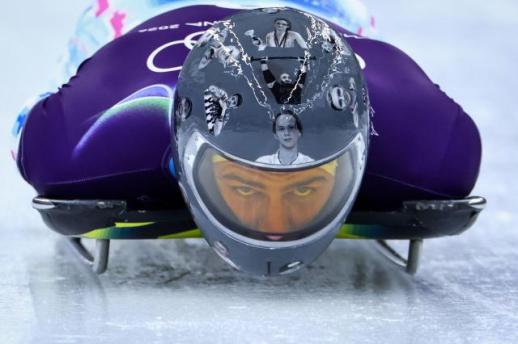 CAS Rejects Ukrainian Skeleton Racer Heraskevych’s Appeal Over Memorial Helmet Ban Ukrainian skeleton racer Vladyslav Heraskevych, 27, will not compete at the 2026 Milan-Cortina Winter Olympics after the Court of Arbitration for Sport rejected his appeal of an International Olympic Committee ban, the AP reported. The IOC barred him from competing after he sought to race wearing a “memorial helmet” honoring teammates killed in the war. CAS upheld the IOC decision under Olympic Charter Rule 50.2, which says “no kind of demonstration or political, religious or racial propaganda is permitted in any Olympic sites, venues or other areas.” CAS said it fully sympathized with Heraskevych’s intent and his effort to highlight the suffering of Ukrainians and Ukrainian athletes during the war, but ruled the ban was “reasonable and appropriate.” Heraskevych’s side protested the ruling, arguing it was inconsistent with how other athletes were treated. The article cited examples from the Games: U.S. figure skater Maxim Naumov showed photos of his parents who died in a plane crash last year; Italian snowboarder Roland Fischnaller competed wearing a helmet that included a Russian flag image; and Israeli skeleton racer Jared Firestone wore a kippah bearing the names of 11 Israeli athletes and coaches killed at the 1972 Munich Olympics. The IOC said those cases did not violate the rules. IOC spokesman Mark Adams said Naumov displayed the photos in the kiss-and-cry area, not during competition; Fischnaller’s helmet honored all Olympic host cities where he had competed, including the 2014 Sochi Games; and Firestone’s kippah was covered by a beanie. After the decision, Heraskevych said, “The IOC is on the wrong side of history.” He had previously lost his Olympic spot after trying to compete in the men’s skeleton event wearing a helmet with the faces of fallen teammates. “The sacrifice of the athletes who died is why we could be here competing as one team,” he said. “I can’t betray them.” * This article has been translated by AI. 2026-02-14 11:18:00
 -
 President Lee to focus on policy planning during Lunar New Year holiday SEOUL, February 14 (AJP) - President Lee Jae Myung will scale back public engagements during the five-day Lunar New Year holiday beginning Saturday and remain at the presidential residence to focus on policy planning, officials said. Lee is expected to review a range of pressing domestic and external issues, including tariff negotiations with the United States, efforts to stabilize the real estate market, and administrative integration, while refining his policy direction for the second year of his term. According to the presidential office, Lee will not travel to his hometown of Andong in North Gyeongsang Province or to the presidential retreat on Geoje Island during the holiday period. Instead, he is expected to spend time primarily with family at the residence. During last year’s Chuseok holiday in October, Lee attended an event for displaced Koreans and visited a child welfare facility and a traditional market. He also paid respects at his family graves in Bonghwa and Andong in North Gyeongsang Province. Lee’s increased activity on social media in recent weeks is expected to continue over the holiday. On the eve of the holiday, he posted consecutive messages addressing real estate issues, effectively setting market normalization as a key topic for the festive period. On Friday, Lee uploaded two posts suggesting the need for tighter lending regulations on multiple-home owners. Delays in the National Assembly’s legislative process and escalating tensions between the ruling and opposition parties remain among Lee’s concerns. A planned luncheon with party leaders ahead of the holiday was canceled on Thursday, adding to the political deadlock. The impasse has raised concerns that parliamentary handling of a special bill on U.S. investment, aimed at responding to Washington’s plan to impose a 25 percent tariff increase, could be delayed. With local elections scheduled for June, discussions over potential reshuffles within the presidential office and Cabinet are also expected to take shape. Following the holiday, Brazilian President Luiz Inácio Lula da Silva is scheduled to pay a three-day state visit to South Korea beginning Feb. 22. 2026-02-14 11:12:52
 -
 OPINION: Korea's economic lifeline: Why its financial system must become transparent SEOUL, February 14 (AJP) - Finance is the bloodstream of an economy. When it flows cleanly—transparent, disciplined, and responsive to real demand—industry strengthens, innovation compounds, households build durable wealth, and the state gains room to maneuver without resorting to panic. When that bloodstream is clogged—by political favoritism, regulatory inconsistency, and the quiet tolerance of chronic underperformance—the economy does not merely slow. It decays at the edges first, then at the center, until even its healthiest organs begin to fail. South Korea stands at a familiar crossroads that many advanced economies have faced and few have navigated gracefully: whether to preserve comfort in the short run or credibility in the long run. The choice is not ideological. It is physiological. A nation cannot reach a truly advanced economic status on the back of a financial system that rewards opacity, subsidizes stagnation, and repeatedly invites speculation to masquerade as growth. For too long, Korean finance has lived with an uneasy compromise between market logic and political convenience. In election seasons, liquidity is loosened. In downturns, restructuring is postponed. Under the banner of “stability,” reforms are delayed until they become crises. And under the rhetoric of “support,” policy too often becomes tailored to specific constituencies—by age, by sector, by region—until the market’s signals are dulled and capital is diverted away from productivity and toward influence. The cost of that compromise is now visible in the places where trust should be strongest: the equity market and the fast-expanding crypto-asset arena. They are different worlds in form, but they share a common pathology: weak discipline at the point of entry and an even weaker willingness to enforce exit. Markets can survive exuberance; they cannot survive the loss of standards. Start with the equity market, particularly the growth-oriented tier that was built to finance innovation. Listing was never meant to be a trophy. It is a covenant. A listed company is granted privileged access to public capital on the promise of minimum governance, transparency, and viability. When that covenant is treated as optional—when firms can remain listed for years while failing basic tests of sustainability—an exchange stops being a price-discovery mechanism and becomes a warehouse of disappointments. This is not merely a question of index performance or investor sentiment. It is a question of national resource allocation. When weak firms linger indefinitely, they do more than drag valuations. They absorb the oxygen that should nourish better enterprises: skilled labor, credit, managerial attention, and scarce institutional trust. “Zombie companies” do not die quietly. They distort the entire ecosystem around them, discouraging investment in healthier competitors and turning productivity growth into a casualty of regulatory hesitation. The most consequential reforms in financial history are often the least glamorous: sharper delisting rules, faster enforcement timelines, and a regulatory philosophy that treats exit not as a tragedy but as a necessary function of a living market. In the United States, the harshness of the public markets is frequently criticized. Yet the logic is clear. There is a widely understood expectation that a firm that cannot meet minimum standards—whether in governance, disclosure, or basic market viability—will be forced out within a defined period. This is not cruelty for its own sake. It is the price of maintaining an exchange whose name still signals credibility. Europe, too, has learned this lesson, sometimes painfully. Mature exchanges and regulators emphasize disclosure discipline and internal controls not because they distrust business, but because they understand what markets become when trust is optional: they become casinos with better typography. Over time, investors do not merely discount a handful of questionable firms. They discount the entire jurisdiction. And the “country discount” becomes a structural tax on every company, including the best ones. Korea’s chronic undervaluation has many causes—corporate governance traditions, capital allocation habits, geopolitical risk, and more. But one cause is particularly actionable: the perception that rules are negotiable and enforcement is slow. When delisting takes years, when lawsuits and reconsiderations become routine, when the market treats failure as a prolonged administrative process rather than a definitive outcome, the signal to investors is unmistakable: standards are soft. That softness does not protect investors. It exposes them. A more rigorous exit regime is therefore not an anti-market intervention. It is pro-market maintenance. But it must be paired with a principle that separates necessary discipline from avoidable harm: predictability. Delisting should not be a sudden lightning strike; it should be the final step in an announced procedure. That means stronger early warnings, more transparent escalation, better disclosure during distress, and a regulatory architecture that makes it impossible for the average investor to claim—credibly—that they were never told. This is where policy must show both firmness and fairness. The goal is not to punish risk; it is to punish deception, negligence, and chronic noncompliance. A market that protects people from all losses is not a market—it is a political program. But a market that allows avoidable losses through preventable opacity is not a market either. It is a breach of public duty. If equity-market reform is about restoring the meaning of “listed,” the crypto challenge is about restoring the meaning of “regulated.” Korea’s crypto-asset space has matured beyond the stage where it can be dismissed as a fringe playground. It is now a meaningful segment of household speculation, tech ambition, and financial experimentation. That makes its shortcomings more dangerous, not less. Recent controversies surrounding major platforms—the foggy lines of ownership, the questions around internal controls, and the broader problem of opaque practices—are not “industry growing pains.” They are stress tests of institutional seriousness. In any system where vast sums move at high speed, the core question is simple: do customers know where their assets are, how they are handled, and what happens if the platform fails? In many jurisdictions, regulators have moved—sometimes unevenly—toward clearer answers. In the United States, the debate often turns on whether certain crypto instruments should be treated as securities, and therefore subject to the disclosure and conduct standards that securities law demands. In Europe, the introduction of comprehensive frameworks has aimed to do what every credible financial regime must do: impose rules on issuance, custody, market conduct, and consumer protection so that innovation can occur without turning public trust into collateral damage. Korea’s task is not to copy any single model. It is to embrace a standard that all credible models share: transparency in custody, separation of customer assets, robust controls against insider trading and market manipulation, and disclosure regimes that do not collapse under the pressure of hype. A platform that cannot prove—continuously—that it is handling customer assets responsibly should not be treated as a national champion. It should be treated as a risk to the public. This is the moment where “mercy” becomes a sophisticated form of irresponsibility. There is a Korean phrase that captures the moral weight of necessary harshness: cutting off a favored general for the survival of the army. In finance, the principle is the same. If a dominant exchange or major listed firm is found to have serious deficiencies, the question is not whether enforcement will cause disruption. It will. The question is whether failing to enforce will guarantee a larger disruption later—one that arrives with deeper losses, broader contagion, and a more lasting collapse of trust. Trust, once broken, is not repaired by slogans. It is repaired by rules that bite. The deeper problem in Korea’s financial history is not a lack of clever policy instruments. It is the habit of treating finance as an extension of political timing. The impulse is understandable: loosen conditions before elections, postpone restructuring when headlines are uncomfortable, rescue favored sectors with cheap funding, and reassure households that tomorrow will be easier if the state absorbs today’s pain. But the world has changed. In a global capital market, credibility travels faster than political promises. If a country’s rules appear elastic, international investors respond with the only language markets trust: higher risk premiums, lower valuations, reduced participation, and a quiet migration of capital to places with clearer standards. Over time, even domestic investors internalize the message and behave accordingly—favoring short-term speculation over long-term investment because the system itself encourages it. What, then, should be done? First, Korea should treat equity-market exit as a pillar of modernization, not an embarrassment. Delisting standards should be clearer, stricter, and, most importantly, faster. A market that cannot remove chronic underperformers in a timely fashion is a market that cannot credibly price anything else. Second, enforcement must be depoliticized. Regulatory agencies should be insulated—by law and by culture—from the temptation to delay discipline for the sake of short-term calm. The calm is illusory. It merely transfers the shock to the future, at a higher cost. Third, crypto markets must be normalized through regulation that focuses on fundamentals: custody, transparency, market conduct, and governance. Innovation deserves room to grow, but it must grow inside a framework that protects the public from the most predictable forms of abuse. The state’s job is not to guarantee profit. It is to guarantee integrity. Fourth, investor protection should be strengthened not by cushioning losses after the fact, but by reducing informational asymmetry before the fact. That means better disclosure standards, stronger auditing and oversight, and real consequences for misrepresentation. Finally, Korean policymakers should embrace a simple global truth: genuine “value-up” is not built on public relations campaigns or one-off shareholder return measures. It is built on ecosystem integrity—where weak firms exit, strong firms attract capital, and the market’s signals are respected rather than managed. There is no way to reform finance without discomfort. Every serious modern economy has learned this. The question is not whether there will be pain. The question is whether the pain is concentrated and purposeful—like surgery—or prolonged and degenerative, like disease. Korea’s economic ambition is not in doubt. Its industrial capacity, technological talent, and entrepreneurial energy remain formidable. But ambition without financial integrity is like speed without steering. In the end, it does not produce greatness. It produces wreckage. Finance is the bloodstream of the economy. Korea can choose to keep the system warm with compromise and delay, and watch the discount deepen. Or it can choose to restore discipline—strict standards, predictable enforcement, and transparent markets—and earn, over time, the one asset no nation can fake: trust. In finance, trust is not a sentiment. It is a structure. And structures, unlike slogans, can carry the weight of a nation’s future. 2026-02-14 10:56:00
 -
 Cha Jun-hwan narrowly misses bronze by less than a point, sets Korean record SEOUL, February 14 (AJP) - On the ninth day of competition at the 2026 Milano–Cortina Winter Olympics on Friday, South Korean athletes delivered notable performances in figure skating and snowboarding. South Korea maintained its tally of one gold, one silver and two bronze medals, remaining 13th in the overall medal standings. Figure skating: Cha Jun-hwan just off the podium In men’s figure skating, Cha Jun-hwan delivered a solid free skate at the Milano Ice Skating Arena to finish 4th overall, marking the best Olympic result yet for a Korean male singles skater. Cha’s total score of 273.92 saw him narrowly miss the bronze medalist Shun Sato of Japan, who scored 274.90 by less than one point after a strong performance highlighted by a clean quad Salchow, though a fall on his quad toe loop brought a deduction. Cha, who placed 15th at the 2018 PyeongChang Winter Olympics — then the best result by a South Korean man in the singles event — improved to fifth at the 2022 Beijing Games. He climbed one spot higher this time to set a new personal Olympic best. Gold-medal favorite Ilia Malinin of the United States struggled under the pressure of his Olympic debut, delivering an uncharacteristically flawed performance and finishing eighth with 264.49 points. With several medal contenders faltering, Kazakhstan’s Mikhail Shaidorov capitalized to claim a surprise gold medal with 291.58 points, securing his country’s first gold of the Games. Snowboarding: Lee finishes sixth in halfpipe, Woo competes in cross At Livigno Snow Park, Lee Chae-un competed in the men’s snowboard halfpipe final and finished 6th with 87.50 points. The 19-year-old landed signature tricks including the frontside triple cork 1620 but fell short of the medals against a deep field. His run showcased Korean progression in snowboarding disciplines. Woo Su-bin, in South Korea’s first Olympic appearance in snowboard cross, was unable to advance to the 16-athlete round after a mid-race slip. She completed her heat despite the fall and won applause from the crowd. Curling: Korea improves to 2-1 in round robin South Korea’s women’s curling team defeated Britain 9-3 in its third round-robin match at the Cortina Curling Olympic Stadium in Cortina d’Ampezzo. The team, skipped by Kim Eun-ji, bounced back from an opening 4-8 loss to the United States with consecutive wins over Italy (7-2) and Britain to improve to 2-1. South Korea moved into a tie for third place among the 10 teams in the standings. In the round-robin format, the top four teams advance to the semifinals. Sweden leads at 3-0, followed by Switzerland. South Korea will face Denmark (1-2) and Japan (0-2) in its next two matches on Feb. 15. Skeleton, Biathlon and Cross-Country: Jung posts second straight top-10 finish In men’s skeleton at the Cortina Sliding Center, Jung Seung-gi clocked a combined time of 3:45.90 over four runs to finish 10th. After placing 10th in his Olympic debut at the 2022 Beijing Games, Jung secured another top-10 finish at his second Olympics. Veteran Kim Ji-soo, competing in his first Olympic appearance since the 2018 PyeongChang Games, finished 16th with a four-run total of 3:48.11. In women’s skeleton at the same venue, Hong Su-jung recorded a combined time of 1:57.33 over two runs to place 22nd among 25 competitors. At the Anterselva Biathlon Arena, Choi Du-jin finished last in the men’s 10-kilometer sprint, crossing the line in 28:05.7 after missing three shots in the prone stage. In cross-country skiing, Lee Jun-seo placed 73rd out of 113 athletes in the men’s 10km interval start free at the Tesero Cross-country Skiing Stadium, finishing in 24:25.4. Norway’s Johannes Klæbo won the event in 20:36.2 to claim his third gold medal of the Games and the eighth Olympic gold of his career, tying the all-time Winter Olympic record. 2026-02-14 10:41:43
 -
 Wavve Unveils Lunar New Year Holiday Picks, From Originals to Blockbuster Films Wavve has released a Lunar New Year holiday watch list spanning originals, blockbuster films and animation. The lineup includes Wavve originals “Chefs of the Temple Kitchen” and “Reading a Criminal’s Letters,” along with food shows, bingeable dramas and movies. “Chefs of the Temple Kitchen” is a food reality series that follows six masters of Korean Buddhist temple cuisine as they prepare and share offerings, exploring the philosophy and meaning behind the food. The cast includes Sunjae, who made the Top 7 as “White Spoon” on “Black and White Chef Season 2,” and Jeonggwan, known internationally through “Chef’s Table,” along with monks Gyeho, Jeokmun, Daean and Uguan. The six appear together in one program for the first time. The series shows the monks sharing their approaches to cooking, episodes centered on traditional fermented sauces such as gochujang, soy sauce and doenjang, and moments of serving guests who seek out temple cuisine. The four-part series will be released in full on Friday, the 13th. “Reading a Criminal’s Letters” (also titled “Read”) is a crime-psychology commentary series that analyzes handwritten letters from people involved in real-life cases that drew national attention. Producers from “Unanswered Questions” and “The Day the Tail Caught the Tail” participated in the project. Lawyer and TV personality Seo Dong-ju and Park Kyung-sik, a producer from “Unanswered Questions,” appear with guests including profiler Pyo Chang-won, criminal psychology professor Park Ji-seon and attorney Park Jun-young, who specializes in retrials. The show covers letters tied to figures including Lee Yeong-hak, known as “Molar Dad,” Jang Dae-ho, dubbed the “Han River dismemberment killer,” Yoo Jeong-ho, described as a YouTuber with 1 million subscribers who became a fraud suspect involving tens of billions of won, and serial killers Yoo Young-chul and Jeong Nam-gyu. Episodes run about 30 minutes and follow an omnibus format, with a different case each time. The 12-part series is being released one episode at a time every Friday. Wavve also highlighted food programming for the holiday. MBN’s “World’s Best Baking: Bake Your Dream” is billed as South Korea’s first K-bakery survival show, with 72 contestants competing for 100 million won. tvN’s “Chagane” follows a “gangster family” trying to strike it big by developing a new spicy sauce, featuring Cha Seung-won and Choo Sung-hoon, along with Tommy, DinDin and Danny Koo. MBC’s “K-GIM Revolution” is a global documentary on the stability and competitiveness of gim, a major Korean seafood product, hosted by Michelin three-star chef Ahn Sung-jae and tracing the process from production to tables worldwide. MBC’s Lunar New Year special “Discovery of the Table” is a K-food road documentary featuring Jang Keun-suk and top chefs as they explore the taste, wisdom and beauty of everyday meals, including appearances by Yoon Nam-no, Fabri and David Lee. JTBC’s “Please Take Care of My Refrigerator since 2014” is also available on Wavve. For drama viewers, Wavve recommended three current hits. “Judge Lee Han-young” follows Lee Han-young (Ji Sung), a corrupt judge living as a servant to a major law firm, who returns to 10 years earlier and makes new choices to punish a powerful enemy; it has held the No. 1 spot on Wavve’s drama rankings. “Spring Fever” centers on teacher Yoon Bom (Lee Joo-bin) and Sun Jae-gyu (Ahn Bo-hyun), and has been gaining popularity as viewing time rises. The historical romance “Eunaehaneun Doduknim-a” follows Hong Eun-jo (Nam Ji-hyun), who becomes a famed thief, and Prince Yi Yeol (Moon Sang-min) after their souls are swapped. “Spirit Fingers,” starring Park Ji-hu and Jo Jun-young, will be released in full starting Friday, the 13th; it follows a girl who has lived without a distinct identity as she finds her own color. Wavve said several “10 million-ticket” films are also available for family viewing. “A Taxi Driver” (2017), based on events surrounding the May 18 Gwangju Democratization Movement, stars Song Kang-ho, Ryu Jun-yeol, Yoo Hae-jin, Choi Gwi-hwa and Eom Tae-goo. “Extreme Job” (2019) is a comedy about narcotics detectives who open a chicken restaurant as a cover, starring Ryu Seung-ryong, Lee Ha-nee, Jin Sun-kyu, Lee Dong-hwi and Gong Myoung. Other picks include “The Admiral: Roaring Currents” (2014), about Adm. Yi Sun-sin’s Battle of Myeongnyang, and “Masquerade” (2012), about a commoner who becomes king of Joseon overnight. Bong Joon-ho’s “Parasite” (2019), which won four Academy Awards, is also on the service. Wavve also said it offers works by Japanese animation director Makoto Shinkai exclusively, including “Your Name” (2016), “Suzume” (2022), “Weathering With You” (2019) and “5 Centimeters per Second” (2007). Wavve noted that “5 Centimeters per Second,” about Takaki and Akari’s love and longing as they move forward at different speeds, is set to be released as a live-action film on Feb. 25. Wavve said it will offer a wide range of content for the Lunar New Year holiday, including Wavve originals, films, animation and international series. * This article has been translated by AI. 2026-02-14 10:21:00
 -
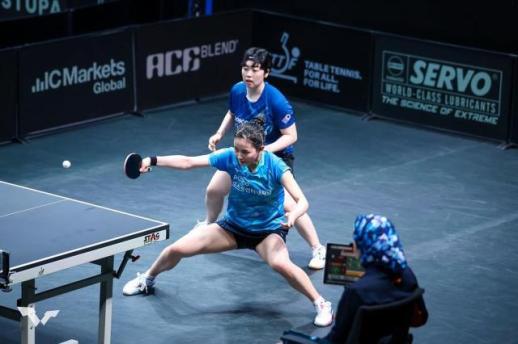 Lim Jong-hoon-Oh Jun-sung, Kim Na-young-Yoo Han-na reach WTT Star Contender Chennai finals South Korea’s doubles teams Lim Jong-hoon-Oh Jun-sung (both Korea Exchange) and Kim Na-young-Yoo Han-na (POSCO International) advanced to the finals at WTT Star Contender Chennai 2026, keeping alive the chance of a double title run. Lim and Oh beat India’s Harmeet Desai and Sathiyan Gnanasekaran 3-0 (11-2, 11-3, 12-10) in the men’s doubles semifinals on Feb. 13 local time in Chennai, India. After taking the first two games comfortably, the Koreans were pushed to deuce in the third but closed it out 12-10. The pair, who won last year’s WTT Star Contender events in Muscat and Skopje, will play France’s Thibault Poret and Flavien Coton in the final as they seek another title. In the women’s doubles semifinals, Kim and Yoo defeated India’s Hadi Patel and Laxita Narang 3-0 (11-4, 11-4, 11-6). Ranked No. 4 in the world, Kim and Yoo won three titles last year in Taiyuan, Lagos and Skopje. They will face Japan’s Sakura Yokoi and Sachi Aoki in the final. In singles, five South Koreans reached the round of 16: Oh Jun-sung and Park Kang-hyun (Mirae Asset Securities) in the men’s draw, and Kim Na-young, Joo Cheon-hee (Samsung Life Insurance) and Lee Eun-hye (Korean Air) in the women’s draw. 2026-02-14 09:30:00
 -
 TVING Unveils Lunar New Year Holiday Streaming Lineup for Binge-Watching TVING has unveiled a Lunar New Year holiday lineup aimed at viewers looking to binge-watch throughout the break. The slate ranges from easy-to-watch variety shows to buzzed-about series some viewers may have missed, plus TVING-exclusive originals. Among the scripted titles is "Judge Lee Han-young," starring Ji Sung, Park Hee-soon and Won Jin-a. The series follows a corrupt judge, once a pawn of a major law firm, who returns to 10 years earlier and seeks to punish powerful wrongdoers. The show mixes revenge-driven justice with tension among the three leads, keeping viewers guessing how far the reckoning will go and who will survive to the end. The undercover reality-variety show "Manito Club" centers on secretly delivering gifts to people who need encouragement. Its first lineup features Choo Sung-hoon, Noh Hong-chul, Lee Soo-ji, Dex and Jennie. Later rounds add Jung Hae-in and Go Youn-jung, along with Cha Tae-hyun and Park Bo-young, reuniting on a variety show for the first time since the film "Scandal Makers." "Extreme 84" follows Kian84 in what TVING describes as an ultra-demanding running variety show. Built around marathon running, it pushes beyond 42.195 kilometers and aims to capture the raw emotions people feel when they hit their limits. Retro-themed "Undercover Miss Hong" is set in Yeouido just before the IMF crisis and follows an elite worker who goes undercover to steal a chaebol family’s secret ledger, blending nostalgia with suspense. Romance series "Spring Fever" pairs Ahn Bo-hyun — playing a tough-looking man with a devoted streak — with Lee Joo-bin as a coolheaded teacher, highlighting their contrasting chemistry. TVING said Ahn’s first dialect performance and visual transformation will drive the show’s fast-paced banter. For viewers seeking lighter fare, "Bogum Magical" follows Park Bo-gum, Lee Sang-yi and Kwak Dong-yeon as they provide hair and nail care and a meal to residents visiting a barbershop, leaning on small-town warmth and the trio’s on-screen rapport. Park’s skills are highlighted after he earned a barber’s license during his military service. Also included are "Please Take Care of My Refrigerator since 2014," which returned after 11 years and has been trending in real time on social media and online communities, and "Manager Kim Works at a Conglomerate and Owns a Home in Seoul," about the struggles of the Kim Nak-su family after a major-company department head gives up his status and starts over. TVING said the lineup is designed to keep viewers busy throughout the holiday. TVING also promoted a set of exclusives, including the original "Baseball Oddball Lim Chan-kyu," which follows pitcher Lim Chan-kyu with close-up access to his candid talk and off-field daily life, positioning it as a new kind of "baseball entertainment." For binge-watchers, TVING pointed to all seasons of the dating-reality franchise "EXchange" and "Show Me the Money: Yacha’s World," focused on Korean hip-hop. It also highlighted "Reply 1988 10th Anniversary Special," bringing back the Ssangmun-dong family for a reunion marking the show’s 10th anniversary. More plot-driven options include Hwang Min-hyun’s action series "Study Group" and the mystery thriller "Dear X," featuring what TVING called a bold acting transformation by Kim Yoo-jung. TVING also spotlighted international programming for viewers staying home. In its Apple TV brand section, it is offering a promotion that lets users watch the first episode for free of major titles including "Pachinko," "Severance," "Hijack," "Dr. Brain" and "K-Popd." Other picks include the Japanese adaptation of "Marry My Husband," as well as Chinese romance titles "Yi Xiao Sui Ge" and "Jiao Yang Si A." TVING also pointed to full-season viewing of "Severance," built on a premise that separates memories of work and daily life, and the U.K.-made aviation action thriller "Hijack," framing the package as a way to sample series from around the world on one platform.* This article has been translated by AI. 2026-02-14 09:21:00
 -
 Netflix Unveils Lunar New Year Holiday Lineup With New Series and Reality Spinoffs Netflix has rolled out a varied slate of new releases for the Lunar New Year holiday, mixing mystery, reality TV and documentaries. Can you call it fake if it’s indistinguishable from the real thing? ... "Lady Dua" Netflix’s series “Lady Dua” follows Sarah Kim, a woman who wants to become a luxury brand even if she is a counterfeit, and Mu-gyeong, a detective who tracks her ambitions. In Seoul’s upscale Cheongdam-dong shopping district, a body is found frozen in a storm drain with the face badly damaged. Mu-gyeong, assigned to the case, uses an ankle tattoo and a luxury handbag left at the scene to identify the victim as Sarah Kim, the Asia branch head of the luxury brand “Budoir.” But the more he investigates, the more confused he becomes as new details about Sarah Kim emerge. Shin Hye-sun plays the enigmatic Sarah Kim, and Lee Jun-hyuk stars as Mu-gyeong, the detective who relentlessly follows her trail. Directed by Kim Jin-min, known for Netflix series “Extracurricular” and “My Name,” and written by newcomer Chu Song-yeon, the show promises an unpredictable plot and a tightly woven mystery. Released on the 13th. Behind the flirting war that crosses the line ... "Single’s Inferno Reunion" Netflix will release “Single’s Inferno Reunion,” a spinoff featuring behind-the-scenes stories from “Single’s Inferno” Season 5, the streamer’s longest-running variety show. Season 5 follows singles on a remote island called “Inferno,” where they can leave only if they become a couple. The season has drawn attention for bold flirting and constantly shifting pairings, and it reached No. 2 on Netflix’s Top 10 list for non-English shows after its release, the best performance in the franchise. The cast reunites to share candid production stories and what happened after the show, including emotional turns not captured in the main series and where relationships went after filming. Set for release on the 14th. Revisiting the glamour — and the controversy — of a supermodel reality show ... "Reality Check: America’s Next Top Model and the Dark Side" “Reality Check: America’s Next Top Model and the Dark Side” is a documentary that examines the lesser-known side of the survival competition “America’s Next Top Model,” which selected a top supermodel from aspiring contestants. Participants and key figures, including judge and host Tyra Banks, look back on the show’s most glamorous moments and its controversies. Once seen as a high-profile gateway for would-be models, the series became a pop-culture force even as it was marked by conflict, emotional blowups and disputes that are still discussed today. The documentary asks how far people should go in the name of entertainment. Released on the 16th. An old friend’s death arrives by email after 20 years ... "How to Get to Heaven From Belfast" “How to Get to Heaven From Belfast” follows three lifelong best friends as they dig into the mystery behind the suspicious death of a childhood friend. The trio includes Siersha, a smart, free-spirited drama writer; Robin, who looks glamorous but is worn down raising three children; and Dara, a dependable, introverted caregiver. Now in their late 30s, they remain close. After receiving an email saying their childhood friend Greta has died, they attend a memorial service. Strange events there pull them into unpredictable incidents that span across Ireland. The series comes from the team behind Netflix’s comedy “Derry Girls,” shifting the focus to adult friendships and the lives built around them. A survival story in top kitchens ... "The Korean Chef" “The Korean Chef” is a documentary series about the intense daily pressure faced by six owner-chefs, including chefs at restaurants that have earned Michelin stars. Behind the elegance, the kitchen is portrayed as a place where even a one-second, one-millimeter or 0.1-gram mistake is not tolerated. The series features Kang Min-goo, owner-chef of Mingles, Korea’s only Michelin three-star restaurant; Atomix co-CEOs Park Jeong-eun and Park Jeong-hyeon, whose restaurant ranked No. 1 in North America on World’s Best Restaurants; Shin Chang-ho, owner-chef of Michelin two-star Joo Ok; Lee Yong-woo, owner-chef of French restaurant Harris; Lee Ha-seong, owner-chef of Oyat and known as a “cooking monster” who drew attention as a “black spoon” contestant on Netflix’s variety show “Culinary Class Wars 2”; and Lim Gi-hak, owner-chef of Lespwa, described as an icon of classic French cuisine. The series follows them as artists and business owners making decisions where their survival is on the line.* This article has been translated by AI. 2026-02-14 09:18:00
 -
 Cha Jun-hwan finishes fourth in Olympic men’s figure skating, best-ever for South Korea South Korea’s Cha Jun-hwan (Seoul City Hall) finished fourth in men’s singles figure skating, closing out his third Olympics with the best result ever by a Korean man. Cha scored 181.20 points in the free skate at the 2026 Milan-Cortina d’Ampezzo Winter Olympics at the Milan Ice Skating Arena, earning 95.16 in technical elements and 87.04 in program components, with a one-point deduction. He had scored 92.72 in the short program on Feb. 12, finishing with a total of 273.92 points for fourth place. Cha placed 15th at the 2018 Pyeongchang Games, then improved to fifth in 2022. He moved up another spot this time. Skating 19th among 24 competitors, Cha performed his free-skate program, “Ballade for a Madman.” He opened with a clean quadruple salchow, but fell hard on his next jump, a quadruple toe loop, drawing a deduction. He recovered to land a triple lutz-triple loop combination and a triple axel to complete his first four jumping passes. He continued with a level-four step sequence and stayed composed in the second half, where elements receive a 10% bonus. Cha landed a triple flip-single Euler-triple salchow combination and a triple axel-double axel sequence. His change-foot combination spin was graded level three, and he finished his final jump, a triple flip, cleanly. He then completed the choreographic sequence, a level-four flying camel spin and a level-four flying change-foot combination spin. Afterward, he sat on the ice, showing disappointment. Cha’s 273.92 total left him behind gold medalist Mikhail Shaidorov of Kazakhstan (291.58), Yuma Kagiyama (280.06) and Shun Sato (274.90), both of Japan. Cha missed the bronze by 0.98 points. * This article has been translated by AI. 2026-02-14 07:24:00