
Journalist

AJP
-
 Air Busan Delivers Lunar New Year Care Kits to Residents Near Gimhae Airport Air Busan said Wednesday it held a Lunar New Year sharing event Tuesday for residents living in noise-mitigation areas near Gimhae Airport. Air Busan employees visited senior centers and homes in the area, delivering essential-goods kits to about 100 older residents and spending time talking with them. The kits included daily necessities such as shampoo, detergent, toothpaste and toothbrushes. The airline said the effort focused on neighborhoods near Gimhae Airport designated for noise countermeasures, giving employees a better understanding of residents’ inconvenience and living conditions. Air Busan has carried out other community programs centered on areas near the airport, including providing a food truck on Jan. 30 for older adults at a welfare center in Gangseo District, Busan. “As an airline operating with Gimhae Airport as our hub, we will continue efforts to coexist with the local community and fulfill our social responsibility, based on deep understanding and empathy for residents affected by airport noise,” an Air Busan official said.* This article has been translated by AI. 2026-02-12 08:27:00
 -
 James Van Der Beek of 'Dawson's Creek' Dies at 48 Actor James Van Der Beek, best known for playing Dawson on the hit U.S. TV drama “Dawson’s Creek,” died Tuesday, local time. He was 48. His family said on his official Instagram account, “Beloved James Van Der Beek passed away peacefully this morning,” adding that he “never lost courage, faith and kindness until the very end.” The New York Times reported that Van Der Beek had been battling stage 3 colon cancer since being diagnosed in 2024. Born in 1977 in Cheshire, Connecticut, he moved to New York to pursue acting and began his career on Broadway in the play “Sand.” He rose to stardom in 1998 as Dawson, a high school student in “Dawson’s Creek.” The series followed the love, friendship and growing pains of teenagers in Massachusetts and helped launch young stars including Katie Holmes and Jason Behr. It also aired in South Korea and was popular there. Van Der Beek later appeared in NBC’s “Mercy” as a womanizing doctor and played an FBI agent in the “CSI: Cyber” series. He continued acting through recent years, including a role in the romantic comedy film “Sidelined: QB and Me.” Van Der Beek married Heather McComb in 2003; they divorced in 2010. He later married Kimberly Brook, and they have six children.* This article has been translated by AI. 2026-02-12 08:21:00
 -
 Renault Korea’s Busan Plant Tops 4 Million Vehicles, Expands Role as Global Hub 르노코리아는 지난 2000년 국내 시장 출범 이래 26년 만에 부산공장에서 누적 생산 400만대를 돌파했다고 12일 밝혔다. 르노코리아는 부산공장이 르노그룹 내 D·E 세그먼트 생산을 맡는 글로벌 허브로, 품질 경쟁력을 인정받고 있다고 밝혔다. 부산공장은 국내 약 220만대, 해외 약 180만대 등 총 400만대 이상을 출고했다. 부산공장에서 가장 많이 생산된 차량은 중형 세단 SM5로, 총 95만4000대가 생산됐다. SM3는 80만5000대, 닛산 로그는 58만5000대가 생산됐다. 니콜라 파리 르노코리아 사장은 기념 행사에서 "부산공장에서 400만대 이상을 생산할 수 있었던 가장 큰 원동력은 최고 수준의 품질 경쟁력과 임직원들의 뛰어난 역량"이라며 "이번 400만대 누적 생산을 새로운 도약의 출발점으로 삼아 500만대 생산을 향해 더욱 힘차게 나아가겠다"고 말했다. 르노코리아는 부산공장이 르노그룹의 '인터내셔널 게임 플랜 2027'에서 핵심 생산 거점 역할을 하고 있으며, 그룹의 주요 품질 관리 지표에서도 최상위권을 기록하고 있다고 밝혔다. 또 부산공장은 하나의 생산 라인에서 최대 4개 플랫폼, 8개 차종을 생산할 수 있는 혼류 생산 체계를 구축했다고 밝혔다. 지난해 1월에는 설비 업데이트를 통해 국내 자동차 기업 최초로 내연기관 생산 라인을 전기차 조립까지 가능한 라인으로 전환했다고 덧붙였다. 이를 기반으로 중형 SUV '그랑 콜레오스', 글로벌 플래그십 크로스오버 '필랑트', '폴스타 4' 등 내연기관과 하이브리드, 순수 전기차를 동시에 생산하는 체계를 갖췄다고 밝혔다.* This article has been translated by AI. 2026-02-12 08:18:00
 -
 South Korea’s Jeong Seung-gi opens Olympic skeleton bid; women’s curling debuts vs. U.S. South Korea’s top skeleton racer Jeong Seung-gi, often described as the successor to Yoon Sung-bin, begins his push for a first Olympic medal on Thursday night. Jeong is scheduled to compete in runs one and two of the men’s skeleton on Thursday at 5:30 p.m. Korea time at the Cortina Sliding Center in Cortina d’Ampezzo, Italy, at the 2026 Milano-Cortina d’Ampezzo Winter Olympics. Skeleton standings are decided by combined times over four runs across two days. Jeong finished 10th at the 2022 Beijing Olympics, his first Games. He later won bronze at the 2022-23 world championships and placed second overall in the World Cup standings, establishing himself among the world’s best. He had surgery after a back injury during training in October 2024, but returned successfully and won a World Cup bronze medal this season. Expectations are higher after Jeong placed fifth at the first World Cup event held on the Cortina track that will host the Olympic race. Veteran Kim Ji-su, also of Gangwon Provincial Office, is also entered, returning to the Olympics for the first time in eight years since Pyeongchang. Another South Korean medal hopeful, the women’s curling team from Gyeonggi Provincial Office led by skip Kim Eun-ji, opens round-robin play Thursday at 5:05 p.m. Korea time against the United States at the Cortina Curling Olympic Stadium. South Korea’s challenges in snow events continue as well. Cross-country skiers Lee Ui-jin of the Busan Sports Council and Han Da-som of Gyeonggi Provincial Office are set to race the women’s 10-kilometer interval-start freestyle at 9 p.m. Korea time at the Tesero Cross-Country Ski Stadium. Both failed to finish the opening 10+10 km skiathlon. They were also disqualified in the sprint classic qualifying on Feb. 10 after fluorine-containing wax was detected during an equipment check. The two said they will recheck their gear and try to restore their standing.* This article has been translated by AI. 2026-02-12 07:51:00
 -
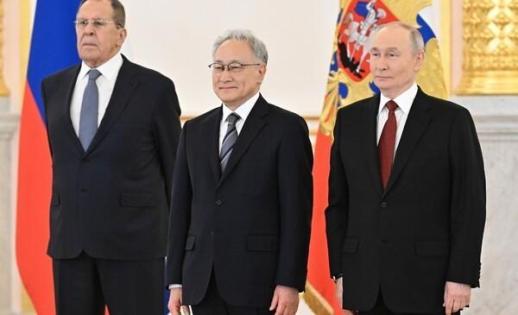 Ukraine War in 5th Year: Seoul urged to take "pragmatic" postwar posture *Editor's Note: As Russia's invasion of Ukraine nears its fifth year, AJP reviews how the war began, how it has evolved, and where it is heading — and asks the most urgent question of all: will it end? The third installment examines a practical post-war strategy for Seoul. SEOUL, February 11 (AJP) - When Vladimir Putin recently spoke of "positive capital" in ties with Seoul while receiving the credentials of South Korea's new ambassador, Lee Seok-bae, last month the phrase carried more strategic weight than diplomatic courtesy. It was, according to Park Byong-hwan, director of the Eurasian Strategic Studies Institute and a former senior diplomat in Moscow, a signal Seoul should not ignore as the war in Ukraine enters its fifth year. "Putin's language was cold and realist," Park said in an interview. "He was reminding Seoul that the window for pragmatic re-engagement is slowly opening. But our bureaucracy remains trapped in a defensive crouch." Since Russia's invasion in 2022, South Korea has aligned closely with U.S.-led sanctions, a stance that has coincided with Moscow's growing reliance on North Korea for arms and manpower. Relations further deteriorated after Seoul became an indirect supplier of artillery shells to Kyiv via the United States, prompting Russia to designate South Korea an "unfriendly nation." Park argued that Seoul has gone beyond what its alliance obligations require. "We failed to distinguish between necessary sanctions and unnecessary hostility," he said. "The result has been little security gain and substantial economic damage." Russian ambassador to Seoul Georgy Zinoviev echoed Putin's earlier narrative in a separate meeting with reporters in Seoul on Wednesday. "We have a lot of positive capital in our interaction with the Republic of Korea that has been wasted in many ways, but we count on the restoration of relations with the Republic of Korea." Trade losses and corporate retreat The economic cost has been tangible. According to the Korea Customs Service, South Korean exports to Russia more than halved, falling from nearly $10 billion in 2021 to $4.52 billion in 2024. New vehicle exports plunged from $2.5 billion to $589 million. Against this backdrop, Hyundai Motor and its affiliate Kia which used to be the largest foreign car brand in Russia allowed a buyback option on their former Russian manufacturing plant to expire in January, effectively ending hopes of an early return. Operations at the facility were suspended in March 2022 following sweeping Western sanctions that disrupted logistics and payments. Hyundai sold the plant in 2024 at a symbolic price, retaining a repurchase option that was quietly abandoned as political risks mounted. "Major corporations can absorb such losses," Park said. "Small and mid-sized exporters cannot." Zinoviev pointed out: "Major Korean producers were forced to leave because the government of the Republic of Korea introduced sanction restrictions against Russia on exports. Now the list of these restrictions has reached 1,402 positions, including semiconductors, cars, components, and electronics." "The glass can be half empty or half full. I would like to see practical steps that would make exchanges between our citizens more convenient, as I believe this would meet the interests of both Russians and Koreans," he added. The cost of over-compliance Park also was critical of Seoul's expansive export controls, which now cover consumer goods such as used vehicles and home appliances. "These measures have no military impact," he said. "Russia sources substitutes elsewhere, mainly from China and India. We are not weakening Moscow's war effort. We are strangling our own businesses." He argued that South Korea's approach has been more restrictive than that of several G7 peers, leaving it with little strategic flexibility as the conflict drags on. Japan, for example, has maintained energy interests in Russia while publicly condemning the war. Seoul, by contrast, has largely withdrawn. A shifting geopolitical landscape Park saw the emerging postwar order as increasingly multipolar. "Unlike China, Russia has no territorial ambitions on the Korean Peninsula," he said. "Historically, Moscow has been receptive to peaceful unification led by Seoul because of the economic benefits." He contended that Washington's growing interest in managing down the Ukraine conflict could eventually open space for recalibrated relations. "As the U.S. explores diplomatic exits, South Korea should position itself as a constructive partner, not a passive follower," Park said. Complementary strengths At a structural level, Park described the Korea-Russia relationship as fundamentally complementary: Russia's strength in basic science and resources paired with South Korea's manufacturing and commercialization capacity. "Much of this cooperation already exists quietly in the private sector," he noted. "Korean firms continue to rely on Russian scientific talent in advanced research." He also pointed to Russia's role as a nearby supplier of energy and food resources—an increasingly valuable asset amid global supply-chain fragmentation. "Geographically, Russia is at our doorstep," he said. "Strategically, that matters." The Arctic connection This logic extends to logistics. The Ministry of Oceans and Fisheries plans to dispatch a trial container vessel from Busan to Rotterdam via the Arctic this September, testing the commercial viability of the Northern Sea Route. But Park warned that such ambitions depend on workable ties with Moscow. "You cannot use the Northern Sea Route without Russia," he said. "They control permits, icebreakers and safety systems. That is geographic reality." The Russian ambassador agreed; "To any person who glances at the map, it is perfectly clear that one needs to interact with Russia. If the Korean side wants to use the Northern Sea Route, it probably can start a corresponding dialogue with Russia." 2026-02-12 07:35:10
 -
 South Korea’s Lee Chae Woon reaches Olympic men’s halfpipe final in 9th South Korean snowboard prospect Lee Chae Woon of Kyung Hee University has reached the Olympic men’s halfpipe final, a first for South Korea in the event. Lee scored 82 points on Wednesday in qualifying at Livigno Snow Park in Livigno, Italy, placing ninth among 25 riders at the 2026 Milano-Cortina d’Ampezzo Winter Olympics. The result put him into the final reserved for the top 12. It is the first time since Kim Ho Jun’s debut at the 2010 Vancouver Games that South Korea will have finalists in both halfpipe events, with Lee and women’s rider Choi Ga On of Sehwa High School advancing. Lee earned his score on his first run, landing a series that included consecutive four-rotation spins and a high-difficulty grab. He could not improve on his second run after a mistake, but his first-run score was enough to advance. Lee competed at the 2022 Beijing Olympics as South Korea’s youngest national team member and was eliminated in qualifying in 18th. Four years later, he has moved into the final and will chase a medal. Teammate Lee Ji O of Yangpyeong High School narrowly missed out. After an error on his first run, he scored 74 on his second but finished 13th, 1.5 points behind 12th-place Jake Pates of the United States (75.5). Asian Games gold medalist Kim Geon Hee of Siheung Maehwa High School was eliminated after mistakes on both runs. Scotty James of Australia led qualifying with 94 points. Japan’s Yuto Totsuka was second with 91.25, followed by Ryusei Yamada with 90.25. Lee will try to win South Korea’s first men’s snowboard medal in the final, scheduled for 3:30 a.m. Friday (Korea time).* This article has been translated by AI. 2026-02-12 05:54:00
 -
 South Korea’s Gu Gyeong-min Misses Medal in Olympic Men’s 1,000; Hungary’s Kim Min-seok Also Comes Up Short South Korea’s Gu Gyeong-min fell short of a medal in the men’s 1,000 meters in speed skating at the 2026 Milan-Cortina d’Ampezzo Winter Olympics. Gu finished in 1 minute, 8.53 seconds in the fourth pairing at the Milan Speed Skating Arena in Milan, Italy, on Wednesday (Korea time). Skating alongside Norway’s Bjorn Magnussen, Gu opened with a strong first lap of 41.12 seconds and briefly led the overall standings after his race. His time was soon surpassed by skaters in the fifth pairing, dropping him to third. He later fell out of medal position after the Netherlands’ Kjeld Nuis posted a dominant 1:07-range time in the ninth pairing. Kim Min-seok, who competes for Hungary after changing nationality, raced in the sixth pairing and finished in 1:08.59, slower than Gu. Kim won Olympic medals for South Korea at the 2018 Pyeongchang and 2022 Beijing Games. After a 2022 drunk-driving incident left him unable to compete as a national team athlete, he became a Hungarian citizen in 2024.* This article has been translated by AI. 2026-02-12 04:03:00
 -
 South Korea’s Abakumova Places 63rd in Women’s 15km Biathlon at Milan-Cortina Games Naturalized South Korean biathlete Ekaterina Abakumova finished in the lower half of the field in her third Olympic appearance. Abakumova, 35, placed 63rd among 90 starters in the women’s 15-kilometer individual at the Milan-Cortina Winter Olympics on Tuesday (Korean time) at the Biathlon Arena in Antholz, Italy. She finished in 47 minutes, 18.2 seconds. She missed three targets — once in prone shooting and twice standing — hurting her overall time. Abakumova, a former Russian youth national team member, became a South Korean citizen in 2016. She placed 16th at the 2018 Pyeongchang Olympics, then finished 73rd at the 2022 Beijing Games, making Milan her third straight Olympics. France’s Julia Simon won gold in 41:15.6. Despite one miss in standing, she led the field with her skiing and crossed first. After helping France win the mixed relay earlier, Simon became a two-time champion at these Games. France’s Lou Jeanmonnot took silver in 42:08.7, and Bulgaria’s Laura Hristova won bronze in 42:20.1.* This article has been translated by AI. 2026-02-12 00:51:00
 -
 Yoon Shin-yi Finishes 13th in Moguls Qualifier, Misses Final at Milan-Cortina Olympics Yoon Shin-yi of Bongpyeong High School failed to reach the final in women’s moguls in freestyle skiing at the 2026 Milan-Cortina d’Ampezzo Winter Olympics. Competing Tuesday (Korea time) at Aerial Mogul Park in Livigno, Italy, Yoon scored 64.46 points in the second qualifying round, placing 13th among 20 skiers. In the first qualifier a day earlier, she scored 59.40 points to finish 21st out of 30, missing the top-10 cutoff for an automatic berth in the final. Her best score across the two qualifiers was 64.46, leaving her 24th overall and out of the final. Moguls is a freestyle skiing event in which athletes race down a course covered with bumps about 1 meter high, then perform aerial tricks off jumps. In this competition, the top 10 from the first qualifier advanced directly to the final, while the remaining 20 skiers competed in the second qualifier for the remaining spots. Yoon improved her score in the second round but did not crack the top 10. Yoon is scheduled to compete in dual moguls on Feb. 14, an event in which two skiers race head-to-head. In men’s moguls, Jung Dae-yoon of the Seoul Ski Association and Lee Yoon-seung of Kyung Hee University are set to compete in the second qualifier at 6 p.m. on Feb. 12. * This article has been translated by AI. 2026-02-11 22:27:00
 -
 Short Track Skater Lim Jong-eon Says Olympic Debut Helped Him Find His Rhythm Short track skater Lim Jong-eon of Goyang City Hall, who made his Olympic debut a day earlier, said he gained confidence after getting a feel for the competition. Lim took part in the national team’s official training session on Feb. 11 at the Ice Skating Arena in Milan, Italy. In his first Olympics, Lim advanced smoothly from the 1,000-meter preliminaries a day earlier to reach the quarterfinals. Reflecting on that race, he said, “It’s been a while since I competed, and I was very nervous, so I’m a bit tired,” adding, “I went in thinking I’d skate like at other international events, but the atmosphere here is definitely different, so I was really shaking.” On his approach, Lim said, “Since it was my first race, I tried to use a new strategy,” and added, “I tried to stay active near the front.” “As I raced, I got a sense of what I need to do and how much I should do,” he said. Lim’s quarterfinal heat will include Lin Xiaojun — known in South Korea as Lim Hyo-jun — along with Italy’s Shupekenhouser, the Netherlands’ Jens Vansbaut and Latvia’s Reinis Berzins. Lim said he has been looking forward to racing Lin. “We often run into each other at the athletes’ village cafeteria and say hello,” he said. “When we ended up in the same group, Lin told me, ‘Don’t be nervous, and let’s do well.’” Still, Lim said he is not focused on any one rival. “Lin is there, but there are also a lot of strong skaters from the Netherlands and Italy,” he said. “Rather than one specific skater, I think I need to manage the race while keeping several skaters in mind.” Lim also pointed to the ice conditions. “It felt a bit softer than during practice, so there have been a lot of mistakes,” he said. “I think I’ll need to skate differently in the race.” * This article has been translated by AI. 2026-02-11 22:18:00