
Journalist

AJP
-
 AI takes front seat in Korean bio "foundries", betting on reduced cost and risks SEOUL, December 04 (AJP) - South Korea's bio industry is going all in on artificial intelligence, betting that the technology will slash time, cost and risk in drug discovery, with eight out of 10 companies are now diverting at least 10 percent of their revenue to AI deployment. "AI is set to play a pivotal role in our sector, and its impact on the industry will be profound," said Lee Seung-kyu, vice chairman of Korea Bio. "Compared to the vague expectations we had last year, we are now better prepared for what AI can bring to the bio industry." The forum comes as global life-science executives pile into AI despite geopolitical turbulence. A Samjong KPMG survey of 1,350 CEOs across 12 industries in 11 countries found that 71 percent ranked AI as their top investment priority, while 68 percent remained optimistic about economic growth. "Some 83 percent of companies plan to allocate more than 10 percent of their budgets to AI, and 67 percent of CEOs expect to generate returns within one to three years," said Park Sang-hoon, a partner who leads KPMG's pharmaceutical and bio practice. "This marks a seven-percentage-point increase from last year." The urgency stems from structural pressures in traditional drug development. Patent cliffs are arriving faster, clinical trial success rates are falling, and R&D costs continue to rise, often outstripping topline growth. "AI is essential for accelerating drug development, reducing costs and identifying failures faster," said Yoon Hee-jung, head of the bio-innovation strategy team at the Korea Institute of S&T Evaluation and Planning. She pointed to breakthroughs such as AlphaFold's protein-structure predictions and Insilico Medicine advancing AI-discovered candidates into clinical trials. She also noted that global tech giants like Nvidia, Microsoft and Amazon now offer bio-focused AI platforms, while Korean firms are quickly joining the race—Naver through targeted healthcare acquisitions and medical LLM development, and LG via a research partnership with Seoul National University. Sung Bong-hyun, senior researcher at the Korea Research Institute of Bioscience & Biotechnology, highlighted the rise of so-called "bio foundries"—a term borrowed from the semiconductor industry—where AI and robotics combine to automate synthetic biology workflows. He said AI-powered automation could dramatically reduce development time and capital requirements while delivering levels of reproducibility that are difficult for human researchers. "Without AI, the astronomical number of genetic combinations makes optimization nearly impossible," Sung said. "Bio foundries running on AI can standardize processes and accelerate development that would otherwise take decades." But regulatory systems are struggling to keep pace. Sung called for clearer rules on AI-generated intellectual property, broader data-sharing frameworks and stronger government support. Park warned that rapid technological shifts risk widening gaps between companies and deepening generational divides in workforce skills. Even with geopolitical uncertainty clouding global markets, Korea's bio sector continues to expand. According to Korea Bio data presented at the forum, the industry's workforce grew 1.5 percent year-on-year, with a five-year average of 5.9 percent. Investment jumped 46.1 percent to 5.48 trillion won ($3.72 billion), with facility investment soaring 145 percent. Exports rose 17.1 percent to 13.7 trillion won. Oh Ki-hwan, head of Korea Bio's research center, said executives cited biosecurity tariffs and the escalating U.S.–China rivalry as top concerns for 2025. He noted rising momentum to phase out animal testing in favor of AI-powered digital twins and in-silico trials. "The digital bio sector is strongly calling on the government to establish dedicated AI drug development funds and develop sovereign AI capabilities," Oh said. A government policy framework on AI in bio is expected later this month, with officials signaling a supportive stance, Yoon said. Beyond pharmaceuticals, industry experts see AI reshaping food security through "green bio" applications. Koo Ok-jae, an executive at Hanwha Solutions, argued that AI-enhanced alternative proteins and precision agriculture will be critical to addressing food shortages tied to population growth and climate change. Lee Dong-yup, a professor at Sungkyunkwan University, said digital twin technology—combining AI modeling with virtual cell simulations—is still in its early stages in bio-manufacturing but could pave the way for personalized medicine and real-time production oversight. "The future will be about turning data into value," Lee said. "AI in bio-manufacturing is still in its infancy, but the potential is enormous." 2025-12-04 16:46:27
 -
 South Korea's Kolon Industries joins hands with Canadian firm for fuel cell business SEOUL, December 04 (AJP) - Kolon Industries said Thursday it has signed a memorandum of understanding with Canada’s Ballard Power Systems to expand cooperation in hydrogen fuel cell components, strengthening its push into the clean-energy sector. The agreement was signed at the World Hydrogen 2025 event held at KINTEX in Goyang, Gyeonggi Province. Ballard, founded in 1979, is a major global supplier of high-efficiency, durable hydrogen fuel cell technology used in buses, trucks, trains, marine vessels and stationary power systems. Kolon Industries has supplied moisture control devices for Ballard’s fuel cell stacks since 2018. Under the MOU, the companies will work to secure a stable supply chain for key components and broaden collaboration on new product development and performance upgrades. “This MOU with Ballard, a global leader in the hydrogen fuel cell market, marks an important milestone in strengthening our strategic partnership,” said Heo Sung, president of Kolon Industries. Kolon Industries has been scaling up its fuel cell materials business, building on more than three decades of membrane design and manufacturing expertise, as well as ongoing research into fuel cell separator technology. * This article, published by Aju Business Daily, was translated by AI and edited by AJP. 2025-12-04 16:44:30
 -
 SK hynix unveils major reorganization to bolster HBM, AI-era memory leadership SEOUL, December 04 (AJP) - SK hynix said Thursday it has created a dedicated high-bandwidth memory (HBM) unit to provide faster technical support and bolster market responsiveness in North America. It also established a new team responsible for HBM packaging, quality and yield management across development and mass production. The move is aimed at reinforcing its position in the global AI era and ensure sustainable growth, the company said. The company also plans to establish “Global AI Research Centers” in the United States, China and Japan. The U.S. center will focus on recruiting top-tier talent and expanding collaboration with major global technology firms to advance next-generation computing system architectures. Construction of an advanced packaging fab in Indiana will proceed this year, while a new “Global Infra” team will work to strengthen production consistency across global sites. The chipmaker will also set up a “Macro Research Center” to analyze global economic and geopolitical developments shaping AI and semiconductor strategies, and operate an “Intelligence Hub” that integrates customer, technology and market data using AI tools to better anticipate client needs. “This restructuring is an essential step toward becoming a full-stack AI memory creator and strengthening our competitiveness as a leading global company,” CEO Kwark No-jung said in a press release. * This article, published by Aju Business Daily, was translated by AI and edited by AJP. 2025-12-04 16:29:32
 -
 South Korea launches world's largest hydrogen expo, eyes global leadership SEOUL, December 04 (AJP) - World Hydrogen Expo 2025, billed as the world's largest hydrogen industry exhibition, kicked off at Kintex in Goyang, Gyeonggi Province on Thursday, drawing 279 companies and organizations from 26 countries. The four-day event, running through Dec. 7, marks the inaugural edition combining the former H2 MEET exhibition and International Hydrogen Conference into a unified platform. The expo spans 22,000 square meters showcasing the full hydrogen value chain from production to storage, transportation and application. The exhibition comes timely as the Hydrogen Council, a coalition of chief executives from about 140 global hydrogen companies, is holding its annual general meeting in South Korea during the same week. Exhibition halls feature major Korean players including Hyundai Motor Group, HD Hyundai Construction Equipment, and Kolon Industries showcasing their latest offerings, products spanning from electrolysis materials and ammonia cracking technology for clean hydrogen production, alongside hydrogen buses, hydrogen-powered trams and hydrogen combustion engines. Refueling systems and liquefied hydrogen storage tanks are also on display. "The government will systematically support the hydrogen ecosystem as a key driver for industrial innovation and decarbonization," said Minister of Climate, Energy, and Environment Kim Sung-hwan at the opening ceremony. "We hope this event becomes an opportunity to invigorate the global hydrogen ecosystem and showcase Korean companies' innovative technologies to the world market." The international conference also runs three parallel tracks: leadership speeches from government and corporate executives, deep-dive sessions on hydrogen technology and industrial strategy, and country-specific discussions featuring officials from Australia, Germany, Japan and representatives from the International Organization for Standardization and the International Partnership for Hydrogen and Fuel Cells in the Economy. Side events include technology presentations by Korean hydrogen firms, export consultation sessions and the H2 Innovation Award to recognize breakthrough technologies and promising companies seeking overseas expansion. 2025-12-04 16:17:30
 -
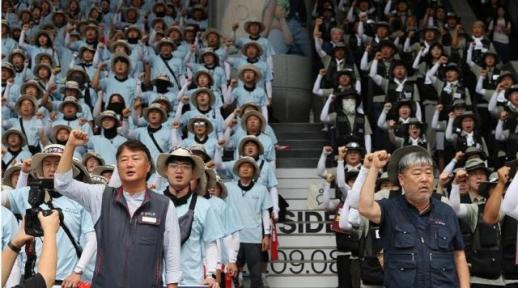 South Korea's union membership rises to 2.77 million SEOUL, December 04 (AJP) - South Korea’s trade union membership increased to 2.77 million at the end of last year, up by about 40,000 from a year earlier, the Ministry of Employment and Labor said on Thursday. The national unionization rate held steady at 13 percent as the pool of eligible workers continued to expand. The Federation of Korean Trade Unions (FKTU) remained the country’s largest labor umbrella group with 1.2 million members, accounting for 43.3 percent of total unionized workers. The Korean Confederation of Trade Unions (KCTU) had 1.079 million members, or 38.8 percent. About 490,000 workers were affiliated with independent unions. Unionization in the public sector remained significantly high at 71.7 percent, compared with just 9.8 percent in the private sector. Larger corporations also showed far stronger labor organization rates, with 35.1 percent of workers unionized at companies with more than 300 employees, versus only 0.1 percent at firms with fewer than 30 staff. * This article, published by Economic Daily, was translated by AI and edited by AJP. 2025-12-04 16:09:27
 -
 PHOTOS: A walk shaped by trains (Gwangju) -1- SEOUL, December 3 (AJP) - The flavors from lunch still linger, but now it is time to walk through Songjeong itself. Even without leaving the station area, small scenes reveal how long people have lived and moved through this neighborhood. The pace is slower here, and the traces of time sit close to the surface. Songjeong Kobrang Fairy Village — stories tucked between homes Past the 1913 market and deeper into the residential lanes, bright murals begin to appear along the walls. This is Kobrang Fairy Village, a compact cluster of alleys lined with scenes from children’s books — Alice in Wonderland, Peter Pan, Jack and the Beanstalk. Walking through feels a little like stepping into a paper page. What stood out most was that the village is not a staged attraction. People actually live behind the painted walls; children ran past while the murals watched quietly. The art is woven into everyday life, not placed on top of it.. Songjeong Small Art Museum — a brief, quiet stop A few steps beyond the village sits the Songjeong Small Art Museum, a compact space that operates free of charge. It is small enough to enter without hesitation and calm enough to make even a short visit meaningful. The current exhibition, “Revisiting Home,” features a local artist whose works bring back scenes familiar to older generations but almost foreign to younger ones. The scale is modest, but the care inside the space is unmistakable. Songjeong Maeil Market — a market still rooted in daily life Walking about ten minutes from the station leads to Songjeong Maeil Market. Even before arriving, the sound of vendors and customers reaches the street outside. Unlike the renovated 1913 market, this place has the unmistakable feel of a traditional, lived-in market. Most striking here were the people — far more locals than visitors. Grandparents carried shopping baskets, bargaining over vegetables and dried fish. Vendors called out to customers with easy familiarity. Nothing is polished or staged, and that is exactly why the market feels genuine. Back to the station — a short but full walk Leaving the market and returning to the station closed out nearly six hours of wandering. The fairy-tale alleys, the quiet museum, the crowded market — all small pieces of a neighborhood that moves at its own pace. Songjeong does not change quickly. Time moves more slowly here, but that slowness reveals the place more clearly. A trip connected by a single station. No long transfers, no complicated plans — just a neighborhood that shows its depth when walked slowly. 2025-12-04 15:59:54
 -
 Thailand marks National Day in Seoul with tribute to late Queen SEOUL, December 04 (AJP) - Thailand's ambassador to South Korea emphasized Bangkok's commitment to a more active global role and deeper cooperation with Seoul during a National Day reception held at Lotte Hotel Seoul on December 3. The event, hosted in the Crystal Ballroom, brought together about 300 diplomats, scholars, media members and business leaders, according to organizers. Before the formal program began, guests observed a one-minute moment of silence in memory of Her Majesty Queen Sirikit The Queen Mother, who passed away on October 24. Ambassador Tanee Sangrat opened his remarks by noting that Thailand's National Day marks four occasions: the National Day of the Kingdom, the birthday anniversary of the late King Bhumibol Adulyadej, Thailand's Father's Day and World Soil Day. "Thailand's National Day is a celebration of four important occasions," he said, highlighting the late king's contribution to sustainable soil and water management. Sangrat also paid tribute to the Queen Mother. "Her Majesty was revered for her tireless work and lifelong dedication to improving the welfare of her people," he said. "Her Majesty's benevolence and grace will forever remain in the hearts of all Thais and will remain one of the guiding lights for us." He said the government of Prime Minister Anutin Charnvirakul aims to pursue "a proactive and forward-looking diplomacy," adding that Thailand hopes to restore its "visibility on the global radar screen" while strengthening ties with South Korea. He described the relationship as "a multi-faceted and future-oriented strategic partnership." Sangrat pointed to senior-level exchanges during South Korea's year as the APEC host economy. "Prime Minister Anutin and President Lee Jae-myung met on the sidelines of APEC and reaffirmed their shared commitment to forging ever closer political, security and economic cooperation," he said, including efforts to speed up negotiations on the Comprehensive Economic Partnership Agreement. Turning to cultural and social ties, he highlighted the Sawasdee Seoul 2025 Thai Festival, which drew more than 100,000 visitors in October, and noted the Thai community in South Korea has grown to over 170,000. He said newly formed community groups, including the Thai Women's Council and the Thai Cultural Council, will play a role in strengthening cultural collaboration. The ambassador also outlined economic priorities, saying Thailand aims to raise bilateral trade from 15 billion to 30 billion US dollars and promote two-way investment. He cited this year's Ignite Thailand-Korea Business Forums in Seoul and Bangkok, as well as emerging academic partnerships in STEM and innovation involving institutions such as KAIST. (These details were stated by the ambassador.) South Korea's Minister of Unification Chung Dong-young, attending as guest of honor, described Thailand as "a treasured friend that stood with the Republic of Korea during the Korean War." He said the two countries have maintained 67 years of diplomatic relations, adding that "last year alone, over two million citizens from both countries visited each other." Chung also called Thailand "a crucial partner in strengthening cooperation between Korea and ASEAN." Addressing regional security, he said the Lee Jae-myung administration is "doing its utmost to open a new era of peaceful co-existence on the Korean Peninsula," adding that Seoul looks to Thailand and ASEAN "to encourage North Korea's participation in the international community." He closed with a toast to the guests: "To the friendship and prosperity of our two nations, and to even closer cooperation in the future." 2025-12-04 15:50:51
 -
 Fewer top scorers as last month's university exam proves tougher SEOUL, December 4 (AJP) - This year's university entrance exam was tougher than last year's, with only five students achieving perfect scores, down from 11 the previous year. According to test results released by the Korea Institute for Curriculum and Evaluation (KICE) on Thursday, five students including one retaker who took the test last month, scored perfectly across all sections. With English being the most challenging section, the number of perfect scorers in math dropped from 1,522 to 780, down 48.8 percent from a year ago. Kim Seung-geol, a researcher at KICE, said that while math, social studies, and science met anticipated difficulty levels, Korean language and English proved more challenging than expected. Lee Man-gi, an education expert, predicted that English scores would be a decisive factor in college admissions. Over 550,000 students took the annual exam at about 1,300 venues across the country on Nov. 13. * This article, published by Aju Business Daily, was translated by AI and edited by AJP. 2025-12-04 15:49:58
 -
 Travel guidebook event highlights Kazakhstan as 'blue ocean' for Korean tourists SEOUL, December 04 (AJP) - Kazakhstan's ambassador in Seoul said tourism is emerging as a new bridge between his country and South Korea, speaking at a book launch held at Lotte Hotel Seoul on December 3 for the travel guide "Travel Kazakhstan" by author Seo Byung-yong. "It's a delight for me to be in front of such a wonderful audience, the true friends of Kazakhstan and the wonderful partners who are always here to support us," Ambassador Nurgali Arystanov told guests at the Garnet Suite on the hotel's 37th floor. The audience included diplomats, officials from the travel industry and business leaders, according to event organizers. Holding up the newly published guide, Arystanov said the book arrived at a moment of deepening ties. "This book is not just yet another book. It's yet another built bridge between our two countries," he said. He noted that more than 1,800 South Korean companies now operate in Kazakhstan and pointed to roughly 20 weekly direct flights connecting the two countries. (The flight frequency figure was stated by the ambassador at the event.) He also referred to Kazakhstan as "the country in the heart of Central Asia," highlighting next year's planned C5+K summit that will bring the presidents of Kazakhstan, Kyrgyzstan, Uzbekistan, Tajikistan and Turkmenistan together with the South Korean president. "Central Asia is a beautiful region, beautiful food, beautiful cultures," he said, encouraging South Koreans to explore the wider region as well. Arystanov ended his speech by reciting the Korean proverb "seeing once is better than hearing a hundred times," adding that books can "open many doors, spark many dreams and bring our two nations even closer." Seo, who has written guidebooks for a decade, traced how his latest project took shape. His earlier titles on Moscow, Saint Petersburg, the Trans-Siberian Railway and Georgia had all focused on places that lacked detailed Korean-language guides at the time. He said the same gap existed for Kazakhstan. The author walked the audience through the structure of the new book, which covers Almaty, Astana, Shymkent, Aktau and Ush-Tobe, along with sample itineraries that combine Kazakhstan with Kyrgyzstan or Uzbekistan. He also pointed to the cover design, which uses yellow typography inspired by the Kazakh flag. "The blue represents the sky and water, the sun stands for abundance and the golden eagle symbolizes future flight," Seo said, adding that the cover image was provided by the Kazakhstan Embassy. A large portion of his talk focused on why he believes Kazakhstan will appeal to South Korean travelers. He listed seven points he said make the country "a blue ocean" for the travel market. The first was flight access. "There are so many direct flights now, with Air Astana, Asiana Airlines, Eastar and SCAT operating around 20 flights a week," Seo said. "This is a huge advantage when you design products or decide where to go." Second, he highlighted visa-free entry. "You do not need a visa for 30 days. If you have a passport, you can fly tomorrow," he said. Third, he argued that the perceived distance is misleading. "The flight to Almaty is about six and a half hours. Bangkok is around six hours, so it is not far at all," he said. His next points focused on scenery and food. Seo described Kazakhstan as "an Asian country that still feels exotic," pointing to places such as the rock formations and coastal desert around Aktau. At the same time, he said travelers rarely struggle with meals. "There are rice dishes, noodle dishes and plenty of meat," he said. "I don't think many people suffer because of the food." His sixth point centered on history, especially the legacy of ethnic Koreans who were deported to Central Asia in the 1930s. "For people interested in the history of Koreans abroad, Ush-Tobe and other sites linked to Koryoin history are very meaningful places," he said. Finally, he mentioned local attitudes and Kazakhstan's policy focus on tourism. "There is almost no discrimination, and the level of friendliness toward Koreans is something you have to experience yourself," he said, noting that Korean convenience store chains and food brands have been expanding in Almaty. (Expansion of Korean brands was mentioned by Seo at the event.) Seo said he hoped the book would be useful for independent travelers, pointing to sections covering local transport, currency, ride-hailing apps, SIM cards and practical travel tips. "We live in an era when more than 30 million South Koreans travel abroad each year," he said. "If this book can help turn curiosity about Kazakhstan into actual journeys, then I think it has done its job." 2025-12-04 15:24:13
 -
 TRAVEL: Historic private academy in Nonsan NONSAN, December 04 (AJP) - Nine Confucian academies, known as seowon, from Korea's Joseon Dynasty (1392–1897), were officially inscribed as a UNESCO World Heritage Site in 2019, cementing their status as crucial institutions in East Asian history and education. The seowon were private, residential academies established by respected Confucian scholars. They served two primary functions: as a place for scholarly worship of revered sages and as an educational institution to prepare the next generation of civil servants and intellectual leaders. This system stood in contrast to the hyanggyo, which were the public, state-run schools of the era. The seowon’s blend of academic rigor and moral cultivation made them vital centers for Neo-Confucianism, the Joseon Dynasty's ruling ideology. Among the nine recognized sites is Donam Seowon, located in the city of Nonsan, South Chungcheong Province. The academy traces its origins back to the influential scholar Sagye Kim Jang-saeng (1548–1631). Kim dedicated over three decades to teaching his disciples at this location, beginning in 1602. Following his passing, his devoted students established the academy in 1634 to honor his life and continuing legacy. Donam Seowon, with its tranquil architecture and deep historical roots, now serves as a tangible link to Korea's rich intellectual past. 2025-12-04 15:18:09