
Journalist

AJP
-
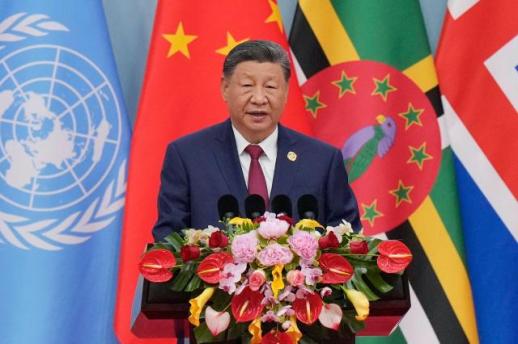 Business leaders to gather for dinner with Xi SEOUL, October 30 (AJP) - Chinese President Xi Jinping is making his first visit to South Korea in 11 years to attend the Asia-Pacific Economic Cooperation (APEC) summit in Gyeongju. According to industry sources, he is scheduled to meet with top business leaders and executives at a dinner to strengthen bilateral economic ties. The meeting is scheduled for Saturday, when the multilateral gathering wraps up. Attendees are expected to include leaders from top conglomerates such as Lee Jae-yong of Samsung Electronics, Chung Eui-sun of Hyundai Motor, Chey Tae-won of SK Group, and Koo Kwang-mo of LG Group. Among notable figures from the Chinese side, battery manufacturer CATL's chairman Zeng Yuqun and Chinese entrepreneur and former CEO of JD.com Liu Qiangdong, are expected to attend. "The dinner could be a chance to foster mutual understanding and improve relations between business leaders from both countries," one industry watcher said. Meanwhile, Xi arrives in South Korea on Thursday for a three-day stay, which includes a meeting with U.S. President Donald Trump. * This article, published by Economic Daily, was translated by AI and edited by AJP. 2025-10-30 09:54:05
 -
 Lee set for first summit with Japan's newly elected prime minister SEOUL, October 30 (AJP) - President Lee Jae Myung is expected to hold his first summit with Japan's newly-elected Prime Minister Sanae Takaichi on Thursday on the sidelines of the Asia-Pacific Economic Cooperation (APEC) summit in Gyeongju. With both sides still coordinating their schedules, the meeting is expected to take place later in the day. Takaichi, known as a staunch right-winger and a self-proclaimed successor to the late former Prime Minister Abe Shinzo, will also hold a series of talks with leaders of other countries during her three-day stay here. Despite her hardline stance on historical issues with South Korea as a key protégé of Abe's political legacies, she emphasized the importance of strengthening ties with South Korea through dialogue and mutual cooperation in her recent address at the Diet shortly after taking office as the island country's first female prime minister last week. Much attention is given to whether Lee and Takaichi can continue their shuttle diplomacy, in which the leaders of the two neighboring countries make regular reciprocal visits, as it was under her predecessor Shigeru Ishiba. 2025-10-30 09:19:08
 -
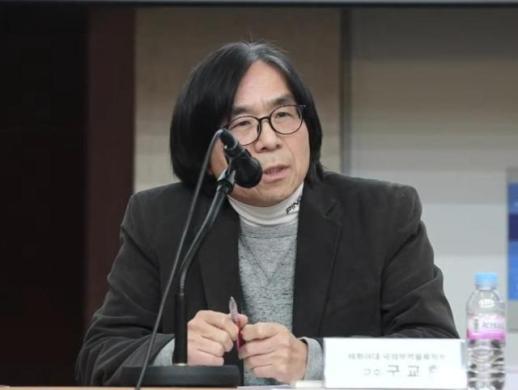 OPINION: Embracing 'creative destruction' in South Korea's shipping industry SEOUL, October 30 (AJP) - This year’s Nobel Prize in Economics celebrated the power of innovation and sustainable growth through the lens of “creative destruction.” Co-recipient Prof. Peter Howitt underscored the need for a competitive environment that enables market leaders to keep innovating — a concept rooted in Joseph Schumpeter’s classic theory that progress is driven as much by destruction as by creation. That message resonates deeply with South Korea’s shipping industry, which is struggling to adapt to what many call the “Big Blur” era — when traditional industry boundaries are dissolving. Global giants like Amazon and Tesla have already transcended their original domains, evolving into platforms designed to solve complex customer problems. Yet South Korea’s shipping sector remains bound by convention, held back by resistance to mergers and acquisitions and a deep-seated wariness toward outside capital. The global landscape tells a starkly different story. Over the past two decades, the world’s leading shipping companies have expanded aggressively through M&A, consolidating their power and reshaping global logistics. Today, the top 10 players control roughly 84 percent of the world’s container capacity. Scale and integration have become prerequisites for survival. Against this backdrop, the planned privatization of HMM — the nation’s flagship carrier — is more than a question of ownership. It is a test of whether South Korea can move beyond its traditional view that only “shipping experts” can manage a shipping company. Such thinking risks isolating the industry at a time when cross-sector collaboration is the engine of global competitiveness. Elsewhere, the lines between manufacturing, logistics, and finance have long blurred. Germany’s Deutsche Post DHL and Denmark’s Maersk have both built integrated logistics ecosystems, creating resilient structures that can weather economic turbulence. South Korea’s shipping industry, by contrast, has struggled to escape the shadow of its past. The collapses of Hanjin Shipping and Hyundai Merchant Marine were not just business failures — they were symptoms of an industry that resisted change until it was too late. If HMM is to avoid a similar fate, it must embrace creative destruction and the discipline of private ownership. Clinging to old models, protecting vested interests, and erecting barriers to competition may feel like safety — but only in the short term. In the long run, such strategies erode competitiveness and innovation. The industry’s future depends on openness, flexibility, and diversification. As the saying goes, “Those who build walls perish; those who build roads prosper.” South Korea’s shipping industry must stop building walls around itself and instead build the roads that connect technology, capital, and service into a unified logistics platform. What the industry needs now is not fear of disruption but the courage to pursue it. Breaking down boundaries and reshaping industrial order is not a threat — it is the path to renewal. The question is whether South Korea’s shipping leaders will have the will to chart that course before the tide turns against them once again. * This article, published by Aju Business Daily, was translated by AI and edited by AJP. 2025-10-30 08:54:17
 -
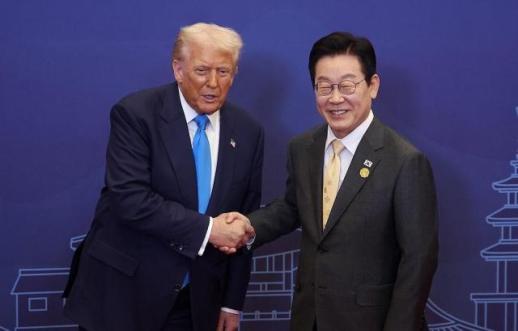 Trump gives a go-ahead to Korea's nuclear submarine project GYEONGJU, October 30 (AJP) - After concessions over upfront cash payment in the $350 billion investment package from South Korea, U.S. President Donald Trump gave a go-ahead to Korean production of nuclear-powered submarine in a show of "stronger-than-ever" bilateral relations, indicating upgrade in military ties to the highest level, given Washington's protectiveness of nuclear submarine technology. "I have given them approval to build a nuclear-powered submarine, rather than the old fashioned, and far less nimble, diesel powered submarines that they have now," Trump wrote on his Truth Social account after he accepted President Lee Jae Myung’s argument for Seoul’s need to transition from diesel to nuclear propulsion in their second face-to-face summit on the sidelines of the Asia-Pacific Economic Cooperation meetings in Gyeongju. "This decision marks a historic step in advancing our security cooperation," he added. Washington shares its nuclear submarine technology with only a select few — the United Kingdom and Australia — underscoring the sensitivity and significance of Trump’s approval. Trump, who was adorned with a gold-glittering ancient crown and awarded South Korea’s highest honor during his visit, declared the bilateral alliance “stronger than ever,” calling Lee “a great president of South Korea.” The nuclear-powered submarine will be built at Philly Shipyard, which was purchased last year by Korea’s Hanwha Group. Trump’s endorsement came shortly after Seoul and Washington finalized details of the $350 billion investment pledge, including $150 billion dedicated to shipbuilding cooperation. A separate White House fact sheet said Korean Air will purchase 103 new Boeing aircraft valued at $26.2 billion, along with GE Aerospace engines worth $13.7 billion. Trump arrived in South Korea on Wednesday for a two-day trip. He is scheduled to meet Chinese President Xi Jinping on Thursday amid an escalating U.S.-China trade war. 2025-10-30 07:56:48
 -
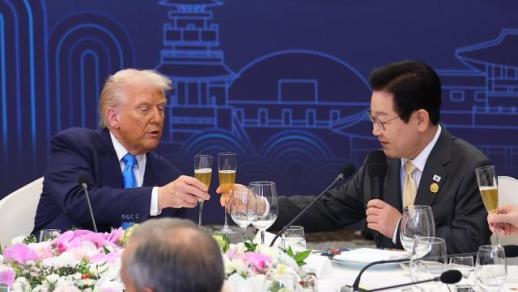 Upon "golden" treatment, Trump agrees to a trade deal with South Korea GYEONGJU, October 29 (AJP) -— President Donald Trump on Wednesday agreed to Seoul’s terms on South Korea’s $350 billion investment package after months of wrangling, clearing the way for a sweeping trade deal on the sidelines of the Asia-Pacific Economic Cooperation Summit, according to Seoul's presidential office. The agreement—$200 billion in cash and $150 billion in shipbuilding projects led by Korean firms—will cut U.S. tariffs on Korean autos from 25 percent to 15 percent, bringing them in line with rates applied to Japan and Europe, which reached similar deals with Washington, presidential chief of staff Kim Yong-beom told reporters in a briefing in Gyeongju. Kim said the annual cash outlay would be capped at $20 billion and distributed over several years depending on project progress. Final approval had been delayed since July as Seoul pushed for installment payments and non-cash components, arguing that a one-time $350 billion transfer—equivalent to roughly 80 percent of Korea’s foreign exchange reserves—risked destabilizing the won. Trump, up until his arrival in Korea, had publicly insisted that Seoul pay “upfront cash.” The breakthrough came after President Lee Jae Myung rolled out an unmistakably “golden” welcome for Trump visiting Korea on the final leg of his first Asian tour in his second presidency. Lee presented Trump with a replica of an ancient Silla gold crown and awarded him the Grand Order of Mugunghwa — Korea’s highest honor — citing his “contributions to peace on the Korean Peninsula.” The gesture played to Trump’s well-known affinity for gold and ceremonial recognition. Kim said the trade package includes most-favored-nation status for Korean pharmaceuticals and wood products, tariff-free access for aircraft parts, generics and non-U.S. natural resources, and semiconductor tariffs aligned with rates applied to Taiwan. Crucially, Korea secured protection for its agricultural sector, avoiding additional openings for rice and beef. Safeguards were built into the investment structure, Kim added. Payment timing and scale may be adjusted if foreign-exchange volatility rises, and only commercially viable projects will proceed under a memorandum of understanding emphasizing “multi-layered” risk controls. Profits will be split evenly between the two countries until principal repayment, with terms adjustable if full repayment is not met within 20 years. The agreement runs through January 2029. The “golden” diplomacy extended beyond the negotiation room. Lee greeted Trump at the National Gyeongju Museum wearing a custom golden tie embroidered with Korean script representing a “golden future” for the alliance. Trump, in a blue tie, laughed and shook hands warmly. He toured an exhibition of Trump-themed memorabilia — from MAGA hats to Korean-language editions of his books — asking aides to send photos to his wife, Melania. A luncheon followed, featuring fusion dishes including New York–inspired courses blended with regional Korean ingredients. Another crucial deal-making awaits Trump as he is slated to meet Chinese President Xi Jinping, also here for the APEC conference, on Thursday. Trump, meanwhile, said he won't be meeting North Korean leader Kim Jong-un who has not returned the U.S. president's repeated invite. * This article, published by Aju Business Daily, was translated by AI and edited by AJP. 2025-10-29 21:33:47
 -
 S. Korean economists see signs of rebound, but growth momentum remains fragile SEOUL, October 29 (AJP) - South Korea’s economy is showing clearer signs of recovery, led by rebounding semiconductor exports and stronger outbound shipments, suggesting that the country may have passed the bottom of the current downturn. According to preliminary data released by the Bank of Korea on Monday, real gross domestic product (GDP) grew 1.2% in the third quarter from the previous quarter, beating market expectations of 1.0%. It marked the fastest quarterly expansion in a year and a half, driven by stronger exports of chips and autos as well as government measures to boost consumer spending. Economists said the recovery is evident but remains moderate. Many forecast growth to stay in the mid-1% range next year. Cho Dong-geun, professor emeritus of economics at Myongji University, said the rebound in the semiconductor industry has been the key driver. “AI-related chips are fueling the turnaround, with SK hynix and Samsung Electronics leading the recovery across the broader industrial landscape,” Cho said. He added that rising chip exports are improving corporate earnings, which in turn support wages and domestic consumption. “When companies make profits, those gains circulate back into the domestic economy,” he said. However, Cho cautioned that “domestic demand remains weak, as seen in the rise of small business closures and sluggish service-sector activity.” He stressed the need for a more business-friendly environment, saying, “Regulatory easing and tax incentives would help companies expand. High inheritance taxes, for instance, discourage firms from raising share prices. Relaxing those taxes or expanding investment credits could create a virtuous cycle for corporate growth and domestic demand.” Kim Jeong-sik, an economics professor at Yonsei University, said the government’s two supplementary budgets this year boosted public spending and helped lift consumption. “The combination of fiscal expansion and export recovery has driven growth higher,” he said. Kim projected next year’s GDP growth could reach 1.6% to 1.8% if trade negotiations between South Korea and the United States conclude smoothly. “Domestic demand is still fragile, but if the government uses its fiscal resources efficiently to support the construction sector, gradual improvement is possible,” he said. He added that the outcome of the Korea-U.S. trade talks would be a “crucial factor” shaping the upper end of next year’s growth outlook. Lee Hong-joo, a consumer economics professor at Sookmyung Women's University, attributed the stronger-than-expected 1.2% quarterly growth—up from an earlier estimate of 0.8%—to broad-based industrial improvements. “Orders for large offshore plant projects in the shipbuilding sector, increased defense exports, and rising semiconductor shipments all contributed to the positive momentum,” he said. Lee noted that both public and private consumption rose, not only due to short-term stimulus measures such as shopping coupons, but also because “those incentives encouraged additional spending, creating a multiplier effect that expanded overall consumption.” Still, he pointed to ongoing weaknesses in construction and agriculture as drags on the recovery. “Conditions will likely improve in 2025 and 2026, but it’s too early to say the economy has entered a full-fledged rebound,” he said. Economists agree that while the third-quarter GDP data signal a turning point, South Korea’s recovery remains uneven. Without a stronger rebound in domestic demand and construction, they say, the economy may struggle to enter a sustained expansion phase. Overall, most experts share the view that South Korea has passed its lowest point and entered a gradual recovery cycle—but its pace will depend heavily on policy direction and external economic conditions. 2025-10-29 17:59:53
 -
 Korea's young pharma breed Samsung Biologics and Celltrion bulk up as bottom line holds SEOUL, October 29 (AJP) - Korea's relatively young pharma heavyweights Samsung Biologics and Celltrion are outgrowing their older peers at home and abroad through aggressive and unconventional expansion. Samsung Biologics, founded in 2011, has scaled up relentlessly and now ranks No. 3 in the global contract development and manufacturing organization (CDMO) market. Within its second Bio Campus in Songdo, Incheon, the Samsung Group unit plans to complete Plants 6 to 8 by 2032, raising total capacity to 1.324 million liters — the largest for any single company worldwide. The massive scale is expected to give Samsung Biologics a structural edge in securing long-term production contracts with multinational drugmakers and position it as an industry power rivaling Samsung’s influence in semiconductors. Celltrion, established in 2002 as a pure drug maker, is expanding through M&A. It recently joined the small group of Korean pharma companies with production bases in the United States, which accounts for roughly half of prescription-drug sales revenue among OECD countries. Last month, Celltrion signed a deal to acquire Eli Lilly's biopharmaceutical manufacturing plant in Branchburg, New Jersey, for about 460 billion won. With planned expansion, total investment is expected to reach 1.4 trillion won — a move designed to reduce tariff risks, cut logistics costs, and strengthen supply-chain stability for North American demand. Their bold expansion rests on a solid bottom line and deep pipelines. Samsung Biologics on Tuesday reported consolidated revenue of 1.66 trillion won ($1.2 billion) and operating profit of 728.8 billion won for the third quarter, up 39.9 percent and 115.3 percent on year, respectively. Celltrion posted consolidated revenue of 1.26 trillion won and operating profit of 301 billion won, marking year-on-year gains of 16.3 percent and 44.9 percent. Samsung Biologics has climbed to the No. 3 global CMO position behind Switzerland's Lonza and China's WuXi Biologics, according to MarketsandMarkets. The CMO market is projected to grow 8.8 percent annually, reaching $34.1 billion by 2030 from $20.5 billion in 2024. 2025-10-29 17:59:41
 -
 Why HBM defines the AI race and seats SK hynix in the lead SEOUL, October 29 (AJP) - DRAM has long been the dependable workhorse of computing — a flat, two-dimensional structure built to read and write data one cycle at a time. It remains essential for general-purpose CPUs, but its architecture is now running into hard physical limits as artificial intelligence demands exponentially higher data throughput. High Bandwidth Memory (HBM) upends that classical design. Instead of laying chips out side-by-side, HBM stacks multiple DRAM layers vertically and connects them with microscopic conduits called Through-Silicon Vias (TSVs). This 3D structure forms an ultra-dense memory tower that delivers dramatically higher bandwidth and capacity within the same or smaller footprint. The difference is not cosmetic — it is foundational. AI training and inference shuffle enormous datasets between processors and memory in real time. Conventional DRAM becomes a bottleneck: a single-lane road trying to handle multi-lane traffic. HBM, by contrast, functions like a multilayer expressway, giving GPUs the bandwidth needed to process massive models without choking the system. Nvidia’s A100 GPU illustrates this shift. Equipped with HBM, it delivers nearly double the bandwidth and memory capacity of its GDDR-based counterpart, the A6000, while maintaining the same physical size. More memory per card means frontier AI models no longer need to be fragmented across multiple GPUs, reducing overhead and accelerating performance. HBM is expensive — far pricier than DDR memory — but in the AI era, cost per gigabyte no longer determines value. What matters is speed, stability, and total usable capacity. For companies training frontier models, HBM is no longer optional but essential infrastructure. This is also why SK hynix has surged to the front of the global memory race. Though traditionally quiet and engineering-driven, the company was first to mass-produce every major generation of HBM — from HBM2E to HBM3E — and consistently delivered memory that met Nvidia’s exacting standards for heat management, power efficiency, uniformity, and defect tolerance. Its lead in TSV processing and 3D stacking has translated into higher yields and greater reliability than rivals. For Nvidia, which cannot risk memory-induced bottlenecks in its flagship AI accelerators, that reliability has proven decisive. SK hynix has become its primary supplier for the H100, H200, and next-generation B-series GPUs. The combination of early technical leadership, rigorous quality control, and quiet operational execution has allowed SK hynix — long overshadowed by Samsung Electronics in traditional DRAM — to seize the decisive high ground in the AI memory era, powering the company’s record-breaking performance as the world enters a new AI super-cycle. 2025-10-29 17:55:30
 -
 South Korea expands visa programs to lure foreign talent SEOUL, October 29 (AJP) - Amid a global race to attract top talent, South Korea is opening its doors to international professionals through a series of new policies, especially those from Asian countries where South Korean companies already have production networks and academic partnerships. Internship program for foreign talent Earlier this week, the Ministry of Justice introduced the so-called "K-Trainee" program, which is designed to help South Korean companies find and foster potential foreign talent before formally hiring them. The program, set to be piloted for two years, will focus on nine Asian countries - China, India, Indonesia, Japan, Malaysia, the Philippines, Singapore, Thailand, and Viet Nam - where South Korean companies have their branches, factories, and other facilities. Those eligible include students in their third year or higher including those pursuing master's or doctoral degrees who are enrolled at universities with training partnerships with South Korean companies in their home countries, as well as professionals working at overseas subsidiaries of South Korean companies in 77 occupations eligible for E-7-1 and E-7-2 visas. They will be invited to take part in a professional internship program in South Korea for a certain period, helping them become familiar with the local working environment. The ministry said that through this program, businesses can quickly retain "reliable" foreign workers to meet their needs, while foreign talent can enhance their practical skills and have the opportunity to build their careers here. At the same time, requirements for the issuance of a D-10 visa, which allows foreign graduates to engage in professional internships, were eased to extend the maximum length of stay from two years to three years, both for those in South Korea and abroad. For applicants from the world's top 200 universities or the top 1,000 universities for engineering majors in the aforementioned Asian countries, Korean language proficiency requirements and visa procedures are either reduced or waived. Justice Minister Jeong Seong-ho said, "This internship program will enable companies to quickly find the talent they need, while top foreign jobseekers can enhance their practical skills and grow into a driving force for future growth here." Program for high-skilled foreign workers Another special visa program for top professionals, called the "K-STAR Visa Track," was introduced early last month to attract talent in the STEM fields (Science, Technology, Engineering, and Mathematics). The program allows highly qualified foreign experts, researchers, and professors in key fields such as artificial intelligence (AI), semiconductors, next-generation batteries, and biotechnology to receive long-term visas as well as several incentives to support their settlement here. Its fast-track visa process enables outstanding scientists and experts to remain in South Korea after just three years of work, instead of the normally required five years. South Korea aims to attract at least 400 such STEM professionals each year through this program. To facilitate this, research institutes, universities, and conglomerates such as Samsung Electronics, SK hynix, and Hyundai Motor are participating. Since March this year, the Seoul Metropolitan Government has also been running an online platform to connect international professionals and provide useful information on housing, daily life, and other administrative procedures, in cooperation with relevant companies. Global race to attract top talent After the U.S. raised H-1B visa fees to a whopping $100,000, countries such as China, Japan, Singapore, and the U.K. have moved quickly to either launch or strengthen policies to retain top-tier professionals. Japan has maintained a similar program since 2012, allowing applicants to apply for permanent residence after just one year if they reach a certain amount of points. However, many restrictions still exist due to language and cultural barriers. Singapore has a program called the "Global Investor Programme (GIP)" for international investors. Although it is not exactly aimed at recruiting professional workers, it demonstrates a strategy to attract both capital and top talent. Singapore, where English is widely spoken, makes it easier to attract talented workers than many other Asian countries, although its market size and industrial base are somewhat smaller than South Korea’s in terms of manufacturing. Since 2009, China has been operating a program dubbed the "Thousand Talents Plan," an initiative that aims to attract foreign scientists by providing various benefits including funding for research. In 2013, China introduced the "R visa" to attract top talent, and recently the State Council announced plans to issue a "K visa" for young foreign scientists and technical experts. The "K visa" targets young foreigners who have graduated from renowned universities or research institutions, both at home and abroad, and hold a bachelor's degree or higher in STEM (science, technology, engineering, and mathematics) fields. Applicants must meet the conditions set by the Chinese government and submit the required documents. "K visa" holders will be able to engage not only in the fields of education, culture, science, and technology after entry, but also in related startups and business activities. Compared to these countries, South Korea is pursuing a two-tier strategy: the K-Trainee program to attract young skilled foreign talent who are in the learning stage or have just begun working, and the K-STAR Visa to invite highly qualified experts ready to contribute immediately to strategic industries. According to a study conducted by the Korea Chamber of Commerce and Industry, together with researchers led by Professor Kim Duk-pa of Korea University and released in August, attracting 1 million skilled foreign workers could boost South Korea's GDP by 6 percent, equivalent to roughly 145 trillion won ($104.3 billion). "When highly skilled foreign experts with specialized knowledge come to South Korea, it's not just about population growth. It also boosts consumption and can maximize the economic ripple effect by improving labor productivity, enhancing industrial competitiveness, and promoting the industrial structure," said Kim. 2025-10-29 17:46:57
 -
 HOT STOCK: Power equipment stocks rally on Saudi contract, US nuclear cooperation hopes SEOUL, October 29 (AJP) - Shares of South Korean electrical-equipment makers, particularly transformer manufacturers, climbed sharply on Wednesday after a consortium led by Korea Electric Power Corporation (KEPCO) was named the preferred bidder for a major wind power project in Saudi Arabia — a decision that investors saw as a boost for Korean exports in the energy-infrastructure sector. Saudi Arabia’s Ministry of Energy announced Tuesday that the KEPCO consortium had been selected to develop the Dawadmi Wind Independent Power Producer (IPP) project in Riyadh Province, about 250 kilometers west of the capital. The project, estimated at 9 billion Saudi riyals ($2.4 billion), will generate up to 1,500 megawatts, or 1.5 gigawatts — roughly equivalent to the output of a nuclear reactor. It marks the first time a South Korean consortium has secured a gigawatt-class power generation contract in Saudi Arabia. The massive scale of the project is expected to drive strong demand for high-voltage transformers, a key component for transmitting and regulating the plant’s electricity output. That expectation sent transformer-related stocks higher across the KOSPI. Hyosung Heavy Industries rose 4.4 percent to close at 1.99 million won ($1,396), extending gains after recent strong earnings. The company, already a major supplier to North America and Europe, has steadily expanded its footprint in the Middle East, where second-quarter 2025 sales accounted for about 6 percent of total revenue. HD Hyundai Electric added 1.6 percent to 852,000 won, while LS Electric jumped 9.2 percent to 420,000 won, leading the rally as investors anticipated potential new orders from the KEPCO-led project. The surge reflects both optimism surrounding Saudi contracts and the sector’s robust fundamentals. HD Hyundai Electric reported 3.32 trillion won in revenue and 669 billion won in operating profit last year — more than double the previous year’s figures. Hyosung Heavy Industries posted 4.9 trillion won in revenue and 363 billion won in operating profit. Analysts expect the trend to continue: Mirae Asset Securities projects HD Hyundai Electric’s 2025 revenue will reach 4.03 trillion won, with profit margins rising to 22.7 percent. Investor sentiment also drew strength from expectations of deepening Korea–U.S. energy cooperation. Seoul and Washington are reportedly discussing a policy initiative known as “Make American Nuclear Cooperation Great Again,” or MANUGA, aimed at revitalizing America’s nuclear industry. Extra-high-voltage transformers — a specialty of South Korean firms — are critical for distributing power from nuclear plants, positioning Korean manufacturers as likely beneficiaries of the proposed collaboration. President Lee Jae Myung and President Donald Trump discussed energy cooperation on Wednesday during the APEC 2025 summit in Gyeongju, further bolstering market enthusiasm. “South Korea will contribute its expertise in nuclear construction, equipment, and operations to new U.S. reactor projects,” said Hwang Sung-hyun, a researcher at Eugene Investment & Securities. “In return, the U.S. aims to rebuild its nuclear infrastructure and enhance energy security — positioning Korea not just as an exporter, but as a strategic partner in America’s nuclear renaissance.” 2025-10-29 17:10:46