

Journalist

KI SU JEONG
-
 Everland Hosts 'Football and Taco' Event Amid Rose Festival Everland, operated by Samsung C&T's resort division, is welcoming visitors this June with an exciting soccer event titled 'Football and Taco' alongside its stunning Rose Festival featuring 3 million blooming roses. On June 4, Everland announced that it has chosen soccer as the theme for the sixth installment of its monthly special project, the 'Whatever Series.' This initiative offers guests unique experiences each month. At the festival content zone in front of Everland's Alpine Village, a 'Football Training Camp' has opened, allowing participants to complete training missions and earn rewards. Guests can engage in position-specific missions for forwards, goalkeepers, and midfielders, as well as additional bingo challenges to record their scores. Based on their total points, participants can receive prizes such as Amazon Express Q-Passes, cheering tools, and soccer merchandise. A special program where guests can experience actual soccer skills is also available. Every Friday and Saturday, elementary school students can learn techniques from freestyle soccer experts Lee Hyun-yong and Park Jin-seok of the 'Lycats Crew.' From Wednesday to Sunday, a recreational event called 'High-Intensity Training with Coaches' will take place. Photo zones reminiscent of soccer fields and training camps will be set up throughout the area. A special photo opportunity featuring the character 'Jack' dressed in soccer-themed attire will also be available. Collaborative merchandise between the K League 2's Suwon Samsung and Everland characters will be sold at the camp's shop. Adjacent to the soccer experience area, a 'Mexican Food Street' has been established, featuring four food trucks offering a variety of dishes, including Mexican chicken tacos, walking tacos, elote, and Mexican shrimp. Additionally, the zoo will host a prediction event linked to its animal enrichment programs. Throughout June, visitors wearing soccer jerseys will receive discounts on admission and benefits for camp participation through the 'Play & Cheer Up!' promotion. After an energetic day, visitors can unwind at the Everland Rose Festival, which opened on May 22 and is currently at its peak. The festival, themed around a classic hotel garden called 'Hotel Loroiti,' has attracted approximately 200,000 visitors within its first ten days. The current rose bloom rate is about 90%. In the Rose Garden, guests can explore over 40 varieties of the homegrown garden rose 'Everrose,' developed by Everland since 2013. In the 'Rose Lab' experience area, visitors can smell four types of Everrose, while a fragrance delivery robot named 'Roji' circulates throughout the garden. A popularity vote for a new rose variety, set to be officially launched soon, is also being conducted both online and offline. At night, the 'Purple Rose Zone' and a 3-meter tall chandelier photo zone will feature garden lighting displays. Jazz band performances will take place daily. Rose-themed food and merchandise are also attracting attention. At the restaurant Cucina Mario, a pizza shaped like a rose made with beef and rose-flavored ade will be offered, while snack booths will sell heart-shaped churros and roseberry ice cream. Visitors can also find over 20 new merchandise items inspired by the artist Daria Song.* This article has been translated by AI. 2026-06-04 17:03:00
 -
 Shifts in Seoul's Apartment Supply: Hyundai Engineering Leads, Daewoo and Lotte Follow Interest is growing in the changing rankings of construction companies in Seoul's apartment supply market. Hyundai Engineering & Construction has taken the lead, with Daewoo Engineering & Construction and Lotte Engineering & Construction closely following. According to the real estate industry on June 4, Hyundai Engineering & Construction has secured the largest share of the planned general sales in Seoul this year. The company is maintaining its top position with projects like 'The H Class' in Banpo-dong, Seocho-gu, and 'The H Kentronine' in Heukseok-dong, Dongjak-gu. The H Class is a large complex being developed through the reconstruction of the Banpo Jugong 1st Complex, consisting of a total of 5,007 units, with 1,832 units expected to be available for general sale. The H Kentronine, part of the Heukseok 9 district redevelopment project, is also expected to offer around 430 units for general sale. Together, these two projects will provide Hyundai Engineering & Construction with over 2,000 units available for general sale in Seoul. Daewoo Engineering & Construction is also likely to rank high in Seoul's supply this year. Key projects include 'Jangwi Prugio Mark One,' part of the Jangwi 10 district redevelopment, as well as 'Summit Hill' in Heukseok 11 district and 'Summit the Tresia' in Noryangjin 5 district. Notably, Jangwi Prugio Mark One is a significant project with over 1,000 units available for general sale, which will boost Daewoo's ranking in Seoul's supply. Lotte Engineering & Construction continues its supply in Seoul through projects like 'Bukhansan Signature Castle' in the Galhyeon 1 district redevelopment, along with 'Bangbae Leel' and 'Ichon Leel.' After establishing a presence in the Seoul market last year with key locations like Jamsil Leel, Lotte is promoting both northern and southern redevelopment projects this year. Samsung C&T has supplied 'Raemian Elavine' this year, a reconstruction project in the Banghwa 6 district of Gangseo-gu. This complex consists of 557 units, with 272 units available for general sale. However, Samsung C&T's supply this year appears to have significantly decreased compared to last year. The rankings for supply in Seoul this year seem to be influenced more by the approval of redevelopment projects, schedules of associations, pricing, and market conditions than by the capabilities of individual construction companies. Given the limited supply of new land in Seoul, most of the supply from large construction companies comes from reconstruction and redevelopment projects. The timing of sales for major redevelopment projects can greatly affect rankings, even for the same company. Industry experts anticipate that this year's Seoul sales market will see demand concentrated around major complexes in the Gangnam area. Despite rising construction costs and pricing pressures, the scarcity of new developments in key locations in Seoul remains high. A representative from a major construction company stated, "Supply in Seoul is inherently limited, so the impact of confirmed redevelopment project sales is significant. This year's rankings are likely to be determined more by the schedules of large projects than by the annual strategies of individual construction companies."* This article has been translated by AI. 2026-06-04 17:03:00
 -
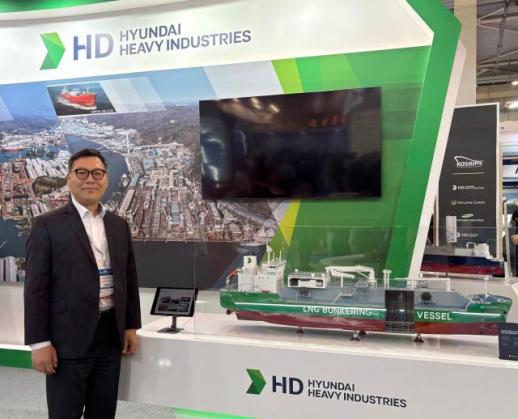 Future of K-Shipbuilding Amid War: Key Survival Strategies from Korea's Big Three The Posidonia 2026, the world's largest maritime and shipbuilding exhibition, has opened in Athens, Greece. This event brings together global shipowners, shipbuilders, and energy companies, focusing on the future competitive landscape surrounding eco-friendly transitions, artificial intelligence (AI), autonomous navigation, and energy security. Aju Economy has visited the Posidonia venue to explore the opportunities, challenges, and future growth strategies facing K-Shipbuilding amid global market changes. The global shipping and shipbuilding market is rapidly restructuring due to the impacts of the Middle East conflict. Disruptions in energy supply chains have increased demand for energy carriers, presenting new opportunities for the shipbuilding industry. Executives from Korea's three major shipbuilders participating in the Posidonia 2026 on June 4 identified energy transport, eco-friendliness, and digital technology as key factors determining future competitiveness. While past competitiveness in shipbuilding was based on construction capabilities and order volumes, the new benchmarks are expected to be energy security, eco-friendly ship technology, and AI-driven digital innovation capabilities. ◇ Turning Crisis into Opportunity: Energy Security Creates New Demand Jeong Ihyo, Executive at HD Hyundai Heavy Industries, stated, "The ongoing geopolitical risks, such as the situation in the Middle East, have significantly reduced predictability in the shipbuilding and shipping markets. I anticipate that the second half of the year will see robust trends based on energy security and eco-friendly transitions." Yoon Jae-kyun, Vice President and Head of Sales at Samsung Heavy Industries, noted, "The war in the Middle East has led to a surge in global energy prices, increasing volatility in the shipbuilding sector, including rising prices for second-hand vessels and charter rates." However, they emphasized that this market uncertainty represents an opportunity rather than a crisis. Jeong remarked, "Uncertainty does not necessarily lead to a decline in demand. Ultimately, what matters is our agility in responding to changes." Kang Sang-don, Executive at Hanwha Ocean, also highlighted that recent geopolitical risks are driving new demand. He explained, "The prolonged war has led to increased orders for energy and tanker vessels, such as Very Large Crude Carriers (VLCCs) and Very Large Gas Carriers (VLGCs). We expect orders to ramp up, particularly around U.S. liquefied natural gas (LNG) export projects." Yoon added, "The conflict in the Middle East is prompting countries worldwide to diversify their energy supply sources. The decrease in LNG production in the region could lead to longer transportation distances and increased project investments and long-term supply contracts." ◇ Shared Vision for the Future, Yet Diverse Survival Strategies While the executives shared a common outlook on the future of the shipbuilding industry, their proposed solutions varied. HD Hyundai emphasized AI and digital technology, Samsung Heavy Industries focused on eco-friendly initiatives, and Hanwha Ocean highlighted LNG value chain competitiveness. Jeong noted, "At this Posidonia, global shipowners have shown significant interest not only in traditional physical Energy Saving Devices (ESDs) but also in AI-based digital ESDs. The combination of eco-friendly technology and digital solutions is enhancing market trust in vessel performance." Indeed, HD Hyundai has garnered considerable interest and trust from global shipowners through its autonomous navigation solution, HiNAS Control. This solution has secured over 350 orders, including a contract for 40 vessels with domestic shipowner HMM, proving its commercial viability. HD Hyundai achieved the most significant collaborative outcomes at this Posidonia, signing over ten global agreements, the highest among Korea's three major shipbuilders. Yoon stated, "Samsung Heavy Industries is solidifying its competitiveness in the global market as a leader in the LNG value chain, from floating liquefied natural gas facilities (FLNG) to LNG ship terminals (FSRU) and LNG carriers. Recently, we are also nurturing a floating data center business as a future growth area due to rising AI demand." Hanwha Ocean emphasized its LNG competitiveness. Kang remarked, "We have a portfolio that can secure profitability across various vessel types, focusing on LNG carriers and VLCCs. We will collaborate with group affiliates, including Hanwha Shipping, to expand the value chain from LNG trading to transportation, securing a competitive edge." ◇ China's Pursuit Remains Intense: Focus on Technology, Not Price The executives identified China as the most significant variable in the market. However, they agreed that by prioritizing technology and trust over price competition, they could maintain their competitive edge. Jeong acknowledged, "It is true that China poses a threat. However, we will maintain our competitiveness in high-value markets based on our technological capabilities, software strengths, and delivery reliability." Yoon also emphasized, "Ultimately, technological competitiveness is key. As new energy sources like ammonia, hydrogen, and small modular reactors (SMRs) emerge, it is crucial to proactively secure related technologies." Kang added, "While it is true that Chinese shipyards are expanding their market share, this reflects a difference in order strategies focused on price. Korean shipyards maintain competitiveness in high-value markets based on quality, delivery, and profitability." 2026-06-04 17:03:00
 -
 US Judge Warns Trump Tariff Refund Appeal Could Disrupt Online Claims System A U.S. International Trade Court judge has warned that an appeal regarding tariff refunds from the Trump administration could disrupt the existing online claims system. On June 3, Richard Eaton, a judge at the International Trade Court, stated in a letter released that if the Justice Department's request for immediate intervention by the appeals court is granted, it could impact the online claims system that has processed at least $85 billion in refunds. The Justice Department contends that this online claims system was established under the government's own authority, not at the direction of Judge Eaton. In response, Eaton acknowledged the government's efforts to disburse refunds but cautioned that any intervention in the ongoing litigation could hinder progress toward resolving the cases. Eaton also submitted a 30-page document demonstrating that U.S. government agencies created the online claims system in response to his rulings, countering the government's assertion that it was built 'voluntarily.' It is rare for a judge to directly rebut an appellant challenging their ruling. However, Bloomberg noted that the tariff refund litigation has been conducted in an unusually manner overall. Previously, Eaton has overseen thousands of lawsuits filed by importers seeking tariff refunds. Most of these cases were on hold until the Supreme Court ruled in February that the so-called 'reciprocal tariff' was illegal. The Liberty Justice Center, which represents small businesses, stated that the progress made in the illegal International Emergency Economic Powers Act (IEEPA) tariff refund process was due to the court's order for the government to take action. The Customs and Border Protection (CBP) agency reported that there are currently $85 billion worth of tariff refund claims being processed or in the process of being paid to importers.* This article has been translated by AI. 2026-06-04 17:00:00
 -
 Candidates for Prime Minister Under President Lee Include Jeong Seong-ho and Others President Lee Jae-myung's candidates for the second-term Prime Minister position have reportedly narrowed down to three individuals: Jeong Seong-ho, Minister of Justice; Han Seong-sook, Minister of SMEs and Startups; and Kang Hoon-sik, Chief of Staff.According to political sources on June 4, the verification process for these candidates is underway as potential successors to Prime Minister Kim Min-seok.The Blue House plans to finalize the Prime Minister appointment soon and will subsequently proceed with personnel changes in the Cabinet and the Blue House.Minister Jeong is noted as a long-time ally of President Lee, having been a classmate at the Judicial Research and Training Institute and a prominent figure in the pro-Lee faction. He has demonstrated solid performance as Minister of Justice, leading efforts for prosecutorial reform.Minister Han, a former CEO of Naver, is currently spearheading the government's policies focused on small and medium-sized enterprises and the livelihoods of small business owners. If appointed, she would become the first female Prime Minister of this administration and the first woman to hold the position since former Prime Minister Han Myung-sook.Chief of Staff Kang is regarded as one of President Lee's closest aides since the new administration took office. He has effectively managed the Blue House without incident over the past year and has gained experience in diplomatic and economic matters as the President's special envoy for strategic economic cooperation.However, the Democratic Party's disappointing performance in the June 3 local elections has raised concerns, leading to speculation that the timing of the Cabinet reshuffle may be delayed as President Lee deliberates on the nature and timing of the upcoming changes.There is a cautious atmosphere in political circles, as the appointment of a new Prime Minister could signal a shift ahead of the party convention.Given that Prime Minister Kim is considered a candidate for party leadership, there are predictions that the timing for his resignation and the subsequent appointment of a successor may be postponed.The Blue House issued a general statement regarding personnel matters, with Chief Spokesperson Gam Yu-jeong stating during a briefing at the Chunchugwan that "no decisions have been made regarding the Cabinet reshuffle or appointments," but added that the government would carefully review public sentiment from the local elections and consider necessary changes if needed.Regarding the results of the June 3 local elections, she remarked, "Every election serves as an opportunity to gauge the diverse voices of the people," emphasizing that the government aims to respond to public sentiment to stabilize livelihoods, promote economic growth, and foster national unity.* This article has been translated by AI. 2026-06-04 16:57:00
 -
 Wonik IPS Hits Upper Limit as Semiconductor Sector Sees Rotation Wonik IPS reached its upper limit today as buying interest shifted to semiconductor materials and equipment stocks, which had been relatively overlooked, following a pause in large-cap semiconductor stocks. According to the Korea Exchange, Wonik IPS traded at 127,200 won, up 29,300 won (29.93%) from the previous session, hitting the upper limit. Market analysts noted that the recent declines in shares of major semiconductor companies, Samsung Electronics and SK Hynix, which fell 2.50% and 2.63% respectively, prompted investors to seek opportunities in semiconductor equipment stocks. Wonik IPS, a provider of semiconductor front-end equipment, is benefiting from expectations of increased investment in memory and advanced processes driven by artificial intelligence (AI). The rotation within the semiconductor sector today saw a focus on front-end equipment stocks, which had previously experienced limited price increases. Analysts suggest that the recent pullback in major semiconductor stocks, which had been leading the market, has led to a rotation within the sector. Lee Kyung-min, a researcher at Daishin Securities, stated, "The KOSPI is experiencing weakness due to profit-taking amid accumulated gains, but sector rotations are occurring, reducing the extent of declines. As large-cap leaders take a breather, there is a noticeable shift in demand towards previously overlooked stocks."* This article has been translated by AI. 2026-06-04 16:54:00
 -
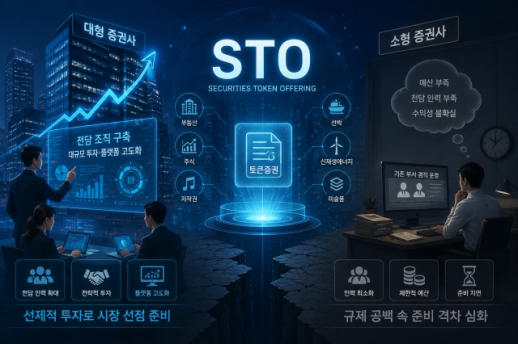 Regulatory Delays Widen Gap Among Securities Firms in Digital Asset Market As competition intensifies among securities firms to dominate the digital asset market, the delay in regulatory legislation is creating a noticeable disparity in preparations among companies. According to the financial investment industry on June 4, major domestic securities firms expect that guidelines and regulations related to Security Token Offerings (STO) will become clearer this month, prompting them to enhance their mobile trading systems and other platform infrastructures. However, discussions in the political arena regarding virtual assets and STO legislation have effectively come to a halt due to the recent local elections. Despite having completed technical preparations for market entry, firms are stuck in a 'zero hour' situation, unable to proceed without regulatory approval. A representative from the Korea Financial Investment Association stated, "All political attention is currently focused on the elections and reshaping the political landscape, leading to a complete suspension of legislative discussions in the National Assembly. Since the previously proposed bills were progressing sequentially, it will take the conclusion of the election period for legislative efforts to resume." During this regulatory vacuum, the internal organization and staffing of securities firms show extreme variations based on company size and strategy. Some mid-sized firms have made bold investments in personnel, establishing dedicated teams comparable to larger firms. Hanwha Investment & Securities, for instance, has created a new Future Strategy Office to oversee STOs, real-world asset tokenization, and global expansion initiatives. Notably, they have also set up a 'Digital Asset Research Team' within their research center, hiring specialized personnel as team leaders to build independent infrastructure. Meritz Securities has similarly established a strategic planning division to serve as a control tower for entering the virtual asset and STO markets. Rather than expanding the organization excessively, they are reportedly creating a system that organically connects traditional securities operations (investment banking and retail) with new digital asset businesses in preparation for market entry. In contrast, smaller firms with limited financial resources and personnel are finding it challenging to allocate budgets and staff for STO projects, as they do not see immediate profitability. For example, a small securities firm recently began preparations for related business but opted for a 'dual role' approach, assigning STO responsibilities to an existing department that handles retail and overseas product orders, rather than creating a dedicated team. In reality, only two staff members are overseeing this work. A representative from the small firm remarked, "Unlike larger firms that issue flashy press releases, smaller firms lack the capacity to invest specialized personnel in future projects that do not yield immediate returns. Essentially, we have just added this work under the existing team name." The securities industry is concerned that as this regulatory gap prolongs, the disparities among firms will become stark when legislation is eventually passed and the market opens. Larger firms with substantial capital can continue to invest in significant equity and enhance their platforms during the legislative pause, while smaller firms may struggle to even take the first step. An industry insider noted, "Larger firms have the luxury to proactively invest in personnel and costs for new revenue streams related to virtual assets, but smaller firms find it difficult. Ultimately, even when legislation begins, smaller firms will have no choice but to follow the path paved by larger firms, and that gap will only widen."* This article has been translated by AI. 2026-06-04 16:54:00
 -
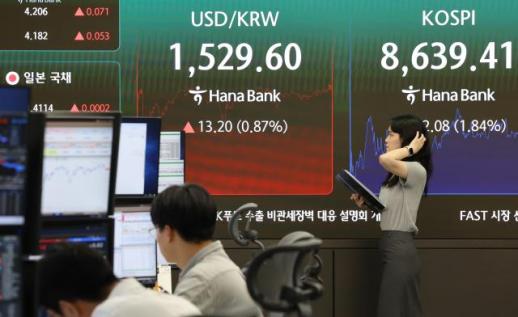
 KOSPI slides as won weakens sharply SEOUL, June 4 (AJP) - SSouth Korea's benchmark KOSPI fell nearly 2 percent to close at 8,639.41 points on Thursday as markets reopened after Wednesday's elections, pressured by escalating tensions in the Middle East. Adding to the pressure, the Korean won also weakened sharply against the U.S. dollar. But beneath the decline, the session looked less like a broad sell-off than a wholesale rotation in market drivers, as crowded artificial intelligence stocks that had driven the recent rally gave way to new market leaders. The split told the story. While the main board fell, the junior KOSDAQ jumped more than 2 percent to around 1,050, as money rotated rather than fled. The artificial intelligence (AI) and technology names that had powered the record-breaking advance reversed hard: LG Electronics, a darling of the recent surge, crashed more than 16 percent to around 328,000 won ($214.5), the day's marquee casualty, with SK Hynix, Samsung Electronics, and Naver all lower. Foreign investors sold nearly 7 trillion won. Where the money went was the day's real news. Department store stocks led the entire market on a wealth-effect wager, as investors bet that record equity gains, reinforced by the ruling Democratic Party (DP)'s sweep in the local elections, will feed consumer spending. Shinsegae soared nearly 16 percent to around 659,000 won and Hyundai Department Store rose about 15 percent. Insurers followed, with Samsung Fire & Marine Insurance up about 14 percent to around 730,000 won. On the KOSDAQ, small-cap semiconductor-equipment and materials makers surged, with Eugene Technology and Duksan Hi-Metal both jumping roughly 30 percent, as investors hunted the next leg of the chip story beneath the megacaps. The trigger for the regional retreat was geopolitical. Oil held elevated after Iran struck Kuwait's airport and the United States launched strikes on Qeshm Island, a marked escalation around the Strait of Hormuz that sent investors out of this year's crowded winners and toward hedges and alternatives. Wall Street's overnight losses compounded the move. China's Shanghai Composite eased about 0.75 percent to around 4,051, weighed by the same risk-off mood even as oil climbed, but the surprise lay in where the oil money did not go. Despite the Hormuz escalation, China's big state-owned producers fell, with PetroChina slipping about 2 percent and CNOOC dropping more than 2 percent as investors took profits after their recent run. The oil bid narrowed instead to the speculative end, where Shanghai Petrochemical hit its 10 percent daily limit, a sign retail money chased the high-beta refiner rather than the blue-chip majors. With Beijing still awaiting direction from its Politburo meeting expected in July, the mainland remained the region's quiet laggard. Japan's Nikkei 225 fell nearly 1.5 percent to around 67,471, pulling back from Wednesday's first-ever close above 68,000 in a classic bout of profit-taking, though the retreat was not led by the chip names. Tokyo Electron, the engine of the previous day's record, extended its run, rising nearly 4 percent to around 63,200 yen. The clear winner was defense: Mitsubishi Heavy Industries climbed about 4 percent to around 3,700 yen as the intensifying Middle East conflict lifted military and heavy-industry names, the same impulse driving defense buying worldwide. Oil names were mixed, with INPEX, Japan's largest oil and gas producer, slipping nearly 2 percent to around 3,600 yen even with crude elevated, leaving Tokyo's decline a broad consolidation rather than the collapse of any single theme. Thursday was a geopolitical risk-off session that doubled as a rotation. The year's most crowded winners, Korea's AI and technology megacaps, gave back ground while money sought hedges and alternatives: defense in Japan, domestic consumer and insurance names in South Korea, and speculative oil and small-cap chip plays on the fringes. The AI trade did not break so much as step aside for a session. The questions from here are whether the Middle East escalation deepens, whether the Bank of Japan moves this month, and whether South Korea's rotation into consumer names has the staying power its sudden violence this week suggests it might. 2026-06-04 16:43:57
 -
 Minimum Wage for 9 Million Contract Workers Under Review The Minimum Wage Commission has begun serious discussions on whether to apply minimum wage standards to special employment workers, such as delivery drivers and riders. This marks the start of a significant debate over the expansion of minimum wage coverage. Labor representatives argue that the changing realities of the labor market necessitate broader protections, while business groups firmly oppose any changes, claiming they fall outside the commission's authority. On June 4, the Minimum Wage Commission convened its third plenary meeting at the Government Sejong Center to discuss the application of minimum wage standards for contract workers. This discussion was prompted by a request from Minister of Employment and Labor Kim Young-hoon, who asked the commission to consider whether it is appropriate to set a separate minimum wage for contract workers or those receiving wages in similar forms, acknowledging that traditional hourly, daily, weekly, or monthly wage structures may not apply. Many delivery riders and drivers, often contracted as individual business owners, frequently find themselves excluded from the current minimum wage system. Labor advocates argue that the existing minimum wage framework, which primarily focuses on wage employees, fails to adequately protect low-wage workers in the evolving labor market. Ryu Gi-seop, Secretary General of the Korean Confederation of Trade Unions, stated, "Currently, nearly 9 million contract workers play a crucial role in the labor market. Expanding minimum wage coverage for these workers is a necessary measure to protect them in low-wage sectors." Lee Mi-sun, Deputy Chair of the Korean Confederation of Trade Unions, emphasized, "Ensuring minimum wage for 8.7 million special employment and platform workers is an urgent task. Even when recognized as workers by the courts, they often lack proper wage calculation standards, leading to repeated instances of inadequate protection." Conversely, business representatives argue that expanding the minimum wage coverage could complicate the implementation of the system itself. Ryu Gi-jeong, Executive Director of the Korea Employers Federation, remarked, "Minimum wage is a system aimed at workers defined under the Labor Standards Act. Determining worker status is not something the Minimum Wage Commission can decide." He also highlighted the challenges in applying uniform standards to contract workers, given the variability in workload, travel distance, and contract methods. Yang Ok-seok, Head of the Human Resources Policy Department at the Korea Federation of Small and Medium Enterprises, expressed concern, stating, "There is insufficient objective verification and data on the impact of applying different minimum wage standards to various types of contract work. Overzealous application could undermine the flexibility of contract work and lead to job losses." The outcome of the Minimum Wage Commission's discussions will determine whether the minimum wage system will expand from its traditional focus on wage employees to encompass new forms of employment. However, significant differences in positions between labor and management regarding the scope of application, criteria for determining worker status, and industry-specific wage calculation methods suggest that the path to actual implementation may be fraught with challenges.* This article has been translated by AI. 2026-06-04 16:42:00
 -
 BDC Launches Amidst Market Stagnation Despite Growth Fund Potential The Business Development Company (BDC) system was officially launched on March 17, but the market remains largely inactive. Designed to provide retail investors with opportunities to invest in unlisted venture and innovative companies, the initiative has seen only one product introduced since its inception due to the absence of tax benefits. Industry experts believe that the BDC market will only begin to take shape once tax reform is determined in the second half of this year. According to the financial investment industry, the BDC system, established under amendments to the Capital Markets Act, has only seen the launch of the 'Shinhan Innovative Company Growth Investment Trust No. 1' by Shinhan Asset Management on April 22. This product is primarily targeted at institutional and professional investors, rather than general retail investors. BDC allows retail investors to invest in unlisted venture and innovative companies through a public fund structure. However, a key issue is the lack of tax support that was expected to accompany the BDC's introduction. The industry had anticipated that tax benefits similar to those for venture investment associations or new technology business investment associations would be implemented. Unfortunately, proposed amendments to the relevant tax exemption laws have not passed in the National Assembly, leaving BDCs subject to the same tax regime as general public funds. As a result, asset management firms are not rushing to launch new products. One asset management official stated, "We are considering product launches, but the speed and scope of tax reform are crucial. We are monitoring discussions as the government and the Financial Investment Association work on tax support measures." Industry consensus indicates that without tax support, the BDC will struggle to gain traction. Investments in unlisted companies tend to be long-term and carry relatively high risks, making tax incentives essential to attract retail investors. A financial investment industry representative noted, "It is rare for products investing in unlisted venture companies to lack any tax benefits. Even if it is not at the level of venture investment associations, some degree of tax support is necessary to create investment incentives." The recent focus on the National Growth Fund also poses a challenge for BDCs. The National Growth Fund is a government-backed policy fund that is discussing tax benefits such as income deductions and separate taxation. Investors are likely to gravitate towards products that offer tax benefits while also investing in innovative company growth. However, a financial investment industry representative remarked, "While the National Growth Fund is drawing market attention, which may overshadow BDCs, the National Growth Fund is temporary, whereas BDCs are designed to operate continuously like new technology business investment associations. Therefore, BDCs could eventually establish a separate market in the long run." Financial authorities also acknowledge the need for tax support. The industry views the direction of tax law amendments in the second half of this year as a critical turning point for the BDC market. If tax reforms are implemented, subsequent fund launches and capital raising could accelerate. Conversely, without such reforms, there are concerns that the newly introduced system could lose momentum right from the start.* This article has been translated by AI. 2026-06-04 16:42:00