
Journalist

Lee Su Wan
-
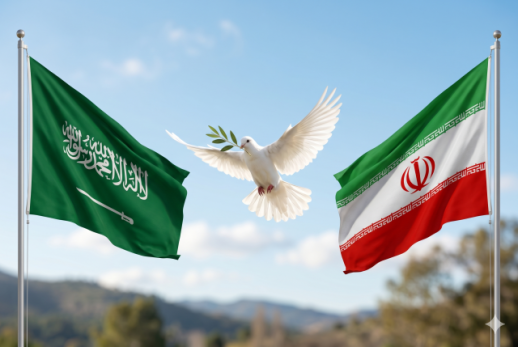 ASIA INSIGHT: The Middle East must now move toward a 'Noah Accord' Saudi Arabia’s First Direct Strike on Iranian Soil — The Middle East Must Now Move Toward a “Noah Accord” A new desert wind is sweeping across the Middle East. Reports that Saudi Arabia has directly struck targets inside Iranian territory are not merely another military headline. They represent a historic signal that the regional order has entered a new and more dangerous phase. For decades, Saudi Arabia and Iran confronted one another while carefully avoiding a direct crossing of certain invisible lines. Their rivalry unfolded through proxy wars, intelligence operations, oil politics and sectarian conflict. Yet the landscape is now changing. The retaliatory strikes reportedly carried out by the United Arab Emirates, the alleged infiltration attempt by Iran’s Revolutionary Guards into Kuwait, and the widening activity of pro-Iranian militias stretching from Iraq to Syria all suggest that the Middle East is becoming a single interconnected theatre of instability. What makes this moment especially significant is the gradual erosion of the old American-centered security architecture in the region. Saudi Arabia is no longer merely an oil kingdom sheltered under the American umbrella. It is transforming itself into a strategic state built simultaneously around artificial intelligence, advanced industry, NEOM, logistics, tourism and global finance. From Riyadh’s perspective, the threat posed by drones and missiles linked to Iran’s Revolutionary Guards is no longer simply a military concern. It is a direct challenge to the kingdom’s economic future and national survival. And yet perhaps the most important detail is this: after the strikes, Saudi Arabia reportedly reopened diplomatic channels and sought de-escalation. That reveals a deeper truth. Both sides understand that if this conflict spirals beyond control, everyone loses. Iran controls one of the world’s most critical strategic chokepoints — the Strait of Hormuz — while also possessing a broad asymmetric network of drones, missiles and proxy forces extending through Hezbollah, the Houthis and other regional actors. Saudi Arabia and the Gulf states, meanwhile, command immense financial power tied to global energy markets, LNG infrastructure, maritime trade and increasingly the future of AI investment. If this confrontation expands into full-scale regional war, the consequences will not stop at the sands of the Gulf. The shockwaves would reach semiconductor factories in South Korea, precision manufacturers in Japan, industrial corridors in India and chemical industries across Europe. Oil prices would surge. LNG markets would convulse. Shipping insurance costs would soar. Supply chains would fracture. Data centers powering the AI revolution could face severe energy instability. Financial markets across the world would tremble. It is precisely at this point that a larger question emerges. The Middle East no longer needs merely another cease-fire agreement or temporary diplomatic arrangement. It needs a deeper civilizational framework for coexistence. That is why I have long argued for what I call a “Noah Accord.” Why Noah? According to the Book of Genesis, humanity spread again after the Great Flood through the descendants of Noah’s three sons: Shem, Ham and Japheth. In the traditional understanding of Abrahamic civilization, the peoples of the Middle East — including Jews and Arabs — are linked through the lineage of Shem. The very word “Semitic” originates from his name. The Jewish people trace their spiritual and historical roots through this lineage. So do the Arab peoples. Abraham himself stands within that same broad ancestral tradition. In other words, beneath centuries of war and division, Israelis and Arabs ultimately emerge from intertwined civilizational roots. And here lies the crucial point regarding Iran. Iran is often viewed simply as Persia — a distinct and separate civilization standing outside the Arab world. Historically, Persia indeed developed its own imperial identity shaped by Central Asia, ancient Iranian traditions and deep philosophical currents of its own. Yet modern Iran is also profoundly connected to the same Abrahamic civilizational sphere. Islam itself stands within the broader monotheistic tradition that reveres Abraham and Noah. The Quran honors Noah as one of the great prophets. The spiritual memory shared by Judaism, Christianity and Islam is therefore not divided by absolute walls, but connected through overlapping narratives of origin and survival. In that sense, Iran is not an alien civilization standing outside the region’s deeper historical structure. It remains part of the same vast Middle Eastern civilizational family — though separated by history, empire, sect and politics. This matters enormously. Today’s Middle East appears trapped inside overlapping conflicts: Shia versus Sunni, Arab versus Persian, Jew versus Muslim, America versus Iran. But when one travels deeper into history, beyond modern geopolitics and ideological slogans, another reality emerges. These societies are not strangers born of separate worlds. They are civilizations that diverged from shared memories, shared prophets and intertwined human origins. That is why the story of Noah matters. Not because of bloodlines alone, but because Noah represents survival through coexistence. The Ark was not built for one tribe alone. It symbolized the minimum structure necessary for life to continue amid catastrophe. And humanity today faces another kind of flood. Artificial intelligence, nuclear tension, collapsing supply chains, energy warfare, demographic decline, climate disruption and civilizational anxiety are arriving all at once. The Middle East sits at the center of many of these converging pressures. What the region now requires is not merely military victory, but a new architecture of coexistence. The essence of a Noah Accord would therefore rest on several principles. First, the collective protection of strategic waterways such as the Strait of Hormuz and the Red Sea. Second, a mutual prohibition against attacks on civilian infrastructure and energy facilities. Third, the establishment of long-term channels for dialogue across sectarian and civilizational lines — between Sunni and Shia, Arab and Persian, Jew and Muslim. Fourth, a shared commitment that advanced technologies, including artificial intelligence, should serve human survival and prosperity rather than endless war. And fifth, a recognition that Israel, Iran, Saudi Arabia, the UAE and the broader Middle East must ultimately see one another not as civilizations destined for annihilation, but as peoples bound to coexist. The Abraham Accords already opened one path toward reconciliation between Israel and several Sunni Arab states. The process remains incomplete and fragile, but it nevertheless established a critical principle: that coexistence is possible. The next challenge is Iran. As the leading power of the Shia world, Iran too may eventually need to recognize that it is not a civilization fated to stand permanently outside the regional order, but part of the same deeper historical and spiritual continuum. Likewise, Israel, Saudi Arabia and the Gulf states must eventually understand that Iran cannot forever be treated solely as an enemy to be contained or destroyed. Because in the current structure, no one can truly achieve total victory. America may possess overwhelming military superiority, yet it cannot fully stabilize Hormuz through force alone. Iran may mobilize proxies and asymmetric warfare, yet it cannot indefinitely sustain confrontation against the wider international system. Saudi Arabia and the Gulf monarchies may command immense wealth, but their futures remain vulnerable if energy routes collapse into permanent instability. In the end, the future of the Middle East will depend not on absolute triumph, but on managed coexistence. And perhaps this is where Asia itself carries an important lesson. For centuries, the West has often spoken in the language of power, finance, military dominance and efficiency. Asia, by contrast, has accumulated long civilizational traditions centered on balance, coexistence, continuity and social harmony. Confucian moderation, Buddhist interdependence and Islamic communal ethics all contain elements of this broader search for sustainable human order. What the world seeks now is not simply more breaking news. It seeks an answer to a deeper question: How shall humanity continue to live together in the age that is coming? The flames spreading across the Middle East are not merely regional fires. They are warnings about the direction of civilization itself in the age of artificial intelligence. That is why the region must ultimately move beyond temporary truces and toward a larger moral imagination. Toward a Noah Accord. An accord in which Israel, Saudi Arabia, the UAE and the Sunni Arab world, together with Iran and the Shia sphere, recognize that beneath their divisions they remain descendants of the same human story. And perhaps, in the age now unfolding before us, that recognition may become the first plank of a new Ark for humanity itself. 2026-05-13 10:23:12
 -
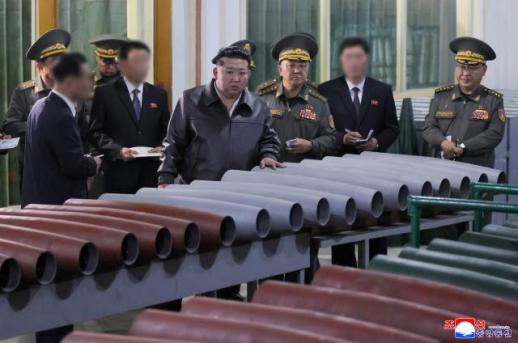 North Korean leader inspects munitions factories, calls for stronger artillery forces SEOUL, May 13 (AJP) - North Korean leader Kim Jong-un inspected munitions factories and called for strengthening "mortar and howitzer forces," state media reported on Wednesday. According to the state-run Korean Central News Agency (KCNA), Kim, accompanied by senior military officials and other key aides, "gave field guidance at several munitions industrial enterprises" earlier this week to "learn about the implementation of munitions production assignments for the first half" of this year. Kim "repeatedly stressed the need to strengthen mortar and howitzer forces," while outlining key tasks such as "setting up a specialized artillery production complex and a small-arms production factory" to meet the future needs of North Korea's military, KCNA said. He emphasized the need to "further modernize" production systems and improve manufacturing processes "in a more scientific way." Kim was also quoted as saying that North Korean munitions industry workers would "make strenuous efforts" to strengthen the country's defense capabilities. 2026-05-13 10:02:09
 -
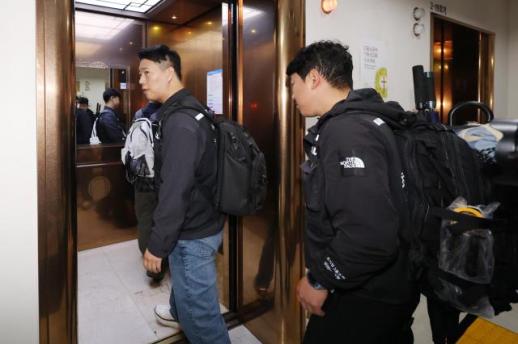
 S. Korea extradites mastermind who targeted BTS' Jungkook in $25.4 mln fraud SEOUL, May 13 (AJP) - South Korean authorities on Wednesday repatriated a 40-year-old Chinese national accused of leading a sophisticated hacking ring that attempted to steal 8.4 billion won from BTS star Jeon Jung-kook. The suspect, identified only as A, was escorted from Bangkok to Incheon International Airport following a coordinated effort between the Ministry of Justice and the National Police Agency. The extradition marks a major development in an investigation into a syndicate that allegedly siphoned 38 billion won ($25.4 million) from 16 high-profile victims. The group specialized in hunting for wealthy individuals who were physically unable to check their financial alerts, such as celebrities serving in the military or individuals in correctional facilities. The 28-year-old BTS member became a primary target while he was away for his mandatory military service. The hackers allegedly used his stolen personal data to open fraudulent phone accounts, which they used to bypass security and attempt to seize his shares in HYBE, the agency behind BTS. A massive loss was only avoided because his management agency spotted the unauthorized activity in time. Once the agency realized someone was trying to move the 8.4 billion won in stocks, they worked with financial institutions to freeze the transactions immediately. Other victims included corporate chairmen and legal professionals who lost significant amounts of cash and cryptocurrency. Investigators said the gang started with a list of 258 potential targets before narrowing it down to a final list based on who had the most assets and the least ability to fight back quickly. South Korean officials spent months working with Thai prosecutors and Interpol to secure the suspect's return. This follows the earlier extradition of a 36-year-old accomplice in August, as part of a wider crackdown on transnational cybercrime. The Ministry of Justice said it intends to pursue international fraud rings until all members are brought to justice. The accomplice is currently standing trial in South Korea after being indicted in September following his initial extradition. 2026-05-13 09:23:49
 -
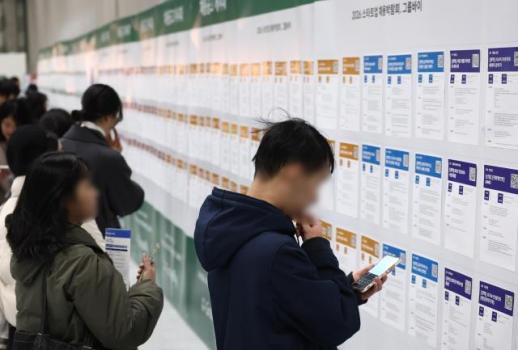 UPDATE: Job growth hits 16-month low in Korea in April, youth employment dips *Updated with additional information SEOUL, May 13 (AJP) — South Korea’s job growth slowed in April to its weakest pace since December 2024, when the country was grappling with the aftermath of the martial law episode, as the war in the Middle East dragged into a third month. The number of employed people aged 15 and older rose by 74,000 from a year earlier to 28.96 million in April, the Ministry of Data and Statistics said Wednesday. It marked the smallest gain in one year and four months, since December 2024, when the number of employed people fell by 52,000. The employment rate for the working-age population, aged 15 to 64, stood at 70 percent, up 0.1 percentage point from a year earlier. But youth employment continued to weaken. The employment rate for people aged 15 to 29 fell by 1.6 percentage points to 43.7 percent, extending its decline for a second straight year since May 2024. Concerns are growing because the weakness in youth employment cannot be explained simply by demographic decline. According to the statistics agency, the number of employed people in their 20s fell by 195,000 from a year earlier, while the youth employment rate has been declining for 24 consecutive months since May last year. The April drop was also sharper than in previous months, widening from declines of 0.7 percentage point in February and 0.9 percentage point in March. The youth unemployment rate stood at 7.1 percent, down 0.2 percentage point from a year earlier, but the figure does not necessarily point to an improvement. The number of people preparing for employment plunged by 43,000, or 6.4 percent, from a year earlier to 626,000, while the number of discouraged workers rose by 15,000. Polarization between experienced workers and newcomers also deepened. The number of unemployed people with prior work experience fell by 1.7 percent on year to 785,000, while the number of unemployed people with no prior work experience surged 21 percent to 68,000. Amid the continued bifurcation of the labor market, more people are staying in education or training. The number of economically inactive people enrolled in education or training rose by 96,000, or 3 percent, over the past 12 months — an unusual increase for April, when the figure typically declines or remains flat. This suggests that young people are delaying their entry into the labor market rather than exiting it altogether, waiting for job conditions to improve. The number of people in their 20s who said they were “taking a break” came to 376,000, down 16,000 from a year earlier, marking a second consecutive monthly decline. The overall increase in those taking a break was driven by people aged 60 and older, whose number jumped 8.4 percent on year to 1.18 million. By industry, employment increased in health and social welfare services by 261,000 and in arts, sports and recreation-related services by 54,000. But job losses continued in professional, scientific and technical services, down 115,000; manufacturing, down 55,000; and agriculture, forestry and fisheries, down 92,000. The decline in professional, scientific and technical services — sectors favored by younger workers and increasingly exposed to artificial intelligence — points to a shortage of quality entry-level jobs and a structural shift in the labor market that is worsening youth employment conditions. The Ministry of Economy and Finance and the Ministry of Employment and Labor on Wednesday unveiled the "Youth New Deal" to address the sluggish job market caused by the Middle East conflict and the shift toward AI. A central component is the "K-New Deal Academy," a vocational training program involving 70 companies, including the top 10 conglomerates, which aims to train 12,000 individuals to align skills with corporate demand. The "Youth Leap Boot Camp," a joint university-industry initiative, will also launch in July following university selections in June. Public and private internship programs are also set to begin recruitment this month. 2026-05-13 09:02:17
 -
 Samsung Electronics union heads toward strike after govt-mediation talks collapse SEOUL, May 13 (AJP) -Samsung Electronics and its largest labor union failed to bridge differences over bonuses in a final round of government-mediated wage negotiations, raising the likelihood of a monthlong strike that could ripple through the global semiconductor supply chain starting next week. The breakdown came after 17 hours of overnight talks at the National Labor Relations Commission in Sejong, where labor and management sought to reach a 2026 wage agreement but ultimately ended negotiations without a deal. Choi Seung-ho, head of the Samsung Electronics branch of the National Samsung Electronics Union, declared the post-mediation process “finally deadlocked” early Wednesday. “We asked for a mediation proposal because the gap between labor and management could not be narrowed, but after nearly 12 hours of waiting, the proposal turned out to be a step backward,” Choi told reporters after the talks collapsed around 3 a.m. The core dispute centered on whether to institutionalize and expand Samsung’s bonus system. The union is demanding the removal of bonus caps and the establishment of a transparent, formalized compensation structure tied to company performance. It has proposed allocating 15 percent of Samsung Electronics’ estimated annual operating profit of 270 trillion won ($194 billion) into bonus funding. Under the union’s proposal, average bonuses for employees in the Device Solutions (DS) memory division could reach roughly 600 million won per worker, while even loss-making nonmemory operations such as foundry and System LSI units could receive payouts exceeding 300 million won. Choi criticized the mediation proposal for effectively preserving the current excess profit incentive (OPI) framework, including its 50 percent bonus ceiling. “The proposal maintained the existing OPI system rather than introducing transparency,” he said. “The 50 percent bonus cap also remained intact.” Management has reportedly proposed broader compensation for struggling nonmemory divisions on the condition that losses improve, but the union rejected what it described as temporary and externally linked standards. Choi also objected to a proposal tying DS division bonuses to whether payouts exceeded those at SK hynix. “It is not desirable to connect our company’s performance to external factors,” he said, adding that the union could not accept a one-off measure lacking institutional guarantees. The union said it no longer intends to participate in further post-mediation proceedings, though Choi said labor would still consider listening if management presented a “proper proposal.” Samsung management and the union had already failed to reach an agreement during earlier mediation sessions held in February and March. The two sides resumed negotiations through a special post-mediation procedure starting Monday. The National Labor Relations Commission said it proposed “various alternatives” based on both sides’ positions but concluded that differences remained too wide after the union requested termination of the mediation process. The commission added that additional mediation could still be arranged if both parties later agreed to resume talks. With negotiations now broken off, the possibility of a full-scale strike planned for May 21 has intensified. The union, which claims around 73,000 members, said about 41,000 workers had already indicated their intention to join a strike, and Choi claimed participation could exceed 50,000 under the company’s current proposal. He stressed the union intended to proceed legally. “There is no point in waiting any longer,” Choi said. “We have no intention of engaging in illegal labor action. We will carry out lawful industrial action.” The union also said it would now focus on responding to Samsung’s court request for an injunction against what the company described as illegal labor activities. The market has been closing watching the government-mediated talks in fear of the repercussions on the chip-led exports and stock rally. Some forecasts estimate losses could exceed 40 trillion won if production disruptions spread across key semiconductor lines, while observers also warn of customer defections and long-term supply chain damage. The American Chamber of Commerce in Korea recently warned that disruptions at Samsung could destabilize global memory chip supply and increase price volatility. Concerns have also spread to suppliers and subcontractors. Samsung’s sustainability report lists roughly 1,700 partner firms across first- through third-tier supply chains, raising fears that prolonged production disruptions could trigger broader employment instability among smaller manufacturers. The government could still interfere through an emergency arbitration powers as a last resort. Under South Korea’s labor law, the labor minister may order emergency arbitration when industrial action is deemed likely to seriously damage the national economy or threaten public welfare. Such a move would ban strikes for 30 days while compulsory mediation and arbitration proceed. The measure has been invoked only four times in modern South Korean history, including during strikes at Hyundai Motor Company in 1993 and pilot walkouts at Asiana Airlines and Korean Air in 2005. A commission official, however, said emergency arbitration was “not a matter currently under our review.” 2026-05-13 07:56:39
 -
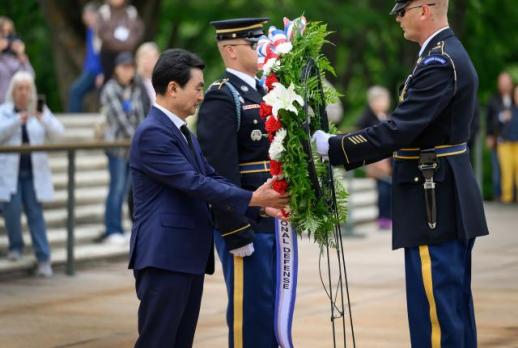 Seoul signals phased support for US-led Hormuz mission SEOUL, May 13 (AJP) -South Korea has told the United States it is willing to consider a phased contribution toward restoring safe passage through the Strait of Hormuz, Defense Minister Ahn Gyu-back said Tuesday. Seoul conveyed to Washington that it would “participate as a responsible member of the international community” and review “step-by-step contribution measures” related to the reopening and protection of maritime traffic through the strategic waterway, Ahn said in an online briefing on the Korea-U.S. integrated Defense Dialogue (KIDD) in Washington and talks with U.S. Defense Secretary Pete Hegseth at the Pentagon. Ahn said possible forms of support discussed included diplomatic backing, personnel dispatch, intelligence-sharing and military asset assistance. “We did not go deeply into specific discussions about expanding the participation of our military,” Ahn said, adding that any such move would also require procedures under South Korean domestic law. The remarks mark Seoul’s clearest indication yet that it may expand its role in the multinational effort surrounding the Strait of Hormuz, a critical global oil shipping route, following the recent attack on the South Korean-operated cargo vessel HMM Namu. The presidential office earlier strongly condemned the attack after a joint government investigation concluded that the fire aboard the vessel was caused by an external strike. Seoul also pledged to continue cooperating with international efforts to guarantee maritime safety and freedom of navigation. Ahn also said Hegseth expressed understanding over Seoul’s push for an early transfer of wartime operational control (OPCON) under a conditions-based framework. Ahn said he explained South Korea’s recent efforts to boost defense spending, secure key military capabilities and strengthen its ability to lead the defense of the Korean Peninsula. “It was a meaningful opportunity to candidly discuss key alliance issues, including the OPCON transition and plans to pursue nuclear-powered submarines,” he said. Ahn stressed Seoul’s commitment to accelerating the transfer of wartime operational control from the United States. “Our position on pursuing an early OPCON transition is firm and unwavering,” he said. “If additional understanding and persuasion are needed, we will continue engaging with the United States.” On Korea’s push to develop nuclear-powered submarines, which both governments previously agreed to explore, Ahn said security issues should be handled “on a different track from economic matters.” He added that both sides shared the view that working-level discussions should begin promptly despite the ongoing conflict involving Iran. According to South Korea’s Defense Ministry, the two ministers reaffirmed the importance of adopting a “realistic and practical approach” to modernizing the alliance, deterring threats and strengthening the combined defense posture. The ministry said the two sides agreed to maintain close communication and expand cooperation in areas of mutual security interest ahead of this week’s Korea-U.S. Integrated Defense Dialogue (KIDD) meetings in Washington. Ahn said no discussions took place regarding a reduction of U.S. Forces Korea or the strategic flexibility of U.S. troops stationed on the peninsula. 2026-05-13 07:36:14
 -
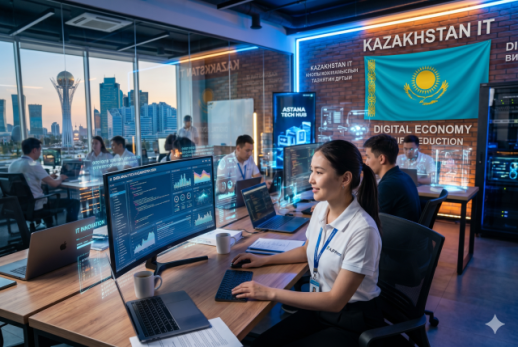 ASIA INSIGHT: Kazakhstan's grand strategy for AI age and reinvention of Eurasia Across the immense steppe of Central Asia, Kazakhstan is attempting something far larger than economic reform. It is attempting a civilizational repositioning. For decades, Kazakhstan was known primarily as a resource giant — a country blessed with vast reserves of oil, natural gas, uranium and rare minerals. It remains the wealthiest of the five Central Asian “Stan” nations and, in many respects, the geopolitical anchor of the region stretching from Uzbekistan and Kyrgyzstan to Tajikistan and Turkmenistan. With a per capita income exceeding $12,000, a strategic location between Russia and China, and enormous territorial scale, Kazakhstan possesses advantages few Eurasian states can match. Yet the leadership in Astana increasingly understands a defining truth of the 21st century: natural resources alone no longer guarantee national power. The hierarchy of nations is being rewritten by artificial intelligence, advanced infrastructure, digital ecosystems and human capital. Oil and gas still matter. But talent, data and technological capacity now matter just as much. That realization lies at the heart of President Kassym-Jomart Tokayev’s emerging national strategy. His government is not merely modernizing an economy. It is trying to transform Kazakhstan from a post-Soviet commodity exporter into a technologically sophisticated Eurasian hub for the AI era. The clearest symbol of that ambition is a project taking shape near Almaty — the country’s former capital and still its commercial and cultural center. Near the city, Kazakhstan is preparing plans for Alatau, a next-generation smart city envisioned as a technological gateway for the digital age. It is an extraordinarily ambitious idea: a new urban platform where artificial intelligence, advanced infrastructure, global talent and international investment converge at the crossroads of Eurasia. Why Kazakhstan Is Opening Its Doors to Global Talent Kazakhstan’s recent decision to overhaul its immigration laws is therefore not a technical administrative adjustment. It is a strategic declaration about the country’s future. The Tokayev administration has openly acknowledged that Kazakhstan faces growing shortages of highly skilled professionals in information technology, engineering, healthcare, education and advanced industrial sectors. The old economic model — exporting raw materials while importing high-value expertise — is increasingly unsustainable in a world defined by artificial intelligence and technological competition. The government’s answer is clear: attract global talent before the talent race becomes irreversible. The proposed immigration reforms are among the most ambitious since Kazakhstan gained independence following the collapse of the Soviet Union in 1991. The measures include streamlined visa procedures, expanded residency opportunities for skilled professionals, enhanced tax incentives and broader “golden visa” pathways designed to attract engineers, researchers, entrepreneurs and specialists from abroad. At one level, the logic is economic. Kazakhstan needs expertise to modernize its industries and accelerate technological development. At another level, however, the strategy reflects a deeper understanding of how power itself is changing. In the industrial age, nations competed for coal, steel and oil. In the AI era, nations compete for minds. The United States built Silicon Valley not simply through capital, but through its ability to absorb global talent. Singapore became a financial and technological center by constructing a highly internationalized ecosystem. The Gulf states are now investing aggressively in AI research, digital infrastructure and global recruitment. Kazakhstan has concluded that Central Asia cannot remain outside this transformation. The country’s leadership appears determined to position Kazakhstan as a Eurasian platform state — a bridge linking Europe, Russia, China, the Middle East and South Asia. Geography has always shaped Kazakhstan’s destiny. For centuries, the Silk Road passed through these lands, connecting civilizations across Eurasia. Tokayev’s vision is to revive that historical role for the digital century. The caravans of the old Silk Road carried silk, horses and spices. The caravans of the AI age carry data, algorithms, semiconductor supply chains and human expertise. Kazakhstan wants to stand at the center of that new flow. Yet attracting global talent requires more than incentives. Highly skilled workers increasingly seek not only economic opportunity, but also institutional trust, educational quality, cultural openness and a degree of intellectual freedom. That may become Kazakhstan’s greatest long-term challenge. The country has pursued economic modernization while maintaining significant political centralization. Critics continue to point to restrictions on media freedom and limited space for opposition politics. In the long run, technological ambition and institutional openness may become increasingly difficult to separate. Still, the direction of travel is unmistakable. Kazakhstan is preparing for a future in which human capital matters as much as hydrocarbons. Alatau and the Dream of a Central Asian AI Civilization The proposed development of Alatau reveals the scale of Kazakhstan’s ambitions. Located near Almaty — the country’s financial center and home to a large ethnic Korean, or Koryoin, population — Alatau is envisioned as far more than a conventional industrial zone. The project aims to create an integrated ecosystem for artificial intelligence, advanced manufacturing, digital infrastructure, education and global business. In many ways, the concept reflects a broader global trend in which nations attempt to compress decades of development into concentrated zones of innovation. Saudi Arabia has NEOM. China had Shenzhen. South Korea built Songdo International Business District as a model of digitally integrated urban planning. Kazakhstan now seeks its own version of that leap. The symbolism is powerful. Central Asia has historically been perceived as peripheral — rich in resources but distant from the centers of technological innovation. Alatau represents an effort to reverse that narrative and position Kazakhstan as a participant in shaping the technological architecture of the future. The country’s resource wealth gives it an unusual foundation for such a project. Kazakhstan possesses not only oil and natural gas, but also enormous uranium reserves and strategic minerals increasingly vital to AI hardware, batteries and advanced manufacturing systems. In the emerging geopolitical order, control over rare minerals may become as strategically important as oil was in the 20th century. Tokayev’s government appears to understand that the future global economy will be built upon the convergence of three forces: energy, technology and talent. Kazakhstan already possesses energy. It now seeks technology and talent. That explains the urgency behind the country’s reforms. Korea and Kazakhstan: Building a Eurasian Partnership For South Korea, Kazakhstan is becoming an increasingly important strategic partner in Eurasia. The relationship is rooted not only in economics, but also in history and culture. Hundreds of thousands of ethnic Koreans remain in Central Asia following the Soviet-era deportations of Koreans from the Russian Far East. Many settled in and around Almaty, helping create enduring human ties between the two countries. Those ties are now acquiring new economic significance. Kazakhstan needs advanced urban planning, digital infrastructure, AI-related systems, transportation technology and industrial expertise. Korea possesses many of those capabilities. Over the past generation, Korea transformed itself from a war-ravaged country into one of the world’s leading technology economies, building globally competitive industries in semiconductors, telecommunications, shipbuilding, batteries and smart infrastructure. That experience carries enormous appeal for emerging economies seeking rapid modernization. The proposed Alatau project could therefore become a natural platform for deeper Korea-Kazakhstan cooperation. Korean firms have already participated in infrastructure, construction, healthcare and energy projects across Kazakhstan. The next stage may involve collaboration in AI infrastructure, smart-city design, digital governance and advanced education systems. Energy cooperation is equally important. Korea remains heavily dependent on imported energy and strategic minerals. Kazakhstan’s reserves of uranium, gas and rare earth resources align closely with Korea’s long-term industrial and energy security interests. There is also a broader geopolitical logic to the relationship. Korea faces demographic decline and labor shortages. Kazakhstan possesses land, resources and a younger demographic profile. One country brings advanced technology and industrial management. The other offers strategic geography and resource depth. The two economies are, in many respects, complementary. More importantly, both countries understand that the future Eurasian order will not be shaped by military power alone. It will also be shaped by infrastructure, technology corridors, supply chains, education networks and the movement of talent across borders. The ancient I Ching teaches: “When change reaches its limit, transformation begins. Through transformation comes continuity.” Kazakhstan today stands at precisely such a moment. The old Silk Road once connected civilizations through caravans and trade routes across the steppe. The new Silk Road may be built from fiber-optic cables, AI infrastructure, digital logistics and human knowledge. And Kazakhstan, standing between Europe and Asia, hopes not merely to witness that transformation, but to help lead it. 2026-05-12 18:08:56
 -
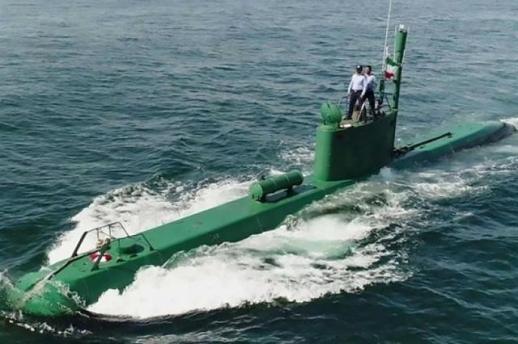 Iran's Hormuz submarines trace lineage to class linked to sinking of ROKS Cheonan SEOUL, May 12 (AJP) — Iran’s reported deployment of additional Ghadir-class midget submarines in the Strait of Hormuz as tensions with the United States intensify is reviving painful memories in South Korea of the country’s deadliest postwar naval disaster. The 2010 sinking of the ROKS Cheonan, which killed 46 South Korean sailors near Baengnyeong Island in the Yellow Sea, was attributed by a multinational investigation to a North Korean Yono-class midget submarine — the same submarine lineage that Iran later acquired and adapted into its domestically produced Ghadir-class fleet. According to a Bloomberg report published Monday citing the International Institute for Strategic Studies, Iran currently operates “at least 16” Ghadir-class submarines. The report did not specify which edition of the institute’s annual Military Balance assessment the figure was drawn from. Other open-source defense assessments estimate substantially larger numbers. The Nuclear Threat Initiative estimates Iran operates around 23 Ghadir-class submarines, while the Washington Institute for Near East Policy places the number near 20. Defense database Global Firepower estimates roughly 26 units. The 2020 edition of Military Balance listed 14. Iran does not officially disclose the size of its submarine fleet. The issue carries direct strategic significance for South Korea. The Strait of Hormuz, where the Ghadir-class is heavily concentrated operationally, carried roughly 20 million barrels per day of crude oil and petroleum products in 2025, according to the International Energy Agency — equivalent to about one-fifth of global oil consumption. South Korea remains among the largest destinations for crude exports transiting the chokepoint, according to the latest transit data from the U.S. Energy Information Administration. While Bloomberg attributed claims that Iran copied North Korean submarine designs to an anonymous source, the underlying connection has long been documented in public intelligence and defense assessments. In its March 2017 unclassified report Iranian Naval Forces: A Tale of Two Navies, the U.S. Office of Naval Intelligence stated that Iran purchased at least one Yono-class submarine from North Korea before developing its own domestic variant. The Nuclear Threat Initiative similarly describes the Ghadir-class as “based on the North Korean Yono-class submarine,” while noting that the precise extent of North Korean involvement in design and production remains unclear. The same Yono designation appeared in the findings of the multinational Joint Civilian-Military Investigation Group that examined the March 26, 2010 sinking of the Cheonan. The investigation, conducted with experts from the United States, the United Kingdom, Australia, Canada and Sweden, concluded that a 130-ton North Korean Yono-class submarine fired a CHT-02D torpedo whose underwater explosion split the 1,200-ton corvette in two. The findings were formally submitted to the United Nations Security Council in June 2010 and remain the internationally recognized record of the incident. Technical characteristics of the Ghadir-class remain broadly consistent across reporting by IISS, ONI, NTI and Jane’s Fighting Ships. Each submarine displaces roughly 117 tons surfaced and 125 tons submerged, measures approximately 29 meters in length and operates with a crew of seven. The submarines are equipped with two 533-millimeter torpedo tubes capable of firing heavyweight torpedoes, launching anti-ship cruise missiles and laying naval mines. The boats are operated by the Islamic Republic of Iran Navy from Bandar Abbas and are specifically designed for the shallow waters of the Persian Gulf, where sea depths rarely exceed 100 meters. Tracy A. Vincent previously assessed that the submarines provide Iran with “additional surveillance capability” while creating “a new layer of defense.” Meanwhile, Daniel Dolan described the submarines as “well-designed for the purpose of guerrilla warfare, ambush and anti-access/area denial.” For South Korea, the connection between the Yono-class submarine implicated in the Cheonan sinking and Iran’s expanding Ghadir-class fleet underscores broader concerns over North Korean weapons proliferation and asymmetric naval warfare. More than a decade after the Cheonan disaster shocked South Korea, the same submarine lineage now sits at the center of one of the world’s most volatile maritime flashpoints. 2026-05-12 18:07:53
 -
 AI-related policy uncertainty sends KOSPI on rollercoaster ride SEOUL, May 12 (AJP) - South Korea's benchmark KOSPI suffered the sharpest decline among Asian markets on Tuesday, reversing sharply after briefly approaching the 8,000 threshold as foreign investors unloaded semiconductor shares amid growing uncertainty over the country's artificial intelligence (AI)-related policies. The index closed down 2.3 percent at 7,643.15 points after swinging between a high of 7,999.67 and a low of 7,421.71. Investor sentiment deteriorated rapidly after presidential policy chief Kim Yong-beom raised the idea of a so-called "national AI dividend," suggesting that excess tax revenue generated from an AI-driven semiconductor boom could eventually be redistributed through public programs. While Kim later clarified that he was not proposing a new windfall tax on corporations, the remarks heightened concerns over potential government intervention in corporate profits at a time when AI-linked semiconductor shares had already rallied sharply. Foreign investors dumped 5.61 trillion won ($3.77 billion) worth of KOSPI shares, as institutional investors sold 1.21 trillion won. Retail investors absorbed the selling pressure, purchasing 6.68 trillion won worth of stocks. Major chipmakers led the decline. Samsung Electronics fell 2.3 percent to 279,000 won, while SK hynix dropped 2.4 percent to 1,835,000 won as investors locked in profits following months of AI-driven gains. Battery and industrial names also came under pressure, with Samsung SDI plunging 8 percent, EcoPro BM falling 7.4 percent and Hanwha Ocean losing 6.5 percent. The sharp reversal came despite continued strength in global semiconductor sentiment after the Philadelphia Semiconductor Index rose 2.6 percent overnight. However, rising oil prices and growing geopolitical tensions surrounding Iran further weakened risk appetite across Seoul's equity market. WTI crude futures climbed 2.7 percent to $100.7 per barrel, while Brent crude rose 2.2 percent to $106.5 after U.S. President Donald Trump dismissed Iran's latest peace proposal and signaled that additional military options remained under review. The Volatility Index, jumped 8.9 percent to 18.7. The Korean won weakened sharply alongside the equity selloff and rising oil prices, falling 1 percent to 1,489.4 per dollar from the previous session as investors moved toward safe-haven assets. Within other parts of Asia, Japan led regional gains despite broader volatility. The Nikkei 225 rose 0.5 percent to close at 62,742.57, while the broader TOPIX also gained 0.8 percent as investors shrugged off hawkish signals from the Bank of Japan. SoftBank Group climbed 4.3 percent and Sony Group advanced 3.3 percent, although Fast Retailing fell 3.8 percent. Chinese markets were comparatively stable. China's Shanghai Composite rose 0.3 percent to 4,214.5, while Hong Kong's Hang Seng Index slipped 0.1 percent to 26,369.7. The tech-heavy KOSDAQ also closed lower, falling 2.3 percent to 1,179.30 after moving between an intraday high of 1,225.29 and a low of 1,142.49. Unlike the KOSPI, foreign investors were heavy buyers on the KOSDAQ, purchasing 509.5 billion won worth of shares. Institutions sold 260.0 billion won, as retail investors offloaded 220.1 billion won. Biotech shares showed relative resilience despite the broader weakness, with Alteogen rising 5.2 percent as investors rotated into defensive growth sectors. Robotics-related stocks also outperformed, with Cosmo Robotics surging 30 percent. Game developer Pearl Abyss slipped 1.1 percent despite reporting record quarterly earnings driven by strong global demand for "Crimson Desert," underscoring how broader market volatility overshadowed upbeat corporate results. 2026-05-12 17:51:03
 -
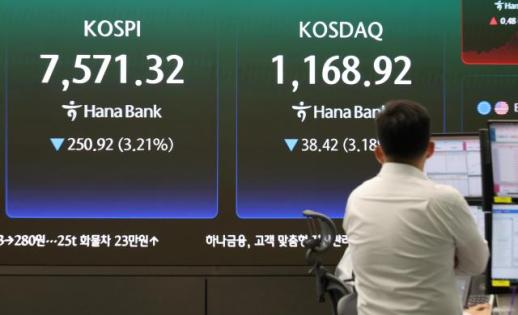 A rollercoaster day for KOSPI before testing new 8,000 peak SEOUL, May 12 (AJP) -South Korea’s benchmark KOSPI swung violently on May 12 after briefly nearing the symbolic 8,000-point threshold before tumbling into its first decline in six sessions, underscoring the heightened volatility gripping one of the world’s hottest equity rallies. The KOSPI opened at a record 7,953.41, up 1.68 percent from the previous session, and climbed as high as 7,999.67 in early trading — just shy of the historic 8,000 level — before abruptly reversing course. Selling pressure intensified through the session, dragging the index to an intraday low of 7,421.71 before it closed at 7,643.15, down 2.29 percent on the day. The reversal came less than a week after the KOSPI first broke above the 7,000-point mark on May 6, extending a blistering rally fueled by semiconductor and AI-related stocks. 2026-05-12 17:41:06