
Journalist

Seo Hye Seung
-
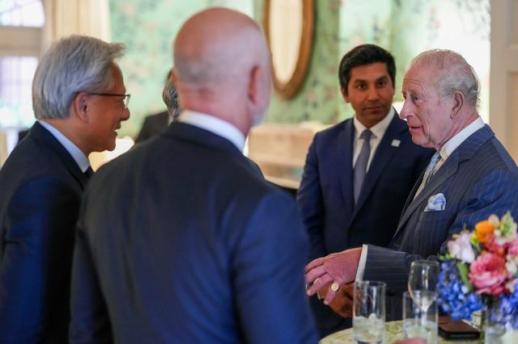 Jensen Huang’s AI Security Stance Signals a New Government-Big Tech Pact Jensen Huang’s remarks were more than a CEO’s political view. They amounted to a signal of how governments and big tech may align in the AI era. Speaking recently at the Milken Global Conference in Los Angeles, he said he “fully trusts the government to use technology properly.” He also said he would not “stand in the way” of a country using technology to protect families. Those comments land in the middle of a debate roiling the U.S. tech sector: How far should AI companies go in meeting national security demands, and how much distance should private firms keep from government power? At the center of the dispute is Anthropic. While working with the U.S. Department of Defense, Anthropic has maintained that use of its AI models should be restricted for “mass surveillance of Americans” and “fully autonomous weapons,” arguing that ethical boundaries are needed. The U.S. government viewed that stance as a national security risk. The Pentagon ultimately designated Anthropic a “supply chain risk company,” and President Donald Trump and Defense Secretary Hegseth publicly criticized it. Nvidia took a different path. Nvidia joined OpenAI, Google, Microsoft and Amazon Web Services in a Defense Department classified work agreement, effectively accepting the U.S. government’s use of its technology for “lawful purposes.” The broader point is that the United States no longer treats AI as just an industrial technology. Like semiconductors, AI has become a strategic national asset. If nuclear technology defined Cold War power competition, today’s AI race is reshaping military, economic and diplomatic order. That is why Washington is pressing AI companies for stronger cooperation. The risks begin there. National security matters, but an overly close relationship between government and big tech can create new dangers. AI is not only a weapon. It can enable surveillance, intelligence analysis, behavior prediction and even public opinion manipulation, placing it directly in some of democracy’s most sensitive domains. Anthropic’s concern reflects that reality. Fully autonomous weapons and large-scale surveillance systems can slip beyond human control. Ethical debate over AI-based weapons is spreading quickly worldwide, and international standards remain unclear on how far to allow systems that do not require a person’s final judgment. At the same time, proponents argue the United States cannot tie its own hands as China and Russia accelerate AI militarization. Huang’s remarks align with a pragmatic view: private companies may not be able to refuse national security demands outright. History offers parallels. The internet began as a U.S. Defense Department project, and GPS was also military technology. Much of today’s civilian infrastructure originated in security needs. AI is moving along the same track. But AI differs from earlier technologies. While the internet and GPS mainly provided connectivity and location, AI can intervene in human decision-making itself — predicting choices, shaping behavior and combining information to produce new conclusions. That makes AI more politically and socially consequential than many past military technologies. What is needed, then, is not a simple yes-or-no argument but clear standards and principles. First, the principle of human control should be preserved. Modern battlefields are already moving at extreme speed, with hypersonic missiles, drone swarms and real-time cyber conflict making it difficult for humans to approve every tactical decision. Still, unlimited acceptance of weapons that fully exclude humans carries serious risk. At minimum, the world needs shared understanding that human responsibility must remain in areas such as mass destruction and strategic weapons. Second, democratic oversight matters. National security depends on secrecy, and military operations and intelligence work cannot be fully public. But placing government-big tech cooperation behind total secrecy also clashes with democratic principles. Limited checks — through legislatures, courts and independent oversight — are needed. Neither full disclosure nor total secrecy is a workable answer. Third, discussion of international norms should begin. A comprehensive agreement will be difficult amid U.S.-China-Russia competition. Yet during the Cold War, the United States and the Soviet Union pursued the Nuclear Non-Proliferation Treaty and strategic arms limitation even as they competed. Competition and rules can advance together as risks grow. AI should be no different, starting with narrow areas such as banning fully autonomous nuclear strike systems. South Korea is not insulated from these pressures. AI and semiconductors have already become national security industries, and companies such as Samsung Electronics and SK hynix sit at the core of the global AI supply chain. South Korean firms may increasingly face pressure to choose between the United States and China. The issue goes beyond exports, tying together diplomacy, security and technological sovereignty. Huang’s remarks, then, are not simply a personal statement. They underscore that in the AI era, technology companies may find it harder to remain purely private actors. They also serve as a warning that governments cannot justify every use of technology under the banner of “security.” The central challenge of the AI era is where to draw the line between national security and technology ethics, and between military efficiency and democratic control. The world is now entering a more intense phase of competition and debate over that new boundary. 2026-05-06 13:30:18
 -
 Korea FTC Orders Concert Membership Refund, Cancellation Terms Revised South Korea’s competition watchdog has ordered changes to what it called unfair terms that limited refunds for paid performance memberships, including clauses that blocked annual-fee refunds after a single use of discount or early-ticket benefits. It also moved to fix terms that made it easy to join online but required cancellation only by phone. The Korea Fair Trade Commission said Tuesday it reviewed membership terms used by 19 venues and ticketing platforms, including the Seoul Arts Center and Lotte Concert Hall, and required corrections to unfair provisions. The review was conducted to prevent consumer harm as public interest in culture and the arts has grown. According to the FTC, some operators had maintained clauses stating refunds were not allowed once service began. Lotte Concert Hall specified that refunds were unavailable if a paid member had received benefits, while Gangneung Arts Center said refunds were not allowed after 15 days from sign-up or if there was any booking history. The FTC said using membership benefits alone does not necessarily mean the operator suffers losses equal to the full annual fee. It required terms to allow full refunds within 14 to 30 days of joining, while permitting only a penalty equivalent to the benefits used to be deducted, with the remainder returned. The agency also cited cases of excessive deductions during refunds. The Seoul Arts Center deducted both an amount based on elapsed time and a fee after two weeks, and the National Gugak Center said refunds were not allowed if the value of discounts exceeded the membership fee. The FTC said such clauses infringed on consumers’ legitimate refund rights and required revisions so that only the larger of the amount corresponding to the period of use or the value of benefits provided can be deducted. Unfair limits on how members could cancel or withdraw were also targeted. Lotte Concert Hall and Interpark allowed sign-ups through easy channels such as online registration but required withdrawals to be made only by phone. The FTC said that improperly restricted how customers could express their intent and ordered changes to allow withdrawal through various methods, including online, phone and written requests. The FTC said it also corrected clauses covering exemptions from liability when user fault overlaps, unilateral deletion of member posts without a chance to explain, and unfair refusals of membership or limits on service use. Kwak Go-eun, director of the FTC’s Division for Standard Form Contracts and Special Transactions, said the changes are expected to reduce consumers’ burdens during refunds. She said the FTC will continue to inspect and correct unfair contract terms and trading practices in areas closely tied to daily life.* This article has been translated by AI. 2026-05-06 12:04:09
 -
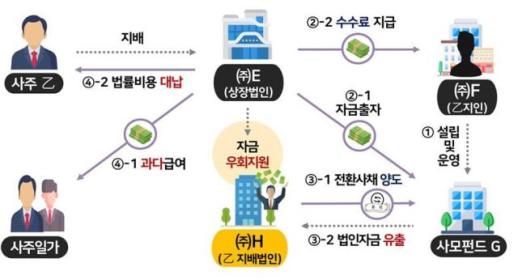 South Korea Tax Agency Probes 31 Firms for Stock Manipulation, Tunneling and Tax Evasion The National Tax Service has launched tax audits of 31 companies accused of unfair, tax-evasive practices in the stock market, including stock price manipulation and “tunneling,” a method of siphoning off assets and profits. The move marks a second round of audits following an investigation of 27 companies announced in July last year. The agency said it aims to curb unfair trading and help establish a “Korea premium.” The NTS said the targets include 11 companies that profited through stock manipulation and accounting fraud; 15 owner families accused of tunneling profits and assets out of companies; and five illegal “stock tip rooms” accused of swindling money from financially vulnerable investors. In the stock manipulation cases, the NTS said companies boosted share prices with false information and inflated performance, then offloaded their holdings onto small shareholders. Some also used accounting fraud, including issuing and receiving fake tax invoices to inflate sales and booking fictitious costs. The agency also cited cases in which listed-company funds were diverted for private use, including transferring corporate assets to a CEO for free or siphoning off tens of billions of won disguised as loans. More than half of the listed firms under audit have had trading suspended after external auditors refused to issue audit opinions, the NTS said. In some cases, share prices plunged to as little as one-tenth of prior levels, it said, deepening investor losses. In tunneling cases, the NTS said the methods have grown more sophisticated. It cited repeated instances of steering business to owner-controlled or related companies, or inserting them into supply chains to collect what it described as “toll” profits. Some companies allegedly paid personal legal fees and luxury purchases for controlling shareholders. Others invested hundreds of billions of won in funds managed by acquaintances with no investment experience, then routed the money to troubled companies controlled by the owners, the NTS said. The agency also said it found cases in which business opportunities or key assets were transferred to companies owned by controlling families, stripping future growth engines and leaving losses to small shareholders. The illegal tip-room operators allegedly lured investors with false or exaggerated ads such as “guaranteed high returns in a short period,” then dumped shares they had accumulated onto members to pocket trading gains. The NTS said they earned profits of tens of billions of won and evaded taxes by booking fake expenses. The NTS said such practices distort the allocation of corporate resources and erode investor trust, contributing to falling share prices and market disruption. It said it will closely verify those involved and the full scope of transactions through the audits. If it finds criminal conduct such as destruction of evidence or concealment of assets, the agency said it will file complaints with investigative authorities and seek criminal punishment. An NTS official said the agency will “firmly establish the understanding that not a single won can be gained from unfair trading in the stock market,” adding it will respond strictly so a “Korea premium” can take hold based on transparency and trust.* This article has been translated by AI. 2026-05-06 12:03:44
 -
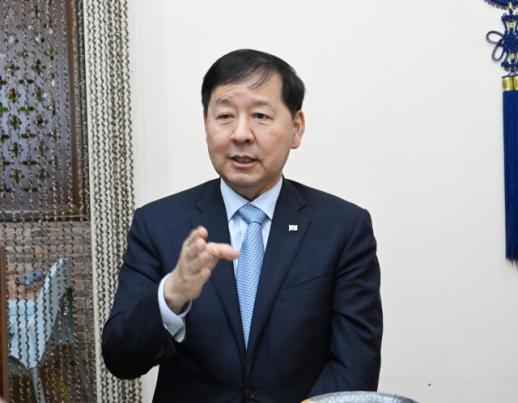 South Korea’s Koo Pyo-cheol vows to meet 2% growth target despite Middle East war risks Deputy Prime Minister and Minister of Economy and Finance Koo Pyo-cheol said South Korea will hold to its 2% economic growth target this year despite the prolonged Middle East war, which he said is adding uncertainty and inflation pressure. Koo made the remarks May 5 (local time) after attending the Asian Development Bank annual meeting in Samarkand, Uzbekistan, along with the ASEAN+3 finance ministers and central bank governors meeting. “Because the Middle East situation is changing a lot, it is practically difficult to forecast growth, and the impact is large,” Koo said. “But I want to say we will achieve the 2% (growth) we originally promised.” He added that investment banks’ forecasts are “much higher than 2%,” and said he told counterparts he would work closely with a new governor on policy cooperation to meet the goal. On inflation measures drawing attention amid high oil prices, including a “maximum oil price system,” Koo said decisions on whether to maintain or end the policy depend on how quickly the Middle East war situation changes. “The best policy is for the Middle East to move to a peace system,” he said. But with uncertainty and oil prices above $100, he said the government would need to respond with a combination of measures if prices stay elevated. Koo said the government would watch inflation closely, citing the risk of broader price increases stemming from higher fuel taxes and rising diesel and gasoline prices. He also said South Korea’s fiscal management and policy response are earning trust from international organizations. Koo said he met with the International Monetary Fund’s deputy managing director, who assessed South Korea as “doing very exemplary work.” Koo said the IMF official spoke highly of South Korea repaying 1 trillion won without issuing government bonds because tax revenue conditions were favorable. He also said the official noted that even as oil prices surged 50% in the United States, South Korea has managed the situation steadily through policy coordination. Asked about the possibility of a second supplementary budget, Koo was cautious. “Right now, we need to focus on executing the first supplementary budget,” he said, noting the government has already approved a 26.2 trillion won package and is prioritizing rapid implementation. He added that with the main budget near 730 trillion won, the focus is also on executing that spending. On exchange-rate volatility, Koo said it is not appropriate to comment on specific levels because the market sets the rate. Still, he said the key factor for the exchange rate, inflation and growth is how quickly the Middle East war stabilizes. If volatility persists, Koo said the government would respond actively with a policy mix and work closely with the Bank of Korea, the Financial Services Commission and the Office of Planning and Budget to prevent economic instability. On the possibility of a currency swap with the United States, Koo said external changes, including a change in the Federal Reserve chair, mean the issue should be reviewed comprehensively, signaling a cautious stance. 2026-05-06 12:03:21
 -
 South Korea Seeks Proposals to Expand Open Quantum Testbed for Next-Gen Networks The Ministry of Science and ICT said Tuesday it will seek proposals for an “open quantum testbed upgrade and expansion project” to strengthen next-generation communications infrastructure for the AI and quantum era and accelerate the spread of quantum communications technology. The open quantum testbed is a core demonstration platform aimed at commercializing quantum cryptography communications and expanding related industries. Since 2024, the government has built and operated a quantum cryptography communications network and measurement equipment used to issue test reports along the Seoul-Pangyo-Daejeon corridor. The call for proposals follows the “First Comprehensive Plan to Foster Quantum Science and Technology and the Quantum Industry,” announced in January. The ministry said it aims to expand the testbed from the Seoul-to-Daejeon route to a nationwide scale, while also building infrastructure that includes overseas connections and efforts to secure next-generation technologies. Eligible applicants are consortia that include major telecommunications operators. The support period runs through 2028, for a total of three years. The ministry began a preliminary notice Tuesday and said full project work is expected to start in July. The project will be pursued across three segments: commercial hubs, overseas hubs and future hubs. Commercial hubs will focus on demonstrating quantum cryptography communications services in real network environments and verifying commercialization using low-cost, compact QKD equipment. Overseas hubs will build international links connected to foreign quantum testbeds to verify interoperability of quantum communications technologies between countries and lay the groundwork for global technical cooperation. Future hubs will focus on building test environments for next-generation communications technologies, including satellite and wireless QKD and quantum entanglement. Kim Seong-su, director general for research and development policy at the ministry, said the project will upgrade the demonstration base for quantum cryptography communications and expand its use across a range of industries. He said the ministry will work to ensure quantum technology becomes core infrastructure supporting future industrial innovation. In January, the government said it would move beyond research and development to produce industrialization results under the comprehensive plan. The plan calls for training 10,000 quantum specialists and fostering 2,000 related companies by 2035, and for achieving the world’s No. 1 position in quantum chip manufacturing. To that end, the government is pursuing work centered on three areas — quantum computing, communications and sensors — including development of a full-stack quantum computer, construction of a nationwide quantum cryptography communications network, and commercialization of quantum biosensors. It is also moving ahead with establishing a joint research center in cooperation with U.S. company IonQ. * This article has been translated by AI. 2026-05-06 12:03:00
 -
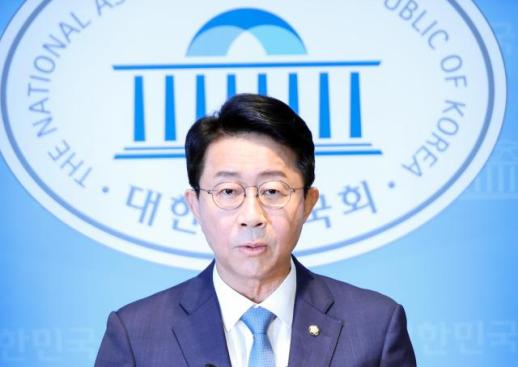 Rep. Cho Jung-sik Enters Democratic Party Race for National Assembly Speaker Democratic Party lawmaker Cho Jung-sik on May 4 announced his bid to become speaker in the second half of the National Assembly term. Cho has highlighted his recent work as a special adviser for political affairs in President Lee Jae-myung’s government, aiming to consolidate support among pro-Lee lawmakers and distinguish himself from rival lawmakers Kim Tae-nyeon and Park Jie-won. Some analysts say Cho could gain an edge in the party’s internal contest, often treated as the decisive race. However, a newly proposed special counsel bill on alleged “fabricated indictments” could become a variable. ■ Strengths(강점) Political circles say Cho’s ability to communicate smoothly with the government is a key strength. In his candidacy statement, he said, “As a National Assembly speaker from the ruling party with blue blood, I will help ensure the success of the people’s sovereignty government and lay a bridgehead for victory in the 23rd general election and the recapture of power.” After Cho resigned as special adviser on May 3, President Lee wrote on Facebook, “You worked hard. I sincerely thank you for always being with us.” Some interpreted the message as support for Cho’s speaker bid. Cho is now the Democratic Party’s only six-term lawmaker after Choo Mi-ae, a Gyeonggi governor candidate, resigned her seat to run. That gives Cho seniority over five-term rivals Kim and Park. Given past practice in which the most senior lawmaker often became speaker, some say Cho has a strong claim. Born in 1963, Cho is also younger than Park, who was born in 1942, a 21-year gap. Supporters say that could matter for a physically demanding post that can include marathon sessions such as filibusters. ■ Weaknesses(약점) Cho’s lower name recognition compared with Park is cited as a weakness. Park has ranked first in multiple opinion polls. This election will also be the first Democratic Party speaker race in which votes by dues-paying party members count for 20%. The rule was introduced after some hard-line supporters protested when Choo, seen as having the party leader’s backing in the 22nd first-half speaker race, lost to Speaker Woo Won-shik. If the party-member vote tracks opinion polls, it could work against Cho. ■ Opportunities(기회) Cho, known as a policy specialist in Seoul politics and a former chair of the party’s policy committee, can stress efficiency in core speaker duties such as coordinating floor schedules and putting bills on the agenda. He also served as party secretary-general during the first leadership under Lee, when Lee led the party, and played a role in nominations for the 22nd general election. Observers say that could help him secure support from many pro-Lee first-term lawmakers. Cho has framed the race as his third attempt — after the second half of the 21st Assembly and the first half of the 22nd — and as his final bid before ending his Yeouido political career. Some say that could build sentiment among colleagues to give him a chance this time. Often described as a moderate, Cho has also raised expectations for bipartisan cooperation. He has said he would be “a livelihood-focused speaker who respects cooperation between the ruling and opposition parties while making firm decisions on people’s lives.” ■ Threats(위협) The special counsel bill on alleged “fabricated indictments,” which has drawn controversy, could also affect Cho’s prospects. Shin Yul, a professor of political science and diplomacy at Myongji University, told Aju Business in a phone interview that “if the president’s approval rating falls due to the special counsel bill, it could affect Cho.” Cho has said of the controversy, “It must be properly clarified through a special counsel.” The Democratic Party proposed the bill after wrapping up work on April 30 by a special committee for a parliamentary investigation into the allegations. Disagreements emerged within the party over a provision that would have the special counsel maintain prosecutions in cases transferred to it. There has also been uncertainty over timing. President Lee said on May 4 he would leave the decision to the party, while party leader Jung Cheong-rae said May 5 he would consult with the presidential office. As the People Power Party attacks the measure as a “special counsel to erase the president’s crimes,” observers say it cannot be ruled out that President Lee’s approval rating could swing. 2026-05-06 11:57:18
 -
 HMM’s NAMU Ship to Reach Dubai as Soon as May 7; Fire Probe to Begin HMM’s heavy-lift vessel NAMU, which was disabled by an explosion and fire near the Strait of Hormuz, is expected to be towed to Dubai in the United Arab Emirates as soon as May 7, where investigators will begin examining the cause and the ship will undergo repairs. Shipping industry officials said May 6 that HMM has secured tugboats for the operation and will start full-scale towing late in the afternoon. If the tow proceeds without problems, the ship is expected to reach Dubai port late May 7 or early May 8. HMM has already dispatched an investigation team to the area and plans to send additional personnel timed to the ship’s arrival. A company official said that once the vessel is berthed in Dubai, a government investigation team and outside experts will be brought in to determine the exact cause and assess the extent of damage. The fire broke out at about 8:40 p.m. on May 4 (Korea time) on the port side of the engine room while the Panama-flagged ship, operated by HMM, was anchored north of Sharjah in UAE waters inside the Strait of Hormuz. There were 24 crew members aboard — six South Koreans and 18 foreign nationals — and no injuries were reported. Five HMM-operated vessels are currently stuck inside the Persian Gulf, within the Strait of Hormuz: two crude oil and petroleum product carriers, two bulk carriers and one container ship. The NAMU is a bulk carrier.* This article has been translated by AI. 2026-05-06 11:54:15
 -
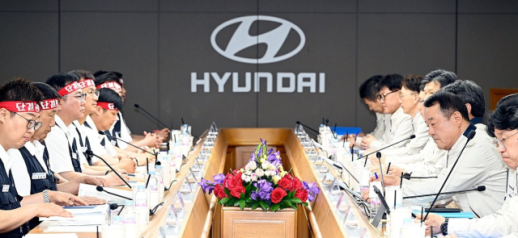 Hyundai Motor union seeks bonus equal to 30% of net profit as wage talks begin Hyundai Motor Co. labor and management opened this year’s wage negotiations with an initial meeting at the company’s Ulsan plant. Yonhap reported on the 6th that about 60 people attended, including Hyundai Motor CEO Choi Young-il, Korean Metal Workers’ Union Chairman Park Sang-man and Lee Jong-cheol, head of the union’s Hyundai Motor branch. The two sides exchanged greetings and discussed the direction and schedule for this year’s talks. The union has already sent management its demands, including a 149,600 won increase in monthly base pay (excluding seniority-based step increases) and a performance bonus equal to 30% of last year’s net profit. It also called for guarantees on jobs and working conditions related to artificial intelligence. Other demands include adopting a full monthly salary system, raising bonuses from 750% to 800%, shortening working hours without increasing work intensity, extending the retirement age in line with the start of National Pension benefits (up to 65), and hiring additional workers. A tough bargaining process is expected again this year. Last year’s talks ended after the union staged three partial strikes. The agreement included a 100,000 won increase in monthly base pay (including step increases), a performance bonus of 450% plus 15.8 million won, 30 shares of stock and 200,000 won in traditional market gift certificates. * This article has been translated by AI. 2026-05-06 11:43:46
 -
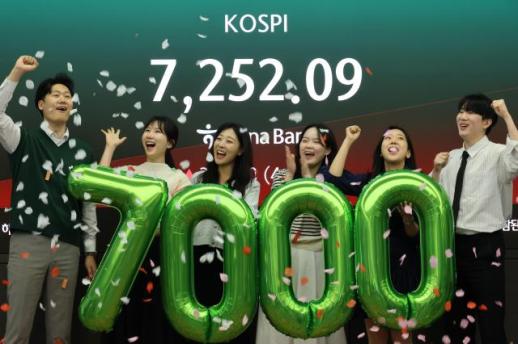 KOSPI Breaks 7,000 for First Time as Rally Broadens Beyond Semiconductors South Korea’s stock market has entered the “7,000 KOSPI” era. The benchmark KOSPI’s first-ever move above 7,000 is more than a round-number milestone, signaling a shift from the long-running “box market” that had weighed on sentiment. The advance comes despite concerns over foreign outflows, geopolitical risks and low-growth worries, suggesting investors are reassessing the market. Semiconductors have led the rally. Surging demand for AI chips, centered on Samsung Electronics and SK hynix, has lifted the broader market. A global tech-stock run and record highs in U.S. equities have also boosted expectations for Korean chipmakers’ earnings. Some market analysts say that even at current levels, the stocks still look undervalued given the pace of profit growth expected at Samsung Electronics and SK hynix. Still, framing the move as only a “semiconductor market” misses a key point: gains have spread to defense, shipbuilding, power, machinery and securities firms. Rather than a spike confined to one sector, the market is increasingly reflecting expectations of broader profit improvement. Market participants also point to the KOSPI’s market capitalization topping 6,000 trillion won for the first time and to a sharp rise in its global market-cap ranking. A major change is the debate over the “Korea discount.” South Korean equities have long been marked down for geopolitical risk, limited shareholder returns and opaque governance. Recently, the government and political circles have pushed capital-market revitalization and “value-up” policies, helping shift sentiment. The Lee Jae-myung government has also promoted capital-market advancement as a key economic task beyond the “KOSPI 5,000” goal. Many analysts say the recent surge reflects a mix of policy expectations and expanding global liquidity. But a higher index does not automatically mean a stronger economy. If the gap between the real economy and stock prices widens too far, markets can quickly become vulnerable to sharp swings. A recent jump in international oil prices, Middle East risks and fears of a slowdown remain ongoing. Some analyses also say economic sentiment indicators are falling and that conditions felt by households and businesses have not clearly improved. South Korean stocks have repeatedly surged and then fallen. Excessive margin trading by retail investors and short-term momentum buying have often amplified shocks. The rapid increase in market-side funds and margin loans is another warning sign. The longer the rally lasts, the more discipline investors need. Markets do not rise forever on expectations alone; sustained gains require corporate earnings and industrial competitiveness. The government, too, should avoid complacency. It can be risky to present a market rise solely as a policy achievement, because markets can reverse quickly. The priority is not short-term index management but structural reforms that strengthen corporate competitiveness and raise trust in capital markets: improving regulatory predictability, reducing outdated practices that undermine shareholder value, and building conditions in which global investors can invest with confidence. Crossing 7,000 is a beginning, not an end. For South Korea to move toward a truly advanced capital market, the celebration of numbers must translate into structural change. A market that relies only on an AI-and-semiconductor boom may not last. Only with stronger industrial competitiveness, capital-market reform and better corporate governance can the “Korea discount” fade into history. 2026-05-06 11:36:21
 -
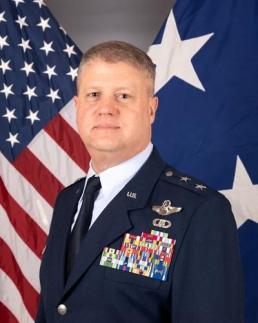 Pentagon Nominates Maj. Gen. David G. Shoemaker as USFK Deputy Commander The U.S. Defense Department has nominated Air Force Maj. Gen. David G. Shoemaker to serve as deputy commander of U.S. Forces Korea. In an announcement made May 5 local time, the Pentagon said Shoemaker would be promoted to lieutenant general and, if confirmed, would also take on the air component command roles for the U.N. Command and the South Korea-U.S. Combined Forces Command, as well as command of the 7th Air Force. Shoemaker is currently deputy commander of the 9th Air Force (Air Forces Central). According to his official Air Force biography, he oversees command and control of air operations and the development and execution of contingency plans in the U.S. Central Command area of responsibility. He has previously served in South Korea. From 2005 to 2006, Shoemaker was responsible for standardization and evaluation at the 8th Operations Group at Kunsan Air Base. From 2017 to 2018, he commanded the 8th Fighter Wing at Kunsan. The post is currently held by Lt. Gen. David R. Iverson, who concurrently serves as USFK deputy commander, air component commander for the U.N. Command and the Combined Forces Command, and commander of the 7th Air Force. The nomination has been announced, but Senate confirmation is still required.* This article has been translated by AI. 2026-05-06 11:29:19