


Latest by
-
 Japan's Government Supports Early BOJ Rate Hike Amid Yen Weakness The Japanese government has shifted to a supportive stance for an early interest rate hike by the Bank of Japan (BOJ), despite ongoing yen depreciation, according to a report by Bloomberg on August 13, citing sources. The Takaichi government is reportedly backing the BOJ's early rate increase, with September or October being the most likely timeframe for the next hike. Prior to the BOJ's monetary policy meeting on July 31, the government conveyed to BOJ Governor Kazuo Ueda that hawkish remarks would be acceptable during a press conference, according to a source. In fact, during the BOJ's monetary policy meeting last month, the short-term policy rate was held steady at 1%. However, Governor Ueda later indicated the importance of considering the risk of inflation overshooting, suggesting the possibility of future rate hikes. On the same day, the U.S. and Japan conducted a coordinated intervention to buy yen, the first such action since 1998. Recently, officials from the Takaichi government have emphasized the independence of the BOJ, effectively lending support to the idea of a rate hike. Economic and Fiscal Policy Minister Minoru Kikuichi stated on August 10, "We respect the independence of the Bank of Japan," while the Prime Minister's Office reiterated via email that decisions on specific monetary policy measures, such as interest rate hikes, should be made solely by the BOJ. They added that the BOJ should work with the government to achieve its inflation target of 2% "stably." The Takaichi government has pursued expansionary fiscal policies to stimulate the economy and has previously shown caution against rapid rate increases. Conversely, the BOJ has raised the need for rate hikes to curb rising import prices due to yen depreciation, leading to a divergence in policy direction between the government and the BOJ. However, as the yen-dollar exchange rate approaches 160 yen per dollar, there is a growing consensus within the government regarding the BOJ's concerns about inflation. Regarding the timing of the next rate hike, the BOJ prefers to assess economic and price trends further before making a decision, but sources indicate that a September hike cannot be ruled out. As of lunchtime on the day of the report, the likelihood of a rate increase at the BOJ's monetary policy meeting on September 18 was estimated at 74%. Since Takaichi took office as Prime Minister last October, the BOJ has raised rates twice. If a third hike occurs in September or October, it would mark the fastest rate increases since Japan's economic bubble period in 1989, according to Bloomberg. Meanwhile, the yen, which was nearing 164 yen per dollar at the end of last month, fell to the 155 yen range following the U.S.-Japan coordinated intervention, but this effect was short-lived. As of August 13, the yen-dollar exchange rate has risen to around 159.4 yen, once again threatening the 160 yen mark.* This article has been translated by AI. 2026-08-13 17:00:00
 -
Motif3 Achieves Highest Score in Global AI Benchmark Ahead of Second Phase Results The second phase evaluation of the 'Reader AI Foundation Model' project, led by the Ministry of Science and ICT, has concluded, revealing the global benchmark results for domestic AI models. Notably, Motif Technologies' 'Motif3' achieved the highest score among domestic models, drawing significant attention to the evaluation results.According to the Artificial Analysis (AA) platform's 'Intelligence Index (AAII)' released on August 13, Motif's 'Motif3' scored 47 points, placing it among the top 10 global large language models (LLMs) and marking the highest ranking for a model developed by a domestic company.Following Motif3, Upstage's 'Solar Open2' scored 37 points, SK Telecom's (SKT) 'A.X K2' received 35 points, and LG AI Research's 'K-Exa One 2.0' scored 31 points. The gap between the top and bottom scores among the four models participating in the Reader AI project is 16 points.AA is a platform that comprehensively analyzes AI model performance, quality, and cost. It provides metrics that consider not only model performance but also price, output speed, latency, and context window, which are crucial in the actual service implementation process.Notably, the AAII combines benchmark results from various fields, such as mathematics, science, and coding, to evaluate the overall capabilities of AI models. This approach is distinctive as it aggregates multiple evaluation results rather than relying on individual benchmarks. However, it does not include a separate metric for assessing Korean language proficiency, which limits its ability to fully reflect model performance in the domestic usage environment.Another noteworthy aspect is that the size of the models did not correlate with their AAII scores. Among the models participating in the second phase evaluation, the largest model is LG AI Research's K-Exa One 2.0, developed with a total of 750 billion parameters. SKT's A.X K2 follows with 688 billion parameters. In contrast, the highest-scoring Motif3 has a total of 314 billion parameters, while Upstage's Solar Open2 consists of 250 billion parameters.However, the AAII scores do not directly translate to the results of the second phase evaluation of the Reader AI project. The second phase evaluation consists of 40 points from benchmarks, 35 points from experts, and 25 points from users. Notably, this evaluation included a public assessment panel of 200 citizens who directly used the four models and evaluated their performance.The gap with the top global models remains significant. In the AAII, Anthropic's 'Claude Opus5' scored 63 points, 16 points higher than Motif3. OpenAI's 'GPT-5.6 Sol' and xAI's 'Grok 4.6' also scored 61 points each.Chinese AI models have also shown remarkable progress. Moonshot AI's 'Kimi K3' scored 60 points, just one point behind GPT-5.6 Sol. Alibaba's 'Q1.8 Max' scored 58 points, Z.ai's 'GLM-5.2' scored 53 points, and DeepSeek's latest model 'V4 Flash' scored 52 points, all exceeding Motif3's score by 5 to 13 points.The Ministry of Science and ICT is expected to announce the results of the second phase evaluation of the Reader AI project soon. Through this evaluation, three of the four elite teams currently participating will advance to the next stage. 2026-08-13 17:00:00
-
 Government moves to stabilize seafood supply amid heat wave A citizen purchases seafood at Gyeongdong Market in Jegi-dong, Dongdaemun-gu, Seoul, August 13, 2026. 2026-08-13 16:59:16
 -
Ulsan Housing Prices Rise as City Plans to Supply 6,671 Public Housing Units by 2030 Ulsan's apartment sales prices and rental prices have both increased, prompting the city to implement housing stability measures that include expanding public housing supply and supporting private housing projects.With a recent decline in new housing supply, demand has concentrated in preferred residential areas such as Nam-gu, Jung-gu, and Buk-gu, leading to continued price increases. The city plans to address short-term supply gaps while alleviating housing market instability through an increase in move-in volumes starting in the second half of this year.According to Ulsan City, the Korea Real Estate Agency's housing price trend survey indicated that Ulsan's apartment sales prices rose by 2.18% in June compared to January, the highest increase among regional cities outside of Seoul and the metropolitan area.The rental market is also on the rise. During the same period, apartment jeonse prices increased by 2.82%, surpassing the national average increase of 2.05%. By region, Buk-gu saw a 3.66% increase, while Nam-gu experienced a 3.31% rise. Monthly rent prices also rose by 2.09%, increasing the housing cost burden for non-homeowners.Ulsan City identified the main causes of the recent housing price increases as a decrease in new housing supply and concentrated demand in preferred areas. The analysis suggests that new housing projects have been stifled due to regulations on real estate project financing (PF) loans and a downturn in the construction market, leading to heightened demand in relatively desirable areas like Nam-gu, Jung-gu, and Buk-gu.There is also a relative shortage of public rental housing supply. Ulsan City's identified public rental housing supply rate stands at 5.9%, below the national average.In response, the city plans to prioritize the expansion of public housing supply for youth, newlyweds, and vulnerable populations. In collaboration with the Ulsan Urban Corporation and the Korea Land and Housing Corporation (LH), Ulsan aims to gradually supply a total of 6,671 housing units by 2030.Some public housing supply projects are already being specified. According to LH's supply plan for this year, 324 public rental housing units, including 266 happy housing units and 58 permanent rental units, will be supplied in the Taehwa River A1 district, with occupancy scheduled for April 2027.Measures are also being implemented to reduce delays in private housing project supply.Private development projects facing financial difficulties will be supported in transitioning to public-supported private rental housing projects. Currently, five projects in Ulsan, totaling 2,308 units, are pursuing this transition.The city is also accelerating redevelopment and reconstruction projects. Ulsan plans to revise its urban maintenance basic plan and related systems to reduce uncertainties in project execution and expand new housing supply within the city.Monitoring of the housing market will be strengthened using actual transaction prices and rental reporting data. The city plans to continuously check price fluctuations and housing supply conditions in specific areas to proactively respond to market instability.The key factor will be the timing of actual move-in volumes being supplied to the market.Ulsan City expects to see 4,327 units move in during the second half of this year, followed by 3,910 units in 2027 and 7,601 units in 2028. The total number of planned move-in units over the next three years will reach 15,838.In this regard, a local real estate expert stated, "If the new apartments scheduled for the second half of this year are supplied as planned, it could help alleviate the recent housing supply imbalance to some extent. However, since it will take time for large-scale move-in volumes to actually be supplied to the market, it is necessary to continuously monitor price trends in the sales and rental markets in the short term."An official from Ulsan City remarked, "Although housing prices have risen somewhat due to a lack of new housing supply, the increase in move-in volumes starting in the second half of this year will significantly boost supply by 2028. We will implement this housing stability plan without delay to minimize the housing burden felt by citizens until large-scale supply begins."* This article has been translated by AI. 2026-08-13 16:56:00
-
LG Reports 90% Surge in Q2 Operating Profit to 533 Billion Won ㈜LG reported a significant recovery in its second-quarter performance, with operating profit soaring over 90% compared to the same period last year. The company also achieved double-digit growth in sales, indicating both revenue expansion and improved profitability. In a disclosure on August 13, ㈜LG announced consolidated sales of 2.14 trillion won and an operating profit of 533 billion won for the second quarter. This marks a 19% increase in sales and a 92.5% rise in operating profit compared to the same quarter last year. Thanks to strong profitability, the operating profit margin for the second quarter was approximately 24.9%. This is nearly double the operating profit of 276.9 billion won recorded in the same quarter last year. The growth in net profit was even more pronounced. The pre-tax income from continuing operations for the second quarter reached 568.7 billion won, a 110.5% increase year-over-year. The net profit for the period surged by 118.6% to 533.8 billion won, while the net profit attributable to shareholders of the parent company jumped 127.6% to 465.7 billion won. For the first half of the year, ㈜LG reported cumulative sales of 3.94 trillion won and an operating profit of 946.8 billion won, reflecting increases of 5.5% and 3.5%, respectively, compared to the same period last year. During the same timeframe, cumulative net profit rose by 7.1% to 912.8 billion won, while net profit attributable to shareholders of the parent company increased by 2.6% to 805.5 billion won.* This article has been translated by AI. 2026-08-13 16:52:00
-
Ruling Party Acknowledges Concerns Over Tax Reform Proposal The Democratic Party of Korea stated on August 13 that "some lawmakers have expressed the need for revisions to the government's tax reform proposal." While there are differing opinions, the party plans to address these concerns and continue discussions to reach a consensus. However, they believe more time is needed regarding the recently announced real estate supply measures.Lee Joo-hee, the party's floor spokesperson, spoke to reporters after a party meeting, saying, "The party is currently in a deliberative process regarding the tax reform proposal." She added, "The government and the party will continue discussions. President Lee Jae-myung has also pointed out areas that need improvement, and we will work to ensure that the tax reform proposal does not feel unfair to the public."She emphasized, "We need sufficient time to review the supply measures announced today, and we will deliberate in a way that genuinely contributes to housing stability for young people and those in their 20s and 30s."Lee also indicated that discussions on the tax reform proposal and real estate supply measures will take place through various channels, including policy meetings, a housing market stabilization task force, and standing committees.Additionally, she noted, "The public is currently providing valuable feedback through various channels, including President Yoon's social media and text messages to lawmakers, and we will ensure that these opinions are thoroughly considered without omission."Meanwhile, Lee reported that today's plenary session was canceled due to opposition from the People Power Party. She mentioned that a session is expected to take place on the 20th, as the opposition party is likely to support it. She also stated that the regular National Assembly session will open on September 1, and if a representative speech by the negotiating group is scheduled, the plenary session will be adjusted accordingly.* This article has been translated by AI. 2026-08-13 16:48:20
-
Reactions Split as Government Unveils 8.13 Real Estate Policy On August 13, the government announced its supply-focused 8.13 real estate policy, eliciting mixed reactions from both ruling and opposition parties. The ruling Democratic Party expressed commitment to swift legislative action and policy support, while the People Power Party criticized the measures as ineffective and called for regulatory reforms.Han Byeong-do, acting leader of the Democratic Party and floor leader, stated during a policy coordination meeting at the National Assembly, "We will consolidate the capabilities of our committees to comprehensively coordinate supply, finance, taxation, and legislative tasks to ensure the government's measures are implemented without a hitch. We promise to create a housing market where the public can feel secure through prompt supply and support for genuine demand."He further criticized the People Power Party, saying, "They are merely criticizing without reflecting on the supply shortcomings of the previous administration, and since becoming the opposition, they have obstructed every government policy aimed at promoting supply."Following the announcement of the government measures, spokesperson Park Ji-hye stated in a written briefing, "We will eliminate barriers between committees and work closely with the government to swiftly advance effective real estate policies and related legislation," adding that efforts will focus on stabilizing the unstable rental market through short-term supply measures. Floor spokesperson Lee Joo-hee also emphasized to reporters, "We must hold a plenary session next week."In contrast, the People Power Party harshly criticized the policy for lacking regulatory relief, labeling it as ineffective and a mere rehash of previous measures. They pointed out that the supply in downtown Seoul is limited to just 1,000 units, while the government touts a figure of 230,000 units in the metropolitan area as misleading. Concerns were also raised about the inadequacy of regulatory relief measures.Chief spokesperson Choi Bo-yoon issued a statement condemning the policy as "misleading and ineffective," asserting, "Without the abolition of punitive regulations, true acceleration of supply is impossible. Promising to break ground in four to five years without regulatory reform is a hollow promise that completely ignores the urgent needs of the homeless and the market for effective supply."Floor spokesperson Choi Soo-jin also commented, "This belated announcement is a rehash of policies that echo the failures of the Moon Jae-in administration," urging the government to acknowledge its failures in real estate policy and to initiate fundamental policy changes for effective supply and market trust restoration.She added, "The reasons for the failure of the Lee Jae-myung administration's real estate policy are clear. The plan was misguided, attempting to increase supply through taxes without actual supply while tightening demand with loan regulations and designating triple-regulation zones. What the public needs is not just numbers in announcements but actual housing that can be occupied."Earlier that day, the government announced a real estate supply plan that includes the release of at least 230,000 housing units in the metropolitan area through the lifting of development restrictions and prioritizing the supply of 27,000 units in areas such as Gangseo-gu in Seoul and Namyangju and Gwangju in Gyeonggi Province. The plan also includes the disclosure of an additional 73,000 hectares of new land by the end of the year. 2026-08-13 16:48:10
-
Oasis Market Reports 95% Surge in Q2 Operating Profit Amid Cost Reductions Oasis Market nearly doubled its operating profit in the second quarter of this year, driven by an enhanced product portfolio and improved cost competitiveness.On August 13, Oasis Market reported that its operating profit for the second quarter reached 6.95 billion won, a 95.5% increase compared to the same period last year. The cumulative operating profit for the first half of the year also rose by 55.3% year-on-year, with an operating profit margin of 5.5%.The company explained that its focus on profitability over expansion has led to improved performance. It also noted that by directly sourcing high-quality products, it reduced its cost of goods sold ratio from 70.54% in the second quarter of last year to 67.04% in the same period this year.Additionally, the use of its logistics solution, 'Oasis Route,' has resulted in cost savings. The company enhanced operational efficiency through automated inventory management and optimized logistics routes, reducing selling and administrative expenses by 5.1% compared to the previous year.Looking ahead, Oasis Market plans to continue investing in logistics automation and retail technology, including AI-driven unmanned stores, to maintain its profitability. A company representative stated, "The second quarter was a time to strengthen our fundamentals through focused management. We will solidify our profitability through innovative retail technology based on our unique logistics automation solutions and the expansion of AI unmanned stores."Meanwhile, Oasis Market is also working to attract customers through its membership program. In June, it launched a subscription membership called 'Club Oasis' for a monthly fee of 2,000 won, offering a 20% points reward on grocery purchases and up to 30% on beauty products.* This article has been translated by AI. 2026-08-13 16:48:00
-
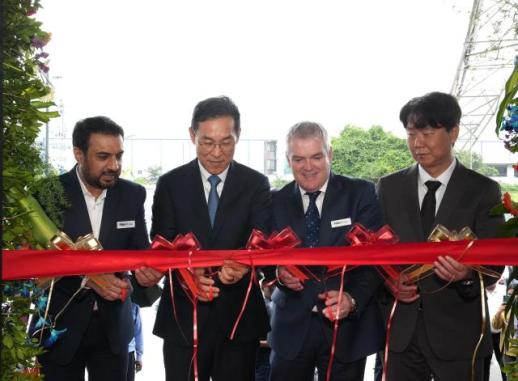 Korea takes AI race from chips to chillers SEOUL, August 13 (AJP) - An AI agent on a laptop or smartphone may appear almost weightless. Behind every prompt, however, sit warehouses of processors and memory running around the clock — consuming enormous amounts of electricity and generating heat that must be removed before the machines can keep thinking. For South Korea, already a powerhouse in the memory chips feeding those machines, that physical burden is becoming the next AI opportunity. Samsung Electronics has already put money behind that opportunity, betting that cooling will become a major business alongside the chips powering AI. The company put that strategy on display Thursday with the completion of a new production line for FläktGroup, its heating, ventilation and air-conditioning business, in Pune, India, as data-center investment accelerates across India and the wider Asia-Pacific region. The 13,826-square-meter facility can produce as many as 6,500 HVAC units a year when fully operational, including air handling units, fan wall units and computer room air handlers used to manage temperature and airflow in data centers and large commercial buildings. The plant reached mass-production readiness about six months after equipment installation began early this year. FläktGroup said in May it was investing 5.7 million euros ($6.7 million) in the Pune facility, with more than 12,000 square meters devoted to production. Pune was chosen partly for its location near industrial corridors and ports serving one of India's fastest-growing data-center markets. The expansion comes nine months after Samsung completed its acquisition of FläktGroup, Europe's largest HVAC company, giving the Korean technology giant a foothold in a business becoming increasingly important to AI infrastructure. Samsung agreed in May 2025 to acquire the company for 1.5 billion euros and completed the transaction in November. Samsung said when it announced the deal that the global data-center cooling market was projected to grow about 18 percent annually through 2030, significantly faster than the broader applied HVAC market. The bet reflects a broader change in the economics of AI. As more powerful graphics processors and other accelerators are packed into server racks, the infrastructure surrounding those chips — memory, storage, electricity and cooling — is becoming a constraint on how quickly additional AI computing capacity can be deployed. Moon Song-chun, professor emeritus at the Korea Advanced Institute of Science and Technology, said the growing importance of cooling stems from the enormous increase in computing and data-processing power required by AI workloads. "Without proper cooling, a data center simply cannot process the data," Moon told AJP. "Cooling technology is one of the most critical elements." AI data centers are not fundamentally separate from conventional data centers, Moon said. What has changed is the intensity of computing. Vast clusters of GPUs process far larger workloads while users still expect rapid responses, putting heavier demands on electricity supply and thermal management. The technology is already forcing a change in how servers are cooled. TrendForce estimates that liquid-cooling penetration in AI server racks will reach 47 percent in 2026 as the thermal design power of individual AI processors rises above 1,000 watts. The research firm says next-generation AI architectures are moving liquid cooling from an optional configuration toward an essential specification. For Korea, that creates an opportunity to stretch an existing advantage in AI memory across more of the infrastructure stack. SK links memory with data centers SK Group is pursuing that integration from another direction, seeking to connect memory production with the data centers that consume it. SK Telecom last month outlined plans for as much as 15 gigawatts of AI data-center capacity in South Korea, with the goal of turning the country into an Asian AI infrastructure hub. The company has since established SK Hyper, a dedicated data-center development subsidiary, and committed 750 billion won through 2030 for groundwork including site acquisition and substations. The scale illustrates how capital-intensive the next stage of AI could become. SK Telecom estimates that building a typical 1-GW AI data center could require about 70 trillion won because of the computing hardware, memory and supporting infrastructure involved. The group plans to combine its own capital with strategic investors, long-term customer contracts and project financing. SK Telecom is also working with Nvidia on a gigawatt-scale AI cloud in Korea using Nvidia's DSX architecture, with the first AI factory planned to begin operations in 2027. That data-center push gives SK an opportunity to link computing infrastructure with another business in which the group already holds a commanding position: memory. SK hynix's board last week approved 54.3 trillion won ($38.4 billion) of investment through 2031 in new semiconductor production facilities in Yongin and Cheongju. The dollar conversion is based on the won trading at about 1,414.4 per dollar Thursday. Of that, 35.2 trillion won will go toward Y2, the second of four fabs planned for SK hynix's Yongin Semiconductor Cluster. Construction is scheduled to begin in July next year, with the first cleanroom opening targeted for June 2029 to produce HBM and other advanced DRAM products. Another 19.1 trillion won will fund the M17 fab in Cheongju, where construction is scheduled to begin in February 2027 and the first cleanroom is targeted for December 2028. M17 will produce NAND flash, including products serving the rapidly expanding enterprise solid-state-drive market for AI servers. The investment illustrates how the AI infrastructure boom is spreading beyond processors. AI accelerators depend on HBM to continuously feed them data. Server DRAM provides working memory, while enterprise SSDs hold the expanding volumes of information required for training and inference. Packing those components into increasingly dense server racks, in turn, creates more heat that must be removed. SK hynix expects both DRAM and NAND demand to grow at a compound annual rate of 19 percent through 2030, citing Omdia estimates, and argues that memory is becoming part of the core infrastructure determining AI performance rather than merely another component. NAND demand in particular is expanding as AI shifts toward inference, where storage is increasingly used for techniques such as key-value caching to avoid repeatedly calculating the same information. Samsung and LG chase the heat Samsung is positioning itself at two ends of that same infrastructure chain. Its semiconductor business supplies DRAM, HBM and storage products for AI servers, while FläktGroup gives it a business supplying the systems that keep data-center equipment operating within safe temperatures. FläktGroup operates 13 production sites globally and provides systems ranging from conventional air handling and computer-room air conditioning to liquid cooling and fan-wall solutions for hyperscale and enterprise data centers. Samsung said last year that FläktGroup had worked on large hyperscale projects, including the Stargate AI infrastructure initiative, giving the Korean company access to customers already building some of the world's biggest computing facilities. The new Pune line extends that manufacturing network closer to Asian customers and will operate alongside FläktGroup's existing Noida facility in India. "The completion of this production line in Pune marks an important milestone in expanding HVAC supply beyond India to the Asia-Pacific region," said Kim Cheol-gi, executive vice president and head of Samsung Electronics' Digital Appliances business. Kim said Samsung plans to combine its AI and platform technologies with FläktGroup's HVAC capabilities to target customers including AI data centers. Samsung is not alone in chasing the heat. LG Electronics has made AI data-center cooling a strategic growth business, building what it calls a "chip-to-chiller" portfolio that stretches from cold plates attached close to processors to coolant distribution units and large chillers that remove heat from the facility. In July, LG's 600-kilowatt coolant distribution unit received Nvidia AI-infrastructure validation after meeting more than 100 technical requirements, making LG a validated supplier for Nvidia-based AI data-center infrastructure. The unit uses direct-to-chip liquid cooling, circulating coolant close to heat-generating components including GPUs and CPUs while working alongside air-cooling systems. LG plans to extend the technology into larger systems as server-rack power density continues to increase. The appeal of such systems is becoming clearer as processors grow hotter. TrendForce says thermal design power has risen from about 700 watts for Nvidia's H100 and H200 processors to more than 1,000 watts for newer generations, helping drive wider adoption of liquid cooling. The challenge is not simply preventing a server from overheating. Higher power density determines how many processors can be deployed in a rack, how closely those racks can be packed and ultimately how much computing output operators can extract from a data-center site constrained by electricity and cooling capacity. Moon cautioned against treating the AI data center as an entirely new type of infrastructure. Data centers have always underpinned computing, he said. What AI has changed is the scale of the workload and the concentration of processing power, placing much greater demands on the infrastructure surrounding the servers. Korean companies have so far been measured largely by their chips in the global AI race. Samsung, SK and LG are now trying to expand that role into storing, housing and cooling the computing power those chips enable. For Korea, the bigger opportunity may be not just to supply the memory inside the AI machine, but to capture a larger share of everything required to keep it running. AJP Takeaways • South Korean technology groups are moving beyond AI memory into the physical infrastructure surrounding it, targeting data centers, storage and cooling as global AI spending spreads across the supply chain. • Samsung's FläktGroup has opened a Pune production line capable of making up to 6,500 HVAC units annually, extending Samsung's AI exposure from memory chips to the systems needed to keep data centers cool. • SK is linking massive memory investment with plans for as much as 15 GW of AI data-center capacity, while SK hynix is spending 54.3 trillion won on new DRAM and NAND fabs in Yongin and Cheongju. 2026-08-13 16:47:27
 -
Chinese Stock Market Declines Amid Profit-Taking; CRO Stocks Surge The Chinese stock market, which had risen the previous day, fell on August 13. After starting the morning session with gains, the market reversed course in the afternoon as profit-taking surged. The Shanghai Composite Index closed down 0.50% at 3,926.96, the Shenzhen Component Index fell 0.87% to 14,288.44, and the ChiNext Index dropped 0.45% to 3,586.04.Overnight, the U.S. Consumer Price Index (CPI) for July met market expectations. While the U.S. CPI showed an increase compared to the previous year, it did not deviate significantly from forecasts. This led to a decrease in the likelihood of a Federal Reserve interest rate hike in September. The probability of a rate increase in the U.S. futures market dropped from about 54% to around 40%. As concerns over Fed tightening eased, Asian markets, including China's, initially turned upward. However, the afternoon session saw selling orders emerge, resulting in a market decline.Within the Chinese market, profit-taking was concentrated in sectors facing high valuation pressures. As buying momentum weakened in the afternoon, the market continued its downward trend.In a report released on the same day, CITIC Securities stated, "The U.S. CPI for July met expectations, and core inflation continues to show a moderate trend, alleviating market concerns about inflation." They predicted that the Federal Reserve would likely keep U.S. interest rates unchanged for the remainder of the year, with potential adjustments in the following year depending on the CPI situation in the fourth quarter.Notably, CRO (Contract Research Organization) stocks surged, with companies like Nanmo Biological and Boji Medical hitting their upper price limits. According to a report from Cailian, Chinese CRO firms possess competitive advantages in cost, response speed, and global delivery capabilities, with ongoing orders from overseas pharmaceutical companies. Additionally, as investments in domestic biotech ventures recover, the CRO industry is expected to thrive.Food and beverage companies also performed well, with Huangshi Group and Yiming Food reaching their upper price limits. Reports of soaring milk tea sales from Chinese beverage franchises Luckin Coffee and Mixue Ice City contributed to this positive trend. On August 7, Luckin Coffee sold 25 million cups of milk tea in a single day, marking a record high. This surge is expected to drive up wholesale milk prices and improve the performance of dairy-related companies.Meanwhile, the People's Bank of China set the yuan's central parity rate against the dollar at 6.7888 yuan, an increase of 0.0006 yuan from the previous day, reflecting a 0.01% decline in the yuan's value.* This article has been translated by AI. 2026-08-13 16:44:00