


Latest by
-
 Han Dong-hoon Opposes Abolishing Supplementary Investigation Rights Independent lawmaker Han Dong-hoon warned on July 29 that if a proposed amendment to the Criminal Procedure Act, which aims to abolish supplementary investigation rights for prosecutors, is passed, "crimes will be forgotten, and only the victims' grievances will remain."Han held an emergency debate titled "Abolishing Supplementary Investigations: Will We Ultimately Favor Criminals?" in the National Assembly. This marked the first time Han organized such a debate, attended by 14 lawmakers from the pro-Han faction, including former pro-Yoon (supporting Yoon Suk Yeol) member Kim Ki-hyun.Kim Ki-hyun stated, "We cannot stand by while a system that could produce numerous victims is in front of us. It is unacceptable to damage the entire judicial and investigative system due to the misconduct of some prosecutors."Han criticized the Democratic Party and the Ministry of Justice for not attending the debate, saying, "The Democratic Party lacks the courage to discuss this law while pushing it through. They are committing a crime against the public."He also pointed out that the Ministry of Justice, which understands the necessity of supplementary investigations for victims and citizens, ultimately chose not to participate in the debate, adding, "If this law passes, the cowardice of the Democratic Party and Ministry of Justice officials will remain evident."Han emphasized that supplementary investigation rights are not merely a prosecutor's privilege but a victim's right, stating, "If supplementary investigation rights are abolished, victims will lose their right to request further investigations." He expressed concern that cases like the Jang Yoon-gi incident could increase, leading to a never-ending cycle of back-and-forth requests in murder cases, which he termed a "ping-pong hell," ultimately harming the powerless and financially disadvantaged citizens.He further criticized the Democratic Party for lacking alternatives, asserting, "The right to request supplementary investigations already exists. The entire process of transferring cases is designed by people like Seo Young-kyu (Chair of the Legislative and Judiciary Committee), who are out of touch with reality."Regarding the inclusion of provisions related to dismissing charges in the amendment, he remarked, "This is legislation for President Lee Jae-myung," asserting that South Korea should not become a country that undermines its judicial system for the benefit of a single powerful individual.* This article has been translated by AI. 2026-07-29 17:51:00
 -
 South Korea rules out Lee reelection as constitutional debate flares SEOUL, July 29 (AJP) - President Lee Jae Myung is only in the second year of his five-year term, but speculation over whether a constitutional amendment could allow him to seek reelection briefly emerged as a political flashpoint before senior ruling-party figures moved quickly to rule out the possibility. The controversy erupted Tuesday after National Assembly Speaker Cho Jeong-sik said whether an incumbent president could run again under a revised Constitution was ultimately a matter of political agreement and "the choice of the sovereign people." His remarks were widely interpreted as leaving open the possibility of Lee seeking another term if South Korea replaces its current single five-year presidency with a four-year term allowing one reelection. The ruling Democratic Party has proposed such a change as part of broader constitutional reform. Cho later sought to end the speculation, saying the Constitution explicitly prevents a sitting president from benefiting from such an amendment. "Article 128, Paragraph 2 of our Constitution stipulates that even if the Constitution is amended to extend the presidential term or permit successive terms, the change does not apply to the president in office at the time of the amendment," Cho wrote on Facebook. "The provision must be respected, and the reelection of the incumbent president is not a subject for future constitutional discussions," he said. "I regret that my answer, which was intended to explain the basic procedures necessary for constitutional revision, caused misunderstanding and controversy contrary to my intention." Presidential Chief of Staff Kang Hoon-sik also distanced the presidential office from the controversy, calling Article 128, Paragraph 2 a "historic consensus" that should not be undermined. Kang said Lee had already stated during his presidential campaign that an incumbent president could not benefit from such a constitutional revision and that the public would be unlikely to accept any attempt to do so. Democratic Party lawmakers echoed that interpretation. "The current Constitution clearly states that provisions allowing reelection do not apply to the president in office when the amendment is proposed," Rep. Cho In-chul told AJP. "In theory, someone could try to amend Article 128 next year, install an interim president and then have President Lee run again, but that would be impossible in South Korea," he said. Cho added that incorporating the spirit of the May 18 Democratic Uprising into the Constitution's preamble should take priority in any constitutional revision. Rep. Kim Won-i was even more direct. "It is constitutionally impossible for the incumbent president to seek reelection," Kim said. "As far as I know, no one in the Democratic Party would violate the Constitution." Opposition lawmakers nevertheless warned against piecemeal constitutional revisions that they said could weaken existing safeguards. "A proper constitutional revision is needed to overcome the political system established in 1987, and electoral reform is particularly urgent," People Power Party Rep. Ahn Sang-hoon said. "However, the Democratic Party's plan appears designed to make constitutional amendments easier through incremental revisions," he said. "It looks like a ploy to delete Article 128, Paragraph 2 first and then allow the incumbent president to seek reelection. Such an amendment would face public resistance." Rep. Kim Gunn said the single five-year presidential term was established to prevent a return to authoritarian rule. "The single presidential term was a promise born from the firm determination of the Korean people, who overthrew military dictatorship and won democracy, never to allow dictatorship to take root again," Kim said. "That is why the Constitution states that an amendment cannot apply to the president in office at the time. President Lee's reelection, therefore, cannot happen." South Korea adopted its first Constitution in 1948 and has amended it nine times. The current Constitution, enacted after the 1987 pro-democracy movement, introduced direct presidential elections and a single five-year term. It took effect on Feb. 25, 1988. Article 128, Paragraph 2 stipulates that any constitutional amendment extending a president's term or changing the rules on successive terms cannot apply to the president in office when the amendment is proposed. The provision reflects South Korea's experience of constitutional revisions that were previously used to prolong presidential rule. The controversy could nevertheless complicate negotiations over broader constitutional reforms, including electoral reform, stronger legislative oversight of martial law and adding the spirit of the May 18 Democratic Uprising to the Constitution's preamble. 2026-07-29 17:42:59
 -
Election Commission Investigation Expands Amid Voting Irregularities The joint investigation team probing allegations related to the June 3 local elections has conducted its first interrogation of an Election Commission employee regarding suspicions of unauthorized modifications to voter counts. The investigation is also expanding to include inquiries into ballot shortages and allegations surrounding Noh Tae-ak's overseas trips with his spouse.On July 29, legal sources reported that the joint investigation team, led by Kim Tae-hoon, deputy chief prosecutor of the Seoul Central District Prosecutors' Office, summoned an employee from the Gyeonggi Election Commission, identified as A, as a suspect for obstructing official duties. This marks the first time the team has interrogated an Election Commission employee in connection with the voter count modification allegations.A is accused of discussing methods for correcting erroneous voter counts with officials from the Central Election Commission after being approached by a staff member from the Gimpo Election Commission on election day. The investigation team is focusing on whether the figures reflected in the system differed from actual voting data and whether the correction process adhered to internal regulations, based on internal messenger conversations they have obtained.The team plans to summon Central Election Commission officials soon to clarify the directives for the modifications and the reporting structure. Earlier, during the search and seizure process, evidence was found indicating that voter count modifications occurred not only in Gyeonggi but also in the Chungcheong region.Documents submitted by the Central Election Commission to the National Assembly's special committee investigating the ballot shortage also confirmed that incorrect voter counts were recorded at polling stations in Jincheon-eup, Jincheon-gun, and Bucheon-dong, Uiwang-si, as well as in Gurae-dong, Gimpo-si.The Election Commission explained that errors occurred in recording the number of voters at certain polling stations, leading to excessive entries by time slot. To maintain the total voter count at the district level, they instructed staff to distribute the excess entries across other polling stations within the same town or village.In Gimpo, the cumulative voter count was mistakenly calculated multiple times from 8 a.m. to 1 p.m., and the inflated figures were then redistributed to eight other polling stations. In Jincheon, the input values were kept the same from 10 a.m. until 3 p.m. Uiwang also recorded more voters than actually participated and maintained those figures until the polls closed.The investigation team is working to determine whether these modifications were merely corrections of input errors or if they were intended to create statistics that differed from the actual voter counts.The investigation into the ballot shortage is also gaining momentum. The team has continued to interrogate the election officer and the first election manager from the Songpa Election Commission in Seoul, who are under suspicion of dereliction of duty. They are accused of failing to take appropriate action despite being aware of the potential for ballot shortages at certain polling stations and not responding promptly to requests for additional ballots on-site. This marks the first instance of the team identifying new allegations against Election Commission employees during the investigation.The inquiry into Noh Tae-ak's overseas trips with his spouse is ongoing. The team summoned a Central Election Commission official as a witness to investigate the circumstances of the trips and the budget execution process. Noh's secretary and others have also been questioned as witnesses.The team applied for a search warrant for Noh's residence and phone, but the court rejected it, citing insufficient necessity and relevance for the search. However, they did obtain a warrant to search the Central Election Commission chairman's office and are considering reapplying for a warrant after strengthening the allegations based on the materials collected and witness statements.Noh is under suspicion of embezzlement for failing to report his spouse's presence on three overseas trips during his tenure. He has returned approximately 47 million won in travel expenses to the national treasury and stated that he did not request his spouse to accompany him on these trips.The joint investigation team plans to continue its investigation into the three major allegations surrounding the Election Commission, focusing on the voter count modifications, ballot shortages, and Noh's overseas trips, while analyzing seized materials and conducting witness interrogations.* This article has been translated by AI. 2026-07-29 17:27:00
-
Blue House Respects Legislative Process for Criminal Procedure Law Amendment Seong Gi-hong, the Chief of Public Communication at the Blue House, stated on July 29 that the government will monitor the legislative process regarding the proposed amendment to the Criminal Procedure Law, which aims to abolish the prosecution's supplementary investigation rights. He emphasized that the government will review and discuss the matter after observing the bill's passage through the National Assembly.In an interview with SBS's 'Joo Young-jin's News Briefing' that afternoon, Seong responded to a question about the possibility of President Lee Jae-myung exercising his veto power over the amendment. He said, "If the National Assembly deliberates thoroughly and prepares a law, it should be respected." He added that since the amendment is a significant bill currently in the National Assembly, he hopes it will be crafted into a desirable law that meets the public's expectations.Regarding the resignation of Minister Jeong, Seong remarked, "In any job, there are times when one wants to resign. While it is natural to express such feelings to friends and colleagues, it is a different matter from what the person in charge, the president, knows." He noted that Jeong has been in office for over a year and expressed his understanding of Jeong's position due to various issues, but clarified that this stance has not been officially communicated to the Blue House.On the controversy surrounding National Assembly Speaker Cho Jung-sik's comments about constitutional amendments for term extensions, Seong stated, "Amending the constitution to extend the current president's term is impossible under the existing constitutional provisions," calling it "unrealistic." He questioned whether the public would accept such a change, expressing skepticism about its feasibility.Seong also referenced past statements made by President Lee during his campaign, clarifying that under the current constitution, any proposed amendments would not apply to the president at the time the amendment is suggested. He expressed hope that unnecessary controversies surrounding this issue would not escalate further.Regarding the timeline for the presidential couple's move to the Blue House residence, Seong predicted that they would likely relocate once environmental preparations are completed, possibly within this year.* This article has been translated by AI. 2026-07-29 17:27:00
-
Russia Charges Telegram Founder Pavel Durov with Terrorism Support Russia has charged Pavel Durov, the founder of Telegram, with supporting terrorist activities and has placed him on an international wanted list.According to a statement from the Federal Security Service (FSB) reported by RIA Novosti on July 29, the agency announced that Durov has been indicted in a criminal case related to terrorism support.The FSB alleged that Telegram's management failed to delete channels and automated response programs used by Ukrainian intelligence agencies and extremist groups to prepare for terrorism, arson, and cybercrime in Russia. Durov and Telegram did not immediately respond to the Russian authorities' announcement.Earlier in February, Russia stated it was investigating Durov for allegedly supporting terrorist activities. At that time, Durov had criticized the Russian government for pressuring Telegram to suppress privacy and freedom of expression.Russian authorities have pointed to Telegram's dating service, 'Daivinchik,' as a tool for luring Russian youth into criminal activities.According to the FSB, Ukrainian intelligence agents disguised as women approached Russians, suggesting meeting locations and sharing location information. They also sent phishing links, claiming to pay for movie or concert tickets and gifts.Subsequently, other agents posed as employees of Russian investigative agencies or the Federal Financial Monitoring Service and contacted these individuals. The FSB claimed that funds from these transactions flowed into accounts of the Ukrainian military, and the shared location information was used to plan missile and drone attacks.The FSB stated that young people subjected to this psychological pressure were mobilized to attack security agency personnel or set fire to transportation, energy, and communication facilities.In connection with this, the FSB reported that since July of last year, in cooperation with the Ministry of Internal Affairs and the Investigative Committee, 46 youths aged 12 to 22 have been arrested across 16 regions of Russia. It claimed that the crimes committed by these individuals resulted in numerous casualties, including women and children, and caused damages amounting to billions of rubles.* This article has been translated by AI. 2026-07-29 17:27:00
-
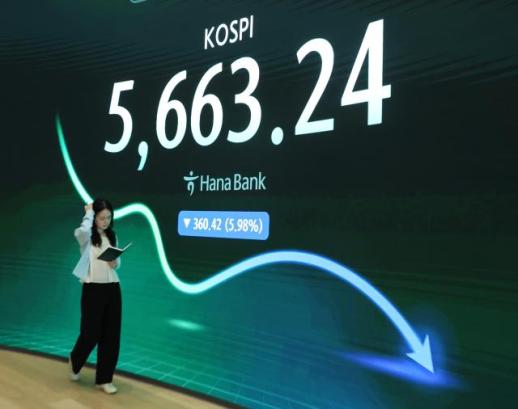 KOSPI rolls back to April, KOSDAQ to January 2025 levels as AI rally unravels SEOUL, July 29 (AJP) - It's only Wednesday, but South Korea's main bourse has already lost nearly 20 percent from its recent high, with the KOSPI retreating to early-April levels and the KOSDAQ to January 2025 as investors interpreted SK hynix's record second-quarter earnings as evidence that the AI-driven semiconductor boom may be maturing. The benchmark KOSPI closed 5.98 percent lower at 5,663.24, while the tech-heavy KOSDAQ fell 6.12 percent to 662.68 after both indexes recovered from intraday losses of more than 10 percent. Earlier in the session, both markets triggered 20-minute circuit breakers as heavy selling swept through the bourse, just a day after the KOSPI suffered its steepest decline in nearly five months. What began as a semiconductor-led correction quickly snowballed into a broader unwinding of South Korea's AI-driven rally. The rout erased about 2,807 trillion won ($2 trillion) in market value from KOSPI-listed companies, exposing how heavily the rally had depended on just two AI champions. SK hynix has lost about 1,051 trillion won in market value since its recent peak, shrinking from roughly 2,080 trillion won to 1,029 trillion won, a decline of 50.5 percent. Samsung Electronics has shed about 680 trillion won, falling from approximately 2,067 trillion won to 1,387 trillion won, down 32.9 percent. The combined market capitalization of KOSPI-listed companies has dropped from about 7,413 trillion won at its recent peak to roughly 4,606 trillion won, erasing nearly 38 percent of market value, according to Korea Exchange data. At the rally's peak, Samsung Electronics and SK hynix together accounted for more than 40 percent of the KOSPI's weighting, helping propel the benchmark to repeated record highs. As sentiment toward the two chipmakers reversed, the broader market quickly followed. Record profits no longer enough SK hynix became the immediate catalyst after reporting record second-quarter earnings that nevertheless fell short of investors' elevated expectations. The world's second-largest memory chipmaker posted record quarterly revenue of 79.21 trillion won and operating profit of 60.54 trillion won for the April-June period, driven by robust demand for high-bandwidth memory chips used in AI accelerators. Its operating margin reached an all-time high of 76.1 percent. Yet even record earnings failed to satisfy investors, reinforcing concerns that exceptional profits were no longer enough to justify AI-driven valuations. During its earnings call, SK hynix reiterated that AI infrastructure investment by hyperscale cloud providers would remain strong beyond next year, said it had secured long-term supply agreements with about 10 major customers and unveiled plans to invest nearly 50 trillion won this year to expand production capacity. Rather than reassuring investors, the outlook raised fresh questions over whether hyperscale spending could continue expanding fast enough to justify another wave of memory-industry capacity investment. The lack of more concrete shareholder-return measures added to the disappointment. SK hynix shares plunged 18.8 percent to 1,258,000 won, while SK Square, whose value is closely tied to its stake in the chipmaker, tumbled 12.0 percent to 403,500 won. Samsung Electronics reversed an early gain to finish 8.0 percent lower at 277,500 won, while Samsung Electro-Mechanics dropped 11.2 percent to 121,000 won. Selling quickly spread beyond semiconductors. Hyundai Motor fell 7.0 percent to 284,500 won, LG Energy Solution lost 7.1 percent to 345,000 won, Samsung Biologics declined 5.3 percent to 1,148,000 won, KB Financial Group slid 8.4 percent to 112,000 won, Samsung Life Insurance dropped 7.4 percent to 136,800 won and Shinhan Financial Group fell 6.4 percent to 69,000 won. Foreign investors started the session as net buyers but turned into sellers as losses accelerated. Individuals also sold shares, while institutional investors absorbed part of the pressure through net purchases, including flows believed to be linked to exchange-traded funds. Concerns had already been building before the earnings release. Investors were reassessing the enormous capital spending required to sustain the AI infrastructure boom, questioning whether hyperscale investment would generate sufficient returns and whether memory-chip earnings were approaching a cyclical peak. China's rapid semiconductor advances added another layer of concern. The blockbuster Shanghai debut of memory maker ChangXin Memory Technologies, together with reports of progress in domestic chipmaking equipment, reinforced fears that China's memory industry was narrowing the technology gap with global leaders. At the same time, expectations of further Bank of Japan rate hikes revived fears of another yen carry-trade unwind. Higher Japanese yields and a stronger yen reduced the appeal of financing overseas investments with cheap yen borrowings, prompting investors to trim leveraged positions across Asian equities, particularly AI-related trades that had attracted heavy foreign inflows. The weakness spread across the region. Japan's Nikkei 225 fell 1.49 percent to close at 61,434.19 as Kioxia Holdings and chip-equipment maker Kokusai Electric tumbled, while Taiwan's benchmark dropped 3.76 percent to 40,039.18. Leverage accelerated the sell-off The market's structure magnified the decline. Retail investors had piled into single-stock leveraged ETFs during the rally, using products designed to deliver twice the daily return of Samsung Electronics and SK hynix. As the shares plunged, those leveraged bets quickly unraveled, triggering another wave of forced selling. Margin calls on investors who had borrowed to buy semiconductor shares and leveraged ETFs further accelerated the decline. Trading in inverse products linked to individual chipmakers also surged as investors rushed to profit from the downturn. Because leveraged and inverse ETFs rebalance their portfolios daily, sharp one-way moves can generate additional buying or selling in the underlying shares, reinforcing volatility. The collateral damage was equally severe. As the market crumbled, panic spread among retail investors. Online stock forums were flooded with desperate posts such as, "Please save me. I'll never invest in stocks again," "I was a fool for believing SK hynix would reach 5 million won," and "How much further can it fall? My hands are shaking." Kim Yong-beom, the presidential chief policy secretary, said single-stock leveraged ETFs should not bear sole responsibility for the market's volatility. Speaking during President Lee Jae Myung's visit to Brazil, he argued that South Korea's market structure—not just leveraged products—had amplified the swings. He cited the heavy weighting of Samsung Electronics and SK hynix in the benchmark index, the dominance of active retail investors and the widespread use of derivatives as structural factors magnifying market moves. "A 10-point move at the center of the market can easily become a 20- or 30-point move in Korea because of the characteristics of our market," he said. The Financial Services Commission has already suspended new listings of such products and will raise the minimum cash requirement for new or additional investments from 10 million won to 30 million won. Even so, Wednesday's sell-off suggested that positions accumulated during the AI rally remained large enough to destabilize the broader market. On the KOSDAQ, individuals were net sellers while foreign and institutional investors were net buyers. Biotechnology heavyweight Alteogen fell 7.3 percent, battery materials maker EcoPro BM dropped 8.9 percent and its parent EcoPro lost 8.2 percent. Robotics developer Rainbow Robotics slid 9.1 percent, semiconductor equipment makers Jusung Engineering and Wonik IPS fell 10.4 percent and 9.6 percent, respectively, while precision-parts supplier Rino Industrial declined 7.5 percent. Drug developer HLB also dropped 6.8 percent. PharmaResearch, a medical aesthetics company, bucked the broader market by rising 3.2 percent. By the close, few corners of the market had been spared. 2026-07-29 17:24:31
 -
Changwon City Launches Initiatives to Become a Business-Friendly City Changwon Special City is implementing tailored initiatives to enhance pride among business owners and workers while significantly improving communication in the field.The city plans to relocate and open the 'Business Hall of Fame' on the first floor of the Changwon Chamber of Commerce and Industry, as well as recognize three exemplary long-standing companies that have been in operation for over 30 years. Additionally, to closely manage on-site challenges, the city will officially introduce a 'One Employee, One Company' system.To address concerns regarding the workload and expertise of dedicated public officials, the city is considering a plan to match experienced mid-level officials with manufacturing companies on a one-to-one basis.A representative from the city's Economic Affairs and Business Support Policy Team stated, "We plan to match companies with experienced officials to reduce their workload while enhancing communication in the field. Simple issues will be quickly directed to the relevant departments, while regulatory or complex complaints will be addressed through collaboration with the Economic Affairs Department and the One-Stop Business Support Team to find multifaceted solutions."Regarding the selection of exemplary long-standing companies, which is being implemented for the first time this year, the city hinted at plans for future support expansion.A city official remarked, "Changwon has many excellent long-standing companies that have been established for over 30 years. After this first year of operation, we plan to increase the number of selected companies and gradually expand the range of benefits."Meanwhile, the 'Business Hall of Fame' on the first floor of the Changwon Chamber of Commerce and Industry will feature a tribute hall for top executives and workers, as well as an exhibition space for exemplary long-standing companies, serving as a venue for citizens and business owners to visit.A city representative emphasized, "We will continue to listen to voices from the field and consistently enhance policies to create a business-friendly environment that both companies and workers can feel."* This article has been translated by AI. 2026-07-29 17:24:00
-
Court Extends Decision on JTBC's Rehabilitation Process by One Month A South Korean court has decided to postpone its ruling on whether to initiate court management proceedings for JTBC by one month. This decision was made to allow more time for negotiations between JTBC and its creditors regarding voluntary debt restructuring.On July 29, legal sources reported that the Seoul Bankruptcy Court's Rehabilitation Division 2, led by Chief Judge Jeong Jun-young, extended the deadline for the decision on the rehabilitation process from July 30 to August 30. This extension aims to facilitate the ongoing Autonomous Rehabilitation Support (ARS) process that JTBC is pursuing.The ARS system allows the court to defer its decision on initiating court management for a set period, enabling the indebted company and its creditors to negotiate a debt restructuring plan autonomously.Previously, on June 15, JTBC applied to the court to begin rehabilitation proceedings while also seeking to engage in ARS negotiations with its creditors. The court accepted this request, initiating the related procedures.Unlike traditional court management, where the court intervenes directly, the ARS process allows companies to take the lead in developing recovery plans, minimizing damage to brand and corporate value. Additionally, since this process occurs before formal rehabilitation proceedings begin, it ensures that the rights of existing creditors and shareholders are not unilaterally diluted or harmed during negotiations.Under current law, if the court approves the ARS application, it can postpone the decision on initiating rehabilitation proceedings for up to three months. If significant progress is made during negotiations with creditors, the court may further extend the postponement at its discretion.If JTBC and its creditors reach a voluntary agreement by the extended deadline of August 30, JTBC will officially withdraw its rehabilitation application and implement its self-developed ARS recovery plan. However, if negotiations ultimately fail, the court will promptly review whether to initiate court management proceedings.This situation arose after JTBC declared a default on June 12, failing to repay a total of 20.6 billion won in maturing liquidity loans. The liquidity crisis of its main affiliate rapidly worsened, leading to a series of rehabilitation applications from major affiliates of the Joongang Group.Two days after the default declaration, on June 14, the group's holding company, Joongang Holdings, along with Contentree Joongang, Joongang P&I, and Megabox Joongang, filed for rehabilitation proceedings with the court. Subsequently, on June 15, JTBC, the source of the crisis, also submitted its rehabilitation application.In contrast to JTBC's ARS process, the four affiliates that applied for rehabilitation have already had their proceedings formally initiated by the court. The court has notified these affiliates of the deadlines for submitting creditor lists and rehabilitation plans.The deadlines for submitting rehabilitation plans are set for December 1 for Megabox Joongang, December 15 for Contentree Joongang, and December 22 for Joongang Holdings and Joongang P&I. 2026-07-29 17:24:00
-
 After BTS comeback year, what's next for K-pop? SEOUL, July 29 (AJP) - K-pop continues to debut new groups, dominate global streaming platforms and fill concert halls from Los Angeles to Bangkok. The industry's talent pipeline remains as prolific as ever, producing acts not only in South Korea but increasingly through overseas partnerships and local adaptations. Yet beneath the steady flow of new debuts lies a quieter reckoning. While visibility has never been broader, far fewer acts are reaching the commercial scale needed to generate the blockbuster album sales, stadium tours and merchandise revenue that underpin the industry's biggest companies. It is the same question now confronting South Korea's semiconductor industry: not whether demand has peaked, but whether the industry's growth model has. K-pop is not facing an immediate collapse. Major entertainment agencies remain profitable, younger artists continue to break through on streaming platforms, and overseas demand continues to expand. But physical-album sales have retreated from their pandemic-era highs, blockbuster releases have become less frequent, and earnings across the industry's largest companies remain heavily dependent on a small group of established stars. The numbers illustrate the shift. Total K-pop physical-album shipments fell from roughly 120 million units in 2023 to 98.9 million in 2024 before slipping further to about 93.5 million in 2025, remaining below the 100 million mark for a second consecutive year. The number of albums selling more than three million copies also declined from 11 in 2023 to seven in 2024. The figures do not suggest listeners are abandoning K-pop. Rather, they point to a widening gap between attention and spending. Streaming has made it easier than ever for audiences to discover new artists. But listening does not necessarily translate into purchases. A fan may stream dozens of groups while buying albums, concert tickets or merchandise from only one or two. As the number of releases grows, visibility has become easier to achieve than commercial scale. The industry's economics are becoming increasingly concentrated. That trend is reflected in trade data as well. Korea Customs Service figures show physical-album export revenue reached a record $120 million in the first quarter of 2026, up 159 percent from a year earlier, despite lower shipment volumes. The United States overtook Japan as the largest export market after revenue surged 506 percent, while exports to the European Union climbed 462 percent. The divergence suggests K-pop's business model is evolving rather than simply shrinking. Industry analysts say Western consumers are more likely to purchase albums at full retail prices, unlike the bulk-buying campaigns and discount-heavy sales common in South Korea and China. Fewer albums are being shipped, but each album is generating more revenue. The industry is increasingly relying on a smaller base of higher-value overseas consumers instead of ever-expanding unit sales. If industry-wide data reveal the structural shift, HYBE's latest earnings show what it means in practice. BTS overhang HYBE reported record second-quarter revenue of 1.45 trillion won, up 105.5 percent from a year earlier and 107.6 percent from the previous quarter. Operating profit surged 159.3 percent to 170.9 billion won. The extraordinary performance was driven overwhelmingly by one factor: BTS. HYBE's quarterly revenue had remained remarkably stable, fluctuating between roughly 698 billion won and 727 billion won over the previous four quarters. Once BTS' "ARIRANG" world tour entered full operation, revenue nearly doubled. Concert revenue jumped 243.3 percent year-on-year to 647.7 billion won. Merchandise and licensing revenue more than doubled to 310.6 billion won, while recorded-music revenue rose 43 percent to 326.8 billion won. Other artists also contributed. SK Securities cited million-selling releases from TXT, BOYNEXTDOOR, TWS and Cortis, together with strong U.S. vinyl sales for BTS. But none altered HYBE's financial scale the way BTS did. The market reaction underscored the distinction. Despite beating consensus estimates for both revenue and operating profit, HYBE shares fell about 16 percent after the earnings announcement. SK Securities noted that operating margins fell short of expectations because concerts carry higher artist settlement costs than recorded music. Investors were not questioning BTS' commercial power. They were questioning how much of that growth could be repeated once the current touring cycle concludes. That may be the defining challenge facing the industry. HYBE has positioned Cortis as one of its next global growth engines. The group has surpassed 12.7 million monthly Spotify listeners, while its second EP, GREENGREEN, has sold more than 3 million copies and remained on the Billboard 200 for 11 consecutive weeks. Those achievements make Cortis one of K-pop's most promising new acts. They do not yet demonstrate that the group can generate the stadium tours, merchandise demand and company-wide earnings impact that BTS continues to deliver. Breaking through and becoming a new financial engine are no longer the same thing. The same pattern appears across South Korea's other major entertainment companies. SM Entertainment posted first-quarter revenue of 279.1 billion won, up 20.6 percent from a year earlier, while operating profit rose 18.4 percent to 38.6 billion won, supported largely by concerts and merchandise sales. Yet forecasts for the full year differ sharply. Korea IR Service expects revenue to rise just 1.2 percent and operating profit 0.6 percent, while LS Securities projects increases of 9.3 percent and 7.9 percent, respectively. The gap reflects uncertainty over whether expanding concert activity and younger artists can offset softer album sales and rising overseas operating costs. JYP Entertainment faces a more immediate slowdown. Eugene Investment & Securities forecasts second-quarter revenue of 190.2 billion won, down 11.9 percent from a year earlier, while operating profit is expected to fall 27.3 percent to 38.5 billion won. The brokerage attributed the weakness partly to modest album sales despite releases from ITZY, NMIXX, KickFlip, NEXZ and Xdinary Heroes. Growth is expected to improve later this year as Stray Kids launches another global tour. Even so, analysts argue that younger groups such as NMIXX and KickFlip must demonstrate meaningful fandom expansion as TWICE approaches another contract-renewal cycle and Stray Kids gradually moves closer to military service. YG Entertainment faces a similar challenge. Second-quarter revenue is expected to increase 10 percent year-on-year to 110.6 billion won, but operating profit is forecast to decline 12 percent to 7.4 billion won as weaker touring activity, heavier production spending and softer merchandise sales weigh on margins. Analysts expect earnings to recover through renewed activities by BABYMONSTER and TREASURE, together with a planned BIGBANG stadium tour. But that outlook reinforces the same structural reality. The next meaningful jump in earnings still depends largely on the next comeback from an already established act. None of this suggests K-pop is entering structural decline. Major agencies are still expected to post positive full-year growth, streaming audiences continue to expand globally and export revenue has reached record highs. The industry's problem lies elsewhere. Its cultural reach continues to widen faster than its commercial foundations. One development could still reshape the equation: China. Following a November 2025 summit between Seoul and Beijing, the two governments have signaled a gradual thaw in cultural restrictions that have largely constrained Korean entertainment activities in mainland China since 2016. Earlier this year, Dream Concert 2026 became the first major Korean music event in years to be broadcast in mainland China through Hunan Television. Entertainment companies are already positioning themselves for a broader reopening. HYBE has expanded its Beijing operations and sold a stake to Tencent Music Entertainment, while analysts covering SM Entertainment identify China as the market with the greatest upside should large-scale concerts resume. None of those expectations has yet translated into earnings, and Beijing has given no indication that it plans to fully remove informal restrictions on Korean entertainment. But China remains the industry's clearest opportunity to reignite growth without waiting for another once-in-a-generation global superstar to emerge. Absent such a catalyst, the industry's challenge is becoming increasingly apparent. K-pop continues to produce successful debuts, streaming hits and global cultural influence. What it is producing less frequently are artists capable of sustaining multi-million album sales, global stadium tours and merchandise ecosystems large enough to transform a company's financial trajectory. That leaves agencies increasingly reliant on volatile comeback schedules, expensive touring cycles and a small number of flagship artists whose commercial power remains difficult to replicate. It also helps explain why investors have become more cautious toward entertainment stocks. The question is no longer whether earnings can continue growing. It is whether that growth can become broad-based enough to sustain premium valuations. 2026-07-29 17:21:57
 -
Binggrae Foundation Awards Scholarships to Descendants of Independence and National Heroes The Binggrae Foundation announced that it held a scholarship award ceremony for 94 students at the Baekbeom Kim Gu Memorial Hall in Yongsan, Seoul, in collaboration with the Ministry of Veterans Affairs. A total of 150 million won in scholarships was distributed on July 29.The scholarship recipients were selected from the descendants of independence heroes and national heroes (uniformed service members) based on recommendations from the Ministry of Veterans Affairs. The ceremony included remarks from two student representatives.Since signing a memorandum of understanding with the Ministry of Veterans Affairs in 2018, marking the 100th anniversary of the March 1st Movement and the establishment of the Provisional Government of the Republic of Korea, the Binggrae Foundation has continued its scholarship program for descendants of independence heroes. Over the past nine years, it has provided a total of 720 million won in scholarships to 509 recipients.Last year, the annual scholarship amount was increased from 60 million won to 150 million won, and starting this year, the program has been expanded to include descendants of national heroes (uniformed service members).The Binggrae Foundation, established in 2011 with contributions from Binggrae, is a public interest corporation. The scholarship program for descendants of independence heroes was initiated by Kim Ho-yeon, chairman of Binggrae, who has shown a commitment to promoting the legacy of the independence movement. Kim, the grandson-in-law of Baekbeom Kim Gu, has established the Kim Gu Foundation and serves as vice president of the Baekbeom Kim Gu Memorial Association, president of the Lee Bong-chang Memorial Association, and a board member of the Independence Hall.A representative from the Binggrae Foundation stated, "We have expanded the scholarship program to include descendants of national heroes this year, and we will continue to carry on the legacy of independence heroes and national heroes for future generations."Independence heroes are those who dedicated themselves to restoring national sovereignty during the Japanese colonial period, while national heroes are individuals who contributed to or sacrificed for the nation, including fallen soldiers and those who died in service.* This article has been translated by AI. 2026-07-29 17:15:00