


Latest by
-
 Dongkuk Steel Reports 52.3% Increase in Q2 Operating Profit Driven by AI Demand Dongkuk Steel and its affiliate Dongkuk CM improved profitability in the second quarter, continuing their recovery trend. This was attributed to seasonal demand and increased needs from AI data centers and the shipbuilding industry.For the second quarter, Dongkuk Steel reported sales of 995.5 billion won, operating profit of 45.6 billion won, and net profit of 11.6 billion won, marking increases of 16.1%, 112.5%, and 87.6%, respectively, compared to the previous quarter. Year-on-year, sales rose by 11.4%, operating profit by 52.3%, and net profit by 26.8%.For the first half of the year, cumulative sales reached 1.8527 trillion won, with operating profit and net profit at 67 billion won and 17.9 billion won, respectively. Compared to the same period last year, sales increased by 14.4%, operating profit by 96.1%, and net profit by 53.5%.In the second quarter, the seasonal peak and rising demand for large industrial infrastructure, including semiconductors and AI data centers, helped improve the profitability of Dongkuk Steel's main product, rebar. The company's global export strategy also contributed positively to increased sales volume. The plate segment saw some improvement in production and sales due to strong demand from the shipbuilding sector.Dongkuk CM reported second-quarter sales of 545.1 billion won, operating profit of 21.1 billion won, and net profit of 14.6 billion won, reflecting improvements of 10.3%, 89.1%, and 41.1%, respectively, from the previous quarter. Year-on-year, sales increased by 8.6%, and both operating and net profits turned positive.For the first half of the year, cumulative sales were 1.0395 trillion won, with operating profit at 32.3 billion won and net profit at 25 billion won. Compared to the same period last year, sales rose by 1.1%, while operating profit saw significant growth due to favorable market conditions, and net profit also turned positive.In April, Dongkuk CM benefited from the imposition of provisional anti-dumping duties on Chinese galvanized and color steel sheets, which reduced the supply of low-cost generic materials, thereby improving domestic market profitability. In a high exchange rate environment, the company maintained a high export ratio of high-value products like Luxsteel and Apsteel, which helped recover its financial performance.A steel industry insider noted, "While the construction sector remains sluggish, demand from shipbuilding and AI infrastructure is providing support. Companies that have secured competitiveness in high-value products are likely to continue their recovery trend for the foreseeable future."* This article has been translated by AI. 2026-07-24 15:36:00
-
Kia to Unveil Autonomous Driving 2+ Vehicle in 2028 Kia announced during its second-quarter earnings conference call on July 24 that it plans to unveil a vehicle featuring its Autonomous Driving 2++ technology in 2028. The company emphasized that the project is currently on track and that there are no changes to the schedule.* This article has been translated by AI. 2026-07-24 15:36:00
-
Court Orders Choi Tae-won to Pay 944 Billion Won to Noh So-young A South Korean court has ruled that Choi Tae-won, chairman of SK Group, must pay 944 billion won to Noh So-young, director of the Art Center Nabi.The Seoul High Court's Family Division, led by Judge Lee Sang-joo, made the decision on July 24 during the remand hearing for the couple's property division lawsuit. The court also specified that a 5% annual interest on the payment would accrue from the day after the ruling until the full amount is paid.The court determined that the SK stocks held by Choi are subject to division, stating, "The stocks were acquired during the marriage, and both Choi and Noh contributed to their formation and value maintenance."The court set April 16, 2024, the date when the appeal hearing for the divorce case concluded, as the basis for assessing the value of the stocks. It referenced a Supreme Court ruling that states the value of divisible property should be determined as of the conclusion of the fact-finding phase of the divorce trial.However, the court noted that the significant rise in stock prices after the conclusion of the appeal hearing would not be reflected in the valuation of divisible property but would be considered in determining the division ratio.The division ratio was set at two-thirds for Choi and one-third for Noh. Choi's side argued that the SK stocks were unique property formed through inheritance and gifts, thus not subject to division, but the court acknowledged Noh's partial claim.The court explained, "A significant portion of the couple's joint property was formed or acquired during the marriage." It added that the substantial increase in the value of Choi's stocks after the conclusion of the appeal hearing was also factored into the equitable distribution of the couple's joint property.Noh's claim regarding former President Roh Tae-woo's 30 billion won slush fund was not recognized as a contribution by the court, following the Supreme Court's remand ruling last October.The method of property division was determined to be a cash payment. The court stated, "Considering the intentions expressed by both parties regarding the division method and the fact that Choi's stocks are the basis for management and control, it was decided that Noh would receive the property division amount in cash."After the ruling, Choi's attorney, Lee Jae-geun, expressed, "After nearly 20 years of marriage, the divorce was finalized last year with the Supreme Court ruling, and today we have the remand ruling on property division. Choi feels regret for causing concern to many during this process."He added, "We will provide a specific position on the ruling after thoroughly reviewing the judgment document."In contrast, Noh's attorney did not respond to questions regarding how they viewed the ruling or Noh's position.This ruling comes nearly nine years after the couple's separation. Choi and Noh married in September 1998 but faced a breakdown in their relationship. In 2015, Choi publicly acknowledged the existence of an extramarital child.Choi filed for divorce mediation in July 2017, but it failed, leading to formal litigation in February 2018. Noh countered with a lawsuit in 2019, stating she would agree to the divorce.In a previous ruling, the first court ordered Choi to pay Noh 100 million won in alimony and 665 billion won in property division. The second court recognized Noh's contribution to the growth of SK Group and set the alimony at 2 billion won and the property division amount at 1.38 trillion won.However, in October of last year, the Supreme Court upheld the 2 billion won alimony but ruled that the 30 billion won slush fund from former President Roh Tae-woo could not be considered a contribution by Noh, sending the case back to the Seoul High Court.The remand court held its first hearing on January 9 and, after three months, referred the case for mediation. However, disagreements on key issues, including the division of SK stocks, led to the failure of mediation. Consequently, the court concluded the hearing process and decided to issue a ruling.If either party disagrees with the ruling, they may appeal to the Supreme Court, indicating that further legal proceedings could follow. 2026-07-24 15:32:00
-
Hana Financial Reports 156% Increase in First Half Net Profit Hana Financial Group reported significant increases in operating profit and net profit for the first half of the year, driven by rising brokerage fees and stable performance in its investment banking (IB) sector.The company announced on July 24 that its consolidated net profit for the first half of the year reached 273.1 billion won, a 155.7% increase compared to the same period last year. In the second quarter, net profit was 169.8 billion won, up 64.4% from the previous quarter's 103.3 billion won.Operating profit for the first half was 345.3 billion won, marking a 190.6% increase.Commission income was a key driver of this performance improvement, totaling 498.6 billion won for the first half, a 158.2% increase from 193.1 billion won during the same period last year. In the second quarter, commission income also rose to 303.3 billion won, up 55.3% from the previous quarter's 195.3 billion won.Other operating income increased by 94.3% to 123.9 billion won compared to the same period last year.However, interest income declined, totaling 248.1 billion won, down 3.9% from 258.2 billion won in the same period last year. The company also recorded a trading and evaluation loss of 104.1 billion won, continuing a trend of losses from the previous year's 108.8 billion won deficit.A company representative stated, "We have proactively responded to market volatility and secured a stable growth foundation."The wealth management (WM) sector benefited from increased trading volumes in the stock market, leading to higher brokerage fees and increased sales of financial products. The investment banking (IB) sector secured stable earnings through high-quality deals, including acquisition financing and real estate transactions. The sales and trading (S&T) sector improved profitability through proactive risk management and strategic asset allocation in response to geopolitical risks earlier in the year.The representative added, "By improving the structure of all business divisions, we have expanded profitability and secured stable growth momentum. In the third quarter, we plan to provide customers with new investment experiences through the commercialization of a foreign investment platform and the launch of a new mobile trading system (MTS)."* This article has been translated by AI. 2026-07-24 15:28:00
-
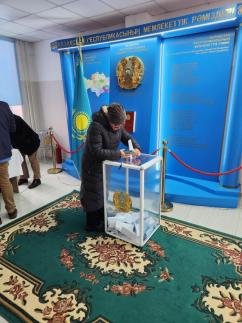 Kazakhstan plans TV debates for Kurultay elections SEOUL, July 24 (AJP) - Kazakhstan will broadcast televised debates between political parties nationwide ahead of the August 23 elections to the Kurultay, the country's new single-chamber parliament, as the Central Asian nation prepares for its first vote under a constitution adopted this spring. The plan was announced at a meeting of the Central Election Commission, Kazakhstan's state-run news agency Qazinform reported Friday. Lyazzat Suyindik, a member of the Central Election Commission (CEC), said media outlets are entitled to host such events as long as they comply with electoral law, and that discussions are underway to stage inter-party debates on the 24KZ channel. Three more broadcasters, Jibek Joly, Qazaqstan, and Channel 7, have applied to carry the debates. Suyindik said media and online platforms must publish their rates and conditions for carrying paid campaign material by July 18, five days before official campaigning begins, and submit the information to the CEC. Parties fielding candidate lists may pay for their appearances in televised programs, including the debates, from their electoral funds. The election will be a milestone in the most sweeping overhaul of Kazakhstan's political system since independence in 1991. Voters will fill all 145 seats of the Kurultay, a unicameral legislature that replaces the two-chamber parliament of the Mazhilis and the Senate. Deputies will serve five-year terms and be elected entirely through nationwide party lists. The Kurultay was created by a new constitution that Kazakhstanis approved in a referendum on March 15, with nearly 90 percent voting in favor on a turnout of 73 percent, the highest for any national vote since 2019. President Kassym-Jomart Tokayev signed the constitution into force two days later, and it took effect on July 1. The document rewrote roughly 84 percent of the 1995 constitution, abolishing the Senate, restoring the office of vice president for the first time since 1996, and establishing the Halyk Kenesi, or People's Council, a presidentially appointed consultative body with the right to propose legislation. The constitutional rewrite is the latest stage in a reform drive Tokayev has pursued since deadly unrest shook the country in January 2022. That year he pushed through constitutional amendments limiting presidents to a single seven-year term, and in 2023 he called early elections to the Mazhilis under a restored mixed electoral system. In September 2025 he went further, declaring it was time to part with what he called the super-presidential form of government, and proposed the transition to a unicameral parliament. The referendum, originally floated for 2027, was moved up to March this year. The government presents the changes as democratic modernization that streamlines lawmaking and strengthens parliamentary oversight, and the new charter grants the Kurultay meaningful powers, including overriding presidential vetoes, initiating referendums, consenting to key appointments, and expressing no confidence in the government. Some analysts abroad have questioned how far the reforms shift the balance away from the presidency, noting that presidential bills could receive priority treatment in the new chamber. The Organization for Security and Co-operation in Europe, which observed the March referendum, is due to field an observation mission for the August vote, and its assessment will be an early test of how the new system is received internationally. Public interest in the election appears high. A telephone survey by the Kazakhstan Institute of Public Development found that 70.3 percent of citizens plan to vote in the Kurultay elections, Qazinform reported. 2026-07-24 15:23:52
-
Choi Tae-won Ordered to Pay 944 Billion Won in Asset Division Choi Tae-won, 65, chairman of SK Group, has been ordered by the Seoul High Court to pay 944 billion won (approximately $800 million) to No So-young, 65, director of Art Center Nabi, as part of their asset division settlement. This amount is 4.368 billion won less than the 1.38 trillion won recognized in the previous appellate ruling, but significantly higher than the 665 billion won awarded in the initial trial.The court ruled on July 24 that Choi must pay the amount with an annual interest of 5% from the day after the ruling until the full payment is made.This ruling brings Choi's cash obligation close to 1 trillion won, prompting expectations of significant changes in the group's financial strategy. Industry insiders suggest various options for raising the necessary funds, including using shares as collateral for loans, utilizing cash assets from dividends and salaries, and asset liquidation.Choi currently holds 12,975,472 shares (17.90%) of SK Corporation, along with shares in SK Discovery, SK Chemical, SK Telecom, SK Square, and a 29.4% stake in SK Siltron. While it is unlikely he will sell his controlling shares in SK Corporation, obtaining funds through collateralized loans is seen as a practical option.Additionally, dividends and salaries from SK affiliates, as well as existing cash assets, are also considered viable sources of funding. The timing and amount of the asset division payment will likely lead to a combination of multiple funding methods, according to industry perspectives.Asset liquidation is also viewed as a key strategy for raising funds. Notably, the sale of SK Siltron, which SK Group has been pursuing since last year, is under consideration. SK Group has been looking to sell its 70.6% stake in SK Siltron, with Doosan selected as the preferred bidder last December, although a formal contract has yet to be signed.The value of SK Siltron has increased due to rising demand for AI semiconductors, making the company more valuable than initially expected. Additionally, improvements in the group's financial structure have reduced the urgency to expedite the sale.However, the recent ruling has heightened the need for Choi to secure cash, which could change the situation. If Choi's 29.4% stake in SK Siltron is included in the transaction, it could significantly contribute to funding the asset division.Market analysts believe that the SK Corporation board meeting scheduled for July 31 will be a pivotal moment in determining the direction of the sale. The board is expected to discuss the progress of the SK Siltron sale and future negotiation strategies in detail. If a sale policy is confirmed, negotiations with Doosan, which have been stalled for an extended period, are likely to resume in earnest.An industry insider commented, "While the burden has decreased compared to the appellate ruling, 944 billion won is still a substantial amount for an individual to raise in a short period. It is highly likely that a comprehensive approach utilizing collateralized loans, dividends, salaries, and existing assets will be employed."However, it remains uncertain whether this ruling will be finalized. Choi's legal team may still appeal to the Supreme Court after reviewing the ruling.Following the ruling, a representative for Choi stated, "After nearly 20 years of marriage dissolution, the Supreme Court's ruling last year confirmed the divorce, and today we received the ruling on asset division. Chairman Choi expresses his regret for the concerns caused during the divorce process and will announce whether to appeal after reviewing the ruling." 2026-07-24 15:20:00
-
 Lee departs for San Francisco to begin multi-nation overseas trip SEOUL, July 24 (AJP) - President Lee Jae Myung left for San Francisco in California on Friday to begin a multi-nation overseas trip that will also take him to three South American countries and Germany. During the trip, which will last about 11 days until early next month, he is expected to seek stronger cooperation in artificial intelligence (AI)-related industries, investment and economic partnerships. In San Francisco, the first leg of his trip, Lee will spend two days meeting the heads of major global technology companies including Anthropic, Broadcom, Nvidia and OpenAI to discuss cooperation and investment in AI and other advanced technologies. Among those scheduled to meet with Lee are OpenAI CEO Sam Altman and Nvidia CEO Jensen Huang. After wrapping up his U.S. itinerary, Lee will travel to Brazil on Sunday for a summit with Brazilian President Luiz Inacio Lula da Silva. He is also scheduled to attend a business roundtable with South Korean and Brazilian companies in São Paulo. He will then fly to Chile and Argentina the following week for separate talks with Chilean President José Antonio Kast and Argentine President Javier Milei. According to Cheong Wa Dae, his visits to the three resource-rich South American countries are expected to deepen cooperation on economic security, critical minerals and broader strategic partnerships. On his way home, Lee will make a brief stop in Frankfurt, Germany on Aug. 2 to meet South Korean nationals there. 2026-07-24 15:11:53
-
Kia Confirms No Additional Electric Vehicle Incentives for European Market in Second Half Kia announced that it will not expand additional incentives for electric vehicles in the European market during the second half of the year. During a conference call on July 24 to discuss its second-quarter earnings, the company stated, "In Europe, we have increased vehicle incentives by over 1,000 euros to respond to competition from Chinese manufacturers by adjusting electric vehicle prices and expanding support for incentives."The company emphasized, "While there were expectations for further incentives in the second half due to our increased market share in lower-priced models, that will not be the case."* This article has been translated by AI. 2026-07-24 15:08:00
-
Japan and China Foreign Ministers Meet for First Time in Eight Months Japan and China’s foreign ministers met face-to-face for the first time in eight months on July 23, following a deterioration in relations triggered by Japanese Prime Minister Sanae Takaichi's comments regarding Taiwan last November. The two ministers did not hold a formal meeting; instead, they briefly conversed while standing without an interpreter at an international conference.Nihon Keizai Shimbun reported that Japanese Foreign Minister Toshimitsu Motegi told reporters in Manila that he exchanged brief greetings and discussed bilateral relations with Chinese Foreign Minister Wang Yi during the ASEAN Foreign Ministers' Meeting. Motegi declined to disclose specific details of their conversation, citing diplomatic confidentiality, but emphasized the importance of continued dialogue for regional peace.According to Yomiuri Shimbun, the Japanese Foreign Ministry had prepared an interpreter for Motegi in case he encountered Wang, but refrained from actively seeking contact, anticipating that Wang would likely avoid engagement. Motegi explained that the opportunity for contact arose as both ministers were passing each other during a series of ASEAN-related meetings.Sources familiar with Japan-China relations indicated to Yomiuri Shimbun that there were no specific discussions on individual issues between the two countries. Topics such as China's submarine-launched ballistic missile (SLBM) drills and Japan's shooting exercises within its exclusive economic zone (EEZ) were not addressed. A senior Japanese Foreign Ministry official remarked that while the brief exchange was significant, it remains uncertain whether it will lead to improved relations.Asahi Shimbun noted that Wang appeared to have avoided official engagements with Japan, as he did not attend a formal dinner where Motegi was present and skipped the ASEAN+3 Foreign Ministers' Meeting, unlike previous years. Throughout the three-day conference, the two ministers did not share any official schedule.In contrast, Wang held a formal meeting with the Philippine Foreign Minister, who has been at odds with China over territorial disputes in the South China Sea, marking their first meeting in two years. Asahi Shimbun suggested that China may be gauging Japan's response by treating it differently from the Philippines.The Chinese Foreign Ministry did not clarify whether the two ministers had met. According to Yomiuri Shimbun, Chinese Foreign Ministry Deputy Spokesperson Lin Jian stated at a press conference that there was no understanding of a meeting being set, but did not confirm whether the brief exchange reported by Japan actually occurred.On the same day as his encounter with Motegi, Wang stated at the China-ASEAN Foreign Ministers' Meeting that the revival of militarism must not be tolerated. Chinese Vice Foreign Minister Hua Chunying, who attended the ASEAN+3 Foreign Ministers' Meeting in Wang's place, also urged regional countries to deeply reflect on historical lessons. While China remained reticent about the brief exchange, it continued to criticize Japan publicly. Expectations for Rapid Improvement in China-Japan Relations Are Premature The backdrop for Wang's brief contact is linked to the United States. A Chinese state media official told Yomiuri Shimbun that the meeting was likely intended to save face for the U.S., which is concerned about the deterioration of Japan-China relations. U.S. Secretary of State Marco Rubio remarked on July 22 in Manila that the Japan-China relationship is showing "worrisome trends." Yomiuri Shimbun interpreted that China, prioritizing stability in its relations with the U.S., responded to Japan's overtures for contact.However, analysts caution against viewing this encounter as a sign of improving relations. Nihon Keizai Shimbun assessed that improving Japan-China relations is not a high priority for Chinese diplomacy. With the U.S. and China engaging in direct high-level talks, the need for Japan to act as a mediator has diminished. Since last November, the only notable ministerial-level contact between Japan and China occurred in May when Japan's Minister of Economy, Trade and Industry Ryosei Akazawa and Wang Wentao, China's Minister of Commerce, spoke briefly while standing.Domestic political situations in both countries also complicate the path to improved relations. According to Nihon Keizai Shimbun, the Chinese leadership, facing the 2027 Communist Party Congress, risks domestic criticism of "submissive diplomacy" if it shows a conciliatory attitude toward Japan. Similarly, the Takaichi administration in Japan must consider the support of conservative factions as it prepares to revise three security-related documents by the end of the year, making it difficult to adopt a flexible stance toward China.Japan is looking ahead to the next opportunity for contact at the Asia-Pacific Economic Cooperation (APEC) summit in Shenzhen, China, scheduled for November. An official from the Japanese government stated to Asahi Shimbun that they hope to gauge China's stance leading up to November. However, a Japanese Foreign Ministry official cautioned that advocating for improved relations with President Xi Jinping carries significant risks within China, making a thaw in Japan-China relations unlikely.There is also growing concern within the Japanese government that U.S.-China relations and trade negotiations could proceed without Japan's involvement. Nihon Keizai Shimbun reported that there is a possibility of three meetings between U.S. and Chinese leaders, including the APEC summit in November. It remains uncertain whether the brief exchange in Manila will lead to a Japan-China summit.* This article has been translated by AI. 2026-07-24 15:04:00
-
Samsung Biologics Shares Surge Over 10% Following Strong Q2 Earnings Samsung Biologics shares have surged over 10% following the announcement of its second-quarter earnings, which met market expectations.As of 2:50 PM on July 24, Samsung Biologics was trading at 1,524,000 won, up 145,000 won (10.51%) from the previous trading day, according to the Korea Exchange.The company reported consolidated revenue of 1.32 trillion won and an operating profit of 586.4 billion won for the second quarter of this year, marking increases of 30% and 23%, respectively, compared to the same period last year.Samsung Biologics attributed its robust growth to the full operation of its first through fourth plants and favorable exchange rates. Despite the upfront costs associated with its fifth plant and the Rockville facility in the U.S., the operating profit margin remained above 40%.For the first half of the year, cumulative revenue reached 2.578 trillion won, and operating profit was 1.1672 trillion won, reflecting increases of 28% and 29%, respectively, compared to the same period last year.Kim Seon-a, a researcher at Hana Securities, stated, "The second-quarter results are in line with market consensus. With revenue from the Rockville plant expected to be reflected starting in the third quarter and continued benefits from exchange rates, achieving an annual revenue growth rate of over 20% is feasible."She added, "While the initial operations of the fifth plant and the Rockville facility may impact short-term profitability due to upfront costs, these expenses are part of the process of securing clients and diversifying the business. In the medium to long term, it is important to focus on expanding production capacity (CAPA) and strengthening business capabilities."* This article has been translated by AI. 2026-07-24 15:04:00