


Latest by
-
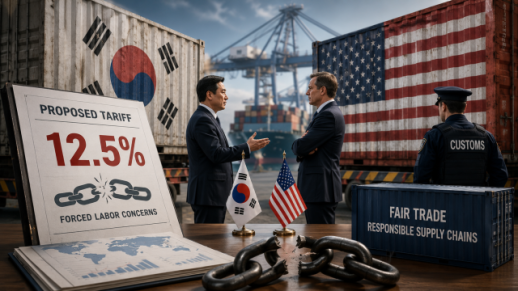 South Korea pushes back on US' proposed forced-labor tariff SEOUL, July 10 (AJP) - South Korea opposed a U.S. proposal to impose a 12.5 percent tariff on imports linked to forced labor, saying the measure is "unjustified" and "unnecessary" as Washington moves to expand its tariff policy under new legal grounds. Lee Seung-heon, counselor for trade, industry and resources at the South Korean Embassy in Washington, presented Seoul's position Thursday at a public hearing hosted by the Office of the United States Trade Representative (USTR) at the U.S. International Trade Commission. The hearing was part of USTR proceedings on proposed tariff action under Section 301 of the Trade Act of 1974, a legal tool that allows Washington to investigate and respond to foreign trade practices it considers unreasonable, discriminatory or burdensome to U.S. commerce. USTR has proposed additional duties of 10 percent or 12.5 percent on imports from 60 economies that it says have failed to impose or effectively enforce bans on goods made with forced labor. South Korea was placed in the higher-rate group, along with several other major trading partners. "Korea reserves its basic position that action against South Korea with regard to the importation of forced labor goods is neither appropriate nor necessary," Lee said. Lee argued that South Korea has pursued policies to address forced-labor risks both domestically and in global supply chains including sustainability disclosure standards, corporate guidelines and efforts to promote responsible business conduct under the Organization for Economic Cooperation and Development framework. He also pointed to a joint fact sheet issued after last year's South Korea-U.S. summit, saying Seoul had already reaffirmed its intention to cooperate with Washington in combating imports of goods made with forced labor. South Korea's argument is twofold. Seoul says it shares Washington's concern over forced labor but disputes USTR's conclusion that South Korea's current system burdens U.S. commerce. It also says that, even if Washington decides to impose tariffs on countries covered by the investigation, South Korea should receive more favorable treatment because of its broader trade cooperation with the U.S. The South Korean government earlier submitted a written statement to USTR, saying the proposed measure appeared to lack a sufficient factual basis and did not adequately reflect Korea-specific circumstances. Seoul also argued that some of the examples cited by USTR, including concerns related to polysilicon produced with forced labor, did not directly implicate South Korea. The Korea International Trade Association (KITA) separately asked USTR to defer implementation of the tariff or reduce the proposed rate for South Korea to 10 percent. The group said South Korea strictly prohibits forced labor through domestic laws and international commitments, even if it does not have an import-ban regime identical to the U.S. model. KITA also requested that goods with low forced-labor risk, or products for which USTR has not identified specific evidence of injury to U.S. commerce, be excluded from any final tariff measure. The dispute comes as the Trump administration is trying to rebuild its tariff policy after earlier emergency-based global tariffs were challenged in U.S. courts. Washington has increasingly turned to other legal authorities, including Section 122 and Section 301 of the Trade Act, to preserve tariff leverage against major trading partners. A temporary 10 percent global tariff imposed under Section 122 is expected to expire later this month, increasing attention on how quickly USTR will finalize the Section 301 cases. The forced-labor investigation is one of several trade probes that could shape the next phase of U.S. tariff policy. USTR is also conducting a separate Section 301 investigation into alleged structural overcapacity in manufacturing sectors, including in South Korea. That inquiry focuses on whether major trading partners are producing more than they can consume domestically and exporting the excess in ways that harm U.S. industry. For South Korea, the stakes are significant as the export-driven country depends heavily on the U.S. market for products including automobiles, electronics, batteries, steel and machinery. Although USTR has proposed exemptions for certain products, including goods already subject to separate national security tariffs, officials and businesses remain concerned that new duties could complicate the tariff balance reached with Washington last year. During the hearing, USTR officials asked South Korea to provide more detail on its policies to prevent imports of goods made with forced labor as well as a timeline for specific measures and plans. It remains unclear whether the public hearing and written submissions will lead USTR to revise the proposed tariff rate for South Korea. A final decision is expected to be closely watched in Seoul as a test of whether last year's bilateral trade understanding can shield Korea from Washington's latest tariff campaign. 2026-07-10 10:41:14
-
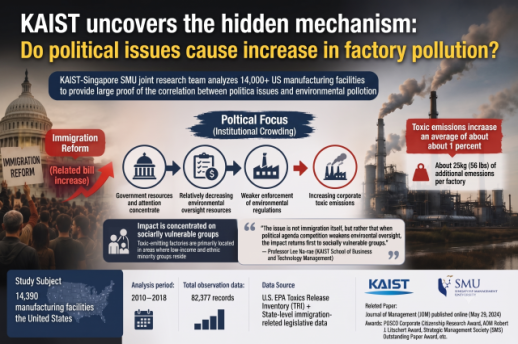 Immigration politics linked to rising factory pollution, KAIST study finds SEOUL, July 10 (AJP) - When immigration dominates political debate, factories quietly release more toxic chemicals. That is the finding of a new study by researchers in South Korea and Singapore, who traced the connection to a simple constraint: governments have only so much money and attention to go around. The Korea Advanced Institute of Science and Technology (KAIST) said Friday that a research team led by Lee Na-rae, a professor in its School of Business and Technology Management, and Heli Wang of Singapore Management University analyzed immigration-related legislation and environmental data across the United States. They found that as immigration rose on the political agenda, government environmental oversight weakened and toxic emissions from manufacturers increased. The researchers examined 82,377 records from 14,390 manufacturing facilities across the United States between 2010 and 2018, combining the Environmental Protection Agency's Toxics Release Inventory with state-level immigration legislation data. Each additional immigration-related bill was associated with an average 1 percent increase in toxic releases per facility, roughly 25 kilograms, or 56 pounds, of additional toxic chemicals per plant. The team calls the mechanism "institutional crowding." When a politically charged issue such as immigration demands government attention and enforcement resources, less visible policy areas like environmental monitoring get pushed aside. Firms, sensing looser oversight, cut back on costly pollution abatement and toxic waste management. The researchers stressed that environmental regulations themselves did not change during the period studied. What changed was how closely anyone was watching. The effect was strongest where money was tightest. In states carrying heavy debt or fiscal burdens, environmental oversight deteriorated further when political attention shifted to new issues, suggesting that cash-strapped governments funnel resources toward whatever is politically urgent first. Although the study used immigration as its test case, the researchers said the mechanism is general. Any issue that consumes government resources, from a public health crisis to a security scare, could crowd out enforcement elsewhere. The findings carry implications for environmental justice, since pollution burdens tend to fall hardest on poorer communities that are least equipped to push back. The Korea Advanced Institute of Science and Technology (KAIST) said the study offers new grounds for designing safeguards that keep environmental enforcement insulated from political swings. The paper, titled "There's More Than Meets the Eye: Assessing the Impact of Immigrants on Firm Environmental Performance," was published online in the Journal of Management on May 29, with Lee as first author. It has received the POSCO Corporate Citizenship Research Award, the Academy of Management's Robert J. Litschert Award, and a best paper award from the Strategic Management Society. "This study does not argue that immigration causes environmental pollution, but shows that shifts in the political agenda can weaken environmental oversight and increase corporate pollution," Lee said. "Even when the government's limited resources are concentrated on a particular issue, environmental oversight needs institutional protection so that it does not falter." (Reference Information) Journal/Source: Journal of Management Title: There's More Than Meets the Eye: Assessing the Impact of Immigrants on Firm Environmental Performance Link/DOI: https://doi.org/10.1177/01492063261442451 2026-07-10 10:35:13
-
 Namyang Dairy to Export 10 Billion Won Worth of K-Food to Mongolia Over Three Years Namyang Dairy announced on July 10 that it signed a memorandum of understanding with Mongolian food distribution company Maximus Distribution to expand K-Food exports worth 10 billion won over the next three years during the Korea-Mongolia Business Forum held on July 9.This agreement follows a 70 billion won export deal made at the Korea-Vietnam Business Forum in April, marking Namyang Dairy's second achievement as part of its economic delegation.Namyang Dairy plans to expand its export products from primarily French Cafe mix coffee to include formula and dairy products based on domestic raw milk. The company intends to introduce products such as Imperial XO and I Am Mother formula, as well as Delicious Milk GT, Da Vinci cheese, and Namyang yogurt to the Mongolian market.Maximus has a distribution network of over 13,000 outlets across Mongolia, supplying products to major supermarkets like Nomin and Orgel, convenience stores such as CU and GS25, traditional markets, and local grocery stores.Kim Seung-won, CEO of Namyang Dairy, stated, "We will contribute to strengthening K-Food competitiveness by broadening our cooperation scope based on the competitiveness of domestic raw milk-based formula products."Bae Sang-gon, CEO of Maximus, added, "We will combine the strengths of both companies to achieve long-term growth together."Meanwhile, Namyang Dairy successfully returned to profitability last year after transitioning to a private equity fund, Han & Company, in 2024, focusing on business restructuring and improving profitability.* This article has been translated by AI. 2026-07-10 10:28:00
-
10-Meter Bonobono Character to Appear at Sajik Stadium Bonobono, a globally popular character licensed by Lotte World, will make an appearance at Sajik Stadium in Busan, in collaboration with the Lotte Giants baseball team. This event is planned to celebrate the 40th anniversary of the original comic series and will take place from July 21 to July 26.During this period, Sajik Stadium will transform into a unique space themed around Bonobono. A giant 10-meter Bonobono air balloon will be displayed in the stadium plaza, along with a photo zone for fans to take commemorative pictures. The Giants Shop, the official store of the team, will offer a range of limited-edition merchandise, including collaboration uniforms, hats, cheering tools, bags, tumblers, and keychain plushies that reflect the identities of both brands.The highlight of the event will be 'Bonobono Day' on July 26, when all attendees will receive specially made collaboration baseball caps. Before the game, fans will have the opportunity to meet a Bonobono character dressed in a Lotte Giants uniform during a photo session. Additionally, Mikio Igarashi, the creator of Bonobono, will throw the ceremonial first pitch. The cheerleading squad will also wear collaboration uniforms during the event.Throughout the game, interactive events will take place, such as 'Follow Me,' where fans can mimic character movements displayed on the scoreboard. Attendees will also have access to Bonobono-themed paper tickets, limited-edition photo cards, and a dedicated photo booth, providing exclusive experiences for those present at the stadium.Moreover, a random toy shop featuring various keychains will be set up inside the Giants Shop during the event. Starting July 16, online emoticons featuring illustrations from the collaboration between Lotte Giants and Bonobono will also be released.Lotte World has successfully led offline projects utilizing Bonobono's intellectual property (IP) in South Korea. A pop-up store held in 2024 at Lotte World Mall in Jamsil attracted around 60,000 visitors, while a second pop-up store at The Hyundai Seoul in 2025 drew an average of over 5,000 visitors per day, marking a successful venture.A representative from Lotte World stated, "We aim to provide fans with a unique experience by combining a familiar character IP with the professional baseball industry. In the future, we will continue to explore collaborations across various fields based on our IP capabilities."* This article has been translated by AI. 2026-07-10 10:24:00
-
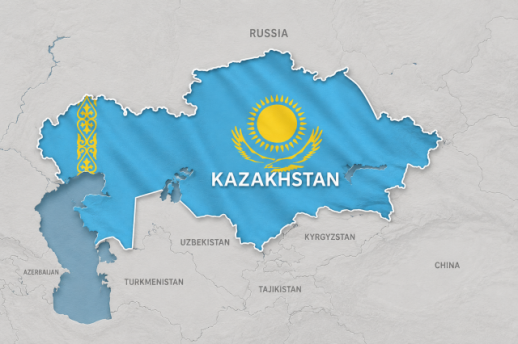 Kazakhstan defies regional slowdown in ADB outlook SEOUL, July 10 (AJP) - Kazakhstan's economy is set to keep growing at a steady pace over the next two years even as the Asian Development Bank trims forecasts for much of the surrounding region, according to the bank's Asian Development Outlook released this week. The Asian Development Bank kept its projections for Kazakhstan unchanged in the July edition of the report, with gross domestic product expected to expand 4.8 percent in 2026 and 4.5 percent in 2027. The economy grew 6.5 percent in 2025, lifted by a surge in oil output after the expansion of the Tengiz field, Kazakhstan's largest, came online ahead of schedule. The unchanged outlook stands out in a subregion where the bank lowered several forecasts. The Asian Development Bank (ADB) cut its 2026 projections for Armenia, Turkiye and Turkmenistan, citing Russian trade restrictions, weak first-quarter growth and the higher cost of rerouting trade around Iran. Forecasts for Kazakhstan, Azerbaijan, Georgia, the Kyrgyz Republic, Tajikistan and Uzbekistan were left untouched for both years. The wider region is under strain. The ADB projects developing Asia and the Pacific, a grouping of 43 economies that excludes Japan, South Korea and Singapore, will grow 4.9 percent in 2026, below the 5.1 percent it forecast in April. The bank blamed the conflict in the Middle East, saying it has caused prolonged disruption to energy markets and supply chains, raised production costs and dampened economic activity. Growth is expected to recover to 5.1 percent in 2027. Kazakhstan's expansion is slowing from last year's pace for reasons the bank flagged in April. Oil production is running near capacity after the Tengiz ramp-up, leaving little room for further gains, while tighter lending conditions, higher taxes and slower real income growth are expected to cool private spending. Government investment continues to support activity. Inflation remains the country's main weak spot. The ADB expects consumer prices to rise 10.4 percent in 2026 before easing to 9.5 percent in 2027, down from 11.4 percent in 2025 but still among the highest rates in Central Asia. The bank attributed the pressure partly to government-regulated utility tariff increases and a new tax code that raised value-added tax, prompting businesses and consumers to bring purchases forward. Across the Caucasus and Central and West Asia, the ADB revised its 2026 inflation forecast up to 22.0 percent, a figure driven largely by Turkiye, as the Middle East crisis slows disinflation and pushes fuel prices higher across the subregion. The report warned that the projections carry elevated uncertainty. The main risks to the regional outlook include renewed geopolitical tensions, tighter global financial conditions, higher commodity prices and trade uncertainty, the ADB said. 2026-07-10 10:19:27
-
 Lee begins 2nd day of visit after sharing vision for 'golden' era with Mongolian leader SEOUL, July 10 (AJP) - President Lee Jae Myung is set to begin the second day of his three-day state visit to Mongolia by visiting a memorial honoring independence activist Lee Tae-jun who practiced medicine there. Lee arrived in Ulaanbaatar the previous day, marking the first such visit to Mongolia by a South Korean president in about 15 years. Lee is then scheduled to hold a luncheon meeting with South Korean residents there, before meeting with Mongolia's parliament speaker Sandag Byambatsogt and Prime Minister Nyam-Osoryn Uchral to discuss ways to strengthen cooperation between the two countries. He will then attend a state banquet hosted by Mongolian President Ukhnaagiin Khürelsükh later in the day. The banquet comes after Lee held a summit with Khürelsükh the previous day, during which the two leaders agreed to expand cooperation in trade, critical minerals and advanced technologies while declaring a shared vision for a "golden age" of bilateral relations. Under the vision, the two leaders agreed in principle to pursue a Comprehensive Economic Partnership Agreement (CEPA) and work toward raising annual bilateral trade to US$1 billion by 2030. "Since the establishment of diplomatic relations between South Korea and Mongolia, the two countries have built cooperation across various fields," Lee was quoted as saying at the summit. "Based on three decades of friendship and trust, I hope the two countries will further deepen strategic partnership." Lee and Khürelsükh agreed to strengthen cooperation in supply chains including those involving critical minerals, while expanding collaboration in artificial intelligence, digital transformation and cutting-edge technologies. They vowed to strengthen cooperation on regional and international issues by expanding high-level exchanges and strategic communication. Lee also shared South Korea’s vision for peace and cooperation on the Korean Peninsula with Khürelsükh and stressed the importance of maintaining peace and stability in the region. Khürelsükh expressed strong support for the vision. The two countries also signed 21 memorandums of understanding (MOUs) on the sidelines of the summit, aimed at expanding cooperation in areas including AI and logistics. Lee will conclude his visit on Friday by attending the opening ceremony of Naadam, Mongolia's largest traditional festival, as guest of honor before returning home on Saturday. 2026-07-10 10:18:38
-
OpenAI's Number Two, Piji Simo, Resigns Due to Health Issues, Raising IPO Concerns Piji Simo, the Chief Executive Officer of Applications at OpenAI and the company's second-in-command, has resigned due to health issues after just over a year in the role. Concerns are growing that the ongoing changes in OpenAI's management could disrupt plans for an initial public offering (IPO) that the company was preparing for this year. Simo announced on social media platform X on July 9 that he would be stepping down from his full-time position at OpenAI to take on a part-time advisory role. He explained that a chronic illness he has suffered from for seven years worsened significantly three months ago, forcing him to take medical leave. Simo noted that he realized the recovery process would be much longer and more complicated than initially expected, leading him to focus on his health. Reports indicate that Simo was diagnosed with postural orthostatic tachycardia syndrome (POTS) in 2019. From 2019 to 2021, Simo oversaw the app division at Facebook and successfully led the IPO of grocery delivery service Instacart in 2023. Following the 'OpenAI coup' in November 2023, he was appointed to the board of OpenAI in March 2024 under the leadership of CEO Sam Altman, and in May of the same year, he became the CEO of Applications at OpenAI. During his tenure, Simo managed OpenAI's product-related operations, including the discontinuation of the video generation service 'Sora' and the initial development efforts for the newly announced super app 'ChatGPT Work.' This product, designed to assist with work tasks, is based on OpenAI's latest AI model, GPT-5.6, and the coding platform Codex. Simo has been instrumental in transitioning the company's offerings into a super app format that consolidates its products. Simo's resignation adds to the ongoing changes in OpenAI's management, raising concerns about competition with Anthropic and potential setbacks to the company's goal of a $1 trillion IPO this year. Following Simo's medical leave in April, co-founder Greg Brockman took over product operations, while Chief Operating Officer Brad Lightcap assumed responsibility for 'special projects,' indicating significant shifts in the leadership team. Additionally, last month, Chief Marketing Officer Kate Louch also took medical leave for cancer treatment. The Wall Street Journal reported, "OpenAI is preparing for an IPO as early as this year while also trying to catch up with competitor Anthropic in the enterprise customer market, amid yet another management shakeup." It noted that Simo was expected to play a larger role in leading the company if it went public, having been appointed by CEO Sam Altman to oversee OpenAI's product and business divisions.* This article has been translated by AI. 2026-07-10 10:12:00
-
E-Channel Launches K-Beauty Commerce Show 'Seoul Unni' Taekwang Group's media subsidiary, E-Channel, is set to target the Asian market with a new business model that combines content and commerce.E-Channel announced on July 10 that it is co-producing a new entertainment program, 'Seoul Unni,' in collaboration with global IP studio Studio Vibe, linking K-beauty and lifestyle with live commerce.'Seoul Unni' features domestic cast members experiencing the latest trends in Seoul alongside international mega influencers, sharing these experiences in real-time with global consumers.First Stop: Vietnam... Maximizing Synergy with TikTok LiveThis project is designed as a relay format targeting various Asian countries, with Vietnam being the first focus due to its strong K-content popularity. The strategy involves conducting a live commerce event, 'Seoul Unni Special,' on the global short-form platform TikTok, collaborating with local mega influencers to convert viewers into consumers.The cast includes prominent figures such as global beauty icon Pony, who has worked with top pop stars like 2NE1's CL and BLACKPINK's Jisoo. Additionally, former Lovelyz member Yein will showcase the vibrant lifestyle of Seoul.Top creators with significant influence in Vietnam will also participate. 'Truong Gia Dinh,' who averages over 10 million views per video on TikTok, and 'Dan Meo,' who boasts a fanbase with a peak of 50 million views, will traverse Seoul to introduce the allure of K-beauty products live.Expanding Across Asia... Aiming for a Combined Content and Commerce Model'Seoul Unni' plans to use its foothold in the Vietnamese market to gradually expand production into major Asian countries such as Thailand, Japan, and Taiwan. The goal is to establish a unique global intellectual property (IP) that combines content and distribution, moving beyond one-off entertainment productions.The production team for 'Seoul Unni' stated, "We will leverage the powerful TikTok platform to imprint Seoul's trendiest culture in the global market, focusing our production capabilities to create differentiated commerce content that goes beyond simple beauty introductions."Targeting the global market, 'Seoul Unni' will have a preview on local channels in Vietnam in August and September. Domestic viewers can watch it on E-Channel and streaming services like Wavve and Watcha.* This article has been translated by AI. 2026-07-10 10:12:00
-
China's Interest in Korean Art Grows at 2026 Global Art Fair in Yantai The second exhibition of the 2026 Global Art Fair international tour was successfully held from July 6 to 9 at the 1861 Gallery Joy in Yantai, Shandong Province, China.This exhibition aimed to introduce the works of Korean artists to the local Chinese audience and to enhance cultural and artistic exchanges between Korea and China.During the exhibition, Chinese artists, cultural officials, and students and professors from art universities, who are interested in Korean art, visited the venue to appreciate the artworks and engage in meaningful discussions about the creative processes and artistic values.Local media also showed significant interest. Chinese broadcasters filmed the exhibition and featured it in news segments, including interviews with artists Hwang Mi-sun (Director of Bom Bi Creative Space, Hongdae Art) and Kim Ah-young (from Singapore), introducing the world of Korean artists to Chinese viewers.From the first day of the exhibition, works by artist Kim Ji-young were sold, and inquiries about purchasing artworks continued, confirming a strong interest in Korean art.Participating artist Lee Seo-yul (from Ho Chi Minh City Korean International School) expressed, "I was excited to share the meaning of my work with more people through this overseas exhibition. I hope to grow as a beloved artist in the future."Reina Lee, chair of the 2026 Global Art Fair organizing committee, stated, "This exhibition in Yantai was more than just a display; it was a cultural exchange platform where artists, citizens, and educational institutions communicated together. The broadcast coverage and artwork sales reaffirmed the competitiveness of Korean art and the potential for international exchanges."Meanwhile, the 2026 Global Art Fair international tour has successfully concluded its exhibitions in Shanghai and Yantai, with a domestic exhibition scheduled to take place at the Dongjak Art Gallery in Seoul from July 23 to 25.The Seoul exhibition will showcase award-winning works that have been introduced both domestically and internationally, continuing the platform for cultural and artistic exchanges between Korea and the world.* This article has been translated by AI. 2026-07-10 10:12:00
-
Maeil Dairy Donates 50 Million Won to Support Families of Severely Ill Children Maeil Dairy's Jinam Social Welfare Foundation announced on July 10 that it has donated 50 million won to the Korea Ronald McDonald House to support families of severely ill children.The Korea Ronald McDonald House is a nonprofit organization that provides family-centered care spaces for children requiring long-term hospitalization or outpatient treatment, allowing them to focus on their recovery while staying near the hospital. The first house opened in 2019 near Busan National University Hospital in Yangsan, and the organization is currently working on establishing a house in the metropolitan area.Since 2023, the Jinam Social Welfare Foundation has been providing dairy products, beverages, and snacks to the Yangsan house. Last year, it also donated 50 million won to support the construction of the metropolitan area house, marking three years of collaboration.A foundation representative stated, "We will continue to support children and families undergoing long-term treatment so they can focus on their recovery in a more comfortable environment."Additionally, last month, the foundation hosted a two-day family healing camp for 27 individuals from 11 families in the Dream Start program in Jongno-gu, Seoul. Dream Start is a child welfare initiative by the Ministry of Health and Welfare that provides tailored integrated services to vulnerable children and families, focusing on health, basic learning, social skills, parent education, and family support for children aged 0 to 12 years.* This article has been translated by AI. 2026-07-10 10:12:00