


Latest by
-
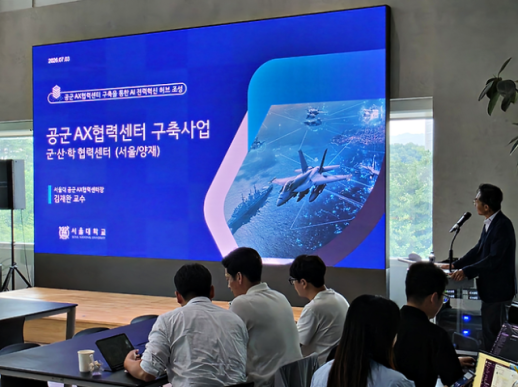 Korea's Air Force, SNU launch AI initiative to reshape aerospace warfare SEOUL, July 06 (AJP) - Seeking to accelerate its digital frontline transformation, the South Korean Air Force has partnered with Seoul National University (SNU) to develop three key AI technologies that can be directly deployed in military operations. The projects will focus on tracking mobile missile launchers, automatically identifying targets and generating combat plans for aerospace operations. Each project will be carried out by a joint team consisting of SNU researchers and a participating private company. The initiative is part of efforts to establish the Air Force AX Cooperation Center, a joint military-academic-industry hub designed to accelerate the Air Force’s adoption of artificial intelligence. AX refers to AI transformation. The Air Force plans to establish an AX base at the Industrial AX Innovation Center within the Seoul AI Hub in August, with support from the Ministry of National Defense. SNU will oversee the cooperation center, while Air Force personnel will be stationed there to identify operational requirements, conduct security reviews and help connect research results to military acquisition and deployment programs. The Artificial Intelligence Research Institute has also been commissioned to provide specialized AI education and support the operation of the SNU-Air Force AX Cooperation Center. “The Air Force AX center is not simply a research space,” said Zhang Byong-tak, head of SNU’s defense AI talent development program. “It is a hub for practical civil-military cooperation where technologies the Air Force actually needs are developed with companies and then directly applied and fielded in military operations.” A project led by Zhang will focus on tracking mobile missile launchers. His team is developing an AI system that combines various data sources with maps to predict where these launcher vehicles will go after firing a missile. By showing these paths on a digital map in real time, the system will help analysts find moving targets much faster. To identify targets automatically, Kwak No-jun’s team is building a system that analyzes both military photos and written text together. It will compare new images with older data to spot similar activities, while also checking past reports and records. This will help analysts pinpoint targets with greater speed and accuracy. Another project, led by Yu Young-jae, applies AI to planning air and space combat. The team is creating a tool that helps assign troops, select targets, and recommend the best weapons based on official guidelines. This system aims to cut down planning time and help commanders make smarter, more accurate decisions. Companies with AI capabilities, including startups, small and medium-sized enterprises and defense contractors, may apply to participate from July 6 to 17. Applicants will first undergo a document review, with a shortlist of up to three candidates for each project. A committee led by SNU will then select the participating companies. The selection and partnership agreements are expected to be completed in late July, with research scheduled to begin in early August. 2026-07-06 17:39:19
-
 Korean Appraisers Association Opposes Patent Attorney Law Amendment The Korean Appraisers Association has expressed strong opposition to a proposed amendment to the Patent Attorney Act currently pending in the National Assembly, calling it a "toxic provision that legally permits conflicts of interest." The association stated on July 6 that it has continuously communicated its objections and suggestions for amendments to the Intellectual Property Office since discussions began in March, but has only received generic responses. The primary concern raised by the association is Article 7-5, Section 1, Subsection 1 of the amendment, which allows patent attorneys to conduct appraisals of patents, utility models, designs, and trademarks for which they have directly represented clients. The association criticized this provision as permitting "self-appraisal," where a patent attorney evaluates their own represented patents, undermining the objectivity and fairness that are vital to the appraisal market. They warned that this could send a dangerous signal that encourages fraudulent patent applications and inadequate evaluations, ultimately causing significant harm to the national economy. In fact, major professional qualification systems in South Korea, including those for appraisers (Article 25 of the Appraisal Act), lawyers (Article 51 of the Attorney Act), and certified public accountants (Article 21 of the Certified Public Accountant Act), strictly prohibit any work that poses a conflict of interest or raises concerns about unfair practices. The association argues that the proposed amendment is regressive, allowing typical conflict-of-interest situations that other professions are prohibited from engaging in. The association has consistently proposed amendments and collaborative solutions to the Intellectual Property Office to resolve the conflict, but claims the office has maintained a "no amendments" policy and has only engaged in a superficial consultation process. They also dismissed claims made by the head of the Intellectual Property Office in March that sufficient consultations with relevant organizations had taken place as inaccurate. Furthermore, the association emphasized the need for a strict national oversight system to be explicitly stated in the law, including significantly strengthening the disciplinary provisions for patent attorneys to prevent a recurrence of past cases of inadequate patent value assessments. Yang Gil-soo, president of the Appraisers Association, cautioned against viewing the issue as merely a turf battle among professional qualifications, stating, "The valuation of intellectual property rights requires collaboration between the expertise of appraisers and the technical expertise of patent attorneys, and the amendment should not become a source of conflict." An industry insider remarked, "Valuations must be determined objectively and independently from clients, but this amendment effectively legitimizes conflicts of interest by allowing patent attorneys to appraise their own represented items, creating a structure that encourages evaluations tailored to client preferences and risks promoting illegal activities."* This article has been translated by AI. 2026-07-06 17:36:00
-
Baejae High School Baseball Team Apologizes Amid Political Debate The Baejae High School baseball team has apologized to Gwangju Ilgo High School following a controversy that erupted during a high school baseball game. The incident has sparked a political debate over the severity of the punishment and the nature of the actions involved.On the afternoon of July 6, all 36 members of the Baejae baseball team, along with some parents and staff, visited Gwangju Ilgo to read an apology letter. This visit came a week after the controversy arose during a match on June 29 at the Cheongryonggi National High School Baseball Championship.The Baejae baseball team stated, "We sincerely apologize to the players, parents, and citizens of Gwangju who were deeply hurt by our inappropriate remarks and actions." The team's coach acknowledged the responsibility, saying, "There is no excuse for regional derogatory cheers."The controversy began during the match between Baejae and Gwangju Ilgo when some Baejae students shouted phrases like "Let's go to Starbucks" and "Tank Day." These cheers were criticized for evoking recent controversies surrounding a Starbucks Korea event that was seen as trivializing the May 18 Gwangju Democratization Movement and the torture and death of activist Park Jong-cheol.Given that the remarks were directed at Gwangju Ilgo, a school in the Gwangju area, the situation escalated into accusations of mocking the May 18 movement and regional discrimination. In response, the Korea Baseball Softball Association imposed a six-month suspension on the Baejae baseball team from national competitions.Political reactions have been mixed. The Democratic Party views the incident as a matter of hate speech and historical distortion. Acting party leader Han Byeong-do expressed dismay, stating, "Regardless of political affiliation, no one should make jokes or belittle such matters." Senior spokesperson Kang Jun-hyuk criticized claims from some members of the People Power Party that the punishment was excessive, arguing that such mockery and hate should not be defended as free expression.Democratic Party lawmaker Kim Jun-hyuk called for stronger accountability from the school, asserting that while appropriate punishment for the players and coaching staff is necessary, the larger failure lies with the school's administration for allowing such behavior to occur. He criticized the incident as not merely a spontaneous act by students but a result of neglect in character education by the school and its governing body.Conversely, some members of the People Power Party and conservative figures argue that the punishment is too harsh. Yang Hyang-ja, a senior member of the People Power Party, acknowledged that extreme and hateful expressions are wrong and contrary to sportsmanship but called for a reconsideration of the severity of the punishment. Kim Jae-won, another senior member, described the players' actions as "immature" but deemed the six-month suspension for all student-athletes as "clearly excessive and violent."Independent lawmaker Han Dong-hoon and Lee Jun-seok, leader of the Reformist Party, also raised concerns about the punishment's severity. Han stated that while using the May 18 Gwangju Democratization Movement as a target for jeering is wrong, a six-month suspension for young students is excessive. Lee similarly urged the Korea Baseball Softball Association to revoke the six-month suspension.The debate has also touched on issues of free expression. Lee Byeong-tae, vice-chairman of the Presidential Regulatory Reform Committee, posted that the May 18 movement has become a taboo subject, emphasizing that the core of the argument remains centered on free expression. In response, the Blue House issued a warning regarding inappropriate conduct from individuals in responsible positions within government-affiliated organizations and subsequently recommended resignation.The Baejae incident has evolved into a complex discussion involving inappropriate cheering by school sports teams, hate speech, gaps in historical education, the severity of punishments for minors, and political interference. While the Baejae baseball team has apologized in Gwangju, the debate over how to address this issue and prevent future occurrences is likely to continue for some time. 2026-07-06 17:32:00
-
Over 10,000 First-Year High School Dropouts Amid Educational Reforms First-year high school classrooms are facing significant turmoil. Amid major changes in the college entrance system, including the full implementation of the high school credit system and the new grading system, the number of first-year dropouts has surpassed 10,000. The Ministry of Education has denied a direct link between the new grading system and the increase in dropouts, but educators and academic experts point to the contradictions of the complex credit system and college entrance policies, along with the 'anxiety marketing' of private education, as contributing factors to the crisis in public education. According to data released by the Ministry of Education on July 6, the number of first-year dropouts in general high schools has steadily increased: 6,112 in 2021, 7,880 in 2022, and 9,373 in 2023. In the 2025 academic year, following the introduction of the new grading system, the number of dropouts reached 10,016.Education Ministry: "Dropout increase not solely due to new grading system... more dropouts from lower ranks"However, the Ministry has drawn a line, stating that it is difficult to attribute the dropout crisis solely to the new grading system. The average rank of first-year dropouts in 2025 is 3.7 (on a 5-point scale), which translates to a 6.7 under the previous 9-point system, indicating that a larger proportion of dropouts are from lower-ranking students. In response to concerns about top students opting for 'resetting their grades' (dropping out and re-enrolling), the Ministry noted that the dropout rate among first-grade students (6.72%) has actually decreased from two years ago (7.07%), and the number of students re-enrolling the following year remains similar to the previous year. Additionally, addressing fears that the new grading system would weaken the differentiation among top students, the Ministry reported that the number of students maintaining straight A's across all subjects in the first and second semesters has decreased by 38% to 4,659, suggesting that the number of students who can maintain straight A's through to their third year is likely to be less than the medical school admission quota of 3,671, indicating sufficient grading differentiation."Career pressure from credit system and mismatch with college entrance exam leads to dropouts"Despite the Ministry's quantitative explanations, the sense of crisis felt by educators and experts is severe. Some in the education sector analyze that the pressure stemming from the full implementation of the high school credit system is a significant underlying factor in the surge of first-year dropouts. Under the credit system, students must choose complex subjects aligned with their career paths from their first year. A professor of education noted in a conversation with Aju Economy that "forcing first-year students, who may not have a clear career path, to select subjects directly tied to college admissions creates extreme stress." Moreover, while the grading system operates under the credit system and the new 5-point scale, the college entrance exam, a major component of admissions, still adheres to the old system, creating a significant contradiction. Among students facing this double burden, there is a growing perception that "it is better to drop out early, take the high school equivalency exam, and focus solely on the college entrance exam rather than being tied down by complicated school life and grade management." Private education institutions are also exploiting these gaps in the system and the anxiety of students to encourage dropouts.Admissions experts: "Rushing to drop out for college entrance exam is a dangerous gamble"However, education authorities and admissions experts warn that hastily dropping out of high school with the hope of relying solely on college entrance exam scores is a very risky choice in terms of college admissions strategy. The landscape of college admissions is gradually shifting away from a 100% reliance on entrance exam scores. In fact, according to the reform intentions for the 2028 college admissions process, nine out of 16 major universities that are subject to regulations on entrance exam-based admissions have either established or strengthened the inclusion of school records in their admissions criteria. Consequently, a total of 11 major universities will now utilize school records as a component of their admissions process. Colleges are transitioning to a more qualitative evaluation of students who have demonstrated diligence and responsibility within the school community, rather than simply selecting those with high quantitative entrance exam scores. Min Byung-gon, head of admissions at Seoul National University, expressed in a commentary that "it is unfortunate that many students are considering dropping out due to concerns about their grades." He criticized the notion that "one must achieve straight A's to gain admission to their desired university" as a form of fear-based marketing. He emphasized that schools are not just places for receiving grades but are environments where students learn to collaborate and take responsibility, growing as democratic citizens. He added that the type of talent universities seek are students who possess the potential to grow proactively within their given environment.* This article has been translated by AI. 2026-07-06 17:28:00
-
Financial Authorities to Provide 300 Billion Won Special Guarantees for Homeplus-Affected SMEs The financial authorities will provide special guarantees worth up to 300 billion won to small and medium-sized enterprises (SMEs) affected by Homeplus.The Financial Services Commission announced on July 6 that it held a 'Homeplus Financial Sector Response Meeting.' The meeting discussed the current status of financial support for partner companies following the decision to terminate Homeplus's rehabilitation process on July 3, as well as future response directions.The Korea Credit Guarantee Fund will apply 'Crisis Response Special Guarantees' to provide emergency liquidity support of up to 300 billion won for SMEs affected by Homeplus. The guarantee limit will be set at a maximum of 50 million won, with the guarantee fee rate reduced by 0.5 percentage points.Cha Byeong-ho, head of the Credit Guarantee Fund's Credit Business Division, stated, "Immediately after the announcement of the decision to terminate the rehabilitation process, we quickly revised our internal guidelines related to special guarantees and completed the relevant procedures, allowing support applications to begin today. We have also communicated this support information to branches nationwide to minimize the time required for fund supply on the ground."Since the initiation of Homeplus's rehabilitation process in March of last year, the banking sector has extended support to partner companies, including the maturity extension of accounts receivable-backed loans totaling 4.8944 trillion won (4,454 cases), repayment deferrals of 122.3 billion won (2,999 cases), and new funding of 15.8 billion won (93 cases).Shin Jin-chang, secretary general of the Financial Services Commission, urged the banking sector to continue to carefully monitor and facilitate additional maturity extensions and repayment deferrals to alleviate financial difficulties faced by small partner companies.The Financial Supervisory Service will continue to operate a financial consultation center for Homeplus suppliers and partner companies, enhancing one-stop support by linking with consultation channels of related agencies.The financial authorities plan to continue discussions on additional support measures in conjunction with a government-wide task force.* This article has been translated by AI. 2026-07-06 17:28:00
-
AlbaMon Reveals List of 859 Employers with Wage Violations AlbaMon, a part-time job platform operated by Worksphere, announced on July 6 that it has published the first list of employers with wage violations for 2026 on its website and mobile application.The Ministry of Employment and Labor discloses employers who have been found guilty of wage violations more than twice within the last three years prior to the disclosure date (August 31 each year) and whose total unpaid wages exceed 30 million won in the year preceding the disclosure date.The published information includes the names of representatives, business names, locations, and the amounts owed. A total of 859 employers are included in this disclosure.AlbaMon has blocked new registrations for these employers and restricted existing members from using key features such as posting job listings and updating member information. JobKorea, also operated by Worksphere, has announced the same list of employers and will limit their access to services.Both companies regard wage arrears as a serious harm to job seekers who are not compensated fairly for their work. They have been publishing lists of employers with wage violations since July 2015.An AlbaMon representative stated, "AlbaMon and JobKorea will continue to strengthen protective measures for job seekers, including the publication of wage violation lists and the provision of secure job postings, to create a trustworthy work environment."* This article has been translated by AI. 2026-07-06 17:28:00
-
2.3 million sign up for Youth Future Savings with up to 19% returns 청년미래적금 가입 신청자가 230만명을 넘어서며 흥행에 성공했다. 최근 증시 변동성이 커진 가운데 안정적인 자산 형성을 원하는 청년층의 수요가 몰린 것으로 풀이된다.금융위원회와 서민금융진흥원은 지난달 22일부터 이달 3일까지 청년미래적금 가입 신청을 받은 결과 약 234만3000명이 가입을 신청했다고 6일 밝혔다.가입 신청자 중 약 8만명은 소상공인 자격으로 신청했다. 연령별로는 30~34세 청년의 가입 비중이 가장 높았다. 30세 이상 신청자는 90만8000명으로 전체의 38.8%를 차지했다. 25~29세는 85만6000명으로 36.5%, 19~24세는 57만9000명으로 24.7%였다. 이날부터 오는 24일까지 3주간 자격심사가 이뤄지며, 심사 결과는 24일 신청자에게 개별적으로 안내할 예정이다. 심사 통과자는 27일부터 8월 7일까지 2주 동안 계좌를 개설할 수 있으며, 계좌 개설 이후에는 매월 1000원부터 50만원까지 납입할 수 있다.청년미래적금은 만 19~34세 청년이 가입할 수 있는 3년 만기 자유적립식 적금 상품이다. 정부가 납입액에 대해 일반형은 6%, 우대형은 12%의 기여금을 지원하고 이자소득세도 면제한다. 금리와 정부 기여금, 비과세 혜택을 모두 반영하면 실질 가입 효과는 일반형 기준 연 13.2~14.4%, 우대형은 연 18.2~19.4% 수준의 단리 적금 상품에 가입한 것과 유사하다.청년도약계좌에서 청년미래적금으로 갈아타는 것도 이번 최초 모집 기간에 한해 허용된다. 이 경우 기존 청년도약계좌 납입금에 대한 정부 기여금, 이자소득세 비과세, 우대금리 혜택이 유지된다. 이미 충족했거나 일부 기간을 채운 급여이체 등 우대금리 요건도 인정된다.가입자는 신용점수 가점도 받을 수 있다. 2년 이상 가입하고 누적 800만원 이상 납입하면 5~10점의 신용점수 가점이 부여된다.또한 올해 7월부터 시행되는 ‘청년 모두를 위한 재무상담’에 참여하면 0.2%포인트의 우대금리를 받을 수 있다. 상담은 적금 만기일이 속한 달의 3개월 전 말일까지만 마치면 된다. 가입 후 약 2년 9개월 안에만 상담을 받으면 우대금리를 받을 수 있는 것이다. 2026-07-06 17:20:00
-
China Tests Submarine-Launched Missile Ahead of NATO Summit, Raising Concerns in Region China conducted a test launch of a submarine-launched strategic missile in the Pacific Ocean ahead of the NATO summit. While China claimed the launch was part of a routine military exercise, countries in the region, including Japan, Australia, and New Zealand, expressed concerns over China's military expansion and strategic intentions. According to China's state-run Xinhua News Agency and the European diplomatic publication Modern Diplomacy, a strategic nuclear submarine from the People's Liberation Army Navy launched a missile equipped with a training warhead at 12:01 p.m. local time on July 6, targeting the Pacific high seas. Wang Xuemei, a spokesperson for the Chinese Navy, stated on social media that the missile test was a regular part of China's annual military training and that relevant countries were notified in advance. He asserted that the test complied with international law and norms and was not aimed at any specific country or target. The Chinese military reported that the missile landed precisely in the designated area, but did not disclose specific launch locations, impact points, or missile specifications. This launch marks the first strategic missile test aimed at the Pacific since China tested an intercontinental ballistic missile (ICBM) in September 2024. At that time, the Chinese military launched an ICBM toward the Pacific for the first time in 44 years since the 'Dongfeng (DF)-5' in 1980. While China described the launch as a routine exercise, concerns were raised in the region. According to Kyodo News, the Japanese government expressed serious concerns about China's military activities after receiving prior notification from China, urging a reconsideration to ensure Japan's safety is not threatened. Australia and New Zealand also voiced their worries. Australian Foreign Minister Penny Wong noted that the test occurred amid ongoing concerns about China's rapid military expansion and lack of transparency regarding its strategic intentions, stating it could undermine regional stability. The New Zealand government criticized the use of the South Pacific as a testing ground for missile capabilities. This test is seen as a demonstration of China's strengthening maritime nuclear deterrent. Submarine-launched strategic missiles, operated from stealthy nuclear submarines, are considered a core component of nuclear deterrence. Modern Diplomacy analyzed that the launch signals China's capability and willingness to project its strategic military power beyond its coastal waters into the broader Pacific region. Notably, this launch occurred just before the NATO summit in Ankara, Turkey, as the United States, Japan, Australia, and New Zealand, among other Indo-Pacific partners, are enhancing security cooperation in response to China's military expansion. Modern Diplomacy anticipates that regional nations will continue to monitor China's submarine operations and future missile tests in the Pacific, with this launch likely becoming a key topic in upcoming security discussions among the U.S., Japan, Australia, and New Zealand. * This article has been translated by AI. 2026-07-06 17:20:00
-
Korea's Broadcasting and Media Commission Fines Agoda $24 Million for Refund Violations Agoda, an online travel platform, has been fined for failing to clearly disclose important information regarding refund conditions and cancellation fees during the booking process for accommodations and flights. The Broadcasting and Media Commission (BMC) convened its 22nd plenary meeting on July 6 and decided to impose a fine of 2.424 billion won ($24 million) on Agoda for violations of the Telecommunications Business Act. Agoda operates as a value-added telecommunications service provider, offering search, booking, and payment services for travel products such as accommodations, flights, activities, and car rentals through its website and mobile application. The BMC initiated an investigation in September 2024 after identifying concerns that Agoda did not adequately inform users about critical aspects affecting their contracts, including refund conditions, cancellation and change fees, and additional charges for deferred payments. The investigation revealed that during the flight booking process, Agoda failed to display refund eligibility and cancellation/change fees on the main booking screen, instead providing this information only through a less relevant link titled 'Baggage Allowance and Policy.' This made it difficult for users to easily verify refund conditions and fee obligations at the booking stage, according to the BMC. Issues were also found in the accommodation booking process. When users selected 'Pay Later,' they could incur an additional fee of up to 5% at the time of payment, yet the pre-payment screen only displayed the 'current rate' without reflecting this potential charge. The BMC noted that the use of foreign currency for the displayed payment amount or vague terms like 'including 5% adjustment' made it challenging for users to accurately understand the total amount they would be responsible for. The BMC determined that such practices constitute prohibited actions under the Telecommunications Business Act that hinder users' rational choices. It ordered Agoda to improve its procedures to ensure that users can easily verify refund conditions, cancellation and change fees, additional charges for deferred payments, and final payment amounts during the booking process, while also imposing a fine of 2.424 billion won. Kim Jong-cheol, chairman of the BMC, stated, "As travel bookings increase, businesses must clearly and easily inform users about matters that affect contract agreements and cost obligations. We will continue to respond with a zero-tolerance policy against actions that hinder users' rational choices or infringe on their rights and will conduct ongoing monitoring." Additionally, during the plenary meeting, the BMC approved the 2026 foreign capital contribution application submitted by Far East Broadcasting. The commission reviewed the nature of the contributing organization, the validity of the intended use of the funds, and the history of previous approvals before granting the application, and it plans to monitor the execution of the funds in accordance with the stated purposes. Furthermore, the BMC recommended the appointment of four directors to the Korean Broadcasting System (KBS) to the president and appointed eight directors each to the Korea Broadcasting Culture Promotion Association and the Korea Educational Broadcasting System (EBS) effective July 10. The recommended KBS directors include Kang Myung-hyun, a professor at Hallym University; Park Sang-hoon, a lawyer at Hwawoo Law Firm; Woo Hyung-jin, a professor at Hanyang University; and Lim Jae-sung, a lawyer at Haemaru Law Firm, while the directors for the Broadcasting Culture Promotion Association and EBS were selected from eight nominees each recommended by their respective organizations. * This article has been translated by AI. 2026-07-06 17:16:00
-
Kazakhstan Celebrates Capital Day Amid New Constitution Implementation Kazakhstan President Kassym-Jomart Tokayev delivered a congratulatory message to the public on July 6, coinciding with 'Capital Day,' emphasizing the significance of the new constitution that took effect on July 1. The new constitution is regarded as the most significant overhaul of Kazakhstan's political system since independence. The new constitution, referred to as the 'People's Constitution' by President Tokayev, was approved in a national referendum on March 15, with a turnout of approximately 73 percent and 87.15 percent in favor, according to the Central Referendum Commission of Kazakhstan. It replaces the 1995 constitution, abolishes the bicameral parliament, and establishes a 145-seat unicameral parliament called the 'Kurultai,' while also reinstating the vice presidency. In his congratulatory message reported by the state news agency Kazinform, President Tokayev linked the constitutional reform to Capital Day, describing Astana as a symbol of national independence and a city that determines the fate of the nation. Tokayev stated, 'Astana has been a driving force behind significant historical developments,' adding that 'our capital has achieved the status of a 'smart city' with the introduction of advanced administrative systems.' He noted that the enactment of the People's Constitution on the eve of Capital Day is symbolic, marking an event that opens a new and historic chapter for the nation and serves as a catalyst for modernizing key government and social institutions. The president also highlighted that the newly established constitutional law regarding the capital's status strengthens Astana's role as a political, administrative, economic, and cultural center. He mentioned that new parks, squares, and children's playgrounds have been developed for residents and visitors, and that Astana is enhancing its international standing as a venue for discussing regional and global issues. He emphasized that the capital will serve as a vivid example of responsible citizenship and the values of 'law and order,' as well as a new civic ethic based on the 'Other Kazakhstan' initiative. The 'Other Kazakhstan' initiative is a nationwide cleanliness and public culture campaign launched by President Tokayev in 2024. He expressed confidence that Astana will continue to prosper and stand at the forefront of building a 'just Kazakhstan.' Previously known as Akmolinsk, Astana became the capital of Kazakhstan in 1997 when the capital was moved from Almaty. From 2019 to 2022, it was also called Nur-Sultan, named after the first president, Nursultan Nazarbayev. Capital Day, celebrated on July 6, has been a national holiday since 2008. The constitutional transition is now moving to the next phase. The previous bicameral parliament held its final session on June 30, and elections for the new Kurultai are scheduled for August 23. The new parliament is expected to be inaugurated by September 1. * This article has been translated by AI. 2026-07-06 17:16:00