


Latest by
-
 President Lee's Approval Rating Drops to 43%, Lowest Since Taking Office President Lee Jae-myung's approval rating for his governance has dropped to 43%, a 7 percentage point decline from two weeks ago, marking the lowest level since he took office. Opposition to the deployment in the Hormuz Strait exceeds support by a significant margin.According to a nationwide survey conducted by Embrain Public, K-Stat Research, Korea Research, and Hankook Research, 43% of respondents rated President Lee's governance positively, down 7 percentage points from the last survey in the fourth week of August.Negative evaluations increased by 5 percentage points to 48%. The gap between positive and negative evaluations is within the margin of error at 5 percentage points, with 9% of respondents unsure or not responding.By age group, negative evaluations were higher than positive ones in all age brackets except for those in their 40s and 50s. Among moderates, 41% expressed positive views while 49% had negative views.Trust in governance was evenly split, with 48% of respondents indicating they trust the government and 48% indicating they do not. Among moderates, 48% expressed trust while 49% did not.In terms of policy areas, welfare policy received the highest positive evaluation at 56%, followed by foreign policy at 49%, economic policy at 40%, North Korea policy at 37%, and real estate policy at 24%. Overall, positive evaluations have declined since the second week of June, with a notable drop in real estate policy ratings.Regarding the deployment of maritime patrol aircraft and logistical support vessels to the Hormuz Strait, 45% opposed the plan, while 36% supported it, a 9 percentage point difference. Unsure or non-responses accounted for 19%.By age group, opposition was particularly strong among those in their 40s and 50s, with 54% and 59% opposing, respectively. Among supporters of the Democratic Party, 31% were in favor while 55% opposed. In contrast, supporters of the People Power Party showed 46% in favor and 40% opposed. Ideologically, 60% of progressives opposed the deployment, while 53% of conservatives supported it.In terms of party support, the Democratic Party stands at 39%, the People Power Party at 25%, the Justice Party at 3%, and both the Reform Party and the Progressive Party at 1%. Compared to the previous survey, the Democratic Party saw a 2 percentage point decline, while the People Power Party increased by 5 percentage points. Those without a party affiliation or who did not respond accounted for 30%.Negative evaluations also dominated the assessment of ministerial nominations. The nomination of Kim Seung-won as Minister of Justice was deemed a "poor choice" by 47% of respondents, while only 24% considered it a "good choice." The nomination of Yong Hye-in as Minister of Gender Equality and Family received a negative evaluation of 63%, far exceeding the 17% positive evaluation.This survey was conducted from September 7 to 9, involving 1,002 men and women aged 18 and older, using telephone interviews with virtual numbers. The response rate was 15.4%, and the margin of error is ±3.1 percentage points at a 95% confidence level. For more details, please refer to the website of the National Election Survey Deliberation Commission. 2026-09-10 11:40:00
 -
2027 Admissions: Medical School Applications Decline as Semiconductor Programs Surge Judging the 2027 early admissions results for the SKY universities (Seoul National University, Yonsei University, and Korea University) solely by surface-level competition rates could lead to misconceptions. While applications to medical schools, a hallmark of the top-tier natural sciences, have noticeably decreased, advanced programs in artificial intelligence (AI) and semiconductors have seen a significant increase in actual applicants despite a drop in competition rates.On September 10, major admissions firms such as Jongno Academy, Yuwon, Etoos, and Jinhaksa analyzed the early application results for the 2027 academic year, revealing significant changes in the core areas of natural sciences, particularly in medical and advanced semiconductor programs. Applications to medical schools have decreased by approximately 11-12% compared to the previous year, while applications to semiconductor programs have increased at certain universities.The most notable change is the easing of the concentration on medical schools. According to Jongno Academy, the total number of applicants to medical schools at the three SKY universities has dropped to 2,883, a decrease of 368 applicants (11.3%) from the previous year. Jinhaksa and Etoos also reported a decline in medical school applications from 2,947 to 2,587, resulting in a drop in competition rates from 14.03 to 12.32 applicants per spot.By university, Seoul National University saw a decrease of 100 applicants (9.5%), Yonsei University had 85 fewer applicants (12.4%), and Korea University experienced a drop of 183 applicants (11.9%). All three universities reported a decline in applicants across seven major admission categories, including general and regional balance at Seoul National University, recommendation and activity excellence at Yonsei University, and school recommendation, academic excellence, and suitability at Korea University.In contrast, the advanced programs exhibited a 'misleading phenomenon' that is difficult to assess through simple competition rates. The competition rate for Seoul National University's Advanced Convergence Program dropped significantly from 10.35 to 5.92. However, according to Yuwon’s analysis, the actual number of applicants increased from 497 to 580, a rise of 16.7% (83 applicants), due to the expansion of the enrollment quota from 48 to 98.Interest in semiconductor programs has also risen. Jongno Academy reported that the total number of applicants for Korea University’s semiconductor contract program increased by 5.2% (60 applicants) to 1,223. Notably, Korea University’s semiconductor engineering program, in partnership with SK Hynix, attracted 408 applicants, a 21.1% surge, achieving a competition rate of 14.57, the highest since its establishment in 2021.Conversely, Yonsei University’s system semiconductor engineering program, in collaboration with Samsung Electronics, saw a slight decrease of 1.3% (11 applicants), reflecting varied trends among universities.Admissions experts attribute the early results to a combination of factors leading to a trend of 'stable applications.'Im Seong-ho, head of Jongno Academy, stated, "The situation regarding medical school applications at Seoul National University and Yonsei University has shifted towards a preference for stability rather than bold choices, likely influenced by the expansion of regional doctor recruitment and a dispersal effect among top-tier applicants." He added, "Conversely, the preference for semiconductor contract programs has generally increased, as seen in the cases of Korea University and Yonsei University."Lee Man-ki, head of Yuwon’s Educational Evaluation Research Institute, noted, "The increase in medical school enrollment quotas and the regional doctor system issue have led to a significant dispersal of top-tier natural science students' applications away from Seoul National University to other medical programs." He advised that competition rates should not be the sole measure of preference, as seen in the Advanced Convergence Program, where the increase in enrollment numbers creates a misleading impression.Kim Byeong-jin, head of Etoos’ Educational Evaluation Research Institute, pointed out that the overall decrease in applicants is influenced by a reduction in the total number of test-takers compared to 2026. He emphasized that all three universities have limited school recommendation category eligibility to graduating students, which inevitably leads to a decrease in applicants for major subject categories due to declining student numbers.Woo Yeon-cheol, head of Jinhaksa’s Admissions Strategy Research Institute, remarked, "While competition rates have fallen at Seoul National University and Yonsei University, Korea University has shown similar results, indicating clear trends by admission category. All three universities have seen a decline in medical school competition rates, while semiconductor programs have shown varied trends, highlighting the need to focus on the changes in competition dynamics created by the decrease in current students and the increase in repeat test-takers."* This article has been translated by AI. 2026-09-10 11:36:00
-
Han Byeong-do Calls External Leak of Investigation Materials a Clear Crime Han Byeong-do, the floor leader of the Democratic Party, asserted on September 10 that the provision of investigation materials that cannot be leaked externally constitutes a clear crime, in response to independent lawmaker Han Dong-hoon's continued attacks on Kim Seung-won, the nominee for Minister of Justice. During a policy coordination meeting held at the National Assembly, Han described the actions of the independent lawmaker as 'illegal political maneuvering' and urged investigative agencies to clarify the situation.Han emphasized, as Deputy Minister of Justice Lee Jin-soo stated during a government questioning session on September 9, that internal reports generated during the prosecutors' decision-making process must not be leaked under any circumstances. He claimed that the materials disclosed by the independent lawmaker were internal documents from the prosecution, highlighting them as 'clear criminal acts.' The leaked indictment plan was accessible only to certain individuals, including the investigation team and the Supreme Prosecutors' Office leadership.He further pointed out, 'The leak of internal prosecution documents is a serious matter. Is this not illegal political maneuvering using the prosecutors' cabinet?' He added that it is a significant incident that undermines public office discipline.Han also noted that his party member Kim Dong-a filed a complaint against the independent lawmaker on September 8, calling for a swift investigation by the authorities. The Democratic Party has also indicated a firm response at the party level.'A complaint has already been filed. The National Investigation Headquarters must conduct a prompt investigation to clarify the facts of the related case,' Han warned, stating that the Democratic Party will respond decisively to any political maneuvers or obstructions to ensure that the personnel hearing proceeds strictly according to law and procedure.Meanwhile, in response to the Democratic Party's accusations, the independent lawmaker dismissed the claims on his Facebook page the previous day, stating, 'I have never received any similar materials from the prosecution.'* This article has been translated by AI. 2026-09-10 11:32:00
-
Pukyong National University to Become Research Hub for Pacific Peace and Regional Economic Security Two research institutes at Pukyong National University have been selected for the Ministry of Education and the National Research Foundation's '2026 Humanities and Social Sciences Research Institute Support Project,' receiving approximately 1.88 billion won each for up to six years.The support project aims to cultivate research hubs and generate outstanding academic research outcomes through the specialization and professionalization of humanities and social sciences research institutes.A total of 44 research institutes from 33 universities nationwide, including Pukyong National University, have been selected for this initiative. Among these, eight universities have two or more institutes selected, including Pukyong National University.The Global Regional Studies Institute and the Decentralization Development Institute at Pukyong National University have been chosen. Professor Park Sang-hyun leads the Global Regional Studies Institute, while Professor Kim Joo-hee heads the Decentralization Development Institute. The Global Regional Studies Institute has been selected for this project consecutively since 2020. Its research theme is 'The Pacific of Latitude and Longitude: Historical Geometry of Multilayered Connectivity and the Expansion of Peace Spaces.'The institute plans to analyze the formation and changes of various networks that have developed across the Pacific over centuries, encompassing people, culture, trade, economy, institutions, and technology.In particular, amid the fragmentation of existing Pacific connections due to U.S.-China strategic competition and the restructuring of global supply chains, the research will explore the potential for 'peace through connectivity' rather than 'peace through power.'The study will examine how various connections, such as migration, trade, ports, and communication networks, have transformed cities and regions, and will propose conditions for new peace spaces based on open and inclusive connections.The research will also focus on the networks of major coastal cities along the Pacific, including Busan. This aims to establish an academic and policy foundation for Busan to develop as an international connectivity hub and a peace city in the Pacific Rim.The Decentralization Development Institute will conduct research on 'Establishing Korean-style Regional Economic Security Governance in the Era of Complex Crises,' drawing on its experience from the past decade of social science research support projects (SSK).The institute will analyze the impact of complex crises, including the pandemic, U.S.-China strategic competition, wars, supply chain restructuring, and instability in energy, food, and logistics, on local regions. It plans to expand the existing national-centered economic security discussions to the regional level, establishing the concept and theoretical framework of 'Regional Economic Security.'The research will systematically analyze how regions respond to and recover from external economic and security shocks, and how inter-regional connections and cooperation create differences.Based on this, the institute aims to develop a 'Regional Economic Security Index (RES Index)' to measure and categorize the level and characteristics of regional economic security, and to clarify how regional economic security is formed and operates under different institutional and regional conditions through comparative studies of major regions domestically and internationally.Furthermore, the institute plans to propose a Korean-style regional economic security governance model involving various stakeholders, including central and local governments, businesses and industries, universities, and research institutions.Meanwhile, Pukyong National University was also selected last year for the Ministry of Education and the National Research Foundation's Humanities Korea 3.0 (HK3.0) support project and the Humanities and Social Sciences Convergence Talent Development Project (HUSS).* This article has been translated by AI. 2026-09-10 11:28:00
-
Chinese Real Estate Firms Face Debt Restructuring Challenges Amid Regulatory Hurdles Chinese real estate companies, including Country Garden (碧桂园), are facing potential setbacks in their debt restructuring efforts as the government has blocked the issuance of forced conversion bonds. This financial instrument is crucial for reducing offshore debt, and its prohibition could hinder the recovery of a real estate market burdened by defaults totaling 174 trillion won.On September 9, Bloomberg reported, citing sources, that the China Securities Regulatory Commission (CSRC) has rejected applications for the issuance of forced conversion bonds from defaulting real estate developers, including Country Garden and Sino-Ocean Group (远洋). Country Garden plans to issue $13 billion (approximately 17 trillion won) in offshore forced conversion bonds as part of a debt restructuring plan that took effect at the end of last year. Some of these bonds have already been issued, but the company received notification from the CSRC weeks ago that it could not submit its application.The CSRC cited Country Garden's classification as an ineligible defaulting company due to its default status and regulatory violations. Sino-Ocean also intended to issue forced conversion bonds during its offshore debt restructuring but reportedly received a similar notification.Forced conversion bonds are financial products that convert debt into equity if certain conditions are met. For companies, this allows them to reduce principal and interest burdens while bolstering capital, thus improving their financial structure.With defaults in the Chinese real estate sector reaching approximately $130 billion (about 174 trillion won), forced conversion bonds have become a key restructuring tool for companies seeking to alleviate their debt burdens and pursue recovery.In practice, companies like Country Garden, Sino-Ocean, Longfor Group (龙光), Shimao, CIFI, and others are in the process of restructuring their debts by issuing forced conversion bonds, aiming to reduce principal amounts to around 20-30% of their original debts.Previously, Chinese real estate firms could issue offshore forced conversion bonds without prior approval from the CSRC, only needing to report after issuance. However, the CSRC has now refused to accept related applications altogether. Bloomberg noted that with multiple regulatory agencies involved, it remains unclear who would be held accountable if issues arise with the forced conversion bonds.This situation could disrupt not only the execution of existing debt restructuring plans but also the development of new restructuring proposals. If this measure is not a one-time occurrence, real estate firms may need to pivot to other methods, such as extending maturities, reducing principal amounts, or directly allocating shares to existing shareholders or creditors.The prospects for recovery among Chinese real estate firms may diminish further. Bloomberg indicated that companies already in debt restructuring may need to renegotiate their agreements with offshore creditors, which could extend the restructuring period and lower creditors' recovery expectations, ultimately constraining the firms' financing capabilities and operational flexibility.Jiang Huaiyu, a senior analyst at Mingzhe Capital in Hong Kong, told the Hong Kong Ming Pao that it is still unclear whether Bloomberg's report is accurate. He noted that some Chinese real estate companies are already in the midst of debt restructuring, and it is difficult to understand why regulatory authorities would suddenly halt the issuance of forced conversion bonds. He expressed hope that this issue would remain limited to a few individual cases, stating, "If true, it would have very negative implications, complicating companies' debt restructuring efforts." 2026-09-10 11:28:00
-
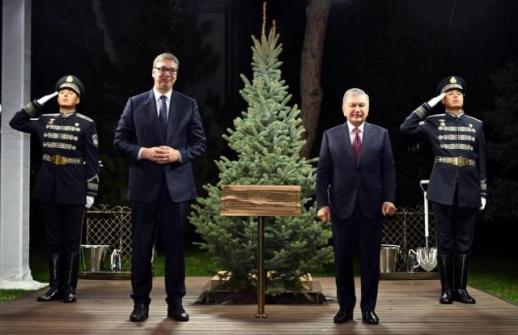 Uzbekistan, Serbia sign environment pact SEOUL, September 10 (AJP) - Environmental protection was written into the package of agreements that lifted relations between Uzbekistan and Serbia to a strategic partnership this week, giving formal shape to environmental contacts that had been building since last year. Shavkat Mirziyoyev and Aleksandar Vucic signed a joint declaration establishing the partnership in Belgrade on Tuesday, at the close of the Uzbek president's first official visit to Serbia. The two sides exchanged 20 bilateral documents covering transport, renewable energy, agriculture, digitalization, labor migration and environmental protection. Bilateral trade reached $41.9 million last year, a record, up 27 percent from $32.9 million in 2024, according to the Serbian Chamber of Commerce. Serbian exports of agricultural and food products to Uzbekistan rose 54.1 percent in the first seven months of this year. The Embassy of Uzbekistan in the Republic of Korea said the environmental track centers on three areas, which are sustainable forest management, biodiversity conservation and cooperation between universities working on climate and environmental science. Forestry is where Serbia has the most to offer. Its Second National Forest Inventory, carried out between 2018 and 2023, put the country's forests and forest land at 3,025,471 hectares, or 39 percent of its territory, an increase of about 5 percentage points over the inventory published in 2009. A large share of that land is privately held, and Serbian forestry authorities have spent years building management arrangements between the state and private owners. Uzbekistan is trying to expand its own tree cover under Yashil Makon, a national planting campaign launched in 2021 with a target of 200 million saplings a year. The government says more than 266 million were planted in 2025. Serbia has granted protected status to 460 natural sites. They include five national parks, 17 nature parks, 20 landscapes of outstanding features, 68 nature reserves, 309 natural monuments and three protected habitats, together covering 583,183 hectares, or about 6.6 percent of the country, according to the International Commission for the Protection of the Danube River. The academic component centers on the Central Asian University of Environmental and Climate Change Studies, known as Green University, which Tashkent has positioned as the region's flagship environmental institution. It was created by presidential decree on May 31, 2023, and opened in Tashkent Region in February 2024, with instruction conducted in English. The opening drew the director general of the International Union for Conservation of Nature, Grethel Aguilar, along with the environment ministers of all five Central Asian states. Uzbekistan wants to link the university with the University of Belgrade and the University of Novi Sad through joint degree programs, research projects and exchanges of students and faculty. The groundwork was laid in Samarkand in early June. Serbia sent a delegation led by Sara Pavkov, who became environment minister in April 2025, to the Eighth Assembly of the Global Environment Facility, held from May 30 to June 6, and to the Eco Expo Central Asia environmental technology exhibition that ran alongside it. Serbian officials took part in a high-level plenary session on green investment and innovation, the embassy said. The exhibition opened on June 2 at the Silk Road Samarkand complex and drew close to 10,000 participants. Its first edition, held in Tashkent in 2025, attracted about 7,500 and launched more than 130 environmental projects with international partners. Uzbekistan has invited Serbia to the next edition, scheduled for June 15 to 17 next year at the CAEx Uzbekistan exhibition center in Tashkent. Both events sit inside an environmental apparatus that Uzbekistan rebuilt last November, when Mirziyoyev removed the Ministry of Ecology, Environmental Protection and Climate Change from the Cabinet of Ministers and reconstituted it as the National Committee on Ecology and Climate Change, reporting directly to the president. Aziz Abdukhakimov, who had been ecology minister, chairs the committee and serves as presidential adviser on the environment. He chaired the Samarkand assembly. Serbia has a platform of its own next year. The United Nations Environment Programme has selected it to host World Environment Day 2027, an event Belgrade intends to run in coordination with Expo 2027. Uzbekistan has confirmed it will take part in that exposition with a national pavilion. 2026-09-10 11:18:22
 -
Vietnam's Secretary General Strengthens Ties with Russia During Moscow Visit Nguyen Phu Trong, General Secretary of the Communist Party of Vietnam and President, emphasized strengthening cooperation with Russia during his visit to Moscow. Russian President Vladimir Putin described the visit as a new milestone in bilateral relations, with both countries setting a trade target of $15 billion and outlining specific cooperation in nuclear power, energy, and science and technology. Following the talks, a ceremony for the exchange of cooperation documents was held in the presence of both leaders. According to local media reports, Nguyen Phu Trong and his wife, Ngo Phuong Lien, departed Moscow on the evening of September 9, concluding their state visit. He stayed in Russia from September 7 to 9 before moving on to France for an official visit and participation in a space summit from September 9 to 12. Kremlin Summit Expands Cooperation Focus The key event of the visit was the summit held at the Kremlin on September 9. After a state welcome ceremony, Nguyen Phu Trong met with President Putin to discuss bilateral relations and international issues. President Putin stated that the visit holds "special significance, marking a new milestone in the traditional friendship and comprehensive strategic partnership between the two countries." He further described Vietnam as a "reliable partner and a priority country" in Russia's Asia-Pacific policy. Nguyen Phu Trong presented the relationship with Russia as a major pillar of Vietnam's foreign policy, explaining that Vietnam views Russia as "an important partner and a top priority." Both leaders agreed to enhance economic cooperation more substantively. They decided to elevate the role of the intergovernmental economic, trade, and scientific cooperation committee and to expedite the goal of reaching $15 billion in bilateral trade. Energy and nuclear cooperation were also major agenda items. The two countries agreed to maintain energy, oil, and gas as core areas of existing cooperation while specifying nuclear collaboration under previously signed agreements and expanding cooperation into wind and gas power. President Putin expressed Russia's readiness to share experience and technology and support workforce training tailored to Vietnam's needs in nuclear cooperation. The joint statement adopted by both countries emphasizes prioritizing nuclear and radiation safety, applying Russia's proven technologies, while determining the project implementation schedule and localization rates by mutual agreement. Scientific and technological cooperation was also highlighted as a new driving force. According to the joint statement, the two countries identified artificial intelligence (AI), digital technology, biotechnology, new materials, quantum technology, space technology, and automation as priority areas for cooperation, agreeing to expand joint research and technology transfer. They also committed to establishing a cooperation roadmap in quantum technology. Additionally, they plan to strengthen connections and exchanges among universities, research institutions, and innovation centers as part of the designated "Year of Russia-Vietnam Scientific and Educational Cooperation" in 2023-2024. Lev Tolstoy Peace Prize Highlights Vietnam's Diplomatic Approach During his visit to Russia, Nguyen Phu Trong received the Lev Tolstoy International Peace Prize. The award ceremony took place on the evening of September 9 at the Kremlin, attended by President Putin, Vyacheslav Volodin, Chairman of the State Duma, and Valentina Matviyenko, Chairwoman of the Federation Council. Renowned conductor and Russian national artist Valery Gergiev, who served as the jury chairman, presented the 2026 Lev Tolstoy International Peace Prize to Nguyen Phu Trong. The award recognizes contributions to promoting peace, enhancing inter-ethnic cooperation and understanding, respecting international law, and spreading Vietnam's tradition of peace and dialogue. Previous recipients include leaders from the African Union in 2023-2024 and three Central Asian countries in 2025. In his acceptance speech, Nguyen Phu Trong stated, "This award is not only recognition for an individual but also an evaluation of the Vietnamese people's tradition of peace and our foreign policy of independence, self-reliance, friendship, cooperation, and development." He added that Vietnam will continue to promote dialogue with the international community and participate in peacefully resolving disputes based on the UN Charter and international law. President Putin remarked that the award acknowledges Nguyen Phu Trong's contributions to strengthening friendship and mutual understanding between Russia and Vietnam. Russian Media: Vietnam as a Bridge to ASEAN Russian media and experts have noted this visit as a new starting point for bilateral relations. The Kremlin's official portal and various Russian outlets reported that Vietnam places significant importance on developing its relationship with Russia. They also addressed potential cooperation in the digital economy, peaceful nuclear energy, transportation infrastructure, industry, and agriculture, as well as issues related to trade barriers. The Russian outlet Ura.news reported that Russia is optimistic about expanding long-term cooperation with Vietnam, emphasizing that Vietnam is ready to serve as a bridge for Russian companies entering the ASEAN market and other international markets. Ekaterina Koldunova, head of the ASEAN Center at the Moscow State Institute of International Relations (MGIMO), explained that cooperation in nuclear energy, information technology, agriculture, infrastructure, logistics, and education is expanding within the context of Russia's pivot to the East and Vietnam's growth strategy aimed at becoming a developed country by 2045. She noted that Vietnam holds a special status as the coordinator of ASEAN-Russia dialogue. Nikita Maslennikov, chief economist at the Russian Political Technology Center, predicted that ASEAN will become a central axis of the global economy in the coming decades, asserting that Russia's presence in the region is crucial for competing in the global economy and achieving its development goals. Anton Bredikhin, a senior researcher at the Institute of Chinese and Modern Asian Studies at the Russian Academy of Sciences, described this visit as a "new historical milestone," confirming the commitment of both countries to deepen their comprehensive strategic partnership and sign documents aimed at realizing potential in science and technology, energy, and oil and gas sectors while enhancing economic, trade, and investment ties. Cultural and human exchanges were also included in the summit agenda. Nguyen Phu Trong welcomed President Putin's positive consideration of visa exemptions for Vietnamese citizens and expressed Vietnam's readiness to cooperate in hosting the "Russian Cultural Season" in Vietnam in 2027. President Putin praised the success of the Vietnamese cultural festival held in Red Square last year. Meanwhile, Nguyen Phu Trong's visit concluded with a farewell ceremony at Moscow's Vnukovo International Airport, attended by Deputy Prime Minister Dmitry Chernyshenko, Gennady Bezdetko, the Russian Ambassador to Vietnam, and the Russian Foreign Ministry's protocol chief, along with the Vietnamese Ambassador to Russia, Dang Minh Khoi, and his wife.* This article has been translated by AI. 2026-09-10 11:16:00
-
Shift Up to Release 'Stella Blade Complete Edition' for Switch 2 on November 6 Shift Up announced that the Nintendo Switch 2 version of 'Stella Blade' will be released on November 6.The 'Stella Blade Complete Edition' for Switch 2 will launch simultaneously worldwide at midnight on November 6, according to Shift Up on the 10th. Pre-orders will begin on the same day.Ahead of the Switch 2 release, Shift Up unveiled a new trailer and collaboration content with 'Bayonetta.' The new trailer focuses on the story, characters, and narrative of 'Stella Blade,' and three new collaboration costumes were revealed for the first time.The collaboration will introduce a total of four new costumes exclusive to Eve. These costumes will be available for free on all platforms, including Nintendo Switch 2, PlayStation 5, and PC, starting November 6.The 'Stella Blade Complete Edition' includes the main game as well as existing collaboration DLCs such as 'NieR: Automata' and 'Goddess of Victory: Nikke.' Bonus content exclusive to the Complete Edition, including Stargazer costumes for Eve, Adam, and Lily, will also be provided.Pre-orders can be made through the Nintendo eShop and major retailers. Customers who pre-order will receive early access to in-game costumes exclusive to Eve, including the 'Planet Diving Suit (White Edition),' 'Classic Round Glasses,' and 'Ear Armor Earrings.' A limited edition steelbook featuring new artwork will also be available for reservation in limited quantities.The physical version of the 'Stella Blade Complete Edition' for Switch 2 will include all game data on the cartridge, allowing for play without a separate game key card or additional downloads.* This article has been translated by AI. 2026-09-10 11:16:00
-
 Kia to unveil PBV at Germany's IAA SEOUL, September 10 (AJP) - Kia will unveil its large electric purpose-built vehicle (PBV) at this year's IAA Transportation, which kicks off in Germany next week. The automaker said Thursday that it will showcase the PV7 for the first time during the biennial trade show, which runs from Sept. 15 to 20 in Hanover, marking its second appearance since announcing plans to enter Europe's PBV market in 2024. Kia will display three variants of the PV7 at its 1,531-square-meter booth, along with seven versions of the PV5, as it seeks to expand its commercial electric vehicle lineup in Europe through its broader PBV strategy. Kia said its PBV business is gaining ground in Europe, with 13,603 PV5s sold in the first half of this year, making it the top-selling model in Europe's compact electric van segment less than a year after its launch there. Riding on this momentum, Kia plans to launch the PV7 in Europe next year. The vehicle will offer a spacious, flexible interior designed to suit a range of uses from commercial work to daily commutes and leisure activities. Kia said Europe's electric commercial vehicle market continues to grow. According to market researcher DataForce, sales of electric light commercial vehicles (eLCVs) in Europe stood at 125,069 units in the first half of this year, up 10.2 percent from a year earlier, even as the overall light commercial vehicle (LCV) market declined 8.7 percent to 1.21 million units. In particular, the midsize electric van segment, where the PV7 will compete, grew 9.2 percent to 57,804 units during the same period. Meanwhile, Kia sold 290,697 vehicles in Europe during the first half of this year, up 6.9 percent from a year earlier, buoyed by strong demand for its electric passenger vehicles. AJP Takeaways - Kia will unveil its large electric purpose-built vehicle (PBV), the PV7, at IAA Transportation 2026 in Hanover, Germany, from Sept. 15 to 20. - Kia will display three PV7 variants and seven PV5 versions as it seeks to expand its commercial electric vehicle lineup and PBV business in Europe. - The PV5 sold 13,603 units in Europe's C-segment electric van market in the first half of 2026, taking a 30.4 percent market share and ranking first in the segment. 2026-09-10 11:12:31
 -
SK Telecom CEO Discusses AI Infrastructure and Digital Trust with Global Telecom Leaders SK Telecom (SKT) announced that CEO Jeong Jae-hun attended the GSMA M360 ASEAN event in Kuala Lumpur, Malaysia, on September 9, where he discussed new growth strategies for the telecommunications industry in the AI era and ways to build digital trust with global telecom leaders.The M360 ASEAN event brought together telecom companies, tech firms, and policymakers from East Asia and the ASEAN region. Key issues addressed included AI transformation, AI sovereignty, enhanced security, and reliable communication networks.On the morning of September 9, CEO Jeong met with GSMA Secretary General Vivek Badrinath to explore next-generation growth opportunities in the telecommunications industry based on AI and strategies for transitioning communication infrastructure to be AI-centric. They sought collaboration on SKT's full-stack strategy and vision, which encompasses infrastructure, models, and services, aiming to establish an 'Asian AI Infrastructure Hub.'Discussions also included infrastructure investment. CEO Jeong met with Shaid Danial Abukari, a director at Trade Winds, an investment company under Malaysia's Abukari Group, to identify collaboration opportunities between the two companies. The Abukari Group operates in various infrastructure sectors in Malaysia, including ports, automotive, energy, finance, and media.CEO Jeong participated in a roundtable with executives from major Asian telecom companies and tech firms from Japan, Malaysia, Indonesia, and Singapore, discussing enhanced security in the AI era, securing technological sovereignty, and restructuring governance. They also shared experiences and expertise in building digital trust.Jeong stated, 'We will work with global telecom companies to solidify cooperation in the field of digital trust and create a sustainable AI ecosystem.' 2026-09-10 11:12:00