


Latest by
-
 Coupang Offers Up to 50% Off on Hanwoo Beef Ahead of Chuseok Coupang is launching a large-scale discount event to stabilize the soaring prices of Hanwoo beef ahead of the Chuseok holiday.On the 18th, Coupang announced that it will hold the 'Surprise Hanwoo Sale' in collaboration with the National Hanwoo Association and the Hanwoo Promotion Fund, offering discounts of up to 50% until the 24th.Due to rising feed costs linked to increased prices of imported grains and a decrease in supply, Hanwoo prices have been on the rise. According to livestock distribution information from 'Dabom', the price of beef sirloin and brisket has increased by 8.3% compared to the same month last year.To ease the burden on holiday shopping, Coupang has secured a total of 25 tons of Hanwoo beef. It has carefully selected over 30 items that are in high demand during the holiday season, including sirloin, brisket, stew meat, and bulgogi, which will be delivered via Rocket Fresh's early morning service.Key discounted items include: 1st grade sirloin (200g, 15,160 won), 1st grade brisket (300g, 12,870 won), 1st grade stew meat (300g, 9,900 won), and 1st grade bulgogi (300g, 9,900 won). Some items will also come with additional discount coupons of up to 45,000 won when purchased with Chuseok gift sets or ritual items.A Coupang representative stated, "This event was organized to assist customers who are concerned about the rising prices of Hanwoo beef for holiday meals and gifts. We aim to support consumers in having a bountiful Chuseok with reasonable prices and fresh delivery services."Meanwhile, a recent survey by the Korea Price Association conducted on the 10th and 11th in traditional markets across six cities, including Seoul, Busan, Incheon, Daegu, Gwangju, and Daejeon, found that the cost of a Chuseok feast for a family of four has risen to 303,750 won, a 4.1% increase from the previous year.* This article has been translated by AI. 2026-09-18 12:00:00
 -
Im Lee-ja Criticizes Government Budget and Future Response Fund Im Lee-ja, the Policy Committee Chair of the People Power Party, sharply criticized the government's budget proposal and the Future Response Fund during a National Assembly meeting on September 18. Im urged for careful and precise fiscal management in light of the U.S. Federal Reserve's interest rate hike on September 16. "The Fed has raised interest rates for the first time in three years and two months. The global economy is entering a high-interest tightening phase again," he said, noting that rising rates increase household interest burdens and corporate financing costs. He pointed out, "However, the financial management of the Lee Jae-myung administration is regressive. On one hand, they are tightening the money supply to control inflation, while on the other, they are implementing an expansionary fiscal policy amounting to 821 trillion won." Im also took issue with the Future Response Fund reflected in next year's budget. He argued that it is contradictory for the government to issue over 100 trillion won in deficit bonds while accumulating 104.4 trillion won of the 162.3 trillion won Future Response Fund as surplus funds. He described it as a "bizarre financial management plan that borrows money to hoard it." Furthermore, he noted that the target return on the accumulated funds is about 0.57 percentage points lower than the borrowing rate, resulting in an annual loss of 568 billion won based on a 100 trillion won benchmark. According to Im, the government aims to manage borrowed funds at an interest rate of 4.41% while targeting a return of around 3.85%. Even if the target return is achieved, it would still incur a daily loss of 1.55 billion won. He urged the government to "immediately reduce bond issuance" and suggested that if there are essential projects in areas like youth, artificial intelligence (AI), and local development, they should be reflected in the budget review process as needed.* This article has been translated by AI. 2026-09-18 11:56:00
-
CJ CheilJedang Donates Food to Vulnerable Communities in Jeonbuk for Chuseok CJ CheilJedang is continuing its efforts to promote a culture of sharing and coexistence by donating food to vulnerable communities in Jeonbuk for the Chuseok holiday.On September 18, CJ CheilJedang announced that it is collaborating with the nonprofit organization 'Sharing Hope' to deliver daily food products to marginalized neighbors in the Jeonbuk region. Sharing Hope is a social welfare organization that supports children who are unable to pursue their dreams due to difficult home environments.This donation marks the first support activity since CJ CheilJedang established a new partnership with Sharing Hope earlier this year. It was planned to provide practical assistance to neighbors facing challenges due to high prices and economic downturn ahead of the holiday.The donated items include a variety of useful products for daily life, such as Bibigo beef soup, spicy beef soup, soybean paste soup, and oxtail soup, as well as cooked rice, rice porridge, sauces (ssamjang and gochujang), spam, and olive oil. These items will be distributed sequentially to vulnerable groups in Jeonbuk, including elderly individuals living alone, people with disabilities, and low-income families, through Sharing Hope and the 'Jeonbuk Good Love Sharing Community Volunteer Group.'CJ CheilJedang plans to expand its support efforts beyond Jeonbuk to regions like Gyeongnam. In the future, it aims to utilize Sharing Hope's network of 30 partner organizations nationwide to continue expanding its food donation initiatives for vulnerable populations.A representative from CJ CheilJedang stated, "In celebration of Chuseok, we prepared substantial food items to help our local neighbors have a warm holiday. We will continue to support marginalized communities while fostering coexistence with the local society."* This article has been translated by AI. 2026-09-18 11:56:00
-
Germany and Taiwan Utilize Coal Power as Backup During Transition Away from Coal As efforts to phase out coal by 2040 progress, experts suggest that instead of shutting down coal power plants all at once, a gradual reduction should align with the availability of alternative energy sources and the stability of the power supply. Germany and Taiwan have managed to maintain power supply stability by keeping some coal generators as backup while closing others.On September 18, Park Myung-deok, a researcher at the Korea Energy Economics Institute, presented findings on international coal phase-out examples during the 7th public forum for establishing the 12th basic power supply plan at the Korea Electric Power Corporation's Nam Seoul headquarters in Yeongdeungpo, Seoul. He highlighted the decarbonization policies of Germany, Alberta in Canada, the United Kingdom, and Taiwan.Park noted that a common theme among these international examples is the prioritization of power supply stability. Even as coal plants are closed, these countries ensure that alternative energy sources are secured first or that some generators remain as backup to prepare for potential supply disruptions.Germany has committed to phasing out coal power by 2038 and has introduced a reverse auction system for hard coal power plants. Power companies bid for compensation to close plants early, with a total of seven auctions conducted, resulting in the allocation of approximately 10.7 GW of the targeted 10.9 GW capacity. If the auction results fall short of the target or after the auctions conclude, older plants are legally required to close.However, being selected for closure does not mean an immediate shutdown. After a system evaluation, these plants can be utilized as 'grid reserve capacity' to address transmission bottlenecks or regional power supply imbalances, as well as 'capacity reserve' to prepare for potential shortages. These plants do not participate in the electricity market and are used solely for system stability.Similarly, Taiwan has adopted a comparable approach. Park explained that Taiwan operates an independent grid not connected to neighboring countries and has a significant semiconductor industry, sharing similarities with South Korea. Taiwan is gradually reducing aging coal plants in line with the schedule for introducing new gas combined-cycle power plants.The Taichung power plant plans to close ten coal units by 2034 while introducing six gas units. Up to six of the coal units may remain as backup, with a reassessment of the need for backup capacity in 2032. The Singda power plant is also linking the introduction of gas combined-cycle power with the closure of coal plants, using some generators as backup only in exceptional situations when supply reserves fall below 8%.Alberta, Canada, has similarly linked the closure of coal plants with securing alternative energy sources. As of 2015, six of the 18 coal plants, representing about 2.5 GW, were slated for early closure, with these plants being replaced by gas power.In contrast, the United Kingdom has encouraged the exit of coal power through environmental regulations and market mechanisms. Stricter emissions standards for coal plants and restrictions on new entrants, along with a carbon price floor, have imposed additional costs. Coal power, which accounted for about 40% of total generation in 2012, has gradually decreased, with the last coal plant expected to close in 2024.Park expressed that it is challenging to apply these international examples directly to South Korea. He emphasized that due to differences in power market structures, generation facilities, and supply conditions, a tailored closure, compensation, and backup system must be designed for the domestic context.He stated, "While reducing coal use, the foremost consideration should be the physical characteristics of electricity. Ensuring the stability of power supply is paramount." He added, "We have our own market structure and unique power supply characteristics, making it essential to create a customized system through collaborative discussions."* This article has been translated by AI. 2026-09-18 11:48:00
-
President Lee Calls for Confidence in Prosecutorial Reform 이재명 대통령은 18일 “검사를 편들거나 검찰개혁에서 후퇴하려 한다는 의심은 거둬주시기를 부탁드린다”고 밝혔다.이 대통령은 이날 청와대 영빈관에서 열린 기자회견에서 ‘전통적 지지층의 마음을 어떻게 되돌릴 것인가’라는 온라인 질문을 받고 “검찰개혁은 제가 공약한 것이고 목표는 수사와 기소를 분리하는 것”이라며 이같이 말했다.이 대통령은 당초 검찰개혁의 목표가 수사검사와 기소검사의 역할을 분리하는 것이었지만 현재 추진되는 개혁은 이보다 더 진전됐다고 평가했다. 그는 “이제 검사는 아예 수사를 하지 못하고 수사를 담당하는 기관은 행정안전부 소속이 된다”며 “법무부에는 공소 제기와 집행을 담당하는 검사만 남게 되는데, 이는 이미 확정된 것”이라고 설명했다.이어 “사후 조치를 통해 불가역적으로 검사가 다시는 수사에 관여할 수 없게 만들겠다”며 “되돌아갈 수도 없도록 철저하게 하겠다”고 강조했다.검찰개혁이 후퇴하고 있다는 일각의 비판에 대해서는 자신의 피해 경험까지 거론하며 반박했다. 이 대통령은 “지금까지도, 앞으로도 검찰의 패악으로 가장 큰 고통을 겪는 사람 가운데 한 명이 저”라며 “그들로부터 얻을 것도 없다”고 말했다.다만 검찰의 수사권을 경찰에 넘기는 과정에서 경찰이 지나치게 비대해질 가능성은 경계했다. 이 대통령은 “권력은 상호 견제시킬 수밖에 없고 한쪽으로 몰면 위험하다”며 “수사와 기소 기능을 철저히 분리하되 상호 견제를 통해 권한이 악용되지 않도록 만들겠다”고 밝혔다.그러면서 “검찰에 대한 반감은 충분히 이해하지만 중요한 것은 수사·소추 기관이 국민의 인권과 범죄 피해자를 보호하고 사회질서를 유지하는 본래 기능을 제대로 수행하도록 하는 것”이라며 “개혁으로 발생할 수 있는 부작용을 최소화하는 균형감각도 필요하다”고 말했다. 경찰 권력의 오남용을 방지하기 위한 경찰개혁도 함께 추진하겠다고 덧붙였다.전통적 지지층 내부에서 오가는 혐오 표현에 대해서는 자제를 호소했다. 이 대통령은 “누군가를 멸칭하거나 혐오하고 증오하지 않았으면 좋겠다”며 “조금 부족하고 화나는 일이 있더라도 원래 가졌던 지향과 가치를 향해 포용하면서 함께 갈 길을 찾으면 좋겠다”고 말했다.이어 “우리 안의 차이가 아무리 커도 우리가 이겨내야 할 상대와의 거리만큼 멀지는 않다”며 “우리끼리 힘을 빼고 서로를 훼손해 가야 할 길을 막는 결과를 만들어서는 안 된다. 다시 시작하면 좋겠다”고 강조했다.* This article has been translated by AI. 2026-09-18 11:44:00
-
President Lee Calls for Special Investigation into Alleged Political Prosecutions President Lee Jae-myung stated that a special investigation is necessary to clarify the allegations surrounding politically motivated prosecutions. He made these remarks during a press conference at the Blue House on September 18.During the conference, President Lee addressed the recent controversy regarding the dismissal of charges related to cases involving him. He urged that the existing provisions concerning the transfer or disposition of cases under investigation by the special prosecutor be removed, emphasizing that the focus should solely be on uncovering the truth.He expressed concern that unnecessary political disputes and misunderstandings about him and the government arise from certain expressions. "While I am aware of the facts, an objective process to prove them is still necessary," he said, reiterating the need for a special investigation.President Lee noted, "I am not the only one who has suffered from politically motivated investigations and prosecutions from the previous administration. While I may have been the most affected, there are many journalists, media outlets, public officials, politicians, and unrelated civilians who have also been harmed. It is appropriate to clarify the truth regarding these malicious investigations and allegations of manipulation through a special investigation."He added that if investigative agencies under his command were to handle these cases, it could lead to further misunderstandings. Therefore, he believes it is essential for the National Assembly to quickly establish a special investigation to transparently reveal the truth to the public.However, President Lee acknowledged that there is ongoing debate about whether to dismiss existing charges during this process. He expressed disappointment that this issue has become a political topic, overshadowing the essence of the matter, stating, "It should be handled according to the law and principles based on the results of the investigation."In response to questions about the appointment of Kim Seung-won, the nominee for Justice Minister, who has faced various controversies, President Lee remarked, "The more appointments I make, the more difficult it becomes. The criteria for appointments vary greatly." He expressed regret over the controversies that have arisen during the public vetting process.President Lee stated, "I have not yet reached a final decision. I will carefully consider the various issues and criticisms raised during the vetting process, taking into account the media's capabilities and public expectations." 2026-09-18 11:44:00
-
Mixed Reactions to New Ticketing System for Busan International Film Festival As the Busan International Film Festival (BIFF) approaches, attention has turned to its new ticketing system. In previous years, the ticket sales often caused server crashes, leading to frustration among attendees. This year, a queue system has been introduced to limit simultaneous users.Ticket sales for the opening and closing ceremonies, as well as some special programs, began on September 17 at 2 p.m. A key change this year prevents one person from monopolizing multiple films and seats at once. After booking a ticket for one film, users must return to the queue to select another.Reactions to the new system have been mixed. One user on an online community noted, "There’s no need to log in exactly at the start time, which makes it more relaxed." However, another user expressed frustration, stating, "The new structure favors groups who can alternate booking over individuals." Popular films sold out quickly as soon as tickets became available. The opening film, 'Day and Night Are Each Other,' directed by Kim Jong-kwan, was fully booked immediately. Hirokazu Kore-eda's latest live-action film, 'Look Back,' also sold out early, especially after the confirmation of the director and lead actors' attendance. Additionally, the talk program 'Actors House,' featuring stars like Kim Go-eun, Shin Min-a, Lee Min-ho, and Ju Ji-hoon, saw all sessions sell out right after the ticket release.Some posts on social media indicated that tickets for popular films were being resold at inflated prices. A festival official stated they are currently investigating the scalping issue.Meanwhile, ticket sales for general screenings and master classes are set to begin on September 21 at 2 p.m. Online communities are already buzzing with predictions that "the real competition will be on the 21st."* This article has been translated by AI. 2026-09-18 11:40:10
-
New York Follows South Korea's Lead in Food Waste Recycling New York City is adopting a food waste management system similar to the one established in South Korea over the past 30 years.The BBC recently reported on Seoul's food waste management system, noting that South Korea's food waste recycling rate has increased from 2.6% in 1996 to approximately 97% in 2023.South Korea implemented a pay-as-you-throw system in 1995 and made food waste separation mandatory in 1997. In 2005, the country banned the landfill disposal of food waste, and in 2010, it introduced RFID (Radio Frequency Identification) smart bins. By 2013, the country also prohibited the ocean dumping of food waste leachate.The RFID food waste disposal system charges residents based on the amount of waste they produce, allowing them to monitor their food waste output directly. According to the BBC, as of 2025, there are 151,934 smart bins installed in South Korea, serving over 8.61 million households.Separated food waste is also utilized for energy production. The Daejeon Bioenergy Center recycles 70-75% of the food waste it receives into energy, generating enough power for about 6,000 households daily. There are over 340 similar facilities across South Korea.The BBC explained that while food waste in landfills generates methane, a potent greenhouse gas, bioenergy facilities can capture it for fuel.New York City is using South Korea as a model to expand its food waste separation program. Starting in October 2024, residents will be required to separate their food waste, affecting approximately 3.4 million households. This initiative represents the largest organic waste recovery program in the United States.However, resident participation remains a challenge. The New York City Department of Sanitation recently engaged in over 60,000 conversations with residents across five boroughs and issued more than 63,000 violation notices to households that failed to comply with the separation regulations since the program's implementation.New York City has also installed over 400 smart composting bins. However, some residents have raised concerns about rodents congregating around these bins.According to the BBC, New York City processed about 140,000 tons of residential organic waste in 2025, which accounted for only about 9% of the annual generation of 1.5 million tons.Steven Cohen, director of the Sustainability Management Program at Columbia University, told the BBC, "South Korea's RFID bins can hold each resident accountable for their organic waste."Additionally, Joom-Sol Joo, a senior researcher at the Korea Environment Institute, stated, "South Korea has made significant progress in food waste recycling, but new technologies and policies are at a turning point to further advance this progress," according to the BBC.* This article has been translated by AI. 2026-09-18 11:40:00
-
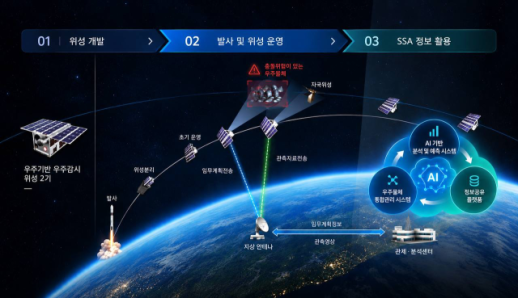 Hanwha Systems joins national AI-based space surveillance project SEOUL, September 18 (AJP) - Hanwha Systems has begun developing an AI-powered space situational awareness system aimed at detecting and tracking objects in orbit and assessing collision and reentry risks. The company said Friday it signed a contract with the Korea Astronomy and Space Science Institute on Sept. 9 to participate in the development of South Korea’s national Space Situational Awareness system, or K-SSA. The project comes as the rapid growth of satellites in low Earth orbit raises the risk of collisions with artificial and natural objects in space, increasing the need for systems capable of protecting national space assets and predicting potential hazards. Under the project, Hanwha Systems will develop a space-based surveillance satellite and an AI-powered ground system that will collect, integrate and analyze information on objects in orbit. The surveillance satellite will be a small spacecraft operating at an altitude of about 480 kilometers. Equipped with an optical camera designed for space situational awareness, it will detect and track artificial and natural objects and gather data needed to assess collision and reentry risks. “The space industry is rapidly expanding beyond simply developing and operating satellites toward the safe use and management of space,” Song Sung-chan, head of Hanwha Systems’ space business division, said. AJP Takeaways - Hanwha Systems is developing an AI-powered space situational awareness system under South Korea’s K-SSA program. - The project includes a 480-kilometer-orbit surveillance satellite and an AI-based ground system for tracking space objects. - The system is designed to assess collision and reentry risks and strengthen protection of South Korea’s space assets. 2026-09-18 11:38:23
 -
Meritz Securities Advances in Issuing Notes Business After Regulatory Approval Meritz Securities has received approval for its issuing notes business from the Securities and Futures Commission, a key regulatory body. If final approval is granted at the Financial Services Commission's regular meeting on the 23rd, the firm will become the ninth issuer of notes in South Korea.According to the financial investment industry on the 18th, the Securities and Futures Commission, under the Financial Services Commission, reviewed and approved Meritz Securities' designation as a comprehensive financial investment business operator and its application for short-term financial operations (issuing notes) during its regular meeting on the 16th. The final decision will be made at the Financial Services Commission's regular meeting on the 23rd.Once the Financial Services Commission completes its approval, Meritz Securities will join the ranks of other major firms, including Korea Investment & Securities, Mirae Asset Securities, NH Investment & Securities, KB Securities, Kiwoom Securities, Hana Securities, Shinhan Investment Corp., and Samsung Securities, as the ninth issuer of notes.Issuing notes are financial products with a maturity of less than one year, issued by comprehensive financial investment firms with more than 4 trillion won in equity based on their own credit. Approved securities firms can raise funds through issuing notes up to 200% of their equity, making it a key funding tool for large investment banks.As of the end of the first half of this year, Meritz Securities reported a separate equity of approximately 8.35 trillion won. If the issuing notes limit is simply applied at 200% of its equity, the firm could secure a funding capacity of up to 16.7 trillion won.Meritz Securities applied for approval to operate the issuing notes business in July of last year, but the review process faced delays due to investigations into allegations of unfair trading related to the issuance of convertible bonds for Iwha Electric and inspections of the firm's branch operations by the Financial Supervisory Service. 2026-09-18 11:32:10