


Latest by
-
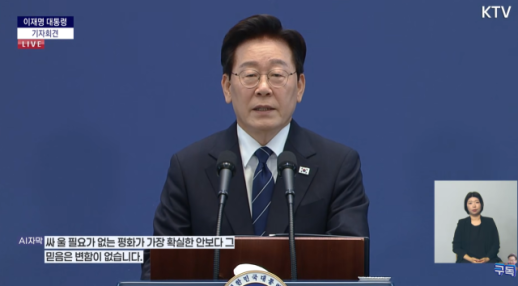
 President Lee: No Need for Concerns Over 'Korea Passing' in U.S.-North Korea Talks 이재명 대통령은 18일 김정은 북한 국무위원장과 도널드 트럼프 미국 대통령 간 회담 가능성에 대해 “성사될지는 단정할 수 없지만 불가능하다고 단정할 수도 없다”고 밝혔다.이 대통령은 이날 청와대 영빈관에서 열린 기자회견에서 “트럼프 대통령은 대화를 원하고 있고, 저 역시 트럼프 대통령에게 대화를 권하고 있다”며 “북미대화가 가능하도록 나름대로 사전 조정 작업을 계속하고 있다”고 말했다.그러면서 “여전히 어려운 것은 사실이고 가능성이 어느 정도인지 단정할 수는 없다”면서도 “그 가능성을 현실로 만들기 위해 최대한 노력해야 하는 것은 분명하다”고 강조했다.남북관계가 단절된 상황에서 북미대화가 한반도 긴장을 완화하는 돌파구가 될 수 있다는 점도 강조했다. 이 대통령은 “북미대화는 남북관계를 포함한 한반도 평화와 안정에 매우 중요한 단초가 될 것”이라며 “어떤 합의를 할 것인지는 다음 문제이고 우선 서로 무엇이 필요한지 대화해야 한다”고 말했다.이어 “북미대화가 재개되는 것이 남북대화 재개보다는 훨씬 쉽고, 북미대화가 남북대화를 가능하게 할 수 있다”고 설명했다. 북한이 현재 한국과의 소통을 거부하고 있지만 정부는 대화를 재개하기 위한 노력을 지속하겠다는 뜻도 밝혔다.북미가 직접 대화할 경우, 한국이 소외될 수 있다는 이른바 ‘한국 패싱’ 우려에는 선을 그었다.그는 “대화가 진전되는 초기에는 우리가 조금 멀리 떨어져 있을 수도 있지만 북미관계 진전을 위해 대한민국 정부가 해야 할 역할이 있다”며 “북미 협력을 위해서도 우리 정부의 역할이 없을 수 없기 때문에 패싱 우려는 하지 않아도 된다”고 강조했다.이 대통령은 북미대화의 성과를 정부가 선점하거나 독차지하려 하지 않겠다고도 밝혔다. 그는 “우리의 존재가 드러나지 않고 생색이 나지 않더라도 실질적인 관계 개선의 결과가 날 수 있도록 보이지 않는 곳에서도 최선을 다하겠다”고 말했다.아울러 “국민과 국가의 장기적이고 전체적인 이익이 가장 중요하다”며 남북관계 개선과 한반도 평화를 위해 실질적인 성과를 우선하겠다는 방침을 재확인했다.* This article has been translated by AI. 2026-09-18 11:32:00
 -
Government Increases Budget for Multicultural Family Support by 7% On September 18, Jo Yong-beom, the Vice Minister of the Ministry of Strategy and Finance, visited a multicultural family support center and stated, "This is an investment in the future that not only addresses the difficulties faced by individual families but also supports their growth as members of our society."During his visit to the family center in Guro-gu, Seoul, Jo assessed the current status of family support programs, including education and care for children of multicultural families, and discussed ways to improve support with local officials. This visit was part of the ministry's initiative to conduct on-site evaluations.The government has proposed a budget of 162 billion won for the Ministry of Gender Equality and Family's 'Support for Healthy Families and Multicultural Families' program for the next fiscal year, an increase of 10.6 billion won (7.0%) from this year. The current year's budget is 151.4 billion won, with 150.1 billion won already disbursed by the end of August, resulting in a 99.1% execution rate.This program integrates services tailored to the life cycle and needs of families, including family counseling, case management, parent education, support for the economic independence of multicultural families, and assistance for families in crisis. The Guro-gu family center has been providing comprehensive support services, including child education and care, and employment support for marriage immigrants since its opening in 2006.During the meeting, local officials noted that as children from multicultural families grow, their support needs are diversifying, requiring not only basic education but also career exploration and emotional support. They emphasized the need for flexible operations of family centers to reflect regional differences in family composition and demand.Jo also reviewed the status of special training for childcare providers, Korean language education for marriage immigrants, the alternative education institution 'Umteum School' for multicultural children, and the shared parenting space 'Tumble Kids.' At Umteum School, which serves youth from immigrant backgrounds and late entrants, he observed Korean language classes and shared songpyeon (rice cakes) and fruit with the students.Jo emphasized, "While the forms of families are becoming more diverse, the principle that every child should have access to sufficient education and growth opportunities remains unchanged. Family centers must serve as a strong link that enables diverse families to live stably in the community and grow together."The Ministry of Strategy and Finance plans to continue monitoring the execution status and improvement tasks in collaboration with relevant departments to ensure that the opinions of policy beneficiaries are heard and that support leads to tangible results.* This article has been translated by AI. 2026-09-18 11:32:00
-
 Lee rules out troop deployment involving Korea in war SEOUL, September 18 (AJP) - President Lee Jae Myung on Friday ruled out sending South Korean troops on any mission that would involve the country in a war, amid debate over a possible deployment to the Strait of Hormuz. "There will clearly be no troop deployment that involves or intervenes in a war," Lee said. 2026-09-18 11:27:21
 -
President Lee: No Troop Deployments for War Engagement 이재명 대통령은 18일 호르무즈 해협에 대한 군사적 기여 방안과 관련해 “전쟁에 관여하거나 개입하는 파병은 없다”고 밝혔다. 이 대통령은 이날 청와대 영빈관에서 열린 기자회견에서 “전쟁에 관여·개입하는 형태의 파병이나 군 자산 파견은 하지 않는다”며 “지금까지 그 원칙을 지켜왔고 앞으로도 변함이 없다”고 말했다. 이 대통령은 군 자산 파견을 일률적으로 ‘파병’이라고 표현해서는 안 된다는 점도 강조했다. 파견 지역이 호르무즈 해협 안인지 인근 해역인지, 목적이 전쟁 참여인지 자국 선박과 국민 보호인지, 전투병력인지 비전투병력인지 등을 구분해야 한다는 설명이다. 다만 우리 상선과 원유 수송로, 국민의 생명과 안전을 지키기 위한 최소한의 활동은 필요하다고 밝혔다. 이 대통령은 “다른 국가들이 하는 것처럼 자국 상선과 원유 수송로, 국민의 생명·안전을 보호하기 위한 최소한의 활동은 해야 한다는 점도 분명하다”고 말했다. 현재 호르무즈 해협 인근에서 활동 중인 청해부대의 역할을 강화하는 방안도 검토하고 있다고 밝혔다. 이 대통령은 “이미 청해부대가 파견돼 해적 등을 포함한 선박 수송로와 국민 안전에 대한 위협에 대응하고 있다”며 “이를 강화하는 부분을 검토하고 고심하고 있는 것도 사실”이라고 설명했다. 그러면서 전투병력을 파견하거나 우리 장병을 외국군 지휘체계에 편입할 가능성에는 선을 그었다. 이 대통령은 “전쟁에 개입하거나 지원하는 파병, 전투병력을 보내거나 외국군 지휘 아래 우리 장병을 배속해 위험에 처하게 하는 것 아니냐는 걱정이 있는 것 같다”며 “분명히 다시 말씀드리지만 전쟁 파병은 없다”고 강조했다. 정부의 호르무즈 기여 방안은 전쟁 개입과 무관하게 한국 선박과 수송로의 안전을 확보하는 범위에서 검토될 것으로 보인다. 이 대통령은 “전쟁 불관여·불개입 원칙은 지금까지도 지켜왔고 앞으로도 계속 지켜질 것”이라고 재차 밝혔다. 이 대통령은 중동 전쟁 초기 위험지역 운항 지침으로 원유 수송에 차질이 빚어졌던 사실도 언급했다. 그는 일정 수준의 위험을 감수하더라도 경제적 충격을 줄이기 위해 현지 상황을 지속해서 파악하며 원유 수송선 운항을 검토하도록 지시했다면서 “그 판단에 따른 책임은 대통령인 제가 감수해야 한다고 생각했다”고 말했다.* This article has been translated by AI. 2026-09-18 11:20:20
-
Hanwha Financial Targets UAE Market with Digital Assets and Payment Infrastructure Partnerships Hanwha Financial is expanding its collaboration in digital finance and digital assets with Abu Dhabi, United Arab Emirates. On September 16, Hanwha Life, Hanwha General Insurance, Hanwha Investment & Securities, and Hanwha Asset Management signed partnerships with the Abu Dhabi Investment Office (ADIO) and Abu Dhabi Global Market (ADGM) during the Abu Dhabi Investment Forum (ADIF Seoul) held at the JW Marriott Hotel in Seoul. Hanwha Life has established a partnership with ADIO to enhance cooperation in the digital finance sector. The two parties agreed to collaborate on creating a digital finance ecosystem, connecting financial and capital markets between Korea and Abu Dhabi, and advancing digital banking and financial innovation. Hanwha Asset Management signed a tripartite agreement with ADGM and Hana Financial Group for a partnership focused on stablecoins and financial infrastructure. They plan to promote cross-border payment and remittance solutions between Korea and Abu Dhabi and work together to build an interoperable digital asset ecosystem. At the Hanwha Financial level, a partnership was also established with ADGM for the Abu Dhabi Finance Week (ADFW) 2026. Kwon Hyuk-woong, Vice Chairman of Hanwha Life, stated, "We will develop our cooperation with Abu Dhabi into tangible business opportunities through this agreement."* This article has been translated by AI. 2026-09-18 11:20:00
-
President Lee Calls for Focus on Truth in Special Prosecutor Investigation President Lee Jae-myung addressed the controversy surrounding the authority of the special prosecutor investigating allegations of politically motivated indictments by the Yoon Suk-yeol administration. He urged that provisions related to the transfer and handling of existing indictment cases be removed, emphasizing the need to focus solely on uncovering the truth. During a press conference at the Blue House guesthouse, President Lee responded to a question about whether it was appropriate to grant the special prosecutor the authority to cancel indictments. He requested the National Assembly to take measures to avoid unnecessary controversies over indictment cancellations. “Everything should be handled according to reason, law, and principles,” he stated, adding that it is undesirable for political disputes to arise from unnecessary expressions that could lead to misunderstandings about him or the government. However, he stressed the importance of investigating the allegations of politically motivated indictments. “I am not the only one who has suffered from excessive investigations and indictments for political purposes during the previous administration,” he noted, mentioning journalists, media outlets, public officials, politicians, and civilians. He continued, “It is appropriate to clarify the facts regarding cases suspected of malicious investigative manipulation through the special prosecutor, as misunderstandings arise when investigative and prosecutorial agencies under my command handle these matters.” He urged the National Assembly to swiftly clarify the facts through a fair and transparent special prosecutor investigation. Regarding the controversy over indictment cancellations, he remarked, “It should be handled according to law, principles, and common sense based on the results,” expressing regret that it has become a political issue that obscures the essence of the matter. On the recurring personnel issues, including the withdrawal of ministerial candidates and related controversies, he acknowledged shortcomings in the verification process and stated that he would reassess the personnel verification system. “We strive to improve the system, but it is always lacking,” he said. “While we have done our best, additional issues arise, and judgments different from ours are sometimes raised.” He added, “It is our fault and inadequacy for not being prepared for such points,” and announced plans to review the personnel system. However, he cautioned, “I cannot guarantee that no issues will arise in the future, but I will do my best.” Regarding his declining approval ratings, he attributed it to his own shortcomings. “I have pondered a lot. There were many aspects I did not understand, and I wondered if it was due to specific events or issues,” he said. “Ultimately, I have come to believe that it is due to my own inadequacies.” President Lee reflected on his lack of consideration, sensitivity, and communication, acknowledging, “It is natural for those affected by my policies to feel pain and resistance, and I may have tried to ignore that.” He concluded, “I think I lacked respect for the people, and that is something I need to reflect on.”* This article has been translated by AI. 2026-09-18 11:16:00
-
Kim Jong-cheol Appointed Head of Incheon Free Economic Zone Authority Kim Jong-cheol has been appointed as the new head of the Incheon Free Economic Zone Authority. He is a seasoned bureaucrat with extensive experience in industrial, trade, and energy policy, as well as foreign direct investment (FDI) initiatives.Born in 1969 in Daegu, Kim graduated from Seoul National University with a degree in Spanish literature. He later earned a master's degree in business administration from the Korea Advanced Institute of Science and Technology (KAIST) and a doctorate in business administration from the Seoul Science and Technology University. In his 50s, he continued his education by transferring to the Computer Science Department at Korea National Open University, where he obtained a bachelor's degree and certifications in information processing and industrial technology.Kim entered public service through the 40th National Civil Service Examination and has held various positions, including Director of the Steel and Chemical Division and Director of the Power Promotion Division at the Ministry of Trade, Industry and Energy. He also served as the head of the Foreign Investment Administrative Support Center at the Korea Trade-Investment Promotion Agency (KOTRA), and later as the Director of the Defense Acquisition Program Administration's Base Strategy Support Division, as well as Director of Trade Cooperation and Director of Resource Industry Policy at the Ministry of Trade, Industry and Energy.During his tenure at KOTRA, Kim focused on attracting foreign direct investment and resolving investment challenges faced by foreign companies, gaining practical experience in investment attraction. At the Ministry of Trade, Industry and Energy, he expanded his expertise in trade cooperation and energy supply policies.As the head of the Incheon Free Economic Zone Authority, Kim is expected to enhance the competitiveness of the Incheon Free Economic Zone by advancing the Songdo Bio-Healthcare Cluster, attracting high-tech companies in semiconductors and artificial intelligence (AI), and fostering the aviation maintenance, repair, and overhaul (MRO) industry in Yeongjong.◇ Profile△ Born in 1969 in Daegu △ Seoul National University, Spanish Literature △ Master's in Business Administration, KAIST △ Doctorate in Business Administration, Seoul Science and Technology University △ Director of Steel and Chemical Division, Ministry of Trade, Industry and Energy △ Head of Foreign Investment Administrative Support Center, KOTRA △ Director of Base Strategy Support Division, Defense Acquisition Program Administration △ Director of Trade Cooperation, Ministry of Trade, Industry and Energy △ Director of Resource Industry Policy, Ministry of Trade, Industry and Energy* This article has been translated by AI. 2026-09-18 11:12:00
-
Naver Cloud Proposes Defense AI Strategy for Rapid Military Technology Integration Naver Cloud hosted the 'Defense AI Strategy Seminar' on September 18, presenting a strategy for the military to rapidly integrate civilian technology while maintaining control over data and artificial intelligence (AI) models.The event, held at the Shilla Hotel in Seoul, attracted 550 participants, including officials from the Ministry of National Defense, the Joint Chiefs of Staff, and various military branches. Naver Cloud emphasized the need to accelerate the transition to defense AI by consolidating, connecting, validating, and evolving civilian technologies.Kim Yoo-won, CEO of Naver Cloud, stated, "Defense AI should not end with technology adoption; it must define the problems the military needs to address and validate them in the field for effective integration." He added, "Our role is to support the military with the fastest and most accurate technology in the areas they require."He further noted that Naver Cloud aims to be a key partner in connecting and supporting the capabilities of the military, defense companies, startups, and research institutions to solve real defense challenges.Naver Cloud outlined its strategy to go beyond being a mere AI provider, positioning itself as a long-term partner in designing and validating the AI transition for South Korea's defense. The company plans to take responsibility for everything from infrastructure to actual mission applications, leveraging its full-stack capabilities and proven security technologies.Former Deputy Minister of National Defense Kim Sun-ho emphasized that the success of Defense AX hinges on how quickly the military can convert civilian innovative technologies into operational capabilities. He stressed the necessity of establishing a 'civil-military fusion ecosystem' under the principle of 'civilian technology first,' where the private sector leads technological innovation and the military swiftly integrates it.He also highlighted the importance of not just validating technologies but also organically integrating AI into military operational concepts and weapon systems to achieve practical deployment and dissemination.Yoo Kyung-beom, Executive Vice President of Naver Cloud's Defense Business, proposed that the acceleration of sovereign AI in defense requires a structure that consolidates, connects, validates, and evolves civilian technologies.Naver Cloud plans to gather expertise from various civilian sectors, including infrastructure, AI models, and applications, ensuring that military data is securely connected to AI models in a closed network environment, allowing the military to maintain control over data and models. The company intends to validate results progressively in mission areas where effectiveness can be measured and continuously evolve performance in collaboration with Field Deployment Engineers (FDE).Sung Nak-ho, who leads model development at Naver Cloud, suggested that for autonomous weapon systems to function correctly, a 'common semantic framework' is necessary to ensure that sensors and platforms can understand the same situations.He proposed technologies such as spatial intelligence, which structures drone footage and sensor information in three-dimensional space, and world models that simulate and predict outcomes in virtual environments reflecting battlefield variables like terrain, weather, and radar.In the future, Naver Cloud aims to connect the entire process of situational understanding, judgment, action, and learning, allowing the military to directly control and implement the intelligence they desire without being dependent on specific models.Naver Cloud's strategy is to provide ongoing support rather than one-time technology supply, continuously enhancing performance by reflecting real-time field requirements through FDE. This approach positions the company as a key technology partner in enabling the military to directly control data and models, ultimately creating a self-evolving operational system.* This article has been translated by AI. 2026-09-18 11:12:00
-
Apple Launches iPhone 18 Pro Series in South Korea On September 18, Apple officially launched its new iPhone 18 Pro series in South Korea. Customers began lining up outside the Apple Myeongdong store before it opened, eager to pick up their pre-ordered devices. However, the crowd was noticeably smaller compared to previous years, likely due to the shift to in-store pickups for pre-orders and anticipation for the upcoming iPhone Duo.This year, customers could not purchase devices on launch day; only pre-order pickups were allowed. The demand for the iPhone Duo, set to launch on October 23, may have also contributed to the reduced turnout.Despite the smaller crowd, some customers camped out overnight to be among the first to receive the new devices. Lee Young-joo, 32, was the first to get her hands on the iPhone 18 Pro after waiting for about 13 hours since 7 PM the previous day. She has attempted to be the first buyer for the past three years and was thrilled to finally succeed."I tried to be the first buyer for the iPhone 16 and 17 but failed," Lee said. "It was on my bucket list, and I’m so happy to finally achieve it after three years." She chose the Glacier model of the iPhone 18 Pro, opting for the traditional bar-style design over the new Duo model due to concerns about its price.The iPhone 18 Pro series maintains the basic design of its predecessor while improving camera capabilities, performance, and battery life. Notably, it features a 48-megapixel Fusion main camera with a variable aperture for the first time. The new A20 Pro chip and a vapor chamber have also been added, with the Pro Max supporting up to 43 hours of video playback.However, the price has increased, with the domestic starting price for the 256GB iPhone 18 Pro set at 1.99 million won and the Pro Max at 2.19 million won, reflecting a rise of about 200,000 won from the previous models. The highest capacity 2TB models are priced at 3.79 million won and 3.99 million won, respectively.Despite the price hike and minimal design changes, buyers cited camera performance and the Apple ecosystem as key reasons for their purchases. For professionals in video and design, the variable aperture was a significant factor in their decision to upgrade. Park Sung-kwon, a 34-year-old director, was the second buyer, waiting for about 12.5 hours since 7:30 PM the previous day. He purchased the Burgundy model of the iPhone 18 Pro with 256GB of storage."I really like the Burgundy color that Rosé from Blackpink chose," Park said. "I waited outside and got bitten by mosquitoes, but now I just want to go to my office and start using the new device for video shoots."Park's primary reason for buying the iPhone 18 Pro was the variable aperture. "I didn’t buy it for gaming or other features; I bought it solely for the variable aperture," he explained. "For a video director, adjusting depth of field through software versus mechanically is a completely different realm."Having used Apple products since he was 20, Park noted the ease of use and emotional appeal of Apple devices compared to competitors. He is also considering purchasing the iPhone Duo for work, believing it will be beneficial due to its improvements over existing foldable phones.Foreign customers also visited the store on launch day. A woman from Nepal, who has lived in South Korea for five years while pursuing a PhD and working in marketing, picked up two iPhone 18 Pro Max devices. She bought the 512GB model for work and the 256GB model as a gift for her family in Nepal.She cited the faster release schedule in South Korea as a reason for her purchase. "New products are released later in Nepal, so I can buy them much sooner here," she said, adding that she applied for pre-order as soon as it opened. South Korea is among the first countries, along with the U.S., Japan, China, the U.K., and France, to launch the iPhone 18 series.Despite the price increase, she believes the product is worth it. "It’s true that the price has gone up compared to the previous model, but Apple products maintain their resale value well after a year of use," she said. She switched to iPhone from Samsung Galaxy due to concerns about privacy and security.On the same day, Apple also began selling the Apple Watch Series 12, Apple Watch Ultra 4, and AirPods 5 in South Korea. The standard iPhone 18 model was excluded from this fall's lineup. Apple plans to release the iPhone Duo, its first foldable phone, on October 23, with a starting price of 3.29 million won. 2026-09-18 11:12:00
-
President Lee Says He Has No Plans for Reelection, Promises Review of Appointment System President Lee Jae-myung stated on September 18 that he has "no intention of seeking reelection" amid ongoing discussions about his potential for a second term. He also pledged to conduct a comprehensive review of the appointment system following recent controversies surrounding ministerial nominees. During a press conference at the Blue House, President Lee remarked, "It is constitutionally impossible for me to seek reelection through a constitutional amendment, and I have repeatedly stated that I have never considered it." However, he reaffirmed the need for constitutional amendments, including the possibility of a presidential reelection system. He noted, "The 1987 Constitution, born from a compromise in political circumstances, no longer fits today’s South Korea," and proposed a constitutional revision through rational discussions between the ruling and opposition parties, as well as public consensus. Among the proposed amendments are the inclusion of the spirit of the May 18 Gwangju Democratization Movement and the Busan Uprising in the constitutional preamble, strengthening citizens' basic rights, decentralizing some presidential powers to the National Assembly and local governments, and introducing a presidential reelection system. He dismissed claims of intending to implement a parliamentary system or a dual executive system as "absurd." President Lee also expressed his commitment to respecting the will of the people in exercising state power, including his appointment authority. He stated, "The sovereignty of the Republic of Korea lies with the people, and all power, including the appointment authority, comes from the people," adding that he would review the appointment system. He emphasized his determination to achieve balanced national development and complete the administrative capital project. President Lee said, "I will steadfastly pursue balanced national development to overcome the one-pole system in the metropolitan area, which is a fundamental obstacle to stabilizing housing prices, and diversify growth and development hubs." He further promised to expedite the construction of the administrative capital, which has been long pursued to alleviate congestion in the metropolitan area and achieve balanced national development, stating, "I will open an era of dual capitals with 'Economic Capital Seoul' and 'Administrative Capital Sejong,' similar to New York and Washington." Regarding the real estate market, he pledged to swiftly implement supply, regulation, and tax policies to stabilize housing prices. President Lee emphasized, "I will ensure the stabilization of the real estate market to avoid the 'lost 30 years' that we will inevitably face if we continue on this path." He added, "Through the firm and swift execution of supply, regulation, and tax policies, along with sufficient communication with stakeholders, I will minimize confusion and backlash, and I will achieve housing price stability." On prosecutorial reform, he stated, "I will responsibly complete the irreversible task of prosecutorial reform, which is a historical challenge." He assessed that the separation of investigative and prosecutorial powers through the exclusion of prosecutors' investigative authority and the division of the Public Prosecution Service and the Serious Crimes Investigation Agency has reached its conclusion, but emphasized that there should be no gaps in investigations or violations of human rights during the reform process. President Lee vowed, "I will thoroughly check and supplement to ensure that not a single unjust victim or small gap occurs," and stated that issues arising from the absence of supplementary investigative powers for prosecutors would be resolved through strict oversight and supplementary measures for police investigations. He also mentioned plans for rigorous police reform to prevent the police, with concentrated investigative powers, from becoming another power institution. Acknowledging recent declines in government approval ratings and internal conflicts within the ruling party, President Lee accepted responsibility. He said, "It is true that I was taken aback by the sudden disappointment and concerns of the public after the local elections," adding, "The result of my reflection is that 'the people are always right.'" He admitted, "All of this is due to my shortcomings," and expressed that he had not sufficiently empathized with the conflicts and pains that inevitably arise in the processes of livelihood, reform, and integration, and that his fear and humility had diminished in the face of small achievements and the public's great support. To his supporters, he appealed for unity, stating, "We are all comrades of the pro-Moon, pro-Roh, pro-Kim Dae-jung, and pro-Lee Jae-myung, who dream of democracy, progress, and reform for a better world," and promised to listen more, communicate, and extend his hand first. He also declared, "I will become a president of integration who reflects the rational opinions of the majority of the people in governance without losing the values of reform and progress," and stated, "I will prove this not with words but with results, walking the path of livelihood, reform, and integration unwaveringly according to the will of the people." 2026-09-18 11:08:00