


Latest by
-
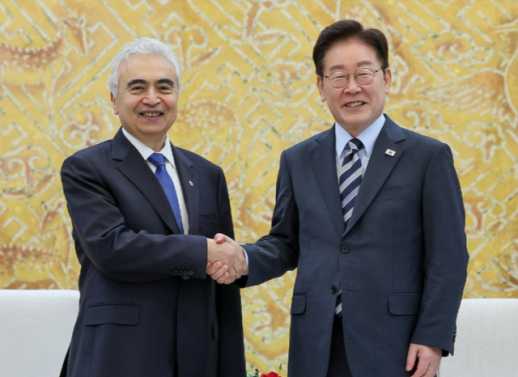 Lee discusses ways to tackle energy crisis with IEA chief in Seoul SEOUL, September 17 (AJP) - South Korean President Lee Jae Myung met with International Energy Agency (IEA)'s executive director Fatih Birol at Cheong Wa Dae in Seoul to discuss the global energy crisis and the country's transition toward renewable energy. Lee said the global energy crisis is becoming more serious amid the prolonged conflict in the Middle East, which has also created a major challenge for South Korea's efforts to shift toward renewable energy. He asked Birol for his views on how the energy situation could develop and how countries should respond, adding that South Korea would continue to work with the international community in line with the IEA's broader energy strategy. Birol responded that the world is facing a massive energy crisis, with countries looking for new strategies to prevent similar disruptions in the future. He pointed to electrification as a way to strengthen energy security and cut reliance on fossil fuels. He also praised South Korea's plan to make it a key part of the country's energy policy and said he would promote the approach internationally. He also said nuclear power could support renewable energy as countries work to reduce their reliance on fossil fuels. The two also discussed ways to strengthen regional cooperation on energy supply chains in the Asia-Pacific. AJP Takeaways - South Korean President Lee Jae Myung met with International Energy Agency Executive Director Fatih Birol in Seoul on Sept. 17, 2026, to discuss the global energy crisis, energy security and South Korea's transition toward renewable energy. - Fatih Birol said electrification could help strengthen energy security and reduce reliance on fossil fuels, while welcoming South Korea's plan to make electrification a key part of its energy policy. - Lee Jae Myung and Fatih Birol also discussed the role of nuclear power and regional energy cooperation, including efforts to strengthen energy supply chains across the Asia-Pacific region. 2026-09-17 17:18:49
 -
 Prosecutors Charge Yoon Suk Yeol Over Kim Geon-hee's Undisclosed Luxury Gifts Prosecutors have charged Yoon Suk Yeol for failing to report luxury gifts received by his wife, Kim Geon-hee, despite being aware of them. However, they found no evidence to support allegations of election law violations related to Kim's involvement in stock manipulation during the presidential campaign. The Seoul Central District Prosecutors' Office's Anti-Corruption Investigation Division 3 announced on September 17 that Yoon has been indicted for violating the Anti-Corruption Law. Yoon is accused of knowing that Kim received gifts worth approximately 5.4 million won, including a Dior bag valued at 3 million won, a Chanel cosmetics set worth 1.79 million won, and liquor worth 400,000 won, from Pastor Choi Jae-young between June and September 2022, yet failing to report this to relevant authorities such as the prosecution or the Board of Audit and Inspection. Under the current Anti-Corruption Law, public officials must report any gifts received by their spouses that are related to their official duties without delay to their agency head or relevant investigative bodies. Previously, in October 2024, prosecutors concluded that the gifts received by Kim had no relevance to Yoon's official duties and therefore did not warrant a reporting obligation, resulting in a decision not to prosecute. However, following Yoon's impeachment, the Kim Geon-hee Special Investigation Team, led by Special Prosecutor Min Jung-ki, reopened the investigation. The police's Special Investigation Headquarters, which took over the remaining cases, recommended Yoon for indictment in June of this year. The prosecutors then reversed their earlier decision not to prosecute and charged Yoon after nearly two years. In contrast, the Seoul Central District Prosecutors' Office's Public Investigation Division 2, led by Chief Prosecutor Kim Hyung-won, dismissed allegations against Yoon regarding violations of the Public Election Act for lack of evidence. During the presidential campaign, from October 2021 to February 2022, Yoon denied allegations of Kim's involvement in stock manipulation during televised debates, stating, "I entrusted stock trading to a specific individual and suffered losses, leading to a severance of ties," and asserted, "Kim has not participated in any stock manipulation." Following these statements, Yoon was reported for allegedly disseminating false information for electoral gain. The police's Special Investigation Headquarters, after reviewing the facts and legal principles, concluded that Yoon's statements constituted false information and recommended charges. However, prosecutors determined that Yoon's statements primarily concerned stock transactions that occurred between January and May 2010, prior to Kim's conviction for violating the Capital Markets Act in October 2010, making it difficult to classify them as false. They also noted that most of the transactions in question occurred before Yoon and Kim's marriage, and there was insufficient evidence to suggest that Yoon was aware of any falsehoods at the time of his statements.* This article has been translated by AI. 2026-09-17 17:16:00
 -
Child and Youth Sexual Crimes to Be Mandatorily Referred to Prosecution In the future, sexual crime cases involving children and youth will not be closed without prosecution, and all cases will be referred to the prosecution regardless of whether charges are acknowledged.The Ministry of Gender Equality and Family announced that an amendment to the 'Law on the Protection of Children and Youth from Sexual Abuse' passed the National Assembly on the 17th.The core of the amendment mandates that judicial police officers must refer all sexual crime cases involving children and youth to the prosecution without exception after investigation.This is expected to enhance protection and judicial verification for child and youth victims, who may find it difficult to fully grasp the facts of the case in the early stages of investigation.Since the implementation of the revised Criminal Procedure Act in 2021, judicial police officers have been able to close cases they deem unsubstantiated without referring them to the prosecution, raising concerns about the need for additional judicial review of non-prosecution decisions.There were also worries that when cases are closed without prosecution, necessary protective and supportive measures for child and youth victims may not be implemented promptly and appropriately.This amendment institutionalizes a procedure for additional review of cases where the facts may not be fully clarified in the early stages of investigation, laying the groundwork for strict investigation and judicial verification of sexual crimes against children and youth.The Ministry of Gender Equality and Family plans to collaborate with relevant agencies to ensure the smooth implementation of the revised law and to monitor that there are no gaps in victim protection and support during the reform of the criminal justice system.Minister of Gender Equality and Family Won Min-kyung stated, "We have established institutional measures to strengthen judicial review of sexual crime cases involving children and youth and to protect and support the rights of child and youth victims. We will continue to work with relevant agencies to ensure that vulnerable citizens are adequately protected and receive prompt support when crimes occur in the new criminal justice system."* This article has been translated by AI. 2026-09-17 17:16:00
-
2026 Aichi-Nagoya Asian Games Set to Begin on September 19 The 2026 Aichi-Nagoya Asian Games, a major sports festival for 4.8 billion Asians, will kick off on September 19 in Nagoya, Japan. Over 16 days, athletes from across Asia will compete for 469 gold medals. South Korea aims to secure between 40 and 45 gold medals, targeting a third consecutive third-place finish in the overall medal standings.This 20th edition of the Asian Games will commence with an opening ceremony at 6 p.m. on September 19 at the Nagoya Paloma Mizuho Stadium and will run until October 4. A total of 10,798 athletes from 45 National Olympic Committees (NOCs) affiliated with the Olympic Council of Asia (OCA), including a refugee team, will compete in 43 sports across 71 events.This marks the third time Japan has hosted the Summer Asian Games, following the 1958 Tokyo and 1994 Hiroshima events, and the first time in 32 years.While the Asian Games are typically held every four years, this event is unusually taking place just three years after the 2022 Hangzhou Games, which were postponed by a year due to the COVID-19 pandemic.The slogan for this year's Games is 'Imagine One Asia,' reflecting the hope for unity and collaboration among Asian nations to build a brighter future together.Competitions will primarily take place in 19 cities within Aichi Prefecture, with some events held in Tokyo, Osaka, and Shizuoka. Swimming and diving will occur at the Tokyo Aquatics Centre, the venue for the 2020 Tokyo Olympics, while equestrian events will also be hosted in Tokyo. Football matches will be held in Aichi, Osaka, Shizuoka, and Gifu Prefectures.New sports making their debut at the Asian Games include virtual taekwondo, padel—a combination of tennis and squash—and techball, which merges football and table tennis.The South Korean delegation will compete in 41 sports, excluding cricket and padel, with a total of 1,052 members, including 792 athletes. According to the Korea Sports Council, table tennis player Shin Yu-bin and rower Kim Dong-yong will carry the national flag during the opening ceremony. The team leaders during the Games will be archery's Kim Woo-jin and shooting's Ivona.The main contingent of 122 members arrived at Chubu Centrair International Airport near Nagoya on September 17, including team leader Lee Sang-hyun and 31 officials, along with 91 athletes and coaches from badminton, cycling (road), women's handball, karate, table tennis, and beach volleyball.The team's goal is to achieve 40 to 45 gold medals and maintain its position as the third overall medal winner for the third consecutive time.South Korea finished third overall at the 2018 Jakarta-Palembang Games (49 gold, 58 silver, 70 bronze) and the 2022 Hangzhou Games (42 gold, 59 silver, 89 bronze), trailing only China and Japan. From the 1998 Bangkok Games to the 2014 Incheon Games, South Korea secured second place five times in a row but has since ceded that position to Japan.The Sports Council has set a goal of narrowing the gap with Japan ahead of the 2028 Los Angeles Olympics. However, given Japan's expected strength as the host nation, South Korea's success in traditional strong sports like archery and taekwondo will be crucial.This event is also expected to see South Korea's 800th gold medal and 2500th overall medal at the Asian Games. To date, South Korea has accumulated 787 gold, 723 silver, and 915 bronze medals, totaling 2,425.Prior to the opening ceremony, some events have already begun. Men's basketball saw South Korea's first game on September 10, with football, volleyball, modern pentathlon, and techball also starting their schedules.* This article has been translated by AI. 2026-09-17 17:12:00
-
U.S. Rate Hike Anticipated in Japan as Market Awaits Ueda's Comments As the U.S. Federal Reserve raised its benchmark interest rate for the first time in over three years and hinted at further increases this year, Japanese market experts assessed the decision as more hawkish than anticipated. The yen surged to around 156 yen per dollar, while the Tokyo stock market experienced a slight uptick, reflecting relief over the Fed's commitment to price stability, which reduced uncertainty.The Fed adjusted its benchmark rate by 0.25 percentage points to a range of 3.75% to 4.00% during its Federal Open Market Committee (FOMC) meeting on September 16. Among the 18 policymakers who submitted rate projections, 16 anticipated at least one more increase this year. Takahide Kiuchi, chief economist at Nomura Research Institute, noted that while the Fed's rate hike and the expectation of another increase this year were within the expected range, the dot plot indicated the possibility of further hikes in 2027. He pointed out that since the Fed adopted the federal funds rate as its main policy rate in the 1990s, the only instance where a hike ended with just one increase was in 1997, suggesting that this decision could mark the beginning of multiple increases.This outlook of consecutive rate hikes led to increased dollar buying and yen selling in the Tokyo foreign exchange market. According to the Nihon Keizai Shimbun (Nikkei) on September 17, the yen-dollar exchange rate reached 156.17 to 156.18 yen per dollar in early trading, up 1.20 yen from the previous day's close. The Nikkei reported that expectations of dollar purchases by Japanese importers also contributed to the rise in the exchange rate.Takuya Kanda, a senior currency analyst at Foreign Exchange.com, commented that while the market had generally priced in the rate hike and the expectation of another increase this year, the dollar's stronger-than-expected rise might indicate that the market's expectations for rate hikes were not as strong as those in the futures market, or that short-term investors who had favored yen buying rapidly liquidated their positions. He suggested that the yen-dollar exchange rate, which has surpassed the key level of 155 yen, might indicate the end of the recent downward trend in the exchange rate.The Tokyo stock market rose as the Fed's expected rate hike confirmed its commitment to controlling inflation, reducing the risk of needing to raise rates significantly later. On September 17, the Nikkei 225 index expanded its early gains to over 700 points but ultimately closed up 213.25 points (0.33%) at 64,136.25. More than 80% of stocks on the Tokyo Stock Exchange's prime market rose, although profit-taking in AI and semiconductor stocks limited the index's gains. Junpei Tanaka, head of investment strategy at Pictet Japan, noted that the Fed's unanimous confirmation of its tightening stance reduced uncertainty and avoided the risk of a sharp rise in long-term U.S. interest rates.Focus Shifts to BOJMarket attention is now turning to Japan. The Bank of Japan (BOJ) is expected to raise its policy rate from 1.00% to 1.25% on September 18. However, Kanda analyzed that even if the BOJ raises rates and hints at further increases this year, the U.S.-Japan policy rate gap will not narrow.Consequently, market participants believe that the Fed's actions have placed significant pressure on the BOJ. According to Reuters, Takeshi Ishida, a strategist at Kansai Mirai Bank, described the recent FOMC meeting as "hawkish, close to the upper end of expectations," and noted that the Fed's indication of future rate hikes has raised the stakes for Ueda's press conference.Tokuhiro Wakabayashi, head of State Street Bank's Tokyo branch, suggested that the BOJ might proactively signal a shortening of its previously expected rate hike cycle, which was anticipated to occur once every six months. He stated that if the BOJ aligns its tightening stance with the Fed, the yen-dollar exchange rate could stabilize, but if it falls short of market expectations, the exchange rate could rise again. However, he added that the recent five-day surge in yen buying by investors has been the strongest in five years, potentially limiting the extent of any exchange rate increase.As a result, the timing of the next rate hike and the ultimate target for the policy rate are now in focus. The Nikkei reported that the market is pricing in a nearly 90% probability of an additional hike by the December meeting, highlighting Ueda's press conference as a key moment for discussions on "accelerating rate hikes," "core inflation at 2%," and "neutral interest rates."Among these, the first critical issue directly related to the timing of the next hike is how Ueda will explain the concept of "accelerating rate hikes." In a press conference at the end of July, Ueda mentioned the possibility of increasing the pace of hikes but avoided using the term "acceleration." While the BOJ views this upcoming hike as an acceleration after three months since June, the market interprets "acceleration" as a series of hikes at shorter intervals.There are differing opinions among policymakers regarding the term "acceleration." Hajime Takata, a committee member, argued that given the shift of foreign central banks toward rate hikes, the BOJ should respond flexibly without being tied to specific intervals or magnitudes of increases. In contrast, Kazuyuki Masu stated that Ueda's comments in July were only intended for this hike and did not imply anything beyond that. The Nikkei noted that how Ueda addresses the differing views among committee members regarding the pace of future hikes will be a major focus of the press conference, and if he clarifies the market's misconceptions about "acceleration," expectations for further hikes could diminish, leading to a rise in the yen-dollar exchange rate.Evaluations of core inflation and neutral interest rates will also provide clues about the potential for further hikes. Ueda stated after the G20 finance ministers and central bank governors meeting on September 1 that the core inflation rate, excluding temporary fluctuations, is "very close to 2%." The Nikkei suggested that since no indicators have emerged that would change this inflation assessment, it is likely that the existing language will be maintained. Therefore, if Ueda provides a more advanced assessment by stating that the inflation rate has "reached 2%" during this press conference, it could be interpreted as achieving the inflation target set by the government and the BOJ in 2013, potentially leading to a decline in the yen-dollar exchange rate.The BOJ estimates the neutral interest rate (the level that neither overheats nor cools the economy) to be between 1.1% and 2.5%. If the policy rate is raised to 1.25%, it will begin to fall within this range. The Nikkei noted that if Ueda gives the impression that there is still a significant gap between the current policy rate and the neutral rate, the potential for further hikes could be highlighted, which may lower the yen-dollar exchange rate.However, there are also forecasts suggesting that Ueda may find it challenging to provide sufficiently hawkish signals to meet market expectations. Daiju Aoki, chief investment officer for Japan at UBS Sumitomo Trust Wealth Management, predicted that due to greater uncertainty in the Japanese economy compared to the U.S., the BOJ may not adopt a hawkish stance like the Fed. Masashi Hashimoto, a senior researcher at the International Monetary Institute, also anticipated that while Ueda would make comments mindful of the exchange rate, he would not specify the timing of the next hike. If expectations for further hikes weaken, dollar buying and yen selling could strengthen again, and Aoki predicted that during Japan's Silver Week holiday from September 19 to 23, the yen-dollar exchange rate could rise to the 157 yen level.* This article has been translated by AI. 2026-09-17 17:04:10
-
Understanding Real Estate Terms in Model Homes Entering a model home can be overwhelming with unfamiliar real estate terms like exclusive area, bay, flat type, and alpha room. Knowing these terms in advance can help buyers accurately compare the actual size, layout, and options of homes.Understanding area measurements: square meters vs. pyeongWhen discussing real estate, people often ask, "How many pyeong is it?" However, sales announcements and contracts use square meters (㎡). In model homes, it is more accurate to distinguish between exclusive area and supply area rather than relying on pyeong.For instance, an "exclusive 84㎡" is commonly referred to as a "32-pyeong" unit. However, dividing 84㎡ by 3.3㎡ yields approximately 25.5 pyeong. The discrepancy arises because exclusive area and supply area are different.Exclusive area refers to the space used for residential purposes within the unit. Common area includes spaces shared by multiple units, such as staircases, hallways, and elevators. The supply area is the sum of the exclusive area and the common area.Service area refers to spaces like balconies that are not included in the exclusive or supply area. Choosing to expand a balcony can increase usable space, but the specific expansion area and costs should be verified with each project.What is a bay? Don't just focus on the numbersBay refers to the number of spaces, such as living rooms and bedrooms, arranged in the same direction from the front balcony in an apartment layout. Typically, if a living room and one bedroom are at the front, it is called a 2-bay unit; if there are two bedrooms, it is a 3-bay unit; and if there are three bedrooms, it is a 4-bay unit.A higher number of bays can enhance natural light and space utilization. However, evaluating a home's advantages and disadvantages based solely on the number of bays can be misleading. Even within the same 4-bay designation, the actual living environment can vary based on room sizes, window orientations, and cross-ventilation.Differences between flat and tower-type structuresFlat type refers to a layout where units are arranged in a relatively linear fashion. This design typically allows for easier placement of living rooms and bedrooms at the front and facilitates cross-ventilation.Tower type or top-type structures are designed to provide views from various directions by arranging units in different orientations. The direction and placement of windows can affect light and ventilation conditions for each unit.Alpha rooms, pantries, and PL types: similar but distinctAlpha room is a space created from surplus area during the layout design process, which can be used as a study, playroom, or dressing room.Pantry is a storage space for items, typically located near the kitchen for storing groceries, and is increasingly found in entryways or hallways.PL type may vary in name and application depending on the project. Some projects refer to multi-purpose spaces utilizing service areas like balconies as PL types, so it is essential to check the actual floor plan, provided area, and expansion options rather than assuming it means an additional room.Additionally, terms like coffered ceiling, door damper, and walk-in closet are also commonly encountered in model homes.Check for price ceiling, resale restrictions, and residency requirementsIn model homes, it is important to verify not only the structure of the home but also terms related to sales conditions.Price ceiling is a system that limits the sale price to a certain standard. Resale restrictions limit the resale of rights or homes for a specified period. If residency requirements apply, buyers may be required to live in the home for a designated time.Resale restrictions and residency requirements can vary based on the complex, region, and timing of the sale, making it crucial to confirm what regulations apply to the specific development.* This article has been translated by AI. 2026-09-17 17:04:10
-
Health and Small Business Ministries Collaborate to Foster 50 K-Pharmaceutical and Bio Startups Annually The South Korean government is joining forces to tackle the significant challenge of funding in drug development, often referred to as the 'valley of death' that occurs after clinical trials begin.The Ministry of Health and Welfare and the Ministry of Small and Medium Enterprises and Startups are launching the 'K-Pharmaceutical and Bio Frontier Company Development Plan,' which aims to support the entire process from drug candidate discovery to clinical trials, regulatory approval, and global market entry. This initiative seeks to provide a comprehensive growth ladder for promising bio ventures to evolve into global unicorns, moving beyond fragmented research and development (R&D) support.On September 17, the two ministries held a roundtable at the headquarters of medical AI company Lunit in Gangnam, Seoul, with representatives from small and medium-sized pharmaceutical and bio ventures. Attendees included Lee Hyung-hoon, the Second Vice Minister of Health, and Noh Yong-seok, the First Vice Minister of Small and Medium Enterprises and Startups, along with eight representatives from various sectors such as new drug development, digital healthcare, medical devices, and bio materials, totaling around 20 participants.“Entering Clinical Trials Requires Significant Funding and Talent”During the meeting, representatives from bio ventures expressed their concerns about the structural limitations they face when transitioning from initial technology development to clinical trials and commercialization.Typically, new drug development takes over a decade and involves astronomical costs, from candidate discovery to non-clinical studies, clinical phases 1 to 3, regulatory approval, and commercialization. Companies emphasized the necessity of support for technology development and testing during the candidate discovery and non-clinical stages, while highlighting that securing large-scale investments, specialized personnel, and organic connections with major hospitals and clinical institutions become critical as they enter the clinical phase.Moreover, they conveyed the need for continuous government support throughout the commercialization phase, including global technology transfer, follow-up investments, and overseas regulatory approvals.Combining Health Ministry's Clinical Infrastructure with Small Business Ministry's Investment CapabilitiesIn response to these industry demands, the two ministries agreed to break away from the existing framework of 'single R&D project support.' They plan to establish a collaborative system that packages support for the entire growth cycle of companies, from technology development to clinical trials, commercialization, investment guarantees, and global expansion.This initiative will merge the Health Ministry's expertise in the pharmaceutical and bio sectors and clinical trial support infrastructure with the Small Business Ministry's strengths in discovering promising ventures and linking them with startup and fund investment guarantees. This is expected to provide a practical breakthrough for small bio companies that have faced setbacks due to the burden of clinical costs and lack of commercialization capabilities.Lee Hyung-hoon and Noh Yong-seok: “Breaking Down Ministry Silos to Fully Support Global Advancement”The government plans to actively incorporate the feedback gathered from companies into the 'K-Pharmaceutical and Bio Frontier Company Development Plan,' which is currently being jointly formulated.Lee Hyung-hoon, the Second Vice Minister of Health, stated, “The pharmaceutical and bio industry requires systematic support tailored to the growth process of companies, from candidate development to non-clinical and clinical trials, regulatory approval, and commercialization. We will closely collaborate with the Small Business Ministry to establish an effective support system that addresses the challenges faced by promising companies based on their feedback.”Noh Yong-seok, the First Vice Minister of Small and Medium Enterprises and Startups, also emphasized, “Even with excellent candidates and technologies, the pharmaceutical and bio sector requires significant time and funding to enter the market through clinical trials and commercialization. We will actively support promising companies in their growth from technology development to clinical trials, commercialization, and global market entry by combining the Small Business Ministry's R&D, investment, and commercialization capabilities with the Health Ministry's expertise in pharmaceuticals and bio.”* This article has been translated by AI. 2026-09-17 17:04:10
-
Five Essential Tips for Viewing Model Homes Model homes, often referred to as "the collection of pretty lies," are designed to showcase the ideal living space that many aspire to own. While they represent a dream home, they can also exaggerate certain features. Nonetheless, visiting a model home is essential as it allows potential buyers to preview the structure and offerings of an apartment that has yet to be built.Upon entering a model home, visitors are often captivated by the stunning interiors, lighting, and furniture arrangements. However, the factors that influence residential satisfaction after moving in extend beyond mere aesthetics. If you are planning to visit a model home, here are five critical items to check.1. Check the Model Map: Location and OrientationThe first thing to examine in a model home is the model map, which provides a scaled-down view of the entire complex. This map allows you to see the layout of the entire development and the positioning of individual units. It is important to verify which building your desired unit is located in and to check the orientation of the living room and other spaces based on the compass rose. Even within the same unit type, sunlight and views can vary significantly depending on the building and floor orientation.Additionally, assess the distance between buildings and whether nearby structures obstruct views. It is also advisable to check the locations of the underground parking entrance, children's playground, and community facilities. However, relying solely on the model map may not provide an accurate sense of distance and scale, so it is wise to cross-reference it with the site plan provided by the developer.2. Floor Plan: Airflow and Traffic FlowAfter reviewing the model map, it’s time to examine the floor plans for each unit type. Check the placement of windows and whether there are windows facing each other to ensure proper airflow. It is also beneficial to visualize the traffic flow from the entrance to the living room, kitchen, and bedrooms. Pay particular attention to the kitchen and dining area layout, hallway width, and the flow between rooms and bathrooms, as these factors can significantly impact how you utilize the space once furniture is arranged.3. Unit: Beware of Optical IllusionsWhile the unit may be furnished to resemble a real home, the displayed furniture, such as beds and desks, may be smaller than standard sizes, creating an illusion of a larger space. To gauge the actual livability of the area, it is helpful to check the dimensions of the furniture and the space between walls. By imagining how your own furniture would fit, you can better assess whether the space will be comfortable for your lifestyle.In the entryway, examine the size of the shoe cabinet and storage space. In the living room, check the ceiling height and window sizes. In the kitchen, walk between the refrigerator, dining table, and sink to ensure that the layout is convenient for cooking and dining. It is also important to evaluate the ventilation, storage options, and drainage structure in the bathroom.Don’t forget to consider the option of balcony extensions. Instead of solely judging based on the extended units, review the floor plan before the extension to understand how usable space changes.4. Verify Options: What’s Included?Not all products and finishes displayed in the model home are included in the sale price. Built-in appliances, fitted wardrobes, and flooring materials may be categorized as standard items or optional upgrades, depending on the project. Be sure to request an options list at the information desk to distinguish between standard and optional items and to understand any additional costs. It is also crucial to confirm whether the finishes displayed in the model home will be the same for the unit type you intend to purchase.5. Visit the Consultation DeskAt the consultation desk, it is essential to clarify the sales schedule and your actual financial obligations. Inquire about when the down payment, interim payments, and final payments are due, as well as the conditions for interim financing. The availability and limits of loans can vary based on individual income, debt levels, and financial regulations. Therefore, it is important to assess your financial plan alongside the consultation information rather than relying solely on the desk's advice. Calculating the total amount needed, including the cost of balcony extensions and optional upgrades, is also vital. Ultimately, what you should focus on in a model home is not just how beautiful it is, but how much you will actually spend to live there.The checklist does not end here. Industry experts recommend visiting the actual construction site before making a subscription decision to observe the surrounding environment, which may not be evident in the model home. It is advisable to check the proximity of roads, public transportation, schools, and other essential amenities.* This article has been translated by AI. 2026-09-17 17:04:00
-
Minister Park Hong-geun Visits Cheonan Central Market Ahead of Chuseok Park Hong-geun, Minister of the Ministry of Strategy and Finance, visited a traditional market to hear the concerns of small business owners and introduce key support projects included in this year's budget ahead of Chuseok.On September 17, Minister Park visited Cheonan Central Market in South Chungcheong Province, accompanied by officials from the Ministry of SMEs and Startups and the Small Enterprise and Market Service. He toured major stores in the market and shared details about the key support projects for small business owners included in the 2027 budget.During the visit, Minister Park purchased fruits and side dishes using the Onnuri gift certificate, listening to the difficulties faced by merchants. They expressed concerns about decreased customer traffic due to the summer heat, the burden of cooling costs, challenges in health check-ups for solo operators, delivery fees, and loan repayment pressures.After hearing the merchants' opinions, Minister Park explained the key support projects reflected in the 2027 budget aimed at providing practical assistance to small business owners.To alleviate the debt and delivery fee burdens on small business owners, the government will continue to support special debt adjustments for long-term overdue debts exceeding three years and a new start fund worth 700 billion won. Additionally, it plans to provide 200,000 discount coupons worth 5,000 won each for a shared delivery app.The safety net for health, childcare, and entrepreneurship will also be expanded. Small business owners undergoing national health screenings will receive support for substitute labor costs of up to 100,000 won per person, targeting 2 million individuals. For those not covered by employment insurance, a monthly childcare allowance of 500,000 won will be provided for three months.To support young entrepreneurs, the government will subsidize up to 80% of the insurance premiums for 48,000 young entrepreneurs. It will also support up to 80% of industrial accident insurance premiums for 12,000 individuals.Support for traditional markets will be strengthened. The budget for a safety management package to assist with the installation of safety equipment, such as cooling systems, will be increased from 13.2 billion won to 56.2 billion won. The benefits for traditional market consumption using digital Onnuri gift certificates will be raised from 7% to 10%.Support for fostering century-old markets will be expanded from a maximum of 3 billion won for two years to 5 billion won for four years per market, while support for cultural tourism markets will increase from a maximum of 1 billion won for two years to 2 billion won for three years per market.Minister Park stated, "The vivid voices of the merchants you hear in every corner of the market are the clearest reasons why the 2027 budget must reach the field properly. I will ensure that the 2027 budget, prepared with the utmost effort by the government, passes through the National Assembly's review process without delay and is swiftly implemented so that merchants can feel the changes."* This article has been translated by AI. 2026-09-17 17:04:00
-
Court Rules Yoon Suk Yeol's Coup Case Ruling Must Disclose Names The court has ruled that the names and positions of individuals involved in the emergency martial law case against Yoon Suk Yeol must be disclosed.On September 17, the 7th Administrative Division of the Seoul Administrative Court, led by Chief Judge Kang Woo-chan, ruled in favor of the People's Solidarity for Participatory Democracy in a lawsuit against the head of the Seoul Central District Court regarding the refusal to disclose information.Earlier, on February 19, the Seoul Central District Court sentenced Yoon to life imprisonment for his role as the leader of a coup and released a redacted version of the ruling. On February 27, the People's Solidarity for Participatory Democracy requested the full ruling with names through the judicial information disclosure portal.However, the Seoul Central District Court denied the request, citing Article 6 of the regulations on providing rulings via email, which states that the court administration must redact personal information such as names, resident registration numbers, and addresses before providing documents in the requested format.In response, the People's Solidarity for Participatory Democracy filed an administrative lawsuit on April 7, arguing that the refusal to disclose the ruling was illegal.In the lawsuit, they contended that while Article 9, Section 1, Item 6 of the Information Disclosure Act allows for non-disclosure of information that could infringe on privacy, it does not permit the non-disclosure of the names and positions of public officials performing their duties.They further argued that the individuals whose names were redacted were primarily public officials who had directly or indirectly participated in the coup, emphasizing that their identities should not be concealed.The group also noted that even if there were non-public officials involved, disclosing their names is necessary for public interest, as this case pertains to an unprecedented coup in South Korean history.They added that those named in the ruling attempted to subvert the constitutional order and should be made subjects of public discourse to prevent a recurrence of such events, thus warranting their names to be recorded in history.The court rejected the Seoul Central District Court's argument that there are no provisions in criminal procedure law allowing the public to access undecided case rulings.The judges stated, "To interpret that access to undecided case rulings by the general public is absolutely prohibited would violate the constitutional principle of proportionality," adding that the interpretation taken by the defendant poses a significant risk of such a violation. 2026-09-17 17:00:00