

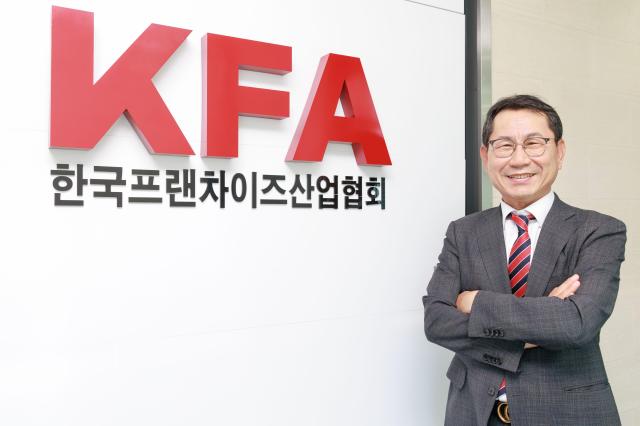
Na Myung-seok, president of the Korea Franchise Industry Association, poses for a photo before an interview with Aju Economy at the association's office in the aT Center in Seocho, Seoul, on June 12. [Photo=Yoo Dae-gil, dbeorlf123@ajunews.com]
The Korea Franchise Industry Association is closing its Seocho chapter and relocating to Yeouido, the heart of South Korean politics. This move reflects President Na Myung-seok's strong commitment to directly convey industry voices to the National Assembly and lead improvements in unreasonable regulations.
In an interview with Aju Economy on June 12 at the association's office in the aT Center, Na announced, "We will move our office to the Yeouido Geukdong VIP Building in front of the National Assembly on June 15. This has been a top priority since I took office as president in January of this year."
The impetus for the relocation is Na's clear goal of strengthening the association's event management capabilities. He noted, "The physical distance from the National Assembly has limited our ability to effectively manage important event functions." He emphasized that the move to Yeouido is not only practical for securing a dedicated training space but also a strategic decision to enhance policy responsiveness through closer communication with lawmakers.
In addition to the relocation, the association is also focusing on revitalizing its personnel to strengthen its network within the National Assembly. A notable example is the recent appointment of Song Gi-jeong, former vice-chair of the Democratic Party's policy committee, as the executive vice president. Na remarked, "Over the past decade, numerous regulatory bills have constrained the franchise industry, but the association often reacted only after laws were passed."
He added, "With the addition of Vice President Song, who has extensive political experience, we aim to actively communicate industry realities from the pre-legislation stage and proactively lead necessary legal amendments, transforming into a more dynamic organization."
Na identified the provision of estimated sales figures as a key area for improvement. Under current franchise law, franchisors are required to provide prospective franchisees with estimated sales ranges based on nearby stores. However, Na pointed out, "Sales can vary significantly depending on location and the franchisee's management style."
He explained, "If a franchisee follows the manual and operates diligently, sales can increase, but if they are late to open or frequently close, sales will suffer. Yet, the law requires franchisors to meet estimated sales figures, essentially making them 'fortune tellers.'"
Na believes that the domestic system is overly stringent compared to international standards. He stated, "In the U.S., there are restrictions on how much can be claimed about potential sales, and I understand that China has similar limitations. Such regulations are rare globally but exist in Korea."
However, he acknowledged that changing regulations is not an easy task. Na concluded, "Altering a law is challenging, but we cannot remain idle. We must continue to strive for change, regardless of the outcome."
* This article has been translated by AI.
Copyright ⓒ Aju Press All rights reserved.