

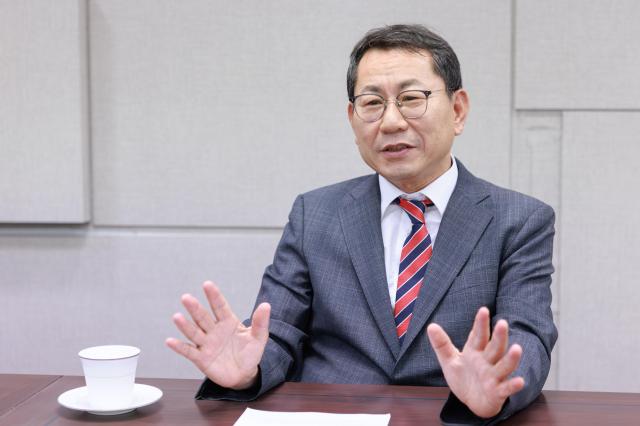
Delivery applications have become a crucial infrastructure for the restaurant franchise industry. Consumers can place orders through a single app, while the platform manages the ordering, payment, and delivery processes. However, franchise headquarters and store owners often struggle to identify their loyal customers. Nam Myung-seok, president of the Korean Franchise Industry Association, highlighted this issue as a key challenge for the franchise sector.
In an interview with Aju Economic Daily on June 12 at the association's office in Seoul, Nam stated, "The only difference is whether the customer orders by phone or through the app, yet all the data necessary for customer management is blocked by the platform. We need to create a structure where the store operators can receive essential information with customer consent."
Nam, who is also the CEO of Wellbeing Food, which operates the Jadam Chicken brand, addressed various industry issues, including the cost burden on franchisees, delivery app commission fees, overseas expansion of K-Franchises, the introduction of artificial intelligence (AI), and the ethical management certification system. He emphasized, "Franchising is not just an industry for headquarters and store owners; it is a key infrastructure for the living economy, involving numerous small businesses, partner companies, farmers, and startups. Changing the perception of the industry based on coexistence and trust is my most important goal during my term."
- The issue of delivery app commission fees remains one of the industry's biggest challenges. How do you evaluate the current delivery platforms?
"The delivery app issue has been raised since I took on the role of emergency response committee chair at the association. At that time, we communicated with platforms like Baedal Minjok, but fundamental improvements have not been made. It is difficult to resolve everything at once. I believe it is realistic to reach a first-stage agreement at a feasible level and then make gradual adjustments in the following years."
- Besides commission fees, what other improvements are needed regarding delivery platforms?
"Customer information sharing is necessary. For instance, even if a customer orders from Jadam Chicken multiple times a week, the franchise headquarters or store owner cannot know this if the order is placed through the app. The only difference is whether the order is made by phone or through the app, yet all the data needed for customer management and service provision is blocked by the platform. We need to create a structure where store operators can receive necessary information with customer consent. Personal data should not be indiscriminately shared, so it should be provided only to companies with security measures in place."
- Despite the K-food craze, small brands struggle to expand overseas due to a lack of funds. What support is the association preparing?
"At the franchise conference held in Jakarta, Indonesia, two years ago, most of the food court restaurants were Japanese, with only a few Korean brands present, and they only imitated the Korean image. If we do not take action ourselves, the image of K-food can be distorted locally. Therefore, we need to consider a collective approach where 20 to 30 restaurant, retail, and service brands enter together, such as models like 'Korea Street,' 'Gangnam Street,' 'Myeongdong Street,' or 'Seoul Street.' Most small franchise headquarters hesitate to expand overseas due to a lack of information, local networks, and funding. Hence, we are promoting the establishment of the 'K-Franchise Global Promotion Headquarters' to create a platform that connects the association, government, large corporations, and overseas networks, making it easier for small brands to enter foreign markets. We have applied for a budget related to overseas expansion this year."
- The ongoing high exchange rate is increasing the burden of raw materials and food ingredients. What is the biggest challenge the franchise industry is facing?
"When the exchange rate rises, import prices increase, and as import prices rise, the prices of products coming into stores also go up. In the chicken industry, a significant portion of feed is dependent on imports, which inevitably raises the cost of raising chickens. Chicken prices have been high since last year and remain similar now. The supply of chickens is also scarce. Ironically, even a 1,000 won increase in chicken prices triggers a sensitive reaction from the public. The industry is in a very difficult situation. Even if we try to improve efficiency, we can only reduce labor costs or adjust operational methods, which we have already done extensively. The government's allocation of tariff-free quotas can provide some help to the chicken industry, but its effect is limited. While the government is understandably sensitive to price increases, there are limits to artificially suppressing prices."
- Discussions on next year's minimum wage are underway. What level does the industry consider manageable, and what does it expect from the government?
"Minimum wage is a crucial issue related to the livelihoods of workers. However, when the minimum wage is raised significantly, it paradoxically leads to job losses for many. Some people end up working at two different places instead of one. I think adjustments should be made without exceeding the inflation rate. Particularly concerning is the issue of wages for foreign workers. There needs to be a discussion on whether the wages for foreign workers should be the same as for locals. I understand that most countries apply wages that are 20-30% lower for foreign workers. In contrast, Korea applies the same wage rate for both. Although the food industry can now employ foreign kitchen assistants through the employment permit system, the actual procedures are complicated, and the burden of providing accommodations makes it difficult for store owners to utilize this option. The cost benefits are not significant, so I believe there are not many applications."
- There is a conflict between headquarters and store owners regarding the proposed amendment to the franchise law that grants collective bargaining rights to store owners. What solutions can promote coexistence?
"The term 'collective bargaining rights' ultimately means we need to have a conversation. The franchise business structure involves headquarters, franchisees, and partner companies working together. Dialogue is essential. However, the final decision-making authority to maintain brand consistency must rest with the headquarters. Decisions that impact the entire brand, such as pricing, funding, and operational standards, should be managed by the headquarters. While dialogue is necessary, it should not undermine brand consistency. The criteria for franchisee collectives must also consider reality. In industries with 20,000 franchise stores like convenience stores, a 30% threshold would require gathering 6,000 stores, which is practically difficult. Conversely, small franchise headquarters with only 10 or 20 stores would face different burdens. Rather than resolving this solely through legislation, ethical and coexistence education through the association and self-regulation are also necessary."
- How is the association conducting ethical and coexistence education?
"We conducted a training session in May, where the executive committee and vice presidents first participated to identify areas for improvement. We plan to expand this training in the second half of the year. The training covers actual dispute cases, ethical management, and changes in franchise law. In the future, we are considering a system where the association grants ethical management certification to companies that have undergone training and have no dispute cases. If we allow them to display this certification at trade shows or on company websites, it could encourage other companies to follow suit."
- Large franchises are adopting AI for ordering, market analysis, and customer management, but small brands face significant cost burdens. Are there any support measures from the association?
"It is challenging for the association to directly support systems. However, we have established an AI committee within the association, which is currently very active. We are in the process of identifying the specific functions that small businesses need. We expect to have a clearer outline by the end of this year. AI is an unavoidable trend. For example, Jadam Chicken has nearly 15 years of accumulated order data. By integrating this data with AI, we can assist franchisees in their ordering processes."
- What is your primary goal during your term?
"This year's goal is to establish the ethical management certification system. The long-term goal remains coexistence. Changing the perception of franchising in Korea is the most challenging and meaningful task. Currently, it is difficult to make progress while being labeled as a 'bullying industry.' Most headquarters and franchisees are working together while fulfilling their roles. I hope the public recognizes that they are not adversarial groups that constantly bully and fight each other. While there can be healthy tension as business partners, the majority of franchises are striving hard for coexistence."
◆ Profile of Nam Myung-seok, President of the Korean Franchise Industry Association
△ Born in 1965 in Incheon
△ Studied photography at Chung-Ang University
△ Former reporter for the current affairs magazine Sisa Journal
△ Publisher of Monthly Start-up & Franchise
△ Launched the Jadam Chicken brand
△ Senior Vice President of the Korean Franchise Industry Association
△ Chair of the Delivery App Response Task Force of the Korean Franchise Industry Association
△ President of the Korean Franchise Industry Association
* This article has been translated by AI.
Copyright ⓒ Aju Press All rights reserved.