


Latest by
-
 Weather Forecast: Rain and Showers Expected Nationwide with Highs of 32 Degrees On Friday, August 28, cloudy skies will prevail across the country, with rain and showers expected in various regions. Heavy rainfall is anticipated, particularly in the southern areas, while much of the nation will continue to experience high temperatures.According to the Korea Meteorological Administration, rain will begin in the Jeonnam and Gyeongnam regions and Jeju Island in the morning, spreading to the Chungcheong, Jeonbuk, and Gyeongbuk areas by night. Rain is also expected along the eastern coast and mountainous regions of Gangwon from late dawn until the evening.Forecasted rainfall amounts are 30 to 80 mm in Busan, Ulsan, Gyeongnam, and Daegu, Gyeongbuk. Chungcheong and Jeolla regions are expected to receive 10 to 60 mm, while Jeju is forecasted to see 5 to 40 mm. Ulleungdo and Dokdo are expected to receive 10 to 40 mm, and the eastern coast and mountains of Gangwon are expected to see 5 to 20 mm.There is a possibility of showers in the Seoul metropolitan area and inland Gangwon, with expected rainfall amounts ranging from 5 to 50 mm.The morning low temperatures on the 28th are forecasted to be between 21 and 26 degrees Celsius, with daytime highs expected to reach 25 to 32 degrees. The heat is expected to ease somewhat in areas experiencing rain.Key low temperatures include: Seoul 25 degrees, Incheon 25 degrees, Suwon 24 degrees, Chuncheon 23 degrees, Gangneung 23 degrees, Cheongju 25 degrees, Daejeon 24 degrees, Jeonju 26 degrees, Gwangju 26 degrees, Daegu 24 degrees, Busan 25 degrees, Ulsan 25 degrees, and Jeju 27 degrees.High temperatures are forecasted as follows: Seoul 30 degrees, Incheon 30 degrees, Suwon 31 degrees, Chuncheon 28 degrees, Gangneung 26 degrees, Cheongju 30 degrees, Daejeon 30 degrees, Jeonju 31 degrees, Gwangju 31 degrees, Daegu 28 degrees, Busan 31 degrees, Ulsan 30 degrees, and Jeju 33 degrees.Waves will be very high in the southern seas and around Jeju, with strong swells expected along the southern coast and Jeju coast. Fine dust levels are expected to be at a 'good' level across all regions.* This article has been translated by AI. 2026-08-27 17:44:00
 -
 US-Canada tariff war squeezes Korean autos, opens crude door SEOUL, August 27 (AJP) - South Korean manufacturers accustomed to being caught between Washington and Beijing now find themselves on a new trade battlefront much closer to their factories. Korean companies poured billions of dollars into North America to escape the heavier tariffs and geopolitical risks of President Donald Trump's second term. The escalating U.S.-Canada trade conflict is now threatening the very assumption behind that strategy - that the United States, Canada and Mexico could continue functioning as one largely integrated production base. For Korean automakers, the rupture creates a new layer of supply-chain risk. For Korea's energy importers, it may create an opening. Canada, increasingly eager to loosen its dependence on the U.S. market, has more crude oil reaching its Pacific coast just as South Korea searches for alternatives to Middle Eastern supplies disrupted by war. The United States imposed a 50 percent tariff on about $20 billion of Canadian imports on Aug. 22 after trade negotiations between Washington and Ottawa collapsed. Canada responded with retaliatory tariffs on roughly the same amount of U.S. goods, scheduled to take effect Sept. 8. The 50 percent rate will hit products including steel, aluminum and smartphones. Duties of 25 percent will apply to cheese, refrigerators, washing machines and other household appliances, while a 15 percent tariff will cover selected industrial equipment including forklifts, industrial robots and some air-conditioning systems and machinery parts. The rates are designed to mirror U.S. tariffs imposed on corresponding Canadian goods. The much larger disruption could arrive next year. Trump has announced plans to double tariffs on Canadian cars, trucks and automotive parts to 50 percent from 25 percent on Jan. 1, striking directly at one of the world's most tightly integrated manufacturing systems. A report released Wednesday by the East Asia Institute (EAI) said the cross-border automotive production network built under the U.S.-Mexico-Canada Agreement, or USMCA, is entering a period of institutional uncertainty. For Korean companies, North America may no longer be one market in quite the way it used to be. Korean autos face a new calculation Few industries illustrate the problem more clearly than automobiles. A component can cross the U.S.-Canadian border several times before the finished vehicle rolls off an assembly line. Ford's F-Series Super Duty, for example, is assembled in Ontario using U.S.-made transmissions and axles alongside Canadian-made engines. A tariff collected at one border crossing can therefore work its way through factories and suppliers on both sides. U.S. automakers have warned that a 50 percent tariff on Canadian vehicles and parts could sharply raise production costs. The emerging tariff map produces an unusual result. The United States has lowered tariffs on South Korean and Japanese vehicles to 15 percent under separate trade arrangements. A Canadian-built vehicle could therefore enter the United States facing a 50 percent tariff while a car shipped across the Pacific directly from South Korea faces 15 percent. The disparity is awkward enough that American automakers themselves worry North American-made vehicles could lose price competitiveness against Asian imports. For Hyundai Motor and Kia, however, any apparent advantage comes with a catch. The companies have spent years localizing production in the United States precisely to reduce exposure to tariffs and political pressure. South Korea produced about 4.1 million vehicles in 2025 and exported roughly 2.74 million. Around 1.65 million of those exports went to North America, meaning the region absorbed about 60 percent of all Korean-made vehicles shipped overseas. Hyundai Motor produced 362,000 vehicles at its Alabama plant last year and another 65,320 at Hyundai Motor Group Metaplant America in Georgia. Kia produced another 355,000 vehicles at its West Point, Georgia, plant. Combined U.S. production reached 782,320 vehicles — equivalent to about 19 percent of all automobiles manufactured in South Korea that year. Hyundai's Tucson shows how quickly the borders blur. The model, assembled in Alabama, was Hyundai's best-selling vehicle in Canada in 2025 with 41,840 units sold. The Alabama factory produced 158,789 Tucsons during the year. A car assembled in America, sold to Canadians and dependent on a regional supplier network can become exposed to a bilateral tariff fight even though the automaker itself is Korean. That is the new calculation. Shipping more vehicles directly from Korea could theoretically exploit the lower 15 percent U.S. tariff. But Hyundai and Kia have simultaneously invested heavily in American factories and in suppliers designed around a continent-wide production system. EAI said the impact would increasingly depend on how much production companies locate inside the United States. Parts suppliers including Hyundai Mobis and HL Mando could face particular pressure as Washington demands greater U.S.-made content and the economics of moving components across borders deteriorate. Localization, once the obvious insurance against tariffs, is becoming more complicated when the tariffs begin appearing inside the supposedly protected market. Canada looks beyond America Canada has a different problem. About 70 percent of its exports go to the United States, leaving the country exceptionally exposed when relations with its largest customer sour. Prime Minister Mark Carney has increasingly called for new trade and security partnerships as Ottawa tries to reduce that dependence. South Korea is already part of that diversification. Energy ties are growing through LNG Canada, whose first phase includes Korea Gas Corp. as an investor. South Korea plans to import at least 1.4 million tons of Canadian liquefied natural gas annually for more than 30 years if the project's second phase proceeds as planned. A longer U.S.-Canada rupture could give Seoul greater room to deepen cooperation in critical minerals, energy and advanced manufacturing. Oil may offer the most immediate opportunity. South Korea receives about 69 percent of its crude imports from the Middle East, according to the industry ministry, leaving refiners particularly vulnerable to disruptions around the Strait of Hormuz. Kpler data on Thursday showed crude flows through the strait averaging only 2.3 million barrels per day in August, compared with 15.82 million barrels a day in the three months before the war. Asia's overall crude imports were running about 14 percent below prewar levels. Thousands of kilometers away, Canada has something Asian refiners increasingly want: oil that does not need to pass through Hormuz. The expanded Trans Mountain pipeline, which nearly tripled capacity for moving Alberta crude to Canada's Pacific coast, has been running at full capacity. By July, about 77 percent of crude shipped from Vancouver through the pipeline was headed to Asia, up from roughly 51 percent in 2024. Japan received its first Canadian crude cargo in more than a year, while India, Malaysia and Singapore resumed purchases after the Iran war began. "Japan's renewed purchases of TMX crude highlight Canada's growing role in Asia's evolving import strategy," said Richard Ro, a senior market analyst at Kpler. South Korea has another reason to take a closer look. The latest U.S. tariffs do not directly apply to Canadian crude, so Korean refiners receive no immediate tariff-induced price advantage. But a prolonged political and trade split could give Ottawa a stronger incentive to move barrels west across the Pacific rather than south into the United States. One obstacle to Korean purchases has already been lowered. The Korea Customs Service and Alberta agreed in April to simplify origin certification for Canadian oil-sands crude, which is frequently blended with U.S. light crude before shipment. Qualifying Canadian crude can therefore receive preferential treatment under the Korea-Canada free trade agreement, eliminating a 3 percent tariff that had discouraged some imports. Canada still has a long way to go before Asia rivals its traditional market. The United States accounted for 93.8 percent of Canadian crude exports during the first year after the Trans Mountain expansion. That dependence explains Carney's urgency. He has set a goal of doubling Canada's non-U.S. exports over the next decade. For Seoul, the timing is notable. Korea itself is trying to secure energy supply lines at a moment when Middle Eastern disruption has exposed the dangers of relying too heavily on one region. Ottawa is trying to find buyers beyond a U.S. market that has absorbed Canadian output almost by default for generations. Their diversification strategies increasingly point toward each other. The irony for Korean industry is that the same trade confrontation producing the opportunity is also undermining another diversification strategy. Hyundai, Kia and their suppliers invested heavily in North America partly because producing inside the region was supposed to insulate them from Trump's tariff walls. The wall is now appearing between the countries inside it. South Korea's relationship with Washington has not deteriorated to anything approaching Canada's. September nevertheless brings its own test, with a possible meeting between President Lee Jae Myung and Trump on the sidelines of the U.N. General Assembly and Seoul expected to announce the first project under its $350 billion U.S. investment package. For Korean companies, the lesson from Canada may be uncomfortable. Putting factories inside North America can reduce the risk of being outside Trump's tariff perimeter. It cannot guarantee that the perimeter will stay in the same place. For Korean energy buyers, Canada's predicament offers the reverse possibility. As one of America's closest economic partners searches for markets farther from home, some of the barrels it once sent almost automatically south may increasingly head west instead — toward Asia. AJP Takeaways • The escalating U.S.-Canada tariff dispute is challenging the integrated North American production strategy of Hyundai Motor, Kia and Korean auto-parts suppliers, which have invested heavily in U.S. manufacturing while relying on regional supply chains. • A planned 50 percent U.S. tariff on Canadian vehicles and parts from January could produce unusual competitive distortions, as South Korean-made vehicles face a lower 15 percent tariff while some North American-built models face much steeper duties. • Canada's push to diversify away from the United States could create new opportunities for South Korea in energy, critical minerals and advanced manufacturing, building on existing LNG cooperation. • Canadian crude is becoming more attractive to Asian buyers as Middle East disruptions constrain supplies through the Strait of Hormuz, while simplified Korea-Canada origin rules have removed a 3 percent tariff obstacle for qualifying Canadian oil-sands crude. 2026-08-27 17:42:09
 -
 AI windfall buys homes, cars and luxury watches in Korea's chip enclave HWASEONG, August 27 (AJP) - At Lotte Department Store in Dongtan, a saleswoman sizing up a customer offers a pitch that would sound peculiar almost anywhere else. "Your husband makes a lot of money this time. You can afford to treat yourself," she coos. There is no need to specify who the husband works for. Dongtan sits inside South Korea's semiconductor heartland, within commuting distance of Samsung Electronics' chip operations in Hwaseong and Giheung as well as SK hynix Icheon connected by company shuttle buses to the country's increasingly prosperous cleanroom class. After an extraordinary run in artificial intelligence-driven memory demand, Samsung Electronics and SK hynix workers are receiving bonuses that would have sounded fantastical barely two years ago. SK hynix is doling out packages worth as much as 700 million won ($507,000) in cash and shares, while Samsung has promised semiconductor employees packages worth around 600 million won, mostly in stock. Some workers outside the chip divisions receive only a fraction of that. The money is certainly going somewhere. It is showing up in record apartment prices, imported cars, foreign-brand watches and jewelry, and families squeezing two overseas vacations into one summer break. What is harder to find is the boom on Dongtan's Main Street. Café owners say business remains grim. An optician says sales have actually fallen. Private academies have not seen parents suddenly double their spending. A local travel agency says the bonus bonanza has barely registered. Dongtan offers a close-up view of a peculiar wealth effect taking shape around Korea's semiconductor boom: when the windfall becomes large enough, workers stop treating it like extra salary and start treating it like capital. The result is an enclave getting richer without necessarily making the neighborhood around it richer. Samsung Electronics and SK hynix are expected to generate roughly 650 trillion won in combined operating profit this year, an extraordinary sum equivalent to nearly a quarter of South Korea's 2025 nominal gross domestic product of 2,676.7 trillion won. Their earnings, share prices and employee bonuses have dominated financial headlines for much of the year. For Korean retail traders, the two names have alternately represented heaven and hell as their shares swung wildly. Inside semiconductor communities, however, the newly minted wealth has remained more discreet. The profligacy is rarely overt. The cleanroom society tends to keep to itself. Housing prices have been less discreet. Apartment prices in Dongtan have risen 16.3 percent so far this year, the steepest increase in the country, while rents have climbed 10.9 percent, according to Korea Real Estate Board data. An analysis of Ministry of Land, Infrastructure and Transport transaction records by Woori Bank's Real Estate Research Lab found that 319 of 494 apartment unit types traded in Dongtan between June and Aug. 25 — 64.6 percent — fetched their highest-ever transaction price during the period. That was the highest proportion anywhere in Gyeonggi Province. Some jumps have been startling. A 97-square-meter apartment at The Sharp Central City in Cheonggye-dong sold for 2.16 billion won, 500 million won above its previous record. A 128-square-meter unit at Dongtan Station Demonstration Hanwha Dream & Green Prestige changed hands for 2.4 billion won, exceeding its previous peak by 420 million won. For some Samsung employees, property prices have been rising faster than their bonuses can catch them. "After receiving the bonus, I started looking into moving to Dongtan," said Hwang, an employee in Samsung Electronics' Device Solutions division. "But prices rose so much in the meantime that now I can't even dream of moving there." Even within Dongtan, the boom has picked favorites. The planned city south of Seoul is divided broadly between the older Dongtan 1 district and newer Dongtan 2, where newer apartments, transport connections and proximity to semiconductor workplaces have made property especially attractive. A real estate agent in Dongtan 1 said Samsung employees are everywhere in the neighborhood. Their money is not. "We don't really feel it here," the agent said. "Apartment prices have gone up, but Dongtan 2 has risen much more." The distinction captures something important about semiconductor wealth: it concentrates. Seo Jeong-ryeol, a professor of real estate studies at Youngsan University, said employees receiving large payouts are unlikely to scatter their money indiscriminately across nearby housing markets. They seek some combination of commuting convenience, residential quality and investment potential. "If conditions are similar, people inevitably prefer places with the best residential environment or the highest investment value," Seo said. Inside what he calls the "shuttle-bus sphere" of Samsung Electronics and SK hynix, the best-positioned homes therefore benefit first. "People don't buy a house somewhere random just because a big company or SK hynix is making money," Seo said. "The priorities become proximity to work and apartments with investment value." Another stream of money arrives Sept. 1. Samsung Electronics plans to offer eligible employees who do not own homes loans of up to 500 million won at an annual interest rate of 1.5 percent. In the Seoul metropolitan area, the program is expected to cover homes priced at 2.5 billion won or below with residential space of up to 85 square meters. The anticipation is already producing behavior usually associated with a rapidly rising property market. Kim, a Dongtan resident, had agreed to move into an apartment when the owner abruptly walked away from the deal. "The landlord didn't say anything and just sent back twice the deposit," she said. "I think the owner believed they could get a higher price." Under a common Korean property-contract practice, a seller can cancel after returning twice the buyer's deposit. Seo said owners become willing to absorb the penalty when they think the property will appreciate by even more. "If they are paying double the deposit to cancel, it means they believe there is a good chance the price will rise further," he said. Walk out of those apartment towers, however, and the prosperity becomes much harder to spot. Local merchants had expected a bumper year after news spread of semiconductor employees collecting record performance bonuses. Instead, some are wondering where everybody took the money. "People ask whether the local economy has improved, but it hasn't," said an optician who has worked in the area and serves many employees of large companies. "Bonuses were paid out, but sales haven't increased. They've actually decreased." From what the optician sees, younger workers would rather own another stock than another pair of glasses. "From what we see, they invest a lot in stocks," the optician said, adding that property is another favored destination. A café owner had made the same assumption many merchants did when Samsung's earnings began surging. "I have to admit we expected to share the windfall," she said. "I thought that if Samsung was paying out bonuses, there would be more economic activity." The customers never quite arrived. In earlier boom periods, large company orders for snacks or other supplies would occasionally spill into neighborhood businesses, she said. This time, merchants around her complain that conditions remain unusually difficult. Her own spending priorities help explain why. "If I suddenly had a large sum of money, I would move house or pay down some debt," she said. "Shopping isn't something that leaves you with anything." Shopping does become attractive when the purchase is big enough. Lotte Department Store's Dongtan branch recorded a 25 percent increase in sales in the first half from a year earlier, beating growth of roughly 20 percent across Lotte's department-store network. Sales of luxury goods and foreign-brand watches and jewelry at the Dongtan store jumped roughly 40 percent to 45 percent. The pattern suggests semiconductor money is bypassing routine purchases and concentrating instead on things substantial enough to feel like rewards. Cars fit the pattern. New registrations of imported vehicles in Hwaseong, which includes Dongtan and Samsung Electronics' Hwaseong semiconductor campus, surged 42.5 percent to 4,273 in the first half from 2,998 a year earlier, according to the Korea Automobile Importers & Distributors Association. Imported-car registrations nationwide rose 33.2 percent during the same period. The numbers do not establish that Samsung bonuses are buying BMWs and Mercedes-Benzes. Some Samsung workers, however, say the payouts have made previously postponed purchases easier to contemplate. "I've wanted to replace my car for a while," said Lee, a Samsung Electronics employee. "I'm thinking this might be the chance, so I've been looking at different models." Travel money is harder to trace. A Dongtan travel agency has seen little obvious bonus-related surge, an employee said, partly because workers at large corporations often book through company-affiliated benefit platforms offering employee discounts. "There are separate travel agencies linked to their companies," the employee said. "Even for the same travel product, they tend to book through those channels to get employee discounts." "Sales haven't increased enough for us to really feel it." Younger workers are even harder for neighborhood agencies to capture because they book flights and hotels themselves through mobile apps. The money may be going abroad. It simply does not stop at the local travel agent first. One educator noticed the departures. Yoo, who works with school-age children in Dongtan, said this summer produced an unusual number of absences as families took repeated trips. "In the past, families would go abroad for three or four days during vacation and that was it," Yoo said. "This time, they keep going." Some squeezed multiple domestic and overseas trips into the relatively short summer break. "They went to Vietnam, and then they would say they had to go to Japan too — two trips," she said. The same families were not suddenly spending twice as much on education. Lee Eun-hee, professor emeritus of consumer science at Inha University, said performance bonuses occupy a different mental account from monthly salaries. Education is already considered a priority expense for many Korean households. A large unexpected payment therefore does not necessarily persuade parents to add another private tutor or move their children to a more expensive academy. The bonus instead creates an opportunity to do something ordinary income could not easily finance. "When money that wasn't expected suddenly comes in, people may think about upgrading their home," Lee said. "That means adding to their assets." Savings and asset accumulation are likely to absorb a substantial portion, she said, with another share going toward expensive wants households have postponed. "Travel, luxury goods and imported cars — things they wanted to do but couldn't normally do," Lee said. Yang Joon-mo, professor of economics at Yonsei University, puts the matter more simply. "People there aren't going to eat two dinners," Yang said. "Children who already attend academies aren't suddenly going to pay twice the tuition." Once a bonus reaches hundreds of millions of won, he said, it stops behaving like spending money. "If someone receives, say, 600 million won, the question becomes whether they buy a home in Dongtan or add that money and move to Gangnam," Yang said. "The money flows according to a completely different logic." Korea has seen versions of the pattern before. Yang said windfalls created during previous export booms often migrated from the places where the money was earned toward higher-value property and financial assets elsewhere. "When someone suddenly comes into a large amount of money, the concept changes to asset investment," he said. The semiconductor enclave may prefer to keep its newfound riches to itself. But Dongtan's soaring apartment prices, crowded airport itineraries and department-store sales counters are making that increasingly difficult. AJP Takeaways • South Korea's AI-driven semiconductor boom is creating a concentrated wealth effect in Dongtan, where Samsung Electronics and SK hynix employees are channeling record bonuses into housing, stocks and other assets. • Dongtan apartment prices have surged 16.3 percent in 2026, while nearly two-thirds of apartment types traded from June through Aug. 25 set record prices, highlighting how chip wealth is feeding property demand. • Luxury goods and imported cars are benefiting more than neighborhood businesses, with Dongtan department-store luxury sales up roughly 40 percent to 45 percent even as cafés, opticians and travel agencies report little improvement. • Economists say exceptionally large semiconductor bonuses behave more like investment capital than ordinary income, helping explain why Korea's chip windfall is lifting asset values without producing an equally broad Main Street spending boom. 2026-08-27 17:40:42
 -
KB Financial Group Narrows Down CEO Candidates to Three KB Financial Group has narrowed its list of candidates for the next CEO to three individuals, including current Chairman Yang Jong-hee.The CEO Candidate Recommendation Committee held a meeting on the 27th and announced that it has selected a final shortlist of three candidates after conducting in-depth interviews with the shortlisted individuals. Internal candidates include Chairman Yang Jong-hee and Lee Jae-geun, the head of KB Financial's division, while Kwon Kwang-seok, former president of Woori Bank, is the external candidate.The committee plans to conduct a second round of in-depth interviews with the three candidates on September 11 before finalizing the selection.Cho Hwa-jun, the committee chair, stated, "This management succession process is being conducted transparently based on fair and objective criteria. We will do our utmost to ensure that the best candidate, who can be trusted by all stakeholders, is appointed as the next chairman."* This article has been translated by AI. 2026-08-27 17:40:00
-
President Yoon Directs Officials to Assist Families of Missing Koreans in Nepal Floods President Lee Jae-myung on August 27 directed the appointment of a dedicated official to assist the families of nine Koreans missing due to flooding in Nepal, as well as a spokesperson to share updates on the rescue efforts. During an emergency meeting at the Ministry of Foreign Affairs, President Lee emphasized the need for careful attention to ensure that families do not feel neglected. This information was relayed by Senior Spokesperson Kang Yu-jeong during a briefing at the Cheong Wa Dae. President Lee urged, "Respond meticulously so that families do not feel any lack of support." He also instructed that rescue personnel be dispatched to the area as quickly as possible and requested that the needs of families, including requests for meetings with relatives who are isolated or out of contact, be thoroughly addressed.* This article has been translated by AI. 2026-08-27 17:36:00
-
SK Telecom Launches AI Data Center Firm SK Horizon with $3.8 Billion Investment SK Telecom is establishing a new AI data center (DC) company, SK Horizon, by splitting off its wholly-owned subsidiary, SK Broadband. The new company has secured an investment of 3.8 trillion won from global investment firms KKR and the IMM Investment-Stonebridge consortium, enhancing its position as an "Asian AI infrastructure hub."On August 27, SK Telecom announced its plan to split SK Broadband into an existing company (SK Broadband) and the newly formed SK Horizon. The split ratio is based on net asset book values, with the existing company at 0.8351323 and the new company at 0.1648677.The existing company will focus on innovation in wired, media, and enterprise businesses, while SK Horizon will oversee the expansion of domestic AI DC infrastructure. SK Horizon will manage a total of 318MW of infrastructure, including eight operational data centers in Seocho, Ilsan, Bundang, Gasan, Centum, Yangju, and Pangyo, as well as new AI DCs under construction in Ulsan and Guro. The company will also gradually expand its subsea cable network. Kim Sung-soo, CEO of SK Broadband, will also serve as the head of the new company.Upon completion of the phased investment, KKR and the IMM consortium will hold 29% and 20% stakes in SK Horizon, respectively, while SK Telecom will maintain a 51% stake, ensuring its status as the largest shareholder and retaining management control. KKR is a global investment firm managing over $1 trillion in infrastructure assets and is pursuing this investment as part of its Asia-Pacific infrastructure investment strategy.Founded in 1999, IMM Investment is a domestic alternative investment firm managing over $7.5 billion in venture capital, growth capital, and infrastructure. Stonebridge Capital is a private equity firm managing approximately $2.5 billion. The funds raised will be used for further expansion of SK Horizon's AI DC and infrastructure development.With this restructuring, SK Telecom has completed its AI DC initiative alongside the specialized company SK Hyper, established in July. SK Telecom will oversee the entire group’s AI DC business and collaborate with global tech giants, while SK Horizon will focus on expanding existing core AI DCs and subsea cable infrastructure. SK Hyper will develop new AI DC projects, aiming for a phased expansion to 5GW by 2029 and 15GW by 2035.The split is expected to be finalized in the first quarter of next year, pending government approvals and a special shareholders' meeting.Kim Sung-soo, CEO of SK Broadband, stated, "This governance restructuring is a proactive measure to secure expertise and rapid execution in the AI DC business. As an AI DC infrastructure company, we will continuously scale up SK Horizon to become the leading DC operator in the country."* This article has been translated by AI. 2026-08-27 17:36:00
-
Park Geun-hye Attends People Power Party Retreat, Emphasizes Unity Park Geun-hye attended the People Power Party's retreat on August 27, emphasizing the need for unity among party members, stating, "The smaller the group, the more we must come together and unite." This call for cohesion comes amid concerns over internal strife following the recent introduction of a direct election system for party committee chairs by the leadership of Jang Dong-hyuk.Speaking at the retreat held in Goyang, Gyeonggi Province, Park warned, "If we are divided while gaining strength against the majority, the outcome will be predictable."She added, "When a nest is broken, the eggs inside are not safe. If the nest of the party shakes and breaks, your future will be the same. There is no enemy more frightening than internal division when fighting against external foes. While various opinions may arise within the party, we must not hate or deny each other."Park also stressed the importance of trust and camaraderie, stating, "The most important thing in politics is trust. Without trust within the party, it cannot survive. A party is a place where like-minded people gather, so the term 'comrade' is fitting."She remarked that the difficulties currently faced are part of the process of strengthening their power to accomplish significant tasks for the people and the nation. Despite the challenges of being a minority party, she asserted that if they face reality and work together, they can earn the public's trust, become the majority party, and regain power.Park expressed hope that this retreat would strengthen the camaraderie among members, urging them to unite around the leadership during difficult times.She also called on the leadership to carefully consider the public's will in guiding the party, stating, "The nation comes before individual thoughts, the lives of the people come before small interests within the party, and the Republic of Korea comes before political gains or losses. If you prioritize these, the public will recognize your sincerity."This marks Park's first attendance at a party retreat since her candidacy for the Saenuri Party's presidential nomination in 2012. It is unusual for a former president to attend a party retreat. Earlier, floor leader Jeong Jeom-sik visited Park on August 19 to invite her to the event. 2026-08-27 17:36:00
-
 Bond yields shoot up after back-to-back hike SEOUL, August 27 (AJP) - South Korean government bonds staged a sharp reversal Thursday after the Bank of Korea's second straight rate hike, while the won strengthened only modestly despite closing at an 11-month high. The dollar-won rate fell 3.9 to close daytime trading at 1,380.9, its lowest level since September last year. The rate dropped as low as 1,377.3 shortly after the decision before recovering much of the decline later in the session. The BOK raised its base rate by 25 basis points to 3.00 percent, following an identical increase in July. Government bonds initially sold off sharply as investors reacted to the consecutive hike and the central bank's large upward revision to its growth outlook. The three-year Korean government bond yield climbed as much as 6.9 basis points to 3.886 percent. The 10-year yield rose 3.9 basis points to 4.321 percent. The moves reversed after investors digested the BOK's six-month rate projections and Gov. Shin Hyun-song's press conference. The three-year yield ended 6.1 basis points lower at 3.755 percent, according to final quotations from the Korea Financial Investment Association. That represented a 13.1-basis-point reversal from its intraday high. The 10-year yield closed 5.0 basis points lower at 4.238 percent, an 8.3-basis-point reversal from its earlier high. The BOK's six-month conditional rate outlook showed a median of 3.25 percent, suggesting one additional quarter-point increase from the current level. Five of the 21 probability-weighted projections remained at 3.00 percent. Board member Hwang Kun-il also dissented in favor of keeping the rate at 2.75 percent. Shin said policymakers would assess the effects of the two consecutive increases and stopped short of committing to another immediate move. Investors took the guidance as reducing the risk of another rapid succession of hikes, helping bonds recover from their initial losses. The won's reaction was more subdued. The currency strengthened after the decision but gave back much of its intraday gain as expectations for another immediate increase eased. Month-end dollar selling by exporters also supported the won, while dollar-buying demand emerged below 1,380. 2026-08-27 17:35:22
 -
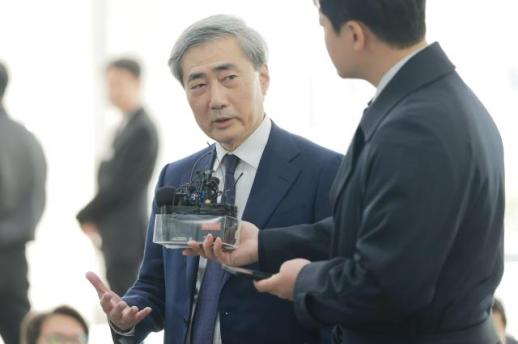 BOK chief Shin to attend Jackson Hole, G20, BIS meetings SEOUL, August 27 (AJP) - Bank of Korea Governor Shin Hyun-song is heading for the United States on Thursday to attend the Jackson Hole Economic Policy Symposium, followed by G20 and BIS meetings. Shin will attend the Jackson Hole symposium from Friday and exchange views with central bank governors and academics. This year's symposium will be held under the theme "Financial Innovation: Implications for Payments and Policy." Shin will then attend the G20 Finance Ministers and Central Bank Governors Meeting in Asheville, the United States, from Aug. 31. He will discuss major global economic issues with finance ministers, central bank governors and officials from international financial institutions. The BOK governor will travel to Basel, Switzerland, for the Bank for International Settlements Governors' Meeting beginning Sept. 5. He will attend the Global Economy Meeting and the Meeting of Governors to discuss recent global economic and financial-market conditions with other central bank governors. Shin will also attend the BIS Board of Directors and the Economic Consultative Council as a BIS board member. Before taking over as BOK governor in April, Shin served as BIS economic adviser from 2014 and headed its Monetary and Economic Department from 2025. He is scheduled to return to South Korea on Sept. 9. 2026-08-27 17:33:06
 -
Kim Kyung-ho: Court Should Decide on Yoon's Rebellion Charges The second comprehensive special prosecutor team, led by Kwon Chang-young, has faced criticism for concluding that there was 'no prosecutorial authority' regarding former President Yoon Suk Yeol's rebellion charges under the Military Criminal Act. Attorney Kim Kyung-ho argued that the court should have been given the opportunity to rule on the matter. Kim plans to file charges of distortion of law against the special prosecutor team that investigated the rebellion, led by Cho Eun-seok.In a Facebook post on August 27, titled 'Kwon Chang-young Special Prosecutor Has Committed a Crime Before History,' Kim pointed out flaws in the comprehensive special prosecutor's reasoning for not prosecuting the rebellion charge.The first issue raised was the logic of 'double prosecution.' The comprehensive special prosecutor concluded that since the rebellion special prosecutor had already charged the same historical facts with rebellion, it would be difficult to prosecute again for the same offense.However, Kim believes that the court could still hear the rebellion charge. He argued that if rebellion and insurrection can occur simultaneously in a single act, then the indictment could be amended in the ongoing insurrection trial.Conversely, if the two charges are considered separate, he contended that they could be prosecuted independently. Kim criticized the notion that 'there is no path' as an answer not found in criminal procedure law, stating, 'They erased it with a single piece of paper without even making a substantive judgment.'Kim intends to hold accountable those involved in the investigation who did not apply the rebellion charge. He mentioned that he has already filed a complaint against former prosecutor Park Se-hyun for distortion of law and plans to do the same against Cho Eun-seok and Kwon Chang-young.The case against former President Yoon regarding insurrection is currently under appeal at the Seoul High Court. In February, the first trial sentenced Yoon to life imprisonment. Kim argues that the court should determine the applicability of the rebellion charge through an amendment to the indictment in the upcoming insurrection appeal.Kim also believes that the comprehensive special prosecutor's decision contradicts its own principles. Kwon stated on August 24 during the announcement of the investigation results that 'it is the prosecutor's duty to broaden the scope so that the court can make a free choice regarding the end of the insurrection.'Kwon also noted that the facts surrounding the 1997 case involving Chun Doo-hwan and Roh Tae-woo differ from those of the December 3 martial law. He emphasized the need for the court to have the opportunity to assess new legal principles rather than being confined to a 30-year-old precedent.Kim believes that the rebellion charge should have been left to the court's judgment. The comprehensive special prosecutor concluded that the likelihood of the court accepting an amendment to the indictment in the appeal was low, which led to the exclusion of the rebellion charge from the trial.There were differing opinions within the comprehensive special prosecutor's office regarding the application of the rebellion charge. Special Prosecutor Kim Jung-min explained that there were arguments supporting the establishment of the rebellion charge and the need for a change in precedent. Kim also personally believes that the rebellion charge is applicable and that there is a possibility of viewing the two charges as concurrent, but the comprehensive special prosecutor ultimately ruled 'no prosecutorial authority.'Kim stated, 'If you haven't read the extensive content of the Chun Doo-hwan Supreme Court ruling, you can only understand half of it by pretending to have read it.'Additionally, Kim offered a different interpretation of the rebellion special prosecutor's decision not to apply the rebellion charge. The rebellion special prosecutor concluded that it would be difficult to apply the rebellion charge to military actions ordered or approved by the President or the Minister of National Defense, citing the 1997 Supreme Court ruling (96Do3376) as a basis.Kim pointed out that the circumstances of that ruling differ fundamentally from those of the December 3 martial law. During the May 17 incident, former President Choi Kyu-ha did not participate in the rebellion but approved troop movements, whereas former President Yoon was himself indicted as the leader of the insurrection following the declaration of martial law. Yoon was removed from office after a parliamentary impeachment and a Constitutional Court ruling.He also referenced the ruling that recognized the armed occupation of the National Assembly as rebellion. The Supreme Court determined that the actions of the Army's 33rd Division occupying the National Assembly and controlling access for lawmakers on May 18, 1980, constituted military rebellion.In a previous post, Kim emphasized, 'The precedent is not blocking the rebellion charge; it is commanding it,' highlighting that both special prosecutors only cited part of the ruling. He argued that the ruling's consideration of the armed occupation of the National Assembly during the May 17 incident should not be interpreted solely as a basis for not applying the rebellion charge.* This article has been translated by AI. 2026-08-27 17:32:00