

Shin will attend the Jackson Hole symposium from Friday and exchange views with central bank governors and academics.
This year's symposium will be held under the theme "Financial Innovation: Implications for Payments and Policy."
Shin will then attend the G20 Finance Ministers and Central Bank Governors Meeting in Asheville, the United States, from Aug. 31.
He will discuss major global economic issues with finance ministers, central bank governors and officials from international financial institutions.
The BOK governor will travel to Basel, Switzerland, for the Bank for International Settlements Governors' Meeting beginning Sept. 5.
He will attend the Global Economy Meeting and the Meeting of Governors to discuss recent global economic and financial-market conditions with other central bank governors.
Shin will also attend the BIS Board of Directors and the Economic Consultative Council as a BIS board member.
Before taking over as BOK governor in April, Shin served as BIS economic adviser from 2014 and headed its Monetary and Economic Department from 2025.
He is scheduled to return to South Korea on Sept. 9.
Kim Yeon-jae
Kim Yeon-jae is a journalist at AJU Press (AJP's English platform),
covering macroeconomics, international finance, and geopolitics.
He closely tracks central bank monetary policies, global energy supply chains,
and the Korean defense industry.
Copyright ⓒ Aju Press All rights reserved.
Related News
-
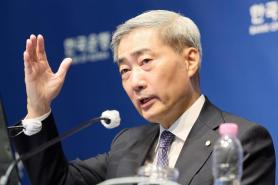 BOK front-loads tightening, but disinflation tests early hikes
Bank of Korea Governor Shin Hyun-song answers reporters' questions during a press conference following a Monetary Policy Board meeting at the central bank's annex conference hall in Seoul on Aug. 27, 2026. Bank of Korea. SEOUL, August 27 (AJP) - The Bank of Korea (BOK) has front-loaded monetary tightening with its first back-to-back rate hikes since January 2023, betting that South Korea's chip-powered economic resilience and increasingly persistent inflation warrant acting before price pressures become harder to contain. The BOK raised its base rate by 25 basis points to 3.00 percent on Thursday, following an identical increase in July. Governor Shin Hyun-song, proving to be a hawk by delivering two rate hikes since taking office in late April, made clear that his preference is to pay the smaller cost of tightening early rather than risk a much more painful response later. He said preemptive monetary-policy action was necessary to preserve macroeconomic stability, including price stability. To explain the consecutive increases, Shin invoked a familiar Korean proverb: "What can be stopped with a hoe should not be left until it requires a spade." "We used the hoe, not the spade," he said. The message was straightforward. Strong growth is likely to continue into next year, and inflation could broaden and remain elevated for longer if the BOK waits until demand pressures become firmly entrenched. The central bank's new economic outlook strengthens that argument. The BOK raised its 2026 growth forecast sharply to 3.3 percent from 2.6 percent in May and its 2027 projection to 2.9 percent from 2.1 percent, citing the semiconductor boom and its widening spillover across the economy. Headline inflation forecasts were unchanged at 2.7 percent this year and 2.3 percent next year. Core inflation, however, was revised up to 2.5 percent for both years. The BOK expects demand-side price pressures to gradually strengthen as domestic demand remains solid, supported by improving household income and an expansionary fiscal stance. Graphics by AJP Song Ji-yoon The central bank's working assumption is that semiconductor profits and investment will increasingly find their way into incomes and consumption, keeping underlying inflation sticky even as headline price increases moderate. Shin said the consecutive hikes departed from the BOK's usual pattern and were intended partly to send a forceful signal to markets. Having sent it, the question becomes whether the central bank needs to fire again soon. The composition of the growth upgrade offers reasons for caution. Half of the 0.7-percentage-point increase in this year's growth forecast came from stronger-than-expected semiconductor conditions. Goods-export growth was raised to 9.7 percent from 4.9 percent, while facilities investment was revised to 6.8 percent from 4.4 percent. Private consumption barely moved, rising to 2.1 percent from 2.0 percent. Construction investment was cut to 0.2 percent from 0.6 percent. The BOK also lowered its employment-growth forecast to 140,000 from 180,000, citing weakness in sectors including construction. The policy debate therefore turns increasingly on transmission: not whether Korea is growing, but how quickly the export and semiconductor boom reaches household spending, wages and service prices. That distinction matters because higher interest rates impose costs across the economy, including on households and companies receiving little of the semiconductor windfall. Inflation itself is sending mixed signals. Consumer prices slowed to 2.8 percent in July, while core inflation edged up to 2.6 percent from 2.5 percent. The BOK expects headline inflation to ease further to 2.3 percent next year. Core inflation is forecast to stay at 2.5 percent as stronger domestic demand offsets some of the relief from goods and energy prices. The won has meanwhile strengthened sharply. The dollar-won rate fell from 1,424.0 at the end of July to 1,380.9 on Thursday, potentially reducing imported inflation. The BOK itself identifies larger declines in oil prices and the exchange rate as downside risks to its inflation forecasts. Timing creates another complication. The July increase has had only about six weeks to work through borrowing costs, household demand and asset prices. Shin acknowledged that the impact of the two consecutive moves now needs to be assessed. The Monetary Policy Board was also not unanimous. Hwang Kun-il voted to keep the base rate at 2.75 percent, while the other six members backed the increase. Shin described Hwang's dissent as a "tactical difference," saying the disagreement concerned timing rather than the broader direction of policy. The board's six-month rate projections nevertheless moved decisively upward. Of 21 probability-weighted dots submitted by the seven board members, 10 were placed at 3.25 percent and six at 3.50 percent. Five remained at the current 3.00 percent. In May, only two dots had been above 3.00 percent. Generated with ChatGPT/Claude The median projection rose to 3.25 percent, putting the center of the board's outlook one additional quarter-point increase above the current rate. Shin stopped well short of promising another immediate move. "All upcoming meetings are live," he said. The combination leaves the BOK in an unusual position: signaling that rates will probably have to go higher while simultaneously arguing that it now has room to watch what the first two increases actually do. Kang In-soo, an economics professor at Sookmyung Women's University, said the move was better understood as a preemptive response to inflation and financial-stability risks than as the beginning of an extended tightening cycle. The back-to-back hikes have already sent a powerful signal, he said, and the BOK should now give greater weight to assessing their impact before raising rates again. Yoon Yeo-sam, a bond strategist at Meritz Securities, said the August meeting strengthened the case that Korean market yields may have reached their peak. He estimated fair value for the three-year Korean government bond yield at 3.8 percent and the 10-year yield at 4.2 percent. Financial markets showed a mixed but relatively contained reaction. The KOSPI's gain narrowed to as little as 0.49 percent around the rate decision before recovering later in the session. The benchmark closed at 6,908.74, up 1.48 percent from Wednesday. The won strengthened into the 1,379 range shortly after the decision and closed at 1,380.9 per dollar, 3.9 won stronger than Wednesday. Korean government bond yields were little changed after an earlier selloff faded. The three-year yield ended 0.6 basis point lower at 3.810 percent. The 10-year yield edged up 1.4 basis points to 4.302 percent, while the 20-year yield rose 1.5 basis points to 4.557 percent. The muted repricing suggested investors were already looking beyond Thursday's increase toward two questions: whether another hike follows, and how long the BOK intends to keep policy restrictive. Financial stability supplies another argument for keeping rates high. Seoul home prices rose 1.1 percent in July from the previous month, while prices across the broader capital region gained 0.7 percent. Bank household lending increased by 5.4 trillion won ($3.9 billion), including a 3.4 trillion won rise in mortgage lending. Shin said interest rates were no cure-all for housing but could help restrain leverage alongside macroprudential measures. Fiscal policy adds another twist. The BOK's own outlook identifies expansionary government spending as one reason domestic demand should remain resilient. Stronger fiscal support can help the economy absorb higher borrowing costs. It can also keep demand and underlying inflation firmer, forcing monetary policy to remain restrictive for longer. Shin argued that the two policies do not necessarily conflict. Fiscal spending that raises the economy's potential growth, he said, could allow faster expansion without generating the same degree of inflation. Ultimately, the BOK's strategy rests on two judgments. The first is that semiconductor-driven income gains will spread widely enough to generate persistent demand-side inflation. The second is that the rest of the economy can withstand higher borrowing costs before that inflation becomes unmistakable. If consumption and wages strengthen as the BOK expects and core inflation remains sticky, the back-to-back hikes may come to look like cheap insurance against a much more disruptive tightening cycle later. If growth remains heavily concentrated in exports and investment while headline inflation continues to subside, the argument for moving twice in rapid succession will become harder to sustain. A stronger won would reinforce that disinflationary pressure by lowering import costs. Thursday's decision shows that Shin has chosen not to wait for the evidence to become conclusive. He has reached for the hoe. Whether Korea's broader economy produces the inflation the BOK is trying to prevent will determine whether those early swings prove prudent — or whether the central bank started digging before it needed to. AJP Takeaways • The Bank of Korea raised its base rate to 3.00 percent with a second consecutive 25-basis-point increase, as Governor Shin Hyun-song argued that early tightening could prevent a more painful inflation fight later. • The BOK raised its 2026 growth forecast to 3.3 percent, but much of the upgrade came from semiconductors, exports and investment, leaving the transmission of chip wealth into household consumption and wages central to the case for further tightening. • The BOK's six-month rate outlook shifted sharply higher, with 16 of 21 probability-weighted projections above the current 3.00 percent rate, although Shin said all future meetings remain "live." • Falling headline inflation, a stronger Korean won and the still-limited transmission of July's rate hike could challenge the case for another rapid increase, even as housing leverage, sticky core inflation and expansionary fiscal policy argue for keeping monetary policy restrictive.
-
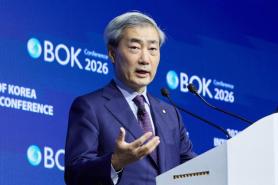 Shin's BOK signals active central bank intervention, putting monetary tightening and CBDC in spotlight
Bank of Korea governor Shin Hyun-song speaks at a conference in Seoul on June 1, 2026. Courtesy of Bank of Korea SEOUL, June 02 (AJP) - The Bank of Korea (BOK) International Conference themed "Central Banks and the Future of Money," which ran from Monday to Tuesday, served as less of a purely academic event and more of a debut public stage highlighting the long-term vision of BOK Governor Shin Hyun-song. The central bank positioned staunch advocates of price and financial stability at the forefront while pitching a future monetary order centered around central bank digital currencies (CBDCs) as its core agenda. Since Governor Shin took office, the BOK’s strategic policy color has crystallized into three pillars: a hawkish monetary policy stance that dampens expectations for premature interest rate cuts; a macrofinancial stability framework that elevates financial vulnerability into a core variable for monetary policy decisions; and institutional restructuring aimed at redesigning the central bank’s payment and settlement infrastructure through CBDCs and tokenized deposits to fit the evolving digital economy. The lineup of participants at this year's conference directly mirrored these institutional priorities. Keynote speaker Isabel Schnabel, an Executive Board member of the European Central Bank (ECB), is recognized as a prominent inflation hawk in Europe. Neel Kashkari, president of the Federal Reserve Bank of Minneapolis, is also a figure who has consistently championed price stability and a highly cautious approach to rate cuts. Tobias Adrian, financial counsellor of the International Monetary Fund (IMF), addressed the critical linkages between financial vulnerability and monetary policy, while Princeton University Professor Markus Brunnermeier presented the policy dilemmas that digital currency creates among payments, credit, and privacy. Ultimately, the event merged a hawkish central banking philosophy emphasizing price and financial stability with a public payment infrastructure theory centered on CBDCs. This aligns closely with Governor Shin’s core philosophy, developed during his tenure at the Bank for International Settlements (BIS). Shin has long maintained a macrofinancial perspective, arguing that monetary policy should not be viewed merely as adjustments to the benchmark interest rate, but rather as an interplay where institutional leverage, asset prices, exchange rates, payment infrastructures, and global liquidity flows can collectively disrupt economic stability. It is hardly a coincidence that Adrian's paper on financial vulnerability—which posits that while easing financial conditions may support the economy in the short term, it exacerbates leverage and risk-taking over time, fueling deeper recession risks—was placed in the very first general session. This reflects Shin’s recent warnings against a simultaneous buildup in household debt, real estate, equity leverage, and lopsided foreign exchange movements. The message is clear: the era when monetary policy focused solely on inflation and growth is over; financial vulnerability must now be factored in. The CBDC discussions follow a similar logic. Participants, including Governor Shin, stressed that as stablecoins and big tech payment networks proliferate, central banks can no longer remain institutions that merely manage physical cash and bank reserves. If private digital currencies capture payment grids, the transmission channels of monetary policy, the commercial bank deposit base, and the broader financial stability architecture could all be destabilized. This concern was echoed by Executive Board Member Schnabel, who drew parallels between stablecoins and Money Market Funds (MMFs) to warn against financial stability risks. "Central banks cannot remain passive observers of these developments," Schnabel said. "The appropriate response is therefore not to resist innovation but to ensure that it develops within a framework that preserves stability, monetary control and trust in the currency." Professor Robert Townsend’s evaluation of this approach as a benchmark case study for central bank digital currency innovation underscores that the BOK under Shin aims to act as an architect, rather than a passive observer, of global payment debates. (from left) Beth Anne Wilson, director of the International Finance Division at the Federal Reserve Board of Governors; François Velde, senior economist and economic advisor at the Federal Reserve Bank of Chicago; Gary Richardson, professor at the University of California, Irvine; and Kris J. Mitchener, Robert and Susan Finocchio Endowed Chair at Santa Clara University, attend Session 4 of the 2026 Bank of Korea International Conference in Seoul on June 1, 2026. Bank of Korea. There were voices of caution, such as Professor Brunnermeier, who emphasized that CBDC is not simply a "nice-to-have technology." He highlighted a "triple dilemma" where boosting payment efficiency could weaken credit supply; strengthening credit supply could erode privacy; and enhancing privacy could hinder transaction tracking and loan enforcement, thereby impairing financial intermediation. Environmental shifts notwithstanding, the BOK continues its aggressive experiments with CBDCs, tokenized deposits, and cross-border payment infrastructures through Project Hangang and Project Agora. Initiated under former Governor Rhee Chang-yong, Phase 1 of the Bank of Korea’s flagship digital currency pilot, Project Hangang, ran from October 2023 to August 2025 to test the real-world viability of wholesale CBDCs and commercial bank deposit tokens. Phase 2, launched in March 2026, expands this scope to peer-to-peer transfers and programmable features, aiming to establish a next-generation public settlement infrastructure that integrates deposit tokens, government treasury execution, and private digital asset transactions. Such blueprints, however, will inevitably clash head-on with ongoing legislative debates over stablecoins. Once private stablecoins enter institutional frameworks, the central bank will need to re-demarcate the roles assigned to commercial bank deposit tokens and its own central-bank-led digital currency infrastructure. Ultimately, the trajectory of the BOK under the Shin administration points toward a "central-bank-led monetary order." It sends a dual signal: the central bank will design public infrastructure and regulatory frameworks ahead of the private sector, while refusing to ease its tight monetary stance until both inflation and financial vulnerabilities are firmly brought under control. Market participants who previously focused solely on interest rate decisions must now navigate a new landscape, tracking how the BOK scales its CBDC pilots, which public and private settlement networks it connects to deposit tokens, and what regulatory principles it establishes for private digital currencies.
-
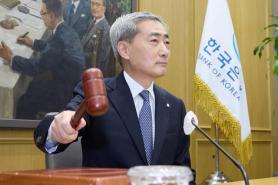 BOK delivers back-to-back hike to 3% Aug
Bank of Korea Gov. Shin Hyun-song presides over a Monetary Policy Board meeting in Seoul on Aug. 27, 2026. Bank of Korea. SEOUL, August 27 (AJP) -The Bank of Korea (BOK) delivered a back-to-back rate hike to bring the benchmark rate to 3.00 percent on Thursday after holding it at 2.50 percent for 14 months through June. The move narrowed the interest-rate gap with the United States to 50 to 75 basis points, with the Federal Reserve's target range at 3.50 percent to 3.75 percent, reducing one source of pressure on the won and capital flows. The BOK said stronger-than-expected growth, persistent inflation pressure and financial-stability risks warranted further tightening despite the stronger won. The decision defied bond-market expectations for a pause in August and quickly rippled through Korean financial markets. South Korea's benchmark rate had remained at 2.50 percent from May last year until the BOK raised it by 25 basis points to 2.75 percent in July, its first increase since January 2023. The July move ended a 14-month pause and marked the start of a new tightening cycle. The central bank also raised its 2026 growth forecast to 3.3 percent from 2.6 percent in May while keeping its inflation forecast unchanged at 2.7 percent. It raised its 2027 growth projection to 2.9 percent from 2.1 percent while maintaining its inflation forecast at 2.3 percent. The KOSPI was up 0.56 percent at 6,840 as of 10 a.m., sharply paring an advance of more than 2 percent earlier in the session after the rate hike was announced. The Korean won strengthened 5.8 won from the previous session to 1,377.6 per dollar at the same time. Gov. Shin Hyun-song is due to explain the policy decision and updated economic outlook at a post-meeting press conference later Thursday. AJP Takeaways BOK raises the rate to 3.00 percent, delivering consecutive hikes in July and August. The Korea-U.S. rate gap narrows to 50 basis points at the lower end of the Fed's target range. The hike defies bond-market expectations for a pause, putting Korean financial markets on alert for further repricing.