


Latest by
-
 Finance Committee Approves Lee Hyung-il's Confirmation Report Amid Opposition Concerns The National Assembly's Finance Committee approved the confirmation report for Lee Hyung-il, the nominee for Deputy Prime Minister and Minister of Finance, on September 17. The People Power Party included a note of 'ineligibility' in the report.During a full committee meeting, the report was adopted with bipartisan agreement. However, the People Power Party expressed that many concerns raised during the confirmation hearing had not been adequately addressed, leading to their note of ineligibility. The Democratic Party reflected a 'qualified' opinion in the report.At the confirmation hearing held on September 15, criticism arose regarding Lee's ownership of an apartment in Gwacheon, where he had only lived for four months out of 17 years, contradicting the government's housing policy focused on actual residence.People Power Party lawmaker Bae Jun-young stated, "We recognize the necessity of a control tower to swiftly restore the economy and that Lee has promised to actively respond to the concerns raised. I ask Chairman Cho Seung-rae to supervise this diligently."Chairman Cho remarked, "I hope the Finance Committee can work together to help Lee effectively carry out his duties in addressing the challenging economic situation," as the confirmation report was adopted.The Finance Committee also approved plans for the National Assembly's audit of 46 institutions, including the Ministry of Finance and the Ministry of Planning and Budget, scheduled from October 6 to 23. The newly established Korea-U.S. Strategic Investment Corporation, which launched in June, has also been added to the list of institutions to be audited.* This article has been translated by AI. 2026-09-17 10:56:00
 -
Choi Min-sik and Han So-hee's 'Intern' Tops Box Office on Opening Day, Surpassing 'Odyssey' The film 'Intern' debuted at the top of the box office on its opening day.According to the integrated ticket sales network on September 17, 'Intern' claimed the number one spot at the box office, surpassing the long-running 'Odyssey.' It became the first Korean film to reach the top of the box office in 50 days since 'Hope.''Intern' tells the story of Gi-ho (played by Choi Min-sik), a silver intern with 37 years of experience, who joins the company of Sun-woo (played by Han So-hee), a rising star in the fashion industry after three years. The film captures the office life of the two characters across generations and ranks.Christopher Nolan's 'Odyssey' attracted over 41,000 viewers (28.8%) on the same day, securing the second position at the box office.'Odyssey,' which had maintained the daily box office number one spot for six consecutive weeks since its release on August 5, has now ceded the top position to 'Intern.' It is the second film this year to surpass 10 million viewers, following 'The King and the Clown.'* This article has been translated by AI. 2026-09-17 10:52:00
-
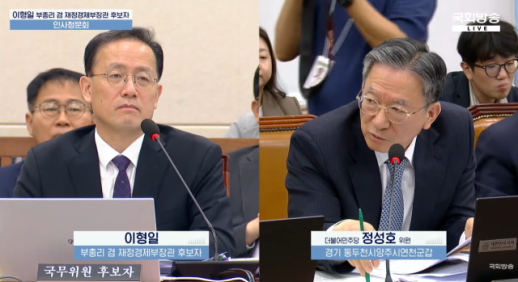 Finance nominee set to take post after clearing parliamentary hearing SEOUL, September 17 (AJP) - Lee Hyung-il, nominee for deputy prime minister and minister of finance and economy, moved a step closer to taking the post as the National Assembly's finance committee adopted his confirmation hearing report on Thursday. The move makes Lee the first of six ministerial nominees tapped by President Lee Jae Myung in his second Cabinet reshuffle on Aug. 30 to clear the parliamentary confirmation process. The committee convened at 9:30 a.m. and adopted the report after Lee underwent a roughly 12-hour confirmation hearing the previous day. During the hearing, lawmakers scrutinized him over a Gwacheon apartment he has owned for about 17 years despite living there for only about four months. Lawmakers from the ruling and opposition parties also clashed over the government’s proposed 164 trillion won ($118.8 billion) fund aimed at addressing future economic challenges. Lee, 55, is a career economic bureaucrat who passed the country's civil service exam for senior government positions in the finance and economics track in 1992 before beginning his career at the Finance Ministry. He later served in a string of senior posts including director-general of the Economic Policy Bureau, deputy minister, presidential secretary for economic policy and commissioner of Statistics Korea before becoming first vice minister of finance and economy. He earned a bachelor's degree in economics from Seoul National University and a doctorate in economics from Texas A&M University. Meanwhile, confirmation hearings for the remaining nominees for the justice, defense, gender equality and family, land and transport, and SMEs and startups ministries are still pending. AJP Takeaways - South Korea's parliament adopted Lee Hyung-il's confirmation hearing report with bipartisan support. - Lee became the first nominee from President Lee Jae Myung's second reshuffle to clear this stage. - A career economic bureaucrat, Lee passed the civil service exam's finance track in 1992. 2026-09-17 10:49:48
 -
 KOSPI climbs as market absorbs Fed hike SEOUL, September 17 (AJP) - South Korean stocks extended gains Thursday morning despite the U.S. Federal Reserve's first interest rate hike in more than three years, as easing oil prices and strength in defense and shipbuilding shares offset continued foreign selling. As of 10:30 a.m., the benchmark KOSPI stood at 6,756.11, up 0.6 percent. The index had climbed as high as 6,795.53 after opening sharply higher, before giving back part of the advance. It touched a session low of 6,710.58. Foreign investors remained firmly on the sell side, unloading 565.5 billion won ($410 million) of KOSPI shares. Institutions sold 59.6 billion won, while retail investors bought a 216.4 billion won. The continued foreign selling limited the market's upside after overseas investors had already sold Korean stocks for six consecutive sessions through Wednesday. The gains came after the Fed raised its benchmark interest rate by 25 basis points to a range of 3.75 percent to 4.00 percent overnight, its first tightening move since July 2023. Fed Chair Kevin Warsh struck a hawkish tone, saying inflation remained too high and had persisted for too long. U.S. Treasury yields remained elevated, with the benchmark 10-year yield around 5.02 percent. Wall Street finished lower following the decision. The Dow Jones Industrial Average fell 1.21 percent, while the S&P 500 lost 0.45 percent and the Nasdaq Composite edged down 0.01 percent. Technology stocks held up better than the broader market. Nvidia gained 0.82 percent and Intel jumped 4.03 percent, helping the Philadelphia Semiconductor Index rise 0.63 percent. Korea's two largest chipmakers, however, moved in opposite directions. Samsung Electronics gained 0.6 percent to 254,750 won, while SK hynix slipped 0.3 percent to 1,754,000 won. Doosan Enerbility rose 2.5 percent and Hanwha Ocean gained 3.2 percent, while Hyundai Motor fell 3.5 percent and Samsung Electro-Mechanics declined 1.4 percent. Defense, aerospace and shipbuilding stocks were leaders of the market. Aerospace and defense shares climbed 5.6 percent, while shipbuilding stocks rose 5.5 percent. SpaceX-related stocks gained 7.5 percent as a theme, while the broader aerospace theme advanced 6.6 percent. The moves followed news that SpaceX is preparing to send its Starship spacecraft into Earth orbit for the first time during an upcoming test flight. Sensorview surged 20.2 percent and Spear gained 9.8 percent. Earlier in the session, Kenkoa Aerospace, Contec and other aerospace-related names also posted sharp gains. Hyundai Pharmaceutical was another standout, rising 7.1 percent to 10,680 won after the government said it aims to introduce abortion medication in Korea by the first quarter of next year. The secondary KOSDAQ gained 0.7 percent to 821.63 after rising as high as 823.58. AJP Takeaways - KOSPI up 0.6% at 6,756.11 as the market absorbed the Fed’s 25-basis-point rate hike. - Foreign selling persists: Overseas investors sold a net 565.5 billion won of KOSPI shares, while retail investors remained net buyers. - Leadership shifts beyond chips: Samsung Electronics edged higher while SK hynix slipped, with defense, aerospace and shipbuilding stocks leading gains instead. Retail investors bought a net 32.9 billion won and institutions purchased 4.7 billion won, while foreign investors sold a net 38.6 billion won. Among actively traded KOSDAQ stocks, Seongho Electronics jumped 19.6 percent, Hana Micron gained 7.3 percent and Jusung Engineering rose 1.98 percent. Oil prices provided some relief after sharp gains earlier in the week. West Texas Intermediate crude fell 0.3 percent to around $102.20 a barrel, while Brent crude slipped 0.03 percent to $105.80. The decline followed reports that Saudi Arabia plans to restore about half the capacity of its East-West pipeline within days, easing concerns over supply routes that bypass the Strait of Hormuz. The Korean won weakened to around 1,379 per dollar as the Fed's hawkish stance supported the U.S. currency. Throughout Asia, Japan's Nikkei 225 gained 0.5 percent to 64,246.36 and China's Shanghai Composite edged up 0.13 percent to 3,896.51. Hong Kong moved in the opposite direction, with the Hang Seng Index falling 0.9 percent to 24,490.04. 2026-09-17 10:48:41
 -
Lee Kang-in Scores Second Goal of the Season in Full-Time Debut for Atletico Madrid Lee Kang-in, wearing the Atletico Madrid jersey in La Liga, scored his second goal of the season during his first full-time start since transferring to the club.On September 17, in a home match against Osasuna at the Cívitas Metropolitano Stadium in Madrid, Lee started and contributed to the team's 4-0 victory in the sixth round of the 2026-2027 La Liga season.Playing as a right midfielder in Diego Simeone's 4-4-2 formation, Lee displayed lively movement from the beginning of the match. He found the net in the 54th minute, scoring after receiving a pass from Jonathan David during a counterattack. With a calm right-footed shot inside the penalty area, he accurately placed the ball into the bottom corner of the net, showcasing his finishing ability with his non-dominant foot.This goal marked Lee's second of the season, following his debut goal in the league opener against Malaga on August 20. He now has a total of 2 goals and 1 assist in 6 league matches.Additionally, this match was Lee's first time playing the full 90 minutes since returning to Spain from Paris Saint-Germain this summer. His performance earned him the Man of the Match (MOM) title, marking his second MVP selection of the season after the league opener.Football statistics site Footmob awarded Lee the highest rating of 9.0 among all players.With Lee's impressive performance, Atletico Madrid celebrated a scoring spree. The scoring began with David's opening goal in the 24th minute, followed by Lee's goal in the 54th minute, Robain Le Normand's third goal in the 63rd minute, and Alex Baena's goal in the 82nd minute, culminating in a 4-0 victory.Atletico Madrid has now secured two consecutive league victories, bringing their record to 4 wins, 1 draw, and 1 loss (13 points), placing them third in the league, just 2 points behind second-place Real Madrid (15 points).Riding this momentum, Atletico Madrid will face their local rivals Real Madrid in the seventh round of La Liga on September 20 at 11:15 PM.* This article has been translated by AI. 2026-09-17 10:48:00
-
Han Byeong-do Criticizes Opposition for Wasting Time with Personal Attacks Han Byeong-do, the floor leader of the Democratic Party, criticized the People Power Party for wasting time during the confirmation hearings for government minister candidates held over the past two days, citing their use of personal attacks and low-level political tactics instead of focusing on policy and qualifications.During a policy coordination meeting at the National Assembly on September 17, Han stated, "The People Power Party has made definitive criminal accusations against the candidates and resorted to mockery and personal attacks, engaging in low-level political maneuvers rather than proper verification."He referenced the People Power Party's suggestion of potential street protests regarding the appointment of Kim Seung-won as Minister of Justice, saying, "It should not be the solution of the main opposition party to turn its back on the National Assembly and seek answers on the streets just because they are dissatisfied with the confirmation hearing results." He urged, "The confirmation hearings have concluded, but the regular National Assembly has not ended. The People Power Party should return to the National Assembly, the place for addressing people's livelihoods, instead of engaging in street protests."Han also introduced youth-related policies being pursued by the party ahead of 'Youth Day' on September 19. He emphasized, "We are preparing a youth housing welfare plan aimed for announcement before Chuseok, ensuring that young people do not have to mortgage their futures due to housing concerns." He also promised the passage of the youth future savings budget and the establishment of support systems for work-life balance, including a three-part support package for spouses.Meanwhile, Kwon Chil-seung, the policy committee chair, stressed the importance of managing 'grocery prices' ahead of Chuseok. He urged the government to ensure that the public's grocery baskets are filled with peace of mind rather than worry, and called for strict measures against price gouging and collusion that may occur during the holiday season.* This article has been translated by AI. 2026-09-17 10:44:00
-
 Korean markets shrug off FOMC, turn to Tokyo and London SEOUL, September 17 (AJP) - South Korean capital markets on Thursday largely brushed aside the U.S. Federal Reserve’s widely expected overnight rate hike, with authorities forecasting limited immediate impact while keeping watch on elevated borrowing costs. The KOSPI rose 0.7 percent to 6,765.65 while the benchmark 10-year government bond yield fell 2.5 basis points to 4.528 percent as of 10:20 a.m. The dollar gained 2.4 won to 1,379.9 won, indicating modest weakness in the Korean currency. South Korean policymakers said the Fed’s quarter-percentage-point increase had largely been priced into financial markets and was unlikely to cause an immediate shock. They nevertheless vowed to closely monitor bond yields and foreign exchange movements ahead of rate-setting meetings in Tokyo and London, where further policy tightening could add to global market volatility. The Federal Open Market Committee unanimously raised its benchmark federal funds target range by 25 basis points to 3.75 to 4.00 percent overnight, its first increase in three years and two months. The Fed also left the door open to further tightening this year, with most policymakers projecting at least one additional increase. Deputy Prime Minister and Finance Minister Koo Yun-cheol chaired an expanded macroeconomic and financial meeting at 8 a.m. with Bank of Korea (BOK) Gov. Shin Hyun-song and the heads of the Financial Services Commission and Financial Supervisory Service. The Fed hike widened the interest-rate gap with South Korea, where the BOK’s benchmark rate stands at 3.00 percent following back-to-back increases over the past two months. The widely expected U.S. increase was accompanied by stronger growth and inflation forecasts and a higher projected interest-rate path, pointing to the possibility that U.S. borrowing costs could remain elevated for longer. Among the 18 Fed officials submitting rate projections, 16 expected at least another 25-basis-point increase this year. Twelve projected one additional hike and four saw room for 50 basis points of further tightening. Fed Chair Kevin Warsh did not submit a projection. The projections, commonly known as the Fed’s “dot plot,” indicate where individual policymakers expect interest rates to stand in the future. Warsh also said recent inflation trends had not improved meaningfully and that current financial conditions were difficult to describe as restrictive, according to the BOK. The BOK, which separately held a market monitoring meeting Thursday morning, said Warsh’s emphasis on price stability and the prospect of further rate increases suggested U.S. monetary policy would remain tight. Officials distinguished between the limited immediate impact of the well-anticipated hike and longer-term risks from additional U.S. tightening. Overnight, the two-year U.S. Treasury yield rose 7 basis points to 4.74 percent and the 10-year yield gained 2 basis points to 5.02 percent. The dollar index climbed 0.7 percent to 100.32. The S&P 500 fell 0.4 percent to 7,552, while West Texas Intermediate crude futures dropped 3.6 percent to $102.02 a barrel. South Korean authorities said volatility in the government bond market had increased as global financial conditions shifted and pledged to take stabilization measures if trading became excessively one-sided. Officials also said they would monitor rising lending rates and heavier repayment burdens on financially vulnerable borrowers while implementing existing support programs and considering additional measures if needed. The meeting reviewed how South Korea’s current account surplus and other changes in economic conditions could affect market liquidity and asset prices. Authorities said they would closely watch oil prices, global capital flows and monetary policy decisions from Japan and Britain alongside risks from the Middle East war, fiscal concerns in major economies and uncertainty surrounding the artificial intelligence industry. AJP Takeaways - South Korean markets showed little initial stress after the Fed hike, with the KOSPI gaining 0.7 percent and the 10-year government bond yield falling 2.5 basis points in morning trading. - Authorities said the 25-basis-point Fed increase had largely been priced in but remained alert to further U.S. tightening and upcoming policy decisions in Japan and Britain. - The Fed hike widened the Korea-U.S. policy-rate gap to as much as 1 percentage point, while Korean authorities said they were prepared to respond if bond or foreign exchange volatility became excessive. 2026-09-17 10:42:10
 -
 Korean refiners' windfall meets a supply test SEOUL, September 17 (AJP) - South Korean refiners, fresh from a record first half, face uncertain crude supply for November after Saudi Arabia shut its main pipeline bypassing the Strait of Hormuz, industry officials said on Thursday. SK Innovation, S-Oil, GS Caltex and HD Hyundai Oilbank earned a combined operating profit of about 14.8 trillion won ($10.73 billion) from January to June. Industry estimates show about half of first-quarter profit came from inventory gains and the lagging effect, the windfall from refining crude bought before prices spiked. Refining profits roughly halved in the second quarter, when ceasefire hopes drove crude down more than 50 percent from its peak and saddled refiners with inventory valuation losses. S-Oil said on Aug. 3 it expected tight product supply to keep margins firm in the third quarter. Saudi Arabia closed its East-West pipeline, which carries crude to the Red Sea port of Yanbu, on Sept. 11 after drone attacks launched from Iraq. Refiners have secured cargoes through October, but November volumes hinge on how quickly the line is repaired. Brent crude has averaged $100.40 a barrel so far in September and West Texas Intermediate $96.30, according to Petronet, the price service of state-run Korea National Oil Corp. Brent settled at $105.83 on Sept. 16, up more than 16 percent for the month. Refiners are weighing detours through the Suez Canal, though the route adds about 30 days and pushes up freight costs. HD Hyundai Oilbank has trialed Argentine crude, and SK Innovation recently bought a small volume as refiners widen sourcing to the Americas. AJP Takeaways - South Korea's four refiners posted about 14.8 trillion won in combined operating profit in the first half of 2026, with inventory gains driving much of the first quarter. - Saudi Arabia shut its East-West crude pipeline on Sept. 11, 2026, after drone attacks, leaving Korean refiners' November supply uncertain. - Brent crude averaged $100.40 a barrel in September through Sept. 17, according to Korea National Oil Corp., as refiners weigh costlier Suez routes and Argentine crude. 2026-09-17 10:40:23
 -
Naver Maps Launches 'Place Agent' for AI-Powered Location Search and Booking Naver Maps has introduced a feature that allows users to find and book desired locations through artificial intelligence (AI) conversations. Users can input their requirements in natural language, and the service will recommend places, facilitating bookings with businesses that use Naver Reservations.On September 17, Naver unveiled 'Place Agent,' an AI-based conversational search feature specialized for location exploration within the Naver Maps app. This tool recommends places based on the user's conversation context and location information.Place Agent utilizes information from registered locations on Naver Maps, including restaurants, cafes, bakeries, hotels, guesthouses, beauty salons, and veterinary clinics, to find suitable places based on user search criteria.The feature understands conversational search queries and can accommodate multiple conditions within a single sentence. For instance, if a user inputs, 'Recommend a bakery tour in Seongsu-dong' or 'A quiet cafe in Yeonnam-dong for reading on a rainy day,' the service will provide a list of places that meet those criteria.The responses include details such as addresses, operating hours, menus, phone numbers, and user reviews from Naver, along with blog posts about the recommended locations.If the recommended place uses Naver Reservations, users can also make bookings through the conversation. For example, if a user types, '(Business Name) please reserve for four people at noon tomorrow,' the system will summarize the necessary conditions, confirm the user's agreement, and proceed with the reservation upon acceptance.Place Agent is available to logged-in users aged 14 and older. A notification indicating that the information was generated by AI will always be displayed with the agent's responses.* This article has been translated by AI. 2026-09-17 10:40:00
-
10 Couples from 'Heart Signal': A Comprehensive Overview Channel A's 'Heart Signal,' a pioneer in dating reality shows, has produced a total of 10 final couples since its first season in 2017, culminating in its fifth season this year. While the show concluded with happy endings, the continuation of love outside the Signal House varies.Examining the confirmed relationships season by season reveals a significant difference between the final choices made on the show and the outcomes in real life.In Season 1, Jung Chan and Bae Yoon-kyung, along with Kang Seong-wook and Shin Ah-ra, were the final couples. Jung Chan and Bae Yoon-kyung continued their relationship after the show. Jung Chan later stated on MBC Every1's 'Video Star,' "It was real even after the show ended," adding, "We had a good relationship and now we support each other." In contrast, Kang Seong-wook and Shin Ah-ra, despite being the final couple of Season 1, did not develop a romantic relationship after the show. They clarified that they remained good friends, dismissing rumors of a romantic involvement.Season 2 saw Kim Hyun-woo and Lim Hyun-joo, as well as Jung Jae-ho and Song Da-eun, emerge as final couples. Kim Hyun-woo and Lim Hyun-joo initially dated after the show, but their relationship did not last long. Lim Hyun-joo mentioned in a special broadcast that as interest in the show grew, they both felt pressure and decided to take a break.Jung Jae-ho and Song Da-eun were among the first 'Heart Signal' couples to develop a real relationship. They publicly dated after the show but broke up after about five months.In Season 3, Kim Kang-yeol and Park Ji-hyun, along with Im Han-gyeol and Seo Min-jae, were the final couples. However, Im Han-gyeol and Seo Min-jae distanced themselves from a romantic relationship, stating they remained good friends. Kim Kang-yeol and Park Ji-hyun also did not continue as a couple in real life.Season 4 featured Han Gye-re and Kim Ji-young, as well as Shin Min-kyu and Yoo I-soo, as the final couples, both of whom developed real relationships outside the show. Their reality dates were showcased in the spin-off 'After Signal,' but both couples eventually announced their breakups.In the most recent Season 5, Jung Gyu-ri and Kim Seo-won, along with Park Woo-yeol and Kang Yu-kyung, were the final couples. While Jung Gyu-ri and Kim Seo-won chose each other, it remains unconfirmed whether they developed a romantic relationship.From Season 1 to Season 5, 'Heart Signal' has produced a total of 10 final couples. While several couples continued their relationships outside the show, most eventually ended their connections. The most recently confirmed couple is Park Woo-yeol and Kang Yu-kyung from Season 5.* This article has been translated by AI. 2026-09-17 10:32:00