


Latest by
-
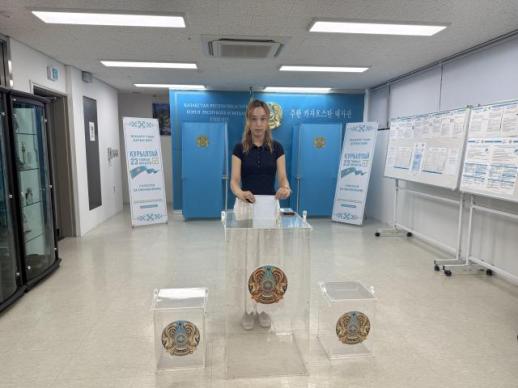 Kazakhs in Seoul vote in first Kurultai election SEOUL, August 23 (AJP) - The first voter reached the Kazakh embassy in Seoul at 7 a.m. Sunday, hours before most of the roughly 300 Kazakh nationals eligible to cast ballots in South Korea would make their way to the compound to help choose their country's new parliament. She was Azhar Karimzhanova, 23, a student at Korea University, according to Rakhymzhan Altynbay, an official at the embassy. By 1:30 p.m., Altynbay said, about 70 people had voted. That is roughly a quarter of the eligible electorate in the country, and they kept arriving through the morning. Some brought children. Some came with family. A few stopped to greet one another at the gate before going in. The Seoul station is one of 79 the Central Election Commission opened at Kazakh diplomatic missions in 61 countries. Voters abroad receive the same ballot as those at home, and there is no postal or online option. At stake are all 145 seats of the Kurultai, the single chamber that replaced the Senate and the Mazhilis when a new constitution took effect July 1. Seven parties are running 545 candidates in one nationwide district. Self-nomination is not allowed. Ulanbek Aueskhan came on his day off with his five-year-old son. He has lived in South Korea for more than 10 years, took his bachelor's degree through his doctorate here, and works as a researcher at Samsung Electronics. He said he brought the boy deliberately. "I wanted to show him," Aueskhan said. "Our country does this. He should see it while he is young, and experience it directly." Voting from abroad, he said, was a way of staying useful to a country he no longer lives in. "We are outside the country, but there is still a contribution to make," he said. "Even from Korea, we can support Kazakhstan." Asked what the new chamber would change, he pointed to the merger itself. "Until now there were the Senate and the Mazhilis," he said. "Now they are combining, so decisions can be made faster." Alisher Saduakas, 28, arrived with him. They are colleagues, both researchers at Samsung Electronics, and Saduakas lives in Suwon. He has been in South Korea for 10 years and had never voted in his life. "I had no plans to vote," he said. "Ulanbek said we should come and do it together. This is the first time, and it feels good." What changed, he said, was that he can now follow what is happening at home. "There was no Kurultai before, and things were complicated," Saduakas said. "Now I can see how it works on social media, what is moving in Kazakhstan. So I thought I could support it too." Kazakhstan's ambassador to South Korea, Asset Issenali, who presented his credentials on July 22, was at the embassy as voters came through. He said the country was in the middle of political and economic transformation, and that the new chamber would let it pass legislation to make economic reform more effective. "This will be a stepping stone," Issenali said. Polls close in Kazakhstan on Sunday evening. The commission has accredited 781 foreign and international observers, among them 39 long-term and 208 short-term monitors sent by the Organization for Security and Co-operation in Europe through its Office for Democratic Institutions and Human Rights. Aueskhan's son waited beside him while he marked his ballot. "From a young age, here, you have to show them," his father said. 2026-08-23 16:22:04
 -
 Government and Party Agree to Ease Tax Burden for Non-Resident Homeowners The government and the Democratic Party have agreed to ease the tax burden on non-resident homeowners and transfer authority for redevelopment and reconstruction projects involving fewer than 500 units to local leaders. This initiative aims to reduce market uncertainty stemming from tax reforms while accelerating housing supply in the metropolitan area by decentralizing approval powers. On August 23, the Democratic Party and the government held a high-level meeting at the Prime Minister's residence in Samcheong-dong, Seoul, to discuss real estate tax reform, housing supply strategies for the metropolitan area, and improvements to redevelopment and reconstruction systems. The Democratic Party expressed concerns over the government's proposal to strengthen the comprehensive real estate tax burden on non-resident homeowners and requested that the government not differentiate between resident and non-resident homeowners when imposing the tax. However, it remains unclear whether the government will accept this request. Park Sung-jun, the party's chief spokesperson, told reporters after the meeting, "The party strongly requested that the government not distinguish between resident and non-resident homeowners regarding the tax burden on single-homeowners." He added that both sides agreed on the need to broadly recognize non-resident homeowners who cannot reside in their properties due to unavoidable reasons such as work, children's education, or caring for parents. The government's proposal to lower the basic exemption for non-resident homeowners from 1.2 billion won to 900 million won was also discussed as a potential area for revision. The Democratic Party believes that the tax burden will naturally increase due to rising property values, and thus, reducing the basic exemption should be carefully considered. Park noted that since both sides agree on the need to alleviate the burden on non-resident homeowners, they expect to finalize supplementary measures before the Cabinet meeting on September 1 and the National Assembly submission on September 3. Kim Min-seok, the Democratic Party leader, emphasized during the meeting that "the real estate tax reform and housing supply measures for the metropolitan area are of great public interest," urging careful consideration of the cascading effects on the rental market. Kim also evaluated the proposal to convert the long-term capital gains tax special exemption into a long-term residency income deduction as a positive step toward strengthening a housing market order centered on actual residents. In terms of housing supply, the government plans to transfer authority for redevelopment and reconstruction projects involving fewer than 500 units to local leaders. Both the government and the party agreed on the need to distribute the currently centralized authority for small-scale redevelopment projects to local leaders to shorten approval periods and expedite projects that align with local conditions. They will also review institutional improvements, including amendments to enforcement regulations, and explore ways to expand private sector participation in redevelopment and reconstruction projects. Expanding housing supply for future generations, including young people and newlyweds, was also a key agenda item. The government and the party agreed to expedite approval processes to secure supply volumes early and reduce project durations, with plans to address necessary legislation during the regular National Assembly session. The government will continue discussions with Seoul City regarding housing supply. Minister of Land, Infrastructure and Transport Kim Yoon-deok and Seoul Mayor Oh Se-hoon are scheduled to meet this week to discuss housing supply plans in central Seoul, including Yongsan Park. Park noted, "There have been discussions regarding Yongsan Park, but it seems we are not at the stage to announce specific details yet," adding that a final decision has not been made. 2026-08-23 16:20:00
 -
InnoBiz Conducts Training for East Timor Officials on Digital Transformation and Manufacturing Innovation On August 23, the Small and Medium Business Technology Innovation Association (InnoBiz) announced the completion of a training program for East Timorese officials aimed at enhancing their capabilities in industrial policy.This training is part of the Korea International Cooperation Agency (KOICA) global training project, which will be implemented over three years from 2026 to 2028.The inaugural session took place from August 9 to 22 at the KOICA training center in Seongnam, South Korea, with 17 participants, including Odete Belo, Director of the Manufacturing Industry Department of the East Timor Ministry of Commerce.The training covered five key topics: the role of small and medium enterprises in Korea's economic development, policies for fostering technology-driven SMEs, the policy environment for SMEs in the global and ASEAN context, digital transformation (DX), and startup support policies. Participants also visited the Seoul AI Summit & Expo, Tip Town, Incheon Startup Park, the Korea Institute of Industrial Technology's Manufacturing AI Research Center, and the Lotte Chilsung Beverage Anseong Plant.Based on the lectures and site visits, the participants developed an 'Action Plan for SME Development' tailored for East Timor. This plan will be submitted as a policy improvement task to the East Timor Ministry of Commerce and will be further refined in the second and third years of the training program.Antonio de Sa Benevides, the East Timorese Ambassador to South Korea, stated, "The application of Korea's SME policies and innovation ecosystem will be reflected in the formulation of East Timor's SME policies. I hope this training will lead to sustained cooperation between our two countries."Jeong Kwang-cheon, President of InnoBiz, remarked, "With East Timor's accession to ASEAN, the scope for regional economic cooperation is expanding. We aim to establish a foundation for cooperation between businesses in both countries by sharing Korea's SME policies and examples of fostering technology-driven enterprises." 2026-08-23 16:12:00
-
IAGIS Expands from Building Management to Urban Development IAGIS Asset Management is broadening its scope from being a "building management company" to a "city development company." As South Korea's largest real estate asset management firm, IAGIS is rapidly expanding its business areas and scale, from the IOTA Seoul project, which is reshaping the area around Seoul Station, to the Seoripul mixed-use development in Gangnam and data centers.As of the end of last year, IAGIS reported approximately 73.3 trillion won in assets under management (AUM). Among its 439 employees, over 330 are specialized in operations, investment, and development. The firm is evolving into the country's largest "management-type developer," moving beyond buying and selling individual buildings to directly managing land acquisition, development, operations, and sales.However, with the growth in business scale comes increased risk. Even the industry leader in project financing (PF) has not been able to avoid challenges in the multi-trillion won mixed-use development sector. The key project, IOTA Seoul 2, faced a bridge loan expiration and auction crisis, and the sale of management rights fell through last month.The question now is whether IAGIS can overcome the dual challenges of large-scale development projects and uncertainties in its governance structure, marking the next test for the domestic management-type developer model.Developing Seoul Station and Gangnam: Expanding the 73 Trillion Won PlatformAt the forefront of IAGIS's development strategy is the IOTA Seoul project, which aims to transform the area around Seoul Station. This initiative links the former Millennium Hilton Seoul site, Metro Building, and Seoul Lotte Tower to create a mixed-use space that includes offices, hotels, retail, and green areas. The project will feature an AI-based large office, the luxury Ritz-Carlton hotel, and a pedestrian pathway connecting Seoul Station to Namsan Park.Rather than merely constructing individual buildings, the plan seeks to fundamentally change the spatial structure of the area around Seoul Station by integrating work, commerce, accommodation, and green spaces. The company aims to emulate global mixed-use developments like Tokyo's Azabudai Hills and New York's Hudson Yards.IAGIS is attempting to differentiate its office designs from existing developments. The standard floor area for IOTA is 3,798 square meters, accommodating over 350 employees per floor. This strategy aims to attract large tenants, including major tech and financial firms, by addressing the limitations of traditional urban office layouts through a "large plate" design.In Gangnam, IAGIS is also scaling up its development efforts. The Seoripul mixed-use development, located on the former site of the National Intelligence Service, is a prime example. This project combines advanced tech offices with cultural and artistic facilities, such as performance venues and exhibition spaces, to extend the business district's reach from Teheran-ro to the Seocho area.The foundation for IAGIS's ambitious projects lies in its large-scale management platform. By segmenting its investment, funding, business development, and management operations, the company can oversee the entire project lifecycle, from land acquisition to financial structuring, design and construction management, tenant attraction, operations, and sales.Unlike traditional developers who rely on bridge loans and main PF after securing land, IAGIS's ability to integrate institutional LPs and real estate funds into the financial structure from the outset is a significant advantage of the management-type developer model.An IAGIS representative stated, "IAGIS possesses proven capabilities developed through successful projects like the Yeoksam Centerfield and Magok One Grove, as well as data centers in Hanam and Goyang. We are committed to responsible development that transforms not just buildings but urban ecosystems and establishes future industrial infrastructure securely."Next Focus: Data Centers with a 520MW Goal by 2031The development focus is rapidly shifting from offices to future industrial infrastructure.In 2019, IAGIS developed a 40MW data center in Hanam, managing the entire process from land acquisition to development and sale. Recently, it completed the Goyang Samsong data center, the largest of its kind in the northwest metropolitan area, with a capacity of 80MW.The company claims it is the only domestic asset management firm to have completed more than two hyperscale data centers. Currently, it is also developing new data centers in the metropolitan area and Busan, aiming to establish a total digital infrastructure portfolio of 520MW by 2031.Data centers can generate stable cash flow through long-term leases, but they also face high entry barriers, particularly in securing power and obtaining permits. According to CBRE data cited by the company, as of March, only 10 out of 522 applications for power system impact assessments in the metropolitan area had received final approval, resulting in an approval rate of just 1.9%. This background enhances the competitive edge of developers with prior construction experience and expertise in securing power.However, as development projects grow, challenges arise that cannot be resolved solely with 73 trillion won in AUM. A notable example is IOTA Seoul 2. Delays in transitioning to main PF led to a bridge loan expiration, and at one point, an auction process worth approximately 1.2 trillion won was initiated.IAGIS secured new major lenders, including Meritz Financial and NH Investment & Securities, and completed bridge loan refinancing in April, alleviating immediate concerns. However, this is not the final financial structure for the project; it is merely a temporary solution. The company still faces the task of transitioning to main PF to secure long-term project financing.The success or failure of IOTA will serve as a case study for whether IAGIS's management-type development model can function effectively in multi-trillion won projects. It also highlights that even companies managing large institutional funds cannot escape traditional PF risks related to construction costs, interest rates, and lender composition as project scales increase.Additionally, governance issues have compounded the situation. IAGIS had selected Hillhouse Investment as the preferred negotiator for the sale of management rights, but disagreements over price and transaction terms led Hillhouse to ultimately halt the acquisition process in July. The management rights sale has returned to square one.Earlier, in April, CEO Cho Gab-joo returned to the forefront of management after nearly five years. Restoring relationships with institutional investors and stabilizing the organization, which had been shaken by the prolonged management rights sale, are among the key challenges ahead. The firm relies on contributions from institutional LPs to create funds, which are then reinvested in real estate investments and development projects, making trust in management and major shareholders a crucial part of its funding competitiveness.Industry insiders note, "In the case of IAGIS, the growing complexity of conditions that need to be considered as a management-type developer is becoming evident. In the past, the focus was solely on securing quality assets and achieving high returns upon sale, but now, the ability to secure PF for multi-trillion won projects, along with trust from institutional LPs and management stability, is also required."* This article has been translated by AI. 2026-08-23 16:04:00
-
Banks Accelerate Downsizing and Real Estate Sales to Secure Capital Banks are rapidly downsizing as they adapt to the rise of digital banking. They are reducing the number of branches and restructuring their networks to focus on smaller outlets while selling off underutilized real estate to bolster their capital.According to the Financial Supervisory Service, as of the end of June, the total number of branches for KB Kookmin, Shinhan, Hana, and Woori banks was 2,702, an increase of 11 from 2,691 in June of last year. However, the number of branches for these four banks decreased from 2,252 in June 2022 to 2,201 in June 2023, a drop of 51 (2.3%), while the number of smaller outlets rose from 439 to 501, an increase of 62 (14.1%).Smaller outlets are facilities that handle relatively simple tasks, such as account openings, and are less costly to operate. By increasing the number of these smaller outlets, banks are managing to cope with regulatory pressures to maintain branch numbers.Banks are also accelerating the sale of their real estate holdings. Kookmin Bank initiated the sale of nine idle properties nationwide last month, including five in Seoul, such as the Yangpyeong Comprehensive Financial Center, as well as two in Gyeonggi Province, one in Daegu, and one in Daejeon.Shinhan Bank is also in the process of selling its Myeongdong 'Shinhan Expace' branch and a staff dormitory in Seongsu-dong, which have been in operation for about 40 years.Woori Financial Group has selected Gravity Asset Management as the preferred negotiator for the sale of the 'Woori Financial Digital Tower' in Myeongdong and is currently in negotiations. Woori Bank also put 14 branches, including the Galleria Palace branch in Jamsil, the Haeundae Centum Park branch in Busan, and the Suwon Financial Center, up for auction on August 11.The trend of banks reducing branches and selling valuable real estate is seen as a move to streamline unnecessary assets and enhance financial stability. Selling idle properties can reduce fixed costs such as maintenance and management fees while also improving the Common Equity Tier 1 (CET1) capital ratio through asset optimization.The growing importance of capital expansion, driven by increased shareholder returns, is also cited as a reason for banks to pursue efficiency. To support dividends and share buybacks, managing capital ratios is crucial, necessitating the disposal of underperforming assets to utilize limited capital effectively. Additionally, with lending regulations constraining profit growth, securing funds for productive finance has become increasingly important.A financial industry official stated, "As digital operations expand and the need for capital management grows, banks are moving towards operational efficiency. The trend of selling real estate to utilize capital and liquidity effectively is likely to continue."* This article has been translated by AI. 2026-08-23 16:04:00
-
Tax Breaks for Large Corporations Surge 82% in a Year, Small Businesses Lag at 4% Last year, tax breaks for major corporate groups surged by over 80% compared to the previous year. In contrast, the increase in tax breaks for small businesses was limited to just 4%, significantly raising the share of tax breaks allocated to large corporations.According to the '2025 Tax Expenditure Statement' received by Representative Lee Yang-soo of the People Power Party from the Ministry of Economy and Finance on August 23, tax breaks for inter-affiliated corporate groups amounted to 4.2685 trillion won, an 81.8% increase from 2.3476 trillion won the previous year.Inter-affiliated corporate groups are classified as those with total assets exceeding 0.5% of the country's GDP, typically referred to as 'major corporate groups.' As of this year, 47 groups have been designated.Of the total corporate tax breaks of 26.7612 trillion won, inter-affiliated groups accounted for 16.0%, a rise of 6.2 percentage points from the previous year. Tax expenditures are a system where the government reduces taxes for specific policy purposes, effectively resembling fiscal spending.In contrast, tax breaks for small businesses reached 18.8301 trillion won, reflecting a modest 4.3% increase from the previous year. Their share of total corporate tax breaks also declined from 75.1% to 70.4%.The significant increase in tax breaks for large corporations is attributed to the expansion of tax credits related to research and development (R&D) and facility investments. Last year, tax credits for research and human resource development amounted to 4.1476 trillion won, an increase of 1.1902 trillion won, while the integrated investment tax credit rose by 719.4 billion won to reach 2.4887 trillion won.The improvement in corporate performance in 2024 also contributed to the reflection of carryover deductions during last year's corporate tax filing process, along with the expansion of tax credit eligibility for new growth and core technologies, as well as national strategic technologies.Last year, the total amount of national tax breaks was 76.1084 trillion won, an increase of 5.5914 trillion won from the previous year. The national tax break rate was 15.9%, a decrease of 0.2 percentage points from the previous year, but still exceeded the legal limit of 15.5% by 0.4 percentage points.The largest category of tax breaks was 'special income deductions and special tax credits for insurance premiums,' totaling 7.253 trillion won. This was followed by pension insurance deductions (4.7581 trillion won), earned income tax credits (4.6367 trillion won), income deductions for credit card usage (4.3243 trillion won), and integrated employment tax credits (4.3035 trillion won).Meanwhile, the government projects this year's national tax breaks to reach 80.5277 trillion won, with a tax break rate of 16.1%. The Ministry of Economy and Finance recently announced a '2026 tax reform plan' that aims to streamline 115 out of 241 total tax expenditures, resulting in an estimated reduction effect of about 2.5 trillion won.* This article has been translated by AI. 2026-08-23 16:04:00
-
 Korea's drinking culture loses its buzz as alcohol shipments hit 27-year low SEOUL, August 23 (AJP) - South Korea's alcohol shipments fell below 3 million kiloliters for the first time since the Asian financial crisis, as declining consumption and changing drinking habits continue to reshape a market long dominated by beer, soju and company gatherings. Domestic alcohol shipments totaled 2.988 million kiloliters last year, according to data from the National Tax Service's Tax Statistics Information Service, or TASIS. It marked the first time shipments fell below 3 million kiloliters since 1998, when the country was reeling from the Asian financial crisis and shipments stood at 2.922 million kiloliters. The latest figure represents a 21.5 percent decline from 3.804 million kiloliters in 2015. The contraction was particularly pronounced in Korea's two dominant alcohol categories. Beer shipments fell 7.2 percent from a year earlier to 1.519 million kiloliters, dropping below 1.6 million for the first time, while shipments of diluted soju fell below 800,000 kiloliters for the first time to 793,000 kiloliters. Takju, a category that includes the traditional Korean rice wine makgeolli, also declined for a fifth consecutive year to 318,000 kiloliters. The figures come as surveys point to a gradual shift in how Koreans consume alcohol. According to a 2025 alcohol industry survey by the Ministry of Agriculture, Food and Rural Affairs and the Korea Agro-Fisheries & Food Trade Corp., consumers drank on an average 8.8 days per month, down from 9.0 days a year earlier. Average consumption per drinking day edged down to 6.6 glasses from 6.7. At the same time, drinking is increasingly moving away from traditional group occasions toward more individualized consumption. Convenience-store purchases were cited by 85.5 percent of respondents as a major alcohol trend, followed by drinking at home at 54.2 percent, drinking alone at 52.2 percent and seeking a wider variety of flavors at 49.1 percent. That shift is creating pockets of growth even as the overall market contracts. Fruit wine shipments recovered to 17,000 kiloliters last year, while general distilled spirits reached 4,000 kiloliters, their highest level since 2015. Brandy shipments rose to 31 kiloliters, the highest since 2017. The diverging trends suggest South Korea's alcohol market is not simply shrinking, but becoming more fragmented as consumers drink less frequently while showing greater interest in where, how and what they drink. AJP Takeaways: South Korean alcohol shipments fell to 2.988 million kiloliters last year, slipping below 3 million for the first time since 1998. Beer and diluted soju both fell through historic shipment thresholds, while overall alcohol shipments have dropped 21.5 percent from 2015. Consumption is shifting toward home and solo drinking and a wider variety of products, with some categories such as distilled spirits growing despite the broader market decline. 2026-08-23 15:37:07
 -
KB: August Apartment Prices in Seoul Rise 1.14%, Southern Gyeonggi Continues Strong Apartment prices in Seoul increased more in August compared to the previous month. However, the outlook index for future price increases has fallen for two consecutive months, indicating a divergence between actual price trends and market sentiment. In Gyeonggi Province, areas such as Suwon's Yeongtong District, Yongin's Suji District, and Hwaseong's Dongtan District, known as the 'semiconductor belt,' led the price increases.According to the 'August National Housing Price Trends' report released by KB Kookmin Bank on August 23, the national housing sales price index rose by 0.27% as of August 10 compared to the previous month. By housing type, apartments increased by 0.41%, while multi-family homes rose by 0.09%, and single-family homes remained unchanged.In the metropolitan area, prices rose in all regions: Seoul by 0.75%, Gyeonggi by 0.62%, and Incheon by 0.04%. Among the major cities, Ulsan and Daejeon saw increases of 0.40% and 0.05%, respectively, while Daegu, Busan, and Gwangju experienced declines of -0.07%, -0.05%, and -0.03%.Seoul's apartment sales prices rose by 1.14%, a slight increase from last month's 1.05% rise.The increase in the northern part of Seoul was particularly notable. Jungnang District saw a 2.25% increase, marking the highest growth rate in Seoul for two consecutive months. This was followed by Seongbuk District at 2.08%, Nowon District at 1.95%, Jongno District at 1.94%, Gangseo District at 1.86%, Guro District at 1.81%, and Dongdaemun District at 1.68%.In Gyeonggi Province, apartment prices rose by 0.83%. Although this was a slight decrease from last month's 0.87%, the strength in the southern region continued. Yeongtong District in Suwon saw the largest increase at 2.85%, followed by Suji District in Yongin at 2.76%, Dongtan District in Hwaseong at 2.61%, and other areas such as Jangan District in Suwon at 2.54%, Gwangmyeong at 2.26%, Byeongjeom District in Hwaseong at 2.14%, and Seongnam's Sujeong District at 1.91%.Notably, the southern Gyeonggi region has maintained its upward trend even after a sharp rise last month. In July, Dongtan District in Hwaseong recorded the highest increase in the country at 6.25%, while Yeongtong District in Suwon rose by 3.06%. This month, while the increases in Dongtan and Yeongtong have slowed, Suji District in Yongin and Jangan District in Suwon have seen larger gains.Conversely, some areas in Gyeonggi Province showed weakness. Ilsan-seo District in Goyang and Icheon both fell by -0.92%, while Ilsan-dong District in Goyang dropped by -0.37%, Manseong District in Hwaseong by -0.23%, Ojeong District in Bucheon by -0.18%, Paju by -0.11%, and Ansung by -0.07%. This indicates a growing disparity in price trends even within the metropolitan area.The rental market also continued its upward trend. Nationally, housing rental prices rose by 0.30% compared to the previous month. In the metropolitan area, prices increased by 0.68% in Seoul, 0.52% in Gyeonggi, and 0.20% in Incheon. Nationally, apartment rental prices rose by 0.45%, with Seoul's apartment rental prices increasing by 1.10%. However, the increase in Seoul's apartment rental prices was lower than last month's 1.34%.Market sentiment appears somewhat disconnected from actual price trends. The national sales price outlook index fell by 0.6 points to 107.2 compared to the previous month. In Seoul, the sales price outlook index dropped by 6.2 points to 117.8. Although the index remains above the baseline of 100, indicating a prevailing expectation of price increases, it has declined for two consecutive months.The rental price outlook index rose by 0.5 points to 120.5 nationally compared to the previous month. In Seoul, it fell by 0.5 points to 135.6 but remains at a high level. Gyeonggi and Incheon saw increases to 128.2 and 123.4, respectively, compared to the previous month.The KB Leading Apartment Price Index rose by 0.20% to 99.4 compared to the previous month. Prices for high-end apartment complexes have risen for three consecutive months since June, although the rate of increase has slowed from last month's 0.38%.A real estate industry official stated, “Following discussions on government supply measures and tax reforms, buyers are adopting a wait-and-see approach, while some areas in the outskirts of Seoul and southern Gyeonggi are experiencing price increases due to actual demand and development expectations.”* This article has been translated by AI. 2026-08-23 15:36:00
-
NOL's Summer Campaign Concludes with Significant Increases in Bookings and Membership Nol Universe's travel and leisure platform NOL has successfully concluded its summer peak campaign, NOLDAY.NOL reported on August 21 that during the campaign, which ran from June 15 to August 17, there was a consistent increase in reservations, purchases, new memberships, and visitor metrics.Notably, the total number of integrated bookings increased by 24% compared to the same period last year, while the number of purchasing customers rose by 18%. The number of new members grew by 30% compared to the previous year, and the combined unique visitors to the app and website surged by 66%.Domestic travel saw particularly strong performance, with a 71% increase in domestic flight bookings as demand for travel to major destinations like Jeju and Busan rose.In international travel, bookings for tours and activities skyrocketed by 804%, with Japanese transportation products such as the Nankai Rapid and Sanyo Shinkansen receiving especially high demand.Additionally, marketing that linked content and commerce expanded customer engagement. During the campaign, NOL collaborated with 34 influencers to showcase themed domestic accommodations, resulting in approximately 20 million cumulative impressions of related content.NOL's own live commerce service, 'NOL Live,' conducted over 100 broadcasts in two months, offering a variety of products at special prices, including accommodations, flights, packages, and tickets for performances and exhibitions. The total viewership during the campaign exceeded 13 million.Jo Mi-sun, head of the marketing group at Nol Universe, stated, "This NOLDAY campaign introduced new themes and benefits each week over nine weeks, expanding customer engagement and driving demand for various domestic and international travel and leisure products. We plan to continue offering products and benefits that carefully reflect seasonal demand and customer interests, allowing for a more diverse experience on NOL."NOL's payment service is also experiencing notable growth. The prepaid payment service 'NOL Money,' launched by Nol Universe in August last year, has surpassed 430,000 cumulative subscribers. Both the number of users and transaction amounts have more than tripled compared to the first month of its launch. The usage breakdown by category shows the highest activity in domestic accommodations, followed by performances and exhibitions, and domestic leisure products.* This article has been translated by AI. 2026-08-23 15:36:00
-
Gong Hyo-jin Discusses Her Role in 'Gyeongju Journey' 배우 공효진이 대체 불가한 생활 연기로 또 한 번 공감의 영역을 넓혔다.영화 '경주기행'은 수학여행에서 돌아오지 못한 막내딸 '경주'를 위해 8년의 기다림 끝에 '죽이는' 여행을 떠난 네 모녀의 가족 복수극이다. 극 중 공효진이 연기한 '장주'는 일찌감치 가업을 돕고 동생들을 건사해 온 든든한 첫째다. 맏딸의 고단함과 애틋함을 능수능란하게 그려낸 공효진은 치열한 서사 안에서 단단한 안정감을 부여했다."글에서부터 감독님의 색깔이 확실히 있었어요. 예를 들면 경주가 엄마에게 오기 전에 구렁이 꿈을 꿨다는 장면 같은 상징적인 신들이 있었죠. 그런 것들이 흐름에 맞게 간단해지기도 했지만 처음부터 그런 느낌은 있었어요. 봉고차 한쪽 라이트가 나가 있고 청테이프가 붙어 있는 디테일도 글보다 영상으로 봤을 때 감독님의 연출 색깔이 곳곳에 묻어 있다고 느꼈고요. 처음부터 '단짠'의 맛이 있어야 이 영화가 재미있고 매력 있겠다고 생각했어요. 너무 슬픈 장면만 이어지면 보기 힘들잖아요. 그런데 짠할 만하면 갑자기 웃기고, '조금만 울게 놔두지' 싶은데 또 웃기고 그래요. 그런 변주가 걱정되기도 했는데 충분히 관객들이 즐길 수 있는 흐름이라고 생각했어요."공효진이 빚어낸 장주는 네 모녀 중 가장 현실적인 무게를 짊어진 인물이다. 복수라는 비일상적인 목표를 향해 달려가는 엄마 '옥실'(이정은 분)의 브레이크 없는 질주를 묵묵히 뒷받침하면서도 남겨진 자신의 남편과 딸을 떠올리며 끊임없이 현실 감각을 환기한다. 맹목적인 복수와 지켜야 할 일상 사이에서 진동하는 장주의 내면은 극이 진행될수록 서사에 현실적인 딜레마를 부여한다."감독님이 장주는 자매들의 사이드가 아니라 엄마 사이드였으면 좋겠다고 하셨어요. 이 일을 끌고 가는 데 힘을 보태는 사람, 엄마가 하고 싶은 것을 풀어주고 싶어 하는 사람인 거죠. '엄마, 하고 싶은 거 해' 하는 마음이 있었던 것 같아요. 그런데 영화가 진행되면서 장주는 '나도 엄마고, 내 딸도 있고, 내가 문제가 생기면 얘는 어떡하지' 하는 각성을 하게 돼요. 딸로 가다가 엄마가 되는 지점에서 반전이 시작된 것 같아요."전형적인 장르물의 문법을 영리하게 비튼 이 작품의 또 다른 성취는 단단한 여성 서사에 있다. 주로 남성 배우들의 몫이었던 누아르 장르의 기능적 역할들을 여성 캐릭터들이 꿰차며 신선한 쾌감을 안긴다. 여기에 삶과 죽음이 기묘하게 혼재된 공간 '경주'의 풍광이 더해지며 영화만의 독특한 매력이 완성됐다."이야기 자체가 모녀 이야기인데 영화를 보면서 새롭게 느낀 건 형사나 필례 같은 역할도 기존 누아르에서 남자들이 맡아온 역할을 여자가 새롭게 선보였다는 점이었어요. 찍을 때는 너무 자연스럽게 받아들였는데 완성본을 보면서 '아, 그랬다' 하는 생각이 들었어요. 영화에 감독님의 색이 많이 묻어 있고 그걸 잘 지켜내고 담아낸 게 기뻤어요."성별의 한계나 전형성에 갇히지 않은 대본의 힘은 공효진이 이 작품을 주저 없이 선택한 이유이기도 했다. 공효진은 특유의 강단 있는 리더십과 유머 감각을 갖춘 김미조 감독의 매력이 글에도 잘 묻어나 있었다고 거들었다."이 영화의 매력을 세 가지로 꼽자면, 우선 '경주'를 새롭게 볼 수 있다는 점이에요. 어릴 때 이후로 처음 가본 경주는 집보다 무덤이 더 많고, 일상적인 풍경 곁에 무덤이 놓인 모습이 무척 새롭게 다가왔거든요. 두 번째는 온탕과 냉탕을 오가는 '단짠'의 맛, 마지막은 누구나 끔찍한 사건을 접하며 '내 일이라면 어떻게 해야 하지?' 하고 상상해 봤을 감정을 아주 현실적으로 그려냈다는 점이에요. 그 쫄깃함을 따라가는 재미가 분명할 겁니다."데뷔 이래 공효진의 이름 앞에는 늘 '대체 불가'라는 수식어가 따라붙었다. 어떤 극적인 상황 속에서도 땅에 발을 단단히 붙이고 있는 듯한 고유의 '자연스러움'은 관객이 그의 캐릭터를 무장해제된 채 믿게 만드는 강력한 설득력이다. 하지만 필모그래피가 쌓일수록 공효진은 개인의 타당성보다 작품 전체의 호흡과 리듬을 관장하는 데 시선을 옮겨왔다고 말했다."제가 특별히 지닌 '설득력이 뭘까' 생각해 봤는데 '자연스러움' 아닐까 싶어요. 대사를 자연스럽게 하는 걸 시작부터 잘해왔던 것 같은데 초반에 김태용 감독님, 민규동 감독님처럼 저를 저로서 장점으로 봐주신 감독님들을 만난 게 큰 행운이었어요. 그래서 카메라 앞에서 겁 없이 설 수 있었던 것 같아요. 더 거슬러 올라가면 어릴 때 구연동화 테이프를 많이 들었어요. 부모님이 자유롭게 키워주신 것도 영향을 준 것 같고요. 예전에는 제 캐릭터를 사람들이 이해하고 응원해 주고, 제가 한 연기가 맞게 전달되는 게 목적이었다면 지금은 달라졌어요. 이제는 극의 흐름에서 내가 무엇을 숨기고 무엇을 부각해야 관객들이 더 흥미롭게 볼 수 있을지가 더 중요하다고 생각해요. 캐릭터에 정답을 내리지 않고, 나중에 이해되더라도 지금은 관객이 지루하지 않게 따라오게 만드는 책임감이 더 커졌어요."'오디세이'와 '스파이더맨4'가 각각 700만과 800만 관객을 돌파하며 거센 흥행 열풍을 일으키고 있다. 이처럼 압도적인 스케일의 대작들이 쏟아지는 극장가에서 '경주기행'이 마주한 현실적인 무게는 결코 가볍지 않다. 하지만 공효진은 "오히려 좋을 수도 있다"며 긍정적인 반응을 내비쳤다."고래 싸움이니까 부담도 있죠. 그런데 그게 오히려 우리에게 좋을 수도 있다고 생각해요. 물론 상영관 수나 점유율 같은 것들이 중요하지만 우리가 어떻게 할 수 없는 부분이잖아요. 결국 관객 마음에 들어야 하고, 입소문이 나야 해요. 좋은 영화는 결국 그렇게 힘을 받는 순간이 있잖아요. 좋은 작품을 두고 개봉을 기다리는 배우들은 무엇이 우리에게 힘을 몰아줄지 장담할 수 없어요. 실망도 있고 낙담도 있고, 마법 같은 순간을 경험하기도 하죠. 이번 결과가 어떻게 될지는 정말 모르겠지만, 혼자가 아니라 네다섯 명이 함께 나눌 수 있어서 좋은 것 같아요. 안 되면 같이 안 되고, 잘 되면 배로 더 기쁘게 잘 되는 거니까요. 이 시간들을 잘 기억해 보려고 합니다.* This article has been translated by AI. 2026-08-23 15:32:00