

UAV operated by U.S. military [Courtesy of General Atomics]
An unmanned aerial vehicle (UAV) suspected of North Korean origin was detected at the military demarcation line between South Korea and the North and warning shots were fired on Wednesday.
According to South Korean Joint Chiefs of Staff, the UAV was spotted near Dorasan observation post in Paju, Gyeonggi Province at around 2:10 PM.
The South issued a series of warnings loud enough to be heard by the ground operatives who could have been controlling the UAV, then fired 20 machine gun rounds at it. The UAV changed course and turned back immediately after the rounds were fired.
Tensions arose in Korean peninsula after the North’s nuclear test last Wednesday, as the North sent large balloons filled with propaganda leaflets towards South Korea. Its contents brutally blamed the South Korean President Park Geun-hye for insulting and disrupting the great will of the North.
The military officials analyzed the North’s behavior as a movement to intimidate the South into armed conflict and also predicted that there will be additional intimidating acts carried out by the North.
아주경제 박세진 기자 = swatchsjp@ajunews.com
Copyright ⓒ Aju Press All rights reserved.
Related News
-
 Trump says North Korea issue raised at historic trilateral summit
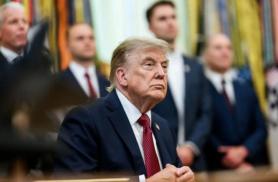
U.S. President Donald Trump is seen at the White House in Washington, D.C., in this grab from its website. SEOUL, November 21 (AJP) - U.S. President Donald Trump said Friday that the situation on the Korean Peninsula was discussed during a historic trilateral meeting with Chinese President Xi Jinping and Russian President Vladimir Putin in Shenzhen, China earlier this week. Speaking at a White House news conference, Trump said the three leaders had discussed the "risks on the Korean Peninsula" and efforts to "stop the killing in Ukraine," adding that they had "spent a lot of time on Ukraine and Russia." His remarks suggest that North Korea-related issues were not a major focus of their 90-minute talks, with much of the discussion instead devoted to the war in Ukraine and efforts to bring the conflict to an end. Trump boasted about the achievements of his recent trip to Asia and outlined his discussions with Xi and Putin, but offered few details about their talks. He did not elaborate on what he meant by the "risks on the Korean Peninsula" or clarify whether the discussions specifically addressed North Korea's nuclear weapons and missile programs. His comments nevertheless confirmed that the issue was on the agenda at the unprecedented meeting, which took place last Thursday on the sidelines of the Asia-Pacific Economic Cooperation (APEC) summit in Shenzhen. Russian President Vladimir Putin (far left), Chinese President Xi Jinping (center) and U.S. President Donald Trump pose for a photo ahead of a trilateral summit in Shenzhen, China on Nov. 19, 2026. Courtesy of the White House Earlier, China's state broadcaster CCTV reported that the three leaders had discussed a range of international issues including the war in Ukraine, nuclear nonproliferation, tensions in the Middle East and the situation on the Korean Peninsula. Their meeting also produced a joint declaration pledging cooperation to reduce nuclear risks and prevent the spread of nuclear weapons. In the declaration, released by the White House the previous day, the three leaders reaffirmed that "a nuclear war cannot be won and must never be fought." They also pledged to "conduct a dialogue on reducing nuclear risks and preventing the proliferation of nuclear weapons." The trilateral meeting marked the first face-to-face summit among the leaders of the world's three major nuclear powers, whose interests often diverge on issues such as nuclear arms control and regional conflicts, making the gathering largely symbolic. Peace and security on the Korean Peninsula remain particularly complex issues for the three countries, as Washington has sought to prevent North Korea from expanding its nuclear and missile capabilities, while Beijing and Moscow have maintained closer ties with Pyongyang and frequently criticized U.S.-led pressure on the North.
-
 Chung Dong-young Meets U.S. Ambassador Michelle Steel, Calls for Resumption of Inter-Korean and U.S.-North Korea Dialogue
Minister of Unification Chung Dong-young met with U.S. Ambassador to Korea Michelle Steel on the 20th. This meeting comes approximately four months after Steel's appointment in July. Chung emphasized the necessity of cooperation between South Korea and the U.S. for peace on the Korean Peninsula and stated that inter-Korean and U.S.-North Korea dialogue should be resumed.According to the Ministry of Unification, Chung welcomed Steel during their face-to-face meeting at the Government Seoul Complex in Jongno-gu, Seoul, expressing optimism that the close ties between the U.S. and Korea would strengthen with Steel's appointment, given her deep connections to Korea.In particular, Chung explained the government's efforts to prevent accidental clashes in border areas such as the Demilitarized Zone and to establish a permanent peace regime on the Korean Peninsula. He also requested continued unwavering support and cooperation from the U.S. The Ministry stated, "Both sides reaffirmed that the South Korea-U.S. alliance is a cornerstone for peace and prosperity in the region and agreed to continue communication regarding issues on the Korean Peninsula."Previously, there were interpretations that the prolonged absence of meetings between Chung and Steel might have led to U.S. dissatisfaction regarding Chung's remarks about nuclear facilities. Typically, U.S. ambassadors to Korea meet with the Minister of Unification shortly after their appointment or within a month. In response to suspicions that Chung's remarks had fueled speculation about conflicts between South Korea and the U.S., he clarified that he made those remarks even before his appointment as minister, asserting that the U.S. had misrepresented the facts.* This article has been translated by AI.
-
Shin Beom-cheol: 'Beware of North Korea's Combat Experience... Innovation Requires Discarding Yesterday's Successes'
Shin Beom-cheol, former Deputy Minister of National Defense, emphasized on November 20 the importance of utilizing artificial intelligence (AI) experts in the military, stating, "We need to reflect on whether we are training people, integrating technology, and creating systems to support technology with a sense of urgency."During his keynote speech at the '2026 Defense Industry Forum' held at the Ntree Premier Hotel in Yongsan, Seoul, Shin stressed that to innovate military capabilities using AI, the foundation of human resources and personnel systems must be restructured.This forum, co-hosted by Aju Economy, the Korea Defense Industry Association, and Jeonbuk National University, was themed 'The Future Battlefield Transformed by AI: A New Leap for K-Defense.'Shin shared his experience from when he took office as Deputy Minister of National Defense in May 2022, pointing out the shortage of AI experts in the defense sector. He recalled asking if there were any AI majors among the senior officials at the Ministry of National Defense, but no one responded, saying, "That is our reality."He then cited the case of an officer with a Ph.D. in AI from KAIST, whom he had placed in the Ministry of National Defense. Although the officer wanted to continue working in AI after being promoted to lieutenant colonel, he was pressured to take on a battalion commander position and eventually left the military for a university position.Shin noted, "The loss of specialized personnel is a disadvantage for our military," pointing out the conflict between the need for continuous development of expertise in technology fields and the existing military personnel system. He argued that it is essential to improve systems so that experts can build their capabilities in their respective fields, rather than merely paying lip service to the introduction of advanced technologies.He highlighted the core aspects of future battlefields transformed by AI, referencing Napoleon's statement on 'time, space, and combat power.' He explained that AI would support commanders' awareness, judgment, and coordination while also directly participating in combat through unmanned combat systems, thereby changing the way wars are conducted.Shin described the role of AI as enabling operations "faster, longer, and simultaneously." He predicted that the ability to shorten decision-making time, enhance the continuity of surveillance and tracking, and operate multiple unmanned systems would determine the advantage in future battlefields.In terms of space, he explained that manned and unmanned combined combat systems would expand the operational range of units and allow for the concentration of firepower at necessary points by connecting dispersed forces through a network.He also warned against underestimating North Korea's accumulation of combat experience. Shin stated that North Korea is gaining real combat experience through the Russia-Ukraine war, particularly in drone warfare, asserting that "the difference between having war experience and not having it is like night and day."He emphasized that North Korea's capabilities should not be evaluated based on past standards, urging a sense of crisis that they could fall behind in terms of time, space, and combat power. He particularly noted that "innovation begins with discarding yesterday's successes," a mindset that should also apply to the field of AI.Additionally, he stated that despite the export achievements of K-defense, the competitiveness in the AI and drone sectors should be assessed realistically. He explained that low-cost drones may offer less profit incentive for companies compared to large weapon systems, necessitating government investment and encouragement, as well as technology development by universities and small businesses.Shin identified defense data management as a key issue. He stated that the data produced during the activities of the Ministry of National Defense, the Defense Acquisition Program Administration, and frontline units forms the basis for AI development, and that it is essential to check whether this data is being properly managed.He also proposed improving the cooperative structure that connects civilian technology with the military. He pointed out that concerns about defense industry corruption can inhibit necessary communication between the government and businesses, and emphasized the need for the military to actively visit companies and universities to find technologies that can be utilized.Shin concluded that developing defense AI cannot be achieved solely by specific agencies, stating, "We must utilize all available data through a national mobilization effort, integrating contributions from small and large enterprises, academic societies, and more."* This article has been translated by AI.