

[Aju News DB]
South Korea's air traffic soared from a year earlier in the third quarter on a sharp increase in international flights to and from the country, the government said Thursday.
In the July-September period, the country's overall air traffic came to 192,913 flights, up 15.2 percent from the same period last year, according to the Ministry of Land, Infrastructure and Transport. The increase was largely attributed to a steep rise in the number of international flights to and from the country.
In the three months ended Sept. 30, international flights to and from South Korea jumped 23.6 percent on-year to 117,863 for a daily average of 1,281 flights.
Domestic flights gained 5.6 percent on-year to 63,079 over the cited period, while international flights passing through the country's airspace slipped 2.9 percent to 11,971.
"Air traffic increased 15.2 percent from the same period last year in the third quarter due to a high demand around the summer vacation season," the ministry said in a press release.
The ministry earlier said the country's international air passenger traffic spiked 26.5 percent on-year to 6.97 million in August, with its domestic air passenger traffic also gaining 6.9 percent to 2.88 million in the same month.
(Yonhap)

Copyright ⓒ Aju Press All rights reserved.
Related News
-
 Korea and China Discuss Tourism Industry Changes in Beijing
Officials from tourism research institutions and industries in South Korea and China gathered to discuss policies and cooperation strategies to respond to changes in the tourism industry. Key topics included tourism services utilizing artificial intelligence (AI) and digital technology, regional consumption by foreign tourists, and shopping and industrial tourism.The Korea Culture and Tourism Institute announced that it held the 13th Korea-China Tourism Cooperation Seminar in Beijing on November 12.The seminar, themed "Innovation in the Tourism Industry and Policy Support," featured researchers from national tourism research institutions in both countries, as well as representatives from Chinese companies such as DiDi and Yili Group.South Korean researchers presented findings focusing on the impact of changes in the tourism industry and foreign tourist spending on local economies. Song Soo-yeop, a deputy researcher at the Korea Culture and Tourism Institute, discussed trends in the new tourism industry and policy responses, while Kang Ji-soo, another deputy researcher, analyzed the effects of spending by foreign tourists in local areas.Chinese researchers addressed topics such as the development of inland water tourism and the impact of foreign tourists' shopping consumption on local economies. Cui Xin from the China Tourism Academy presented policies for fostering inland water tourism, while Ma Xiao-feng discussed the spatial ripple effects of inbound shopping consumption and the structure of consumption transitions.Examples of tourism business initiatives were also shared. The Chinese mobility company DiDi presented cases of Korea-China tourism exchanges utilizing digital transportation services, while the dairy company Yili Group shared its experiences in industrial tourism operations.Following the presentations, representatives from Shilla Duty Free and Jeju Air participated in discussions about current issues in the tourism industries of both countries and potential avenues for cooperation.Hwang Kyo-ik, director of the Korea Culture and Tourism Institute, stated, "Both institutions share the common task of responding to changing tourism demands between Korea and China, supporting the growth of a converged tourism industry, and expanding tourist consumption through policy research. We will continue our collaborative research to enhance tourism exchanges and policy development, as we have done for the past 13 sessions."* This article has been translated by AI.
-
 Editorial: Tourism is booming. Make visitors want to return
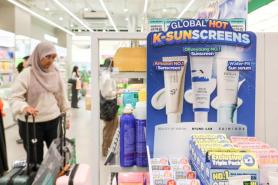
A foreign shopper look at beauty items at Olive Young store in Myeongdong. AJP Yoo Na-hyun Tourists AJP spoke to describe struggles to obtain digital transit cards, navigate restaurant kiosks and complete payments. Booking a table, ordering dinner and paying the bill can each present a separate digital hurdle. Visitors arrive ready to spend but encounter systems built around the assumption that every customer is a local resident. As annual arrivals approach 20 million, these frustrations deserve as much attention as the milestone itself. Korea has invested heavily in giving travelers reasons to come. It must now make it easier for them to stay, explore and spend with confidence that the price is fair. The country’s growing appeal has proven in numbers. Foreign visitors’ tourism-related card spending reached 15.94 trillion won in the first nine months of this year, up 47.7 percent from a year earlier. Arrivals increased 21.5 percent to 17.11 million over the same period. Spending is growing considerably faster than visitor numbers. Seoul illustrates the opportunity. Foreign visitors spent 8.84 trillion won by card in the capital through September, up 57.7 percent and already above last year’s full-year total. Shopping accounted for 46 percent of spending and medical and wellness services another 23.8 percent. Korea is drawing visitors who come to shop, eat and seek treatments as well as see the sights. Yet the experience on the ground does not always match the sophistication of the country’s tourism pitch. They report problems navigating payment systems, from cash and debit-card use to unfamiliar digital procedures. The inconvenience follows them into restaurants. Diners encounter kiosks for ordering and payment, while reservations and orders increasingly require an app or an online account. A visitor may find a restaurant, understand its menu and be ready to spend, only to struggle with the system required to get a table or order a meal. For residents accustomed to these services, digitalization saves time. For a traveler without a Korean phone number, a compatible payment method or familiarity with local apps, each step can become another obstacle. Booking, ordering and payment may all be digital, but that does not mean they are accessible. These accounts reflect a broader pattern. Yanolja Research’s analysis of travel posts on Reddit identified digital services as the largest category of inconvenience for visitors to Korea, followed by tourist information, transport and payments. Together, those four categories accounted for 69.3 percent of the problems classified. The study reflects online accounts rather than a representative survey of all visitors, but it points to practical weaknesses that tourism authorities can address. A country seeking more tourism spending should make it straightforward for a willing customer to complete a purchase. Essential travel services should offer a usable alternative to authentication through a Korean mobile number. Overseas credit and debit cards should work reliably throughout booking and payment. Public transport cards should be easy to obtain and recharge, with clear multilingual instructions and accessible payment options. Restaurants using kiosks should provide language choices and assistance for customers who cannot complete an order. Digital convenience should come with a workable fallback. A staffed counter or the ability to order from an employee can determine whether a visitor becomes a customer or walks away. Overcharging is another threat to confidence. Encouraging tourists to spend more must go hand in hand with ensuring that they know what they are paying for. Prices should be visible before an order is placed, with additional charges clearly disclosed and itemized receipts readily available. Visitors also need a simple multilingual route to challenge an incorrect bill or report suspected overcharging. Unfamiliarity with the language, currency or local practices should never become an opportunity to extract a higher payment. A disappointing purchase can undermine the goodwill built by an entire trip. Making travel easier also matters for spreading tourism income beyond the capital. Seoul captured 70.9 percent of foreign visitors’ nationwide offline card spending in the first nine months. Within Seoul, Gangnam, Jung and Mapo districts accounted for a combined 64.4 percent of the city’s total. Regional destinations need more than attractive promotional material. Travelers must be able to find transport, book accommodation, reserve activities and pay without navigating a succession of inaccessible systems. Festivals, food and evening performances should connect with reliable transport and places to stay, giving visitors a practical reason to extend their trips. Tourism authorities should test the entire journey with an overseas phone number, a foreign bank card and no knowledge of Korean. That exercise may reveal more than another campaign celebrating arrival figures. Success should be measured through longer stays, wider regional spending, repeat visits and fewer unresolved complaints. Twenty million arrivals would be a meaningful milestone. The lasting return will depend on whether visitors feel welcome, can spend without difficulty and trust that they have paid a fair price.
-
Government Tightens Regulations on Discount Tourism to Curb Shopping Commissions
Some low-cost group tour packages sold overseas do not accurately reflect the actual travel expenses, such as accommodation, meals, and transportation. These packages lower prices to attract tourists and then compensate for the shortfall through shopping commissions received from domestic duty-free shops or retailers. The more tourists purchase, the higher the income for the travel agencies.This has led to excessive shopping schedules in some group tour packages and instances where tourists feel pressured to buy products. Tourists often only compare the prices displayed when booking, making it difficult to understand the actual costs of the trip or the proportion of the shopping schedule. In contrast, travel agencies that include necessary expenses for accommodation and meals in their package prices often struggle to compete with low-cost options.To reduce such discount tourism, the government is moving to limit shopping commissions. This initiative aims to establish standards for the commissions travel agencies receive from duty-free shops and improve the business model that relies on shopping income. Once the regulations are implemented, changes are expected in the pricing of group tour packages and transactions between travel agencies and retailers.According to the Ministry of Culture, Sports and Tourism, a public forum will be held on November 13 at 2 p.m. at the Seoul Garden Hotel to discuss the commission rates between designated travel agencies and retailers as part of the amendments to the Tourism Promotion Act.The amended Article 12-3 of the Tourism Promotion Act, enacted on June 2, prohibits designated travel agencies from receiving commissions exceeding the rates set by the ministry when significantly lowering the costs of attracting group tourists, which disrupts the order of the tourism industry. It also bans practices that force tourists to make purchases or engage in disrespectful behavior, as well as using shopping commissions to cover costs owed to tourism workers. The upcoming regulatory amendments are a follow-up measure to establish commission rates.The ministry plans to apply different commission caps based on the type of retailer and purchased items until the end of 2027, after which a uniform standard will be implemented regardless of the retailer or item.This phased approach allows retailers time to adjust existing contracts and encourages travel agencies to cover accommodation, meal, and transportation costs through package sales rather than relying on shopping commissions, thereby minimizing market contraction due to sudden changes.As shopping commissions decrease, the prices of some low-cost group tour packages may rise, as travel agencies will need to reflect previously covered costs in their package prices. However, this price increase could pose challenges in attracting tourists. The government's decision to implement regulations gradually until the end of 2027 also considers this burden.The government believes that limiting shopping commissions will enable travel agencies to secure necessary expenses through package sales and increase the number of reasonably priced travel products. Reducing the reliance on tourist purchasing performance for agency income is expected to help improve excessive shopping schedules and pressure to buy.Duty-free shops and retailers may also need to adjust existing contracts. Since shopping commissions are costs incurred in attracting group tourists, new standards will require renegotiation of commission payment conditions.Before amending the regulations, the ministry gathered opinions from designated travel agencies and duty-free retailers, receiving written feedback as well. According to the ministry, there were concerns about reduced agency income, alongside calls for the government to facilitate securing profits through normal product sales instead of shopping commissions.At the public forum on November 13, the Korea Culture and Tourism Institute will present on "Improving the Distribution Structure of Group Tourism and Enhancing Market Health," followed by an explanation of the background and key points of the regulatory amendments. This will be followed by presentations and open discussions representing both regulatory tightening and easing perspectives.The government plans to review the opinions raised during the forum to prepare a partial amendment to the regulations, followed by consultations with relevant agencies, legislative announcements, and regulatory and legal reviews.Gang Jeong-won, head of the tourism policy division at the ministry, pointed out that some discount tourism practices have relied excessively on shopping commissions, undermining tourism order and diminishing tourist satisfaction. He emphasized that the restriction on shopping commissions is a necessary turning point for establishing a fair market order and achieving qualitative advancement in inbound tourism.* This article has been translated by AI.