

[Gettyimages Bank]
CHA Biotech said in a regulatory filing on Tuesday that it sold a 60 percent stake in Stem Cell & Regenerative Medicine International to Astellas Institute for Regenerative Medicine, a subsidiary of Astellas Pharma, an American company which develops stem cell therapies with a focus on diseases that cause blindness.
"Based on the country's largest stem cell pipeline, we will strive harder to advance the commercialization of our products," CHA Biotech CEO Oh Sang-hoon said. CHA Biotech's parent medical group established a cell therapy center in Tokyo in 2013.

Copyright ⓒ Aju Press All rights reserved.
Related News
-
 Pharmaceutical Companies Compete in Drug Delivery Technology
Drug delivery technology (DDS), which replaces intravenous injections with subcutaneous injections and patches, has emerged as a new battleground in the pharmaceutical industry. Domestic pharmaceutical companies are accelerating platform development and production facility construction, targeting a market expected to grow to 700 trillion won by 2033.According to industry sources on November 15, the method of drug delivery can affect the frequency of administration, side effects, and convenience, prompting pharmaceutical companies to invest heavily in drug delivery technology development. Market growth is also anticipated. Market research firm SkyQuest predicts that the global new drug delivery system market will grow from $30.405 billion last year to $54.885 billion (approximately 735 trillion won) by 2033.Domestic pharmaceutical companies continue to invest heavily. Daewoong Pharmaceutical recently signed joint development contracts for drugs utilizing its high-concentration subcutaneous injection platform, Thermicra, and its soluble microneedle platform, Clofam. Thermicra is being developed by three companies, including Daewoong Bio, while Clofam is a collaboration between Daewoong Pharmaceutical and Daewoong Therapeutics. Thermicra technology converts antibody-drug conjugates (ADCs) previously administered via intravenous injection into subcutaneous injections. Clofam is a patch-type platform that delivers drugs through microneedles that dissolve in the skin.The company is also building production infrastructure. Daewoong Pharmaceutical plans to complete a dedicated manufacturing facility for Thermicra in Seongnam by December 2027 and aims to receive GMP approval for a microneedle dedicated sterile manufacturing facility being built at its third plant in Hwaseong in the first half of 2027. Park Sung-soo, CEO of Daewoong Pharmaceutical, stated, "This is an important stepping stone to apply next-generation drug delivery technology to various pharmaceuticals and connect it to actual product launches."Hanmi Pharmaceutical is also leveraging drug delivery technology as a competitive advantage for new drugs. The company received approval from the Ministry of Food and Drug Safety for its obesity treatment, Epe (active ingredient: epeglanatide), which utilizes its sustained drug delivery platform, LabDiscovery. This technology extends the half-life of the drug, allowing for stable blood concentration and weekly administration. It is used for chronic weight management in adults with obesity without diabetes.Dongkook Pharmaceutical is seeking global collaborations with its long-acting injection platform, DK-LADs. The company explains that this technology can reduce the frequency of administration and enhance treatment convenience, emphasizing its potential applications in chronic diseases and cancer treatment. Donggu Bio Pharmaceutical has signed a letter of intent (LOI) with U.S. biotech company Pelamore and Link Korea for the domestic development and commercialization of next-generation transdermal drug delivery technology. Pelamore is developing a technology that delivers active ingredients through the skin without microneedles, based on its proprietary lipid vesicle and skin penetration technology.Industry insiders noted, "Securing drug delivery platforms allows companies to apply them to various products, broadening their pipelines and increasing opportunities for technology exports and joint development with global big pharma, which is why pharmaceutical companies continue to invest."* This article has been translated by AI.
-
President Lee Jae-myung Hosts Capital Market Policy Meeting with New Participants
On November 13, President Lee Jae-myung hosted a 'Capital Market Policy Meeting' at the Korea Exchange in Yeouido, Seoul, which featured a different lineup of attendees compared to typical financial sector events. Traditionally, such meetings include the chairman of the Korea Exchange and the head of the Financial Investment Association, who sit prominently at the event.However, the list of over 80 attendees released for this meeting did not include the name of Hwang Seong-yeop, chairman of the Financial Investment Association. Jeong Eun-bo, chairman of the Korea Exchange, was present and exchanged greetings with Yoo Dong-soo, chairman of the National Assembly's Political Affairs Committee, before the meeting began, but the contributions from institutional leaders during the discussions were minimal.Instead, the meeting was filled with professionals and external experts who typically have less representation at government events. Among the attendees were Park Se-ik, CEO of Chesley Investment Advisory and a former stock YouTuber, Kim Sung-il, CEO of Uprise Investment Advisory, Lee Seong-won, CEO of Truston Asset Management, and Hyun Sang-kyun, CIO of DS Asset Management, along with executives from venture and biotech firms such as Kim Byung-soo of Robotis, Yoon Seong-ho of Machinarax, and Kim Hang-yeon, vice president of Alteogen.This shift in participant composition has been interpreted in the financial investment sector as an effort to gather ideas from professionals and experts actively working on the front lines of the market, rather than relying on the conventional reports dominated by association heads and institutional leaders.The meeting lasted approximately two and a half hours and focused more on addressing issues from the field rather than delivering ceremonial remarks. In his opening statement, President Lee noted, 'The recent significant corrections in the stock market have put the government's reform commitment to the test,' expressing his determination to normalize the capital market while wearing a red tie. During the subsequent open discussion, when Park Se-ik suggested the need for a market stabilization fund due to increased volatility from foreign futures and options trading, President Lee engaged directly with officials to assess the practicality of the proposal, marking a departure from the usual format of government-led discussions.President Lee also urged officials to avoid generic responses during the discussions, instructing them to focus on conclusions and to expedite matters that could be addressed through changes to exchange regulations, even without legislative amendments. This approach reflects a desire to directly verify the actual demands of the market rather than relying on reports prepared by relevant agencies.During the meeting, President Lee also called for the establishment of a 'dedicated organization for capital market reform.' He acknowledged that not creating such a body last year, when reforms appeared to be progressing smoothly, was a mistake. He directed the formation of a high-level task force that includes participation from financial authorities, political parties, and private experts, reporting directly to the president. He emphasized the need for rigorous discussions in a horizontal structure rather than a hierarchical one, urging that conflicting issues be reported on a case-by-case basis. Concerns were also raised about the inadequate understanding of the current state of corporate investor relations (IR) and lax listing maintenance requirements.However, there were clear differences in perspectives between attendees and financial authorities regarding key issues such as the activation of the market stabilization fund and derivatives regulations. Many tasks require legislative changes, raising questions about how effectively the new dedicated organization can drive substantive reforms.Meanwhile, some in the securities industry have expressed caution regarding the establishment of the dedicated organization. There are concerns that launching a separate high-level task force could lead to overlapping functions and confusion in responsibilities, given that existing financial authorities and related agencies already oversee capital market policies and supervision.* This article has been translated by AI.
-
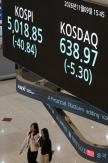 OPINION: KOSDAQ at 30 needs to grow up
Ticker at KRX lobby. AJP D/B Life begins at 30, so they say. Investors in KOSDAQ are still waiting for the junior stock market to grow into the promise of its birth as Korea’s answer to Nasdaq. The market turned 30 in July. By Thursday, its index stood more than 30 percent below its starting level on today’s scale. In an otherwise rewarding year for many stock markets, including its bigger sibling KOSPI, the KOSDAQ has lost about 22 percent. For two sessions this week, it seemed ready to shake off the gloom. The index gained 10.35 percent despite the Nvidia leadership drama and fears of a sharp U.S. Federal Reserve rate increase. Speculation about fresh government support gave investors something else to trade on. Then came the denial. The KOSDAQ ended Thursday down 1.22 percent at 696.53 after financial authorities dismissed reports that they would announce another support package Friday. It remained 43.34 percent below its April intraday peak of 1,229.42. President Lee Jae Myung on the day called for faster development of the KOSDAQ and reform of the venture capital ecosystem so innovative companies could raise funds as they grow. He urged consistent reforms to improve corporate value and shareholder returns, alongside measures to encourage long-term investment. Earlier in the morning, the Financial Services Commission (FSC), Financial Supervisory Service and Korea Exchange had denied online claims of an imminent package. The rumors included loosening or phasing out the daily 30 percent stock-price limit and measures to encourage retail trading. The FSC warned that spreading groundless rumors could constitute unfair trading. The positions are not formally contradictory. The president called for market development; regulators denied a specific announcement and its supposed contents. They were right to correct false information. But investors were left with another round of presidential encouragement and regulatory rebuttals, without a clearer understanding of when promised reforms would change the market they own. That gap is fertile ground for speculation. Broad pledges sustain expectations of official support. Rumors supply the missing details. Denials send investors scrambling to reassess them. Companies’ earnings and prospects struggle to compete with guesses about the next government announcement. The scoreboard shows why investors are so eager for relief. Source: Financial Supervisory Service. Compiled and edited by AJP. Graphics AI assisted. A longer history chart is more uncomfortable. The KOSDAQ is 30.35 percent below its July 1, 1996 base level of 1,000 on today’s scale. The original base was 100 before a tenfold rebasing in 2004. The comparison excludes dividends, and the companies making up the index have changed. Even with those qualifications, it is a poor anniversary portrait for a market created to finance Korea’s future. Nor is the weakness confined to its smallest companies. The KOSDAQ 150 closed at 1,149.35, down 47.27 percent from its March peak of 2,179.57. The index of its leading stocks has lost nearly half its value. Thirty years on, it remains a junior market whose successful companies have reasons to leave and whose investors repeatedly turn to the government for reassurance. The departures of NHN, now Naver, Kakao and Celltrion for the main board illustrate the problem. A Korea Capital Market Institute study found that the exit of stronger companies weakened KOSDAQ performance and could encourage further transfers. When growing up means moving elsewhere, the market loses the businesses that could demonstrate its own maturity. Some companies nurtured on KOSDAQ have succeeded elsewhere. Korea has produced corporate successes without building an equally successful destination for sustained investment in its growth market. Another weakness lies in the gap between financing innovation and evaluating it. Young technology companies may need years of research before producing meaningful revenue. Conventional earnings screens alone cannot distinguish a promising laboratory from a business surviving on its next capital raising. A November study by the Korea Capital Market Institute found that companies admitted through technology-special listing provisions often continued to report losses while investing in research after going public. Their aggregate five-year stock performance concealed a wide divide between a small number of strong winners and many laggards. Opening the listing gate is only the beginning of the market’s job. Investors need reliable information about what happens afterward. For a biotech company, that means clinical progress, cash requirements and the commercial significance of licensing agreements. For an industrial technology company, it means whether announced partnerships produce customers, revenue and cash flow. Repeated announcements cannot substitute for evidence of progress. External shocks compound these weaknesses. Higher interest rates make distant profits less valuable today, while uncertainty over AI spending can unsettle smaller suppliers. A market with credible disclosures and committed institutional investors is better equipped to assess those risks than one waiting for the next support rumor. The government already has a reform agenda. In March, the FSC outlined market segmentation, faster removal of failing companies and measures to broaden institutional participation. It also noted that the benchmark used in public fund management evaluations had been changed to include a 5 percent KOSDAQ component. Investors should now be able to judge implementation and results. Start with communication. The presidential office and financial authorities should publish a shared timetable identifying what has been approved, what remains under consultation and who is responsible for delivery. Rumor rebuttals should accompany accessible progress reports on actual reforms. A denial should leave investors better informed about policy. Then make remaining on KOSDAQ attractive to successful businesses. A credible upper segment could help if admission rests on sustained disclosure quality, governance and operating performance. It must give investors a useful distinction and companies a reason to stay. Attaching a premium label without changing the investment experience would accomplish little. Long-term capital also needs people equipped to deploy it. Independent research, specialist fund managers and evaluation periods that reflect the time needed to commercialize technology would help. Pension funds should retain investment discretion. Directing them to support an index would transfer the market’s problems to retirement savers without repairing its foundations. Investor protection must become visible in daily practice. Authorities should pursue manipulation and misleading disclosures promptly, scrutinize financing arrangements that dilute existing shareholders and enforce credible exit standards. Genuine research risk deserves patient capital. Concealing setbacks or repeatedly selling implausible promises does not. Reform should be measured by the quality of post-listing disclosures, progress toward commercialization, institutional ownership over time and the retention of strong companies. Listing counts, turnover spikes and a few buoyant sessions reveal far less about whether the market is doing its job. Expanding price limits might change trading behavior. Fresh incentives might bring buyers through the door. Neither gives those buyers a durable reason to remain shareholders. The president is right to emphasize long-term investment. His administration must now make that ambition concrete enough to displace the daily guessing game over stimulus. At 30, KOSDAQ needs investors who stay because companies deliver. Another rumor-driven rally would only postpone growing up. * The writer is managing editor of AJP. ** The views expressed are the writer’s own and do not necessarily reflect those of AJP.