

[Courtesy of Netmarble]
It's not simply the mobile version of Netmarble's previous PC online role-playing game (RPG) "A3," developers said, adding the battle royale genre was converged to catch two rabbits simultaneously. "To create a market-friendly game, Netmarble has set two key development goals: well-made and genre convergence," CEO Kwon Young-sik told reporters on Wednesday.
Battle royale games involve dozens to hundreds of players, who start with minimal equipment and then must eliminate all other opponents while avoiding being trapped outside of a shrinking "safe area", with the winner being the last player or team alive.
"I intend to keep challenging myself until I create great success with the RPG genre in the global big market," Kwon said. "I understand that there is quite a lot of expectation for the Chinese market early this year."
Based on market research that users were tired of the overflow of mobile MMORPG, Netmarble combined the two genres to secure both users who focus on growth and collection and those who focus on competition and victory as customers.
The battle royale part does not apply to characters and equipment that are developed and collected in the MMORPG part. It is played only with the ability of users to compete with each other in a fair manner. Up to 30 people can gather in one place for a battle royale game. Some items collected can be used for character development in MMORPG.
Copyright ⓒ Aju Press All rights reserved.
Related News
-
 Seoul stocks cheer China's move toward K-wave opening
South Korean and Chinese delegations, led by President Lee Jae Myung (left) and President Xi Jinping, hold a summit in Shenzhen, China, on Nov. 18. Courtesy of Cheong Wa Dae SEOUL, November 19 (AJP) - South Korean entertainment stocks surged at Thursday's opening bell on hopes of a full-fledged return to China after President Xi Jinping gave the strongest signal yet that Beijing could ease nearly a decade of unofficial restrictions on Korean cultural content. President Lee Jae Myung and Xi announced the substantive conclusion of follow-up negotiations on services and investment under their free trade agreement at a summit in Shenzhen on Wednesday. The breakthrough capped eight years and eight months of talks. China agreed to grant most-favored-nation treatment to Korean films and games and apply a nondiscrimination principle when prescreening Korean content. According to the Ministry of Trade, Industry and Resources, this is the first time Beijing has included those commitments in a trade agreement. Lee said on X the deal "will lay the foundation for building a new future for Korea-China relations, beyond a full and substantive restoration of ties." Industry Minister Kim Jung-kwan called it "a stable institutional foundation to enter the Chinese market." The agreement offers the clearest indication yet that Beijing may loosen "hanhallyeong," the unofficial restrictions on Korean entertainment that followed Seoul's 2016 decision to deploy the U.S. THAAD missile defense system. China has never acknowledged the ban, but K-pop acts with Korean members have been largely shut out of mainland concert stages. A full reopening, however, remains unconfirmed. Neither side's published summit documents explicitly authorize K-pop concerts on the mainland. BIGBANG's 2016 tour remains the last large-scale K-pop concert held in mainland China, following a tour that drew about 250,000 fans across 13 Chinese cities the previous year. A roughly 1,000-seat show by the all-Korean boy band EPEX, approved for May 2025 in Fuzhou, was postponed over "local circumstances" and never held. At least 15 events featuring Korean stars, mostly fan meetings, have been canceled or postponed in China since May. BIGBANG performs during its 2015 MADE Tour concert in Shanghai. Courtesy of YG Entertainment For game publishers, the immediate stakes center on the publication license known as a "panho," which every title must obtain before launching in China. Approvals for Korean games plunged after 2017 and only began recovering in 2022. Korean titles accounted for nine of the 36 imported games approved through late July. The Korean tally reached 12 by late August, including Netmarble's "Solo Leveling: Arise" and Devsisters' "Cookie Run: Tower of Adventures." Once in force, the agreement would give Korean publishers a treaty basis to challenge treatment less favorable than that afforded to other foreign studios. Analysts have singled out Krafton, which earns royalties from Tencent's "Game for Peace," the Chinese version of "PUBG Mobile," and Wemade, owner of the "Legend of YMIR" franchise. Chinese studios, meanwhile, already have a firm foothold in Korea. HoYoverse, the Shanghai-based developer of "Genshin Impact," returns to G-Star in Busan on Thursday with a 100-booth presence, its first appearance in four years. Nexon, NC and Netmarble are foregoing large booths. "Korea has always been an important pillar of our global community," said Sam, HoYoverse's global PR communications lead, as the studio prepared the first offline Korean showings of "Honkai: Nexus Anima" and "Petit Planet." Broadcasters and film studios could also gain substantially. The two countries agreed to extend co-production status, previously limited to films, to dramas, animation, variety shows and documentaries. China treats qualifying co-productions as domestic content, exempting them from import quotas, according to the Ministry of Culture, Sports and Tourism. The potential opening is significant for sectors with limited access to Chinese audiences. Korea's game exports to China reached $1.9 billion in 2024, while broadcasting and film exports earned just $15 million and $7 million, respectively, according to the Korea Creative Content Agency. More licensed deals could also provide an alternative to imitation. Tencent Video's cooking contest "Yi Fan Feng Shen" drew plagiarism accusations in 2025 for mirroring Netflix's "Culinary Class Wars," whose format rights Netflix said it had never sold in China. In game footage of "Honkai: Nexus Anima." Courtesy of HoYoverse As of Thursday morning 10:07 a.m., trading opened an hour late for the college entrance exam, SM Entertainment shares were boosted by 8.99 percent, JYP at 7.81 percent, HYBE seeing a 6.3 percent rise, and YG rising 3.2 percent. Game stocks joined the rally, with Netmarble up 5.29 percent at 32,850 won, NCSoft 4.01 percent at 191,900 won and Krafton 3.20 percent at 203,000 won, while Tokyo-listed Nexon rose 2.68 percent to 3,147 yen. "As the possibility that performances will visibly resume in some form has become real, a rerating of the entertainment sector as a whole will gain momentum," said Lee Hwa-jung, an analyst at NH Investment & Securities. Other analysts cautioned that the agreement does not immediately authorize concerts or guarantee more game approvals. At their January summit, Lee and Xi agreed to expand cultural exchanges gradually, starting with areas acceptable to both sides. The agreement still requires signing and completion of domestic approval procedures before taking effect. For entertainment companies and investors, the next test will be whether the diplomatic opening translates into licenses, distribution deals and performances. The deal takes effect only after both sides sign the text and it is ratified by Korea's National Assembly and the Standing Committee of China's National People's Congress.
-
 AI startup headlines G-Star as game giants sit out
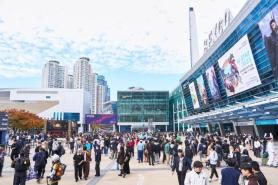
Visitors gathered outside the G-Star 2025 held in BEXCO, Busan. Courtesy of the G-Star Organizing Committee SEOUL, November 19 (AJP) - An artificial intelligence startup took the main sponsor slot at G-Star, South Korea's largest game show, for the first time as the four-day event opened in Busan on Thursday. Wrtn Technologies, which runs the AI character chat app Crack, is the first non-gaming sponsor in the show's history, a role long held by publishers such as Nexon, NC and Wemade. It is staging a 200-booth hall and a concert by girl band QWER, the app's advertising model, on Friday. Nexon, NC and Netmarble, the country's three biggest game publishers, have no large booths at this year's show. The event drew 1,237 exhibitors from 41 countries with 3,445 booths, according to a preliminary count by organizers, down from 1,273 exhibitors from 44 countries but up from 3,269 booths in 2025. "We judged it the best partner in terms of letting visitors experience the depth of stories and content," said Jung Seung-woo, a director at the organizing committee, when Crack was named sponsor in August. Krafton, the maker of PUBG: Battlegrounds, is running the largest booth among Korean exhibitors in its 10th straight appearance, showing five titles. China's HoYoverse is giving Korean gamers their first hands-on play of "Petit Planet" and "Honkai: Nexus Anima." Capcom, Sega, NetEase and CD Projekt Red fill the second hall. The G-CON conference, running through Friday, features Marcin Blacha, story director of "The Witcher" series, and Shift Up CEO Kim Hyung-tae. All programs stream only on Naver's Chzzk platform, and entry is by advance ticket only for a second year to keep crowds safe.
-
 G-Star 2026 Kicks Off with AI Filling the Void Left by Major Game Companies
The largest game exhibition in South Korea, G-Star 2026, will open on November 19 in Busan. Major domestic game companies, including Nexon, NC, and Netmarble, have announced their absence from the exhibition, while AI company Luton will participate as the main sponsor. Companies from other industries, such as webtoons, streaming platforms, and automotive, are also joining the exhibition, suggesting a shift in G-Star's landscape.According to the game industry on November 18, the G-Star organizing committee will hold the 22nd International Game Exhibition, G-Star 2026, from November 19 to 22 at BEXCO in Busan. The Korea Game Industry Association is hosting the event, with the G-Star organizing committee and Busan Information Industry Promotion Agency co-organizing it. The Business-to-Consumer (BTC) exhibition for general visitors will run until November 22, while the Business-to-Business (BTB) exhibition will operate for three days until November 21.This year, the most notable change is the reduced participation of major domestic game companies, which has been filled by non-gaming companies. Luton, the main sponsor, plans to move away from the traditional game-centric exhibition structure and focus on AI-based content creation and integration with other industries.Luton will operate a large exhibition space themed 'A New World of Creation Opened by AI and Crack.' On the opening day, November 19, Luton CEO Lee Se-young and Chief Product Officer (CPO) Lee Dong-jae will present on Luton's business direction and the creator ecosystem of the AI story creation platform Crack.Collaboration with webtoons will also expand. This year's main key visual for G-Star was created in collaboration with artist Lee Dong-geon, known for the popular Naver Webtoon series 'Yumi's Cells.' Characters from the work will be featured on the exhibition's outer walls, official merchandise, and on-site banners. The aim is to attract not only gamers but also visitors familiar with webtoons and popular culture.Collaboration with online platforms will also be strengthened. Naver's streaming platform Chijijik will participate as the official media partner for G-Star after three years. It will exclusively broadcast all programs of the online showcase 'G-Star Premier' and 'G-Star TV' on the eve of the opening, and will operate the 'Chijijik Stage' on-site. Support for influencer passes will connect online broadcasts with the offline event.In the mobility sector, Hyundai Motor will set up a special booth in the BTC hall. The '2026 Hyundai N Virtual Cup Grand Final,' which combines gaming and automotive, will also be held.In the game industry, Krafton will set up a large booth to welcome visitors. Krafton will participate in G-Star for the 10th consecutive year, showcasing four new titles. These include the Eastern fantasy action role-playing game (RPG) 'Tale: Unbound,' the two-player cooperative adventure 'Age Twister,' the action-adventure 'Waltz and Jam,' and the roguelike strategy RPG 'Hero of Item.' Amid limited participation from major game companies, Krafton plans to maintain the exhibition's presence by focusing on new game experiences.The G-Star organizing committee has set this year's slogan as 'Expand Your Horizons,' aiming to broaden the scope of the gaming industry. They intend to maintain the essence of gaming while expanding collaborations with AI, mobility, webtoons, and other industries.The G-Star organizing committee stated, 'Through the advancement of self-planned content and new attempts, we will complete a global festival where both participating companies and visitors can experience new inspiration and enjoyment in a safe and pleasant viewing environment.'* This article has been translated by AI.