

[Gettyimages Bank]
SEOUL -- South Korea's health regulatory agency eased tight regulations on the use of propionic acid, which is a naturally occurring carboxylic acid and has many important uses because of antibacterial properties. It will be recognized as natural when detected in small amounts.
Propionic acid is used as a preservative and flavoring agent in packaged foods because it has antibacterial properties and prevents the growth of various molds. In agriculture and livestock operations, propionic acid can be used to sanitize the surface of places. When not handled properly, however, propionic acid can be potentially dangerous.
The Ministry of Food and Drug Safety revised strict regulations to make more extensive use of propionic acid. In principle, propionic acid detected in small amounts is recognized as natural, but animal materials that can produce propionic acid naturally in the process of decomposition are excluded.
If propionic acid is found to be less than 0.10 grams per kilogram, which cannot be preserved as a food additive, it shall be recognized as natural, the ministry said, adding the revision would ease the difficulties of producers to prove that propionic acid originated from food ingredients or manufacturing processes, and the cost burden of product disposal if not proven.

Copyright ⓒ Aju Press All rights reserved.
Related News
-
 Exploring POSCO's Ambitious Expansion into Energy and Strategic Resources
On November 2, a visit to Gwangyang in South Jeolla Province evoked images of the film 'Charlie and the Chocolate Factory.' The city is dotted with production facilities of the POSCO Group, resembling a vast 'POSCO village.' From the electric furnace at Gwangyang Steelworks to the liquefied natural gas (LNG) terminal operated by POSCO International, the rare gas plant by POSCO Air Solution, the cathode material factory of POSCO Future M, the lithium refining plant of POSCO Pilbara Lithium Solutions, and the battery recycling facility of POSCO HY Clean Metal, the future of POSCO Group's expansion into materials and energy was clearly on display. The Gwangyang LNG terminal, which stores LNG at minus 162 degrees Celsius, is impressive in size. Towering cylindrical storage tanks, approximately 55 meters high, line the waterfront. Seok Gi-sik, head of the terminal construction team at POSCO International, explained, "The internal diameter of the storage tanks is about 84 meters. They are designed for a lifespan of 40 years to store LNG in liquid form at minus 162 degrees for extended periods." The total storage capacity of the Gwangyang LNG terminal is 1.33 million cubic meters, the largest for a single private company in South Korea, enough to supply heating gas for the entire population for about 40 days. At the newly established unloading dock, long docking facilities and LNG transfer pipelines were visible. A site official noted that when LNG at minus 162 degrees flows through the pipes, surrounding moisture freezes, creating a winter-like scene even in summer. Passing by the pipes felt like stepping into winter. Just a short drive from the LNG terminal, several long tanks came into view. These are used by POSCO Air Solution to produce rare gases essential for the semiconductor and aerospace industries. The company utilizes gases obtained from the oxygen production process at Gwangyang Steelworks as raw materials, separating rare gas components and removing impurities to create high-purity products. This facility has an annual production capacity of 130,000 normal cubic meters, which the company estimates will meet about 52% of domestic demand for rare gases. The following day, a visit to the Gwangyang Yulchon Industrial Complex revealed a concentration of battery material production sites. The POSCO Future M Gwangyang cathode material plant, with a production capacity of 90,000 tons per year, employs automation technology in its manufacturing and quality inspection processes. The quality analysis lab is equipped with automated systems for measuring particle size and residual lithium content, as well as X-ray analysis equipment and electron microscopes. The cathode materials, baked in a kiln, resembled slightly burnt brownies. The plant operates using a 'top-down' method, where precursors and lithium are mixed on the upper floor and sent down to the kiln below. The noise from the machinery was incessant, creating a bustling atmosphere. Next, at POSCO Pilbara Lithium Solutions, lithium hydroxide, a key raw material for cathode materials, was being produced. Upon entering the raw material warehouse, a massive pile of sand came into view. This was spodumene concentrate imported from Australia. Unlike typical ores that come to mind, it resembled finely ground white sand. Son Hong-rok, head of the technology and quality department at POSCO Pilbara Lithium Solutions, explained, "We import spodumene ore mined from Australian mines, which is then crushed and sorted for lithium content." The secured ore undergoes heat treatment at around 1,000 degrees before being mixed with sulfuric acid. Water is then used to extract lithium components into a solution while removing impurities. This process extracts essential battery materials from what appears to be a simple pile of sand. The plant employs two different production technologies. The first line uses an electric dialysis method developed by POSCO, applying electricity to an ion exchange membrane to separate lithium. The second line produces lithium hydroxide through a chemical reaction using sodium hydroxide. POSCO Pilbara Lithium Solutions can produce 43,000 tons of lithium hydroxide annually. Son explained the rationale for operating both processes: "The optimal method can vary depending on factors like electricity costs and environmental regulations in different countries." The aim is to compare the advantages and disadvantages of both technologies for future overseas plant construction. Finally, at POSCO HY Clean Metal, the focus is on recycling, the last link in the supply chain for secondary battery materials. This facility uses black mass obtained from pre-processing waste batteries and scraps generated during battery manufacturing. The plant is filled with large tanks that trigger chemical reactions and equipment for separating liquids and solids. It undergoes a leaching process using sulfuric acid to dissolve metals, followed by an extraction process to separate individual metals and a crystallization process to produce solid products. A POSCO Group official stated, "This site visually demonstrates the 'Triple Core' strategy centered on industrial resources, strategic resources, and energy resources, promoted by Chairman Jang In-hwa. We are expanding our business areas into energy and advanced industrial materials by leveraging the technology and production base built on steelmaking."* This article has been translated by AI.
-
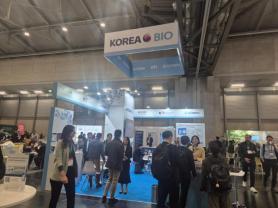 Korean biotech firms tap European market at BIO-Europe
The Korea pavilion at BIO-Europe 2025 in Vienna, Austria, last November. At least eight South Korean biotech firms will seek European partners at this year’s BIO-Europe in Cologne, Germany, from November 9 to 11. (Photo: Korea Health Industry Development Institute) ZURICH, November 08 (AJP) -Small and mid-sized South Korean drug developers are tapping the European market through BIO-Europe this week, seeking licensing deals with global pharmaceutical companies to bring their experimental medicines to patients worldwide. At least eight Korean firms will attend the three-day event opening Monday in Cologne, Germany. The gathering brings together more than 2,000 companies and investors from over 60 countries for about 30,000 one-on-one business meetings. For smaller developers, securing a global partner can help bridge the costly gap between a promising drug candidate and an approved medicine. Licensing agreements can provide funding and access to the clinical development, regulatory and sales networks needed to reach international markets. Now in its 32nd year, BIO-Europe offers Korean companies a chance to meet European drugmakers and investors face to face. Organizer Informa Connect says the event is expanding beyond dealmaking to address broader industry strategy, including regulation, manufacturing and financing. Korean developers arrive with some high-profile deals already behind them. ABL Bio licensed its brain drug-delivery technology to Britain’s GSK in April 2025 and to U.S. drugmaker Eli Lilly in November that year. In Cologne, ABL Bio will pursue further partnerships for the technology, called Grabody-B, which is designed to help medicines cross the blood-brain barrier — a protective layer that prevents many drugs from reaching the brain. It will also promote Grabody-T, its cancer immunotherapy platform designed to help the immune system attack tumors. D&D Pharmatech will continue licensing discussions for DD01, a once-weekly injection being developed for metabolic dysfunction-associated steatohepatitis (MASH), a serious form of fatty liver disease. In a U.S. mid-stage trial, 62.5 percent of patients receiving DD01 achieved resolution of MASH without worsening liver scarring, compared with 5.3 percent of those given a placebo. Rznomics, which already has a deal with Eli Lilly to develop a treatment for hereditary hearing loss, will seek partners for its ribonucleic acid (RNA) editing technology. It will also promote RZ-001, a drug candidate being developed for liver cancer and glioblastoma, an aggressive form of brain cancer. G2GBio will pitch GB-5001, a once-monthly injection intended as an alternative to daily doses of donepezil, a medicine used to treat symptoms of dementia. Other participants include Olix, which is developing RNA-based treatments for obesity and macular degeneration, an eye disease that can cause severe vision loss. Vigencell will present cell therapies for lymphoma, brain cancer and liver cancer, while Y-Biologics will promote its antibody-based cancer drug candidates. Pangen, a subsidiary of Huons Group, is seeking European partners for its biosimilar of erythropoietin (EPO), a medicine used to treat anemia. Biosimilars are medicines highly similar to existing biological drugs and can offer lower-cost treatment options. “We are expanding our biopharmaceutical business from emerging markets into developed countries based on our own core technology,” Pangen CEO Yoon Jae-seung said. Cologne is the latest stop in a busy year of overseas outreach for Korean biotech companies, following participation in BIO USA in San Diego in June and BIO Japan. The commercial goal is to turn those meetings into agreements that fund further development and establish a route to market. For smaller Korean firms, global partnerships can help advance their leading drug candidates while freeing resources for the next generation of treatments. AJP Takeaways - At least eight South Korean biotech firms, including ABL Bio, D&D Pharmatech and Rznomics, will seek licensing partners at BIO-Europe in Cologne, Germany, from November 9 to 11. - BIO-Europe brings together more than 2,000 companies and investors from over 60 countries for about 30,000 one-on-one partnering meetings, according to Korean media reports. - South Korean biotech companies have drawn growing global interest, with ABL Bio licensing its brain drug delivery technology to GSK and Eli Lilly in 2025. - Tags: BIO-Europe, South Korea, biotech, ABL Bio, D&D Pharmatech, Rznomics, G2GBio, Olix, Vigencell, Y-Biologics, Pangen, Hugel, Eli Lilly, GSK, Informa Connect, Cologne, licensing
-
Acetic Acid Spill at Chungbuk Mart Causes Discomfort for Two Customers
An incident involving an acetic acid spill occurred at a mart in Jeungpyeong-eup, Chungbuk Province.According to Yonhap News, around 1:49 p.m. on November 4, a 1.8-liter bottle of food-grade acetic acid fell from a display and spilled onto the floor.As a result, two of the six customers present in the store reported discomfort, including eye irritation, and received treatment on-site before returning home.The local government is investigating the incident, believing that a customer accidentally dropped the acetic acid bottle, and is looking into the exact circumstances and extent of the damage.* This article has been translated by AI.