

This captured picture shows the K200A1 tracked armored vehicle developed by Hanwha Defense.[Courtesy of Hanwha Defense]
The self-propelled system is based on a variant of the K200A1 tracked armored vehicle developed by Hanwha Defense. The project costing about 770 billion won ($647 million) will be completed by 2025, according to the Defense Acquisition Program Administration (DAPA).
The self-propelled mortar system to be used by South Korea's mechanized military unit can carry four passengers, with a maximum speed of 70 kilometers (43 miles) per hour. With a maximum range of 12 km, it can fire up to eight shots per minute.
Copyright ⓒ Aju Press All rights reserved.
Related News
-
 South Korea makes good weapons. Is it ready for war?
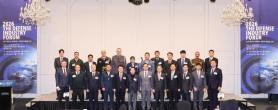
Panelists discuss the competitiveness of South Korea's defense industry and the modernization of its military in the AI era at the 2026 Defense Industry Forum at Nine Tree Premier ROKAUS Hotel in Yongsan, Seoul, on Nov. 20, 2026. From left: Choi Ki-il, professor at Sangji University; Chang Won-jun, professor at Jeonbuk National University; Kim Yoon-tae, former president of the Korea Institute for Defense Analyses (KIDA); Yang Uk, research fellow at the Asan Institute for Policy Studies; and Eom Hyo-sik, director of defense industry and security at the Korea Defense and Security Forum. AJP Yoo Na-hyun SEOUL, November 20 (AJP) - South Korea’s weapons are selling well abroad, but its military’s readiness for future warfare is less assured, experts warned Friday, pointing to outdated procurement practices, limited investment in military AI and an emphasis on hardware over battlefield effectiveness. “Our companies are developing weapons for the future, but we have to ask if our government and military are postured for the wars of the past,” said Yang Uk, a research fellow at the Asan Institute for Policy Studies. Speaking at the 2026 Defense Industry Forum in Seoul, Yang drew a distinction between the country’s success as an arms manufacturer and its ability to put those weapons to effective use. “The ability to manufacture good weapons and the ability to win wars are two entirely different things,” he said. The forum brought together government officials, lawmakers, defense executives and military experts, along with military attachés from nine countries, to discuss how artificial intelligence is changing warfare. Jointly organized by Aju Business Daily, the Korea Defense Industry Association and Jeonbuk National University, the event featured a keynote address by former Vice Defense Minister Shin Beom-chul, presentations by Hanwha Aerospace and HD Korea Shipbuilding & Offshore Engineering, and a panel on industrial competitiveness and military modernization. Yang pointed to Ukraine, where relatively inexpensive drones have destroyed tanks and other equipment worth millions of dollars, as evidence that conventional measures of military strength are becoming less reliable. South Korea, he argued, remains too focused on how many tanks, fighter jets and warships it can acquire, with insufficient attention to how effectively they can operate together. He also questioned the government’s plan to train 500,000 military personnel in drone operations, arguing that developing even 100 highly skilled operators could matter more than expanding the headcount. For defense companies, the obstacles begin long before their technology reaches the battlefield. Choi Ki-il, a professor of military studies at Sangji University, identified three barriers to developing military AI: unclear requirements, restricted access to military data and insufficient funding. Domestic companies are increasing their AI investment, he said, but the military has yet to clearly explain what it needs. Companies also struggle to obtain the operational data necessary to develop and train their systems. According to Choi, only about 340 billion won of this year’s roughly 66 trillion won defense budget was allocated to military AI and systems enabling soldiers and unmanned equipment to operate together. That amounts to about 0.5 percent of the budget — roughly the cost of three KF-21 fighter jets, he said. Choi also warned of South Korea’s heavy reliance on Chinese-made drone components. He called for greater investment in domestic production and stronger protection against cyberattacks on unmanned systems. Chang Won-jun, a professor at Jeonbuk National University, said manufacturing prowess alone would no longer be enough to sustain South Korea’s position in the global arms market. Participants pose for a group photo at the 2026 Defense Industry Forum at Nine Tree Premier ROKAUS Hotel in Yongsan, Seoul, on Nov. 20, 2026. Clockwise from top left: Meinardo Cabral, head of the Science, Technology and Innovation Section at the Brazilian Embassy; Rafael Jose Vieira Barreto, Brazil's defense, army, navy and air force attaché; Aldrin Gacusan, Philippine naval attaché; Ahmed Elhadidi, Egyptian military attaché; Pawel Janik, Polish military attaché; Pamela T. Stein, U.S. Air Force attaché; Yang Uk, research fellow at the Asan Institute for Policy Studies; Boldkhuu Batkhuyag, Mongolian military attaché; Eom Hyo-sik, director of defense industry and security at the Korea Defense and Security Forum; Park Mae-hoon, head of the Fourth Business Division at Hanwha Aerospace's Land Systems Business Group; Aqeel Ibrahim Mohammed Al-Karawi, Iraqi defense attaché; Yeo Sang-jae, team leader of unmanned and autonomous vessel research at HD Korea Shipbuilding & Offshore Engineering; Choi Ki-il, professor of military studies at Sangji University; Antonio P. Villareal, Jr., second secretary at the Philippine Embassy; Chang Won-jun, professor of advanced defense industry studies at Jeonbuk National University; Shin Beom-chul, senior research fellow at the Sejong Institute; Lee Nam-woo, executive vice chairman of the Korea Defense Industry Association; Kim Il-dong, acting head of the Defense Acquisition Program Administration; Rep. Yoo Yong-won, member of the National Assembly's National Defense Committee; Kwak Young-kil, chairman of Aju News Corporation; Kim Ki-young, director general for force policy at the Ministry of National Defense; Yang O-bong, president of Jeonbuk National University; Gino Chretien, Canadian defense attaché; and Tanel Sepp, Estonian ambassador to South Korea. AJP Yoo Na-hyun Despite years of efforts to promote military AI, he said, AI-based weapons remain difficult to find among the approximately 200 weapons development projects overseen by the Defense Acquisition Program Administration (DAPA). He advocated pursuing domestic AI development alongside partnerships with foreign companies that already have expertise. HD Hyundai’s partnership with U.S. defense technology company Anduril Industries to develop unmanned vessels offers one example of how Korean manufacturers can combine their industrial capabilities with foreign technology. But partnerships will have limited value if procurement cannot keep pace. Conventional weapons programs can take years to move from development to deployment. AI and drone technologies evolve much faster, raising the risk that equipment will be outdated before it reaches troops, Chang said. He called for procurement procedures that would allow new equipment to be introduced within 60 to 90 days and prototypes to be developed within a year. Companies could then improve their products continuously using feedback from soldiers. Eom Hyo-sik of the Korea Defense and Security Forum questioned whether the military still treated future warfare as a distant concern. “In the past, when we talked about the future, we usually meant 20 or 30 years from now. Today, the future could be as soon as next week,” Eom said. North Korean drones were first discovered in South Korea in 2014, he noted. More than a decade later, the country is still debating how to counter the threat. A panel discussion on the competitiveness of South Korea's defense industry and the modernization of its military in the age of AI warfare takes place at the 2026 Defense Industry Forum at Nine Tree Premier ROKAUS Hotel in Yongsan, Seoul, on Nov. 20, 2026. From left: Choi Ki-il, professor at Sangji University; Chang Won-jun, professor at Jeonbuk National University; Kim Yoon-tae, former president of the Korea Institute for Defense Analyses and moderator of the discussion; Yang Uk, research fellow at the Asan Institute for Policy Studies; and Eom Hyo-sik, director of defense industry and security at the Korea Defense and Security Forum. AJP Yoo Na-hyun With many modernization projects scheduled for completion in the 2030s, Eom questioned how the military would address its vulnerabilities in the intervening years. He also urged South Korea to nurture domestic AI startups alongside partnerships with global companies, noting that Palantir Technologies and Anduril had themselves begun as small businesses. The urgency extends to the heavily guarded border with North Korea, where a shrinking pool of recruits is accelerating plans to replace some personnel with unmanned surveillance systems. Yang said the military plans to reduce the number of troops guarding front-line positions from approximately 22,000 to 6,000. Greater reliance on technology is inevitable, he acknowledged, but troop reductions should follow proof that unmanned alternatives can do the job. “The true advancement of K-defense is not achieved by selling more weapons, but by building a military capable of winning future wars,” Yang said.
-
 Hanwha Aerospace selected for major homegrown engine project
SEOUL, November 13 (AJP) - Hanwha Aerospace has been selected as the preferred bidder for a 177.3 billion won (US$123 million) project to develop a homegrown 10,000-pound-class turbofan engine for a low-observable reconnaissance drone, the company said on Friday. Led by the Agency for Defense Development (ADD) and backed by the Defense Acquisition Program Administration (DAPA), the project will run through October 2031 and aims to secure key technologies for advanced aircraft engines. Hanwha will oversee the entire development process including the design, manufacturing, assembly and testing of four prototype engines. The high-bypass engine is designed to deliver more than 10,000 pounds of thrust while improving fuel efficiency and overall performance. The project is expected to strengthen South Korea's technological self-reliance in aircraft engine production and expand its capabilities in the aerospace industry. Tags: Hanwha Aerospace, aircraft engines, defense, reconnaissance drones, aerospace technology
-
Korea and Indonesia Hold 12th Defense Cooperation Committee Meeting
The Defense Acquisition Program Administration (DAPA) announced that it held the 12th Korea-Indonesia Defense Cooperation Committee meeting in Jakarta, Indonesia, on November 11. The meeting focused on expanding defense cooperation, including joint development and localization.This meeting was organized as a follow-up to the agreements made in the defense sector during the Korea-Indonesia summit in April. Jointly chaired by Jeong Gi-young, head of DAPA's Future Power Business Division, and Sriyanto, head of the Indonesian Ministry of Defense's Directorate General of Defense Potential, the meeting included defense procurement officials from both countries.Representatives from 10 South Korean companies, including Korea Aerospace Industries (KAI), Hanwha Ocean, and LIG D&A, as well as over 30 Indonesian companies, participated in the discussions.During the government-to-government discussions, participants explored ways to diversify cooperation models, including joint development, localization, and joint exports. They also reviewed the progress of major defense cooperation projects and future implementation plans. In the business exchanges, participants shared technological capabilities and cooperation needs in the fields of aviation, naval vessels, ground weapons, and ammunition, while seeking new collaboration opportunities.DAPA plans to activate a regular public-private consultation channel to support exchanges between companies from both nations based on the discussions.Jeong stated, “This meeting serves as an important opportunity to quickly connect the agreements made during the summit to the field. We will work to create a cooperation model that allows the defense industries of both countries to grow together.”* This article has been translated by AI.