

[Gettyimages Bank]
KR said in a statement that it has teamed up with two Turkish construction companies, Limak and Yapi, to make a bid for a high-speed railway between Halkali and Gebze in Turkey. The 143.5-kilometer (89-mile) section will be ordered in the second half of this year as a private investment project linking a section of Istanbul with its new airport.
"We signed an MOU with leading Turkish construction companies to provide a bridgehead for Turkey's high-speed railway project," KR chairman and CEO Kim Sang-gyun said in a statement. Turkey has pushed for a high-speed railway project including "Central Corridor" which provides direct connections between Bulgaria and Ankara.
Copyright ⓒ Aju Press All rights reserved.
Related News
-
 Mayor Lee Min-keun: Expanding Public Transport Network is Urgent for Ansan's Future Growth
Mayor Lee Min-keun stated on the 23rd, "Expanding the public transport network is urgent for the future growth of Ansan." Mayor Lee requested the government to include the extension of the Shinansan Line to Daebu Island and the extension of the Bundang Line to Banwol Station in the national railway network construction plan. On this day, Mayor Lee met with Jeong Ik-kyung, the second vice minister of the Ministry of Land, Infrastructure and Transport, and delivered a policy proposal containing five major transportation issues in Ansan, urging active government support. The key issues proposed include: △Extension of the Shinansan Line to Daebu Island △Extension of the Bundang Line to Banwol Station △Improvements to metropolitan subway operations △Underground construction linking Ansan Line and Jungang-daero. First, Mayor Lee requested the inclusion of the Shinansan Line extension to Daebu Island and the Bundang Line extension to Banwol Station in the 5th national railway network construction plan. The extension of the Shinansan Line to Daebu Island is a project that will connect approximately 28 kilometers from the temporarily named Hanyang University Station through Ansan Sadong and Hwaseong Songdo Green City to Daebu Island, adding seven new stations. This project aims to prepare for increased transportation demand due to the attraction of businesses to the Ansan Science Valley (ASV) Free Economic Zone, the complex development of blocks 89 and 90 in Sadong, and the development of the former Korea Maritime and Ocean University site, and is expected to improve urban accessibility for Daebu Island residents and boost tourism. The extension of the Bundang Line to Banwol Station is a project that will connect approximately 14.54 kilometers from Gwanggyo Station through Suwon, Uiwang, and Gunpo to Ansan Banwol Station. It is expected to enhance accessibility to Pangyo and Gangnam in eastern Ansan by allowing transfers to the metropolitan subway line 4 at Banwol Station, and to respond to future transportation demand in the public housing districts of Uiwang, Gunpo, and Ansan. In this regard, Mayor Lee delivered a petition with approximately 25,000 signatures from residents urging the extension of the Shinansan Line to Daebu Island to the Ministry of Land, Infrastructure and Transport last August. He also jointly requested the inclusion of the Bundang Line extension to Banwol Station in the national railway network construction plan with Suwon Special City, Uiwang City, and Gunpo City. Mayor Lee also proposed measures to improve railway operations. He requested the installation of a shared turnaround track to minimize the reduction of operations on metropolitan subway line 4 due to the opening of the high-speed rail (KTX) from Incheon and to extend the Sui Bundang Line trains to Hanap Station. Additionally, he urged administrative support for the linked promotion of the underground construction project for the Ansan Line and Jungang-daero to connect the urban areas separated by rail and road. Meanwhile, Mayor Lee emphasized, "Expanding the public railway network that citizens and businesses can conveniently use is important before the development in the Sadong area." He added, "We will do our best to ensure that the extension of the Shinansan Line to Daebu Island and the Bundang Line to Banwol Station are reflected in the national railway network construction plan to improve local transportation conditions and accessibility to Pangyo and Gangnam."* This article has been translated by AI.
-
Vietnam's North-South High-Speed Rail Project Involves Korean Participation in International Consortium
Vietnam's North-South high-speed rail construction project, valued at approximately 673.4 million dollars (about 90.63 trillion won), has awarded a contract for key design and survey services to an international consortium involving South Korea, France, and Vietnam. With the participation of domestic companies, including the Korea National Railway Corporation, South Korean technology will be utilized in the preparatory phase of this major rail project connecting Hanoi and Ho Chi Minh City.According to local media Youth Newspaper on the 22nd (local time), Nguyen Trung Son, chairman of the Thang Long Project Management Committee under Vietnam's Ministry of Construction, announced that the consortium of France, South Korea, and Vietnam was selected as the contractor for the 'TV-02' service, which will conduct feasibility studies and basic design for the North-South high-speed rail project.The contract amount for this service is approximately 10.24 trillion dong (about 535.71 billion won), and the project duration is set for 30 months. The consortium will be responsible for business feasibility studies, field surveys, basic design (FEED), and preparation of bidding documents.Participation of Korea National Railway Corporation and Others... 30 Months of Design and Survey WorkThe consortium is led by the French engineering firm SYSTRA, with participation from rail specialists and design firms from South Korea and Vietnam.In South Korea, three companies are involved: Korea National Railway Corporation (KNR), Sambo Engineering, and Yooshin. In Vietnam, four firms are participating: Transport Engineering Consulting Joint Stock Company (TEDI), Southern Transport Engineering Consulting (TEDI SOUTH), Transport Investment Construction Consulting (TRICC), and Hoang Long Construction Consulting.Chairman Nguyen Trung Son explained, "Following the selection of the contractor, the Thang Long Project Management Committee and the awarded consortium will enter negotiations for contract signing."The TV-02 service is a critical procedure for reviewing the technical and economic feasibility of the North-South high-speed rail project before significant investments are made. The findings will serve as a basis for determining the technology and funding methods necessary for rail construction, as well as assessing project efficiency. Additionally, if investment profitability and project viability are secured, the possibility of attracting private capital through public-private partnership (PPP) methods will also be examined.Connecting Hanoi and Ho Chi Minh City Over 1541km... Project to be Advanced by 2035The Vietnam North-South high-speed rail is a massive national rail project connecting Ngoc Hoi Station in the capital Hanoi to Thu Thiem Station in the southern economic city of Ho Chi Minh City, covering approximately 1541 km. It is often compared to the construction of South Korea's Gyeongbu high-speed rail. The route is planned to pass through 15 provinces and cities based on Vietnam's current administrative divisions. A new standard gauge double-track railway with a design speed of 350 km/h will be constructed throughout the entire route, with an axle load set at 22.5 tons.The rail network will include a total of 28 stations, comprising 23 passenger stations and 5 freight stations. The estimated total investment for the entire project, including trains and related facilities, is 673.4 million dollars (about 90.57 trillion won), with the project timeline set to extend until 2035.Previously, the Thang Long Project Management Committee held a briefing for international rail consulting firms on May 15. Representatives from various countries, including Japan, China, Germany, France, and Spain, attended, and over 80 domestic and international consulting firms expressed interest.With the selection of this international consortium, the Vietnam North-South high-speed rail project has entered the critical phases of feasibility review and design preparation. However, given the substantial funding required for the entire project, verifying technical feasibility and investment profitability, as well as solidifying the potential for private capital procurement, will be key procedures for advancing the project.* This article has been translated by AI.
-
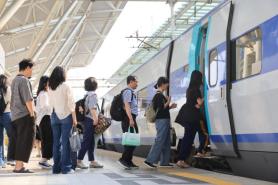 Korea's railway union delays protest action
Railway strike put off to Nov. 26 after the Korean Rail Workers' Union agreed to join forces to restore railway after derailment on Nov. 21, 2026. Photo by AJP Yoo Na-hyun SEOUL, November 22 (AJP) - South Korea's national railway union postponed planned industrial action for Monday to Thursday to focus first on restoring a freight-train derailment amid lingering staffing disputes following the KTX–SRT merger. The Korean Railway Workers' Union announced the postponement Sunday evening to join forces after a 21-car freight train derailed at Sojeong-ri Station in Sejong at 5:37 a.m. Saturday. Five cars went off the tracks, damaging overhead power equipment and forcing the suspension of conventional passenger services along a major section of the Gyeongbu Line. No casualties were reported. Korea Railroad Corp. (KORAIL) deployed 180 workers and heavy equipment for overnight repairs, restoring passenger services Sunday morning. The union said full recovery would take longer and pledged to prioritize repairs before launching its work-to-rule campaign, originally scheduled for Monday. The industrial action is part of a widening labor dispute over chronic staffing shortages and deteriorating working conditions following the September 1 merger of KTX and SRT high-speed rail operations. The union claims the integration expanded passenger capacity and services, particularly on routes serving Suseo Station in southern Seoul, while maintenance personnel, depots and other support facilities have failed to keep pace with the increased workload. The union has demanded additional maintenance workers, expanded high-speed train maintenance depots and storage tracks, and more station personnel. It argues that overtime, holiday shifts and understaffed maintenance operations have long helped keep trains running on schedule, potentially masking safety risks. Under the planned work-to-rule campaign, drivers and maintenance personnel would strictly follow operating and safety regulations, refuse certain hazardous assignments without adequate staffing and limit overtime and holiday work. The union has threatened an indefinite nationwide strike beginning December 10 unless its demands are addressed. The derailment's cause has not been established, and there is no confirmed link between the accident and the staffing shortages alleged by the union. Separately, three unions at Seoul Metro are threatening an indefinite strike Wednesday unless final negotiations Tuesday produce an agreement. They are demanding the withdrawal of a plan to cut 2,212 positions and the recruitment of 1,313 additional workers. Seoul authorities have cited financial pressures and operational efficiency as reasons for restructuring. The overlapping labor disputes could complicate travel for commuters and college applicants attending essay examinations, interviews and practical skills tests. KORAIL has activated an emergency transport task force and advised passengers to check schedules and consider alternative transportation for important appointments. Tags: KORAIL, South Korea railway strike, train derailment, KTX SRT merger, rail safety, maintenance staffing, Seoul subway strike, railway workers union.