
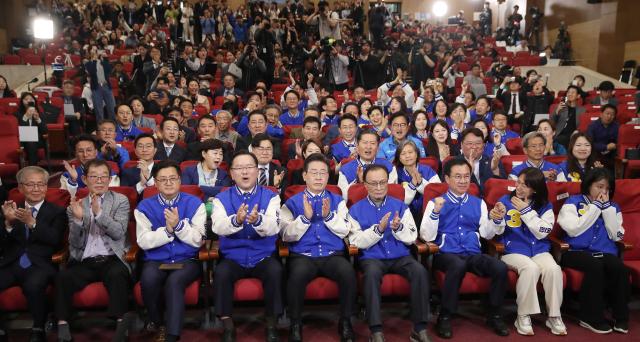
This is another major setback for President Yoon Suk Yeol and the ruling People Power Party (PPP), which managed to win 108 seats.
The wider opposition bloc, including the Rebuilding Korea Party led by former Justice Minister Cho Kuk, has won 187 seats combined. Cho's party secured 12 proportional seats, becoming the third largest party of South Korea following the DP and the PPP.
The New Future Party (Saemirae), formed by former Prime Minister Lee Nak-yon, and the New Reform Party led by ousted former PPP leader Lee Jun-seok secured one and three seats, respectively, while the leftist Jinbo Party had one seat.
The election results may weigh on the Yoon administration with Yoon still having three years to finish his five-year term.
Approximately 29.66 million people, representing 66.2 percent of South Korea's 44.28 million voters, participated in the 22nd parliamentary elections through a total of 14,259 polling stations across the country. This year's general elections showed the highest-ever voting rate of 67 percent compared to the previous record-high of 66.2 percent in the 2020 general elections.
Park Sae-jin
Experienced journalist and editor at AJU PRESS specializing in multilingual news. I cover international diplomacy, geolpolitics, and policy, consistently delivering highly accurate, compelling reporting for a worldwide audience.
Copyright ⓒ Aju Press All rights reserved.
Related News
-
 Taiwan Local Elections: DPP Claims Victory Despite Loss in Taipei
The ruling pro-American and anti-China Democratic Progressive Party (DPP) is being evaluated as having achieved a de facto victory in the local elections held on November 28, expanding its local power compared to the main opposition party, the pro-China Kuomintang (KMT).In the elections, the KMT won in three of the six special municipalities: Taipei, New Taipei, and Taoyuan, while the DPP secured victories in Taichung, Tainan, and Kaohsiung.When considering the overall 22 cities and counties, the KMT holds 11 seats and the DPP has 10, giving the KMT a numerical advantage. However, the DPP doubled its secured regions from 5 to 10 compared to the local elections four years ago, while the KMT decreased from 15 to 11.Wang Jianmin, a Taiwan issues expert at Fujian Min Nan University, diagnosed the outcome as a "slight victory for the DPP and a limited defeat for the KMT," according to the Hong Kong South China Morning Post (SCMP).Most notably, the DPP failed to capture the politically symbolic KMT strongholds of Taipei and New Taipei. Despite leading a campaign dubbed the "Yang Liu" (洋流) movement to boost public support with Taipei mayoral candidate Shen Boyang, the DPP could not overcome the incumbent KMT Mayor Jiang Wan-an, who is the great-grandson of former President Chiang Kai-shek.Wang Kun, president of the Taiwan International Strategic Association, stated, "The Yang Liu movement could not penetrate Taipei's 'blue fortress' (the KMT's symbol), indicating that Taiwan's local politics are still based on a solid voter base that is difficult to shake." On the other hand, the KMT's most painful defeat was losing Taichung to the DPP. Taichung is considered a key battleground and a major indicator of presidential election outcomes. The KMT and DPP have alternated in power there for the past 20 years.Wang Jianmin analyzed that "the defeat in Taichung could change the political landscape for the KMT in the 2028 presidential election." The current KMT Mayor Lu Shiow-yen, who has served for eight years, has been mentioned as a strong candidate for the 2028 election, but this loss may weaken her influence within the party and her chances for nomination.Chen Xiaoxiao, a Taiwan issues analyst at Jimei University in Fujian, predicted to the SCMP that "this defeat will exert pressure on the KMT regarding its direction, leadership, and candidate selection for the 2028 presidential election."Taiwan President Lai Ching-te positively assessed the election results. He held a press conference at the DPP headquarters in Taipei, stating, "There are always winners and losers in elections, but democracy always wins," adding that he has come to a deeper realization that the election results reflect the people's most genuine voice.KMT Chairman Zheng Liwen emphasized at a press conference that "the election results did not meet expectations," stating that regional integration and party unity are essential tasks that the KMT cannot avoid. This election revealed the structural issues of the KMT, as its traditional support base of older voters is gradually shrinking, while support from younger and independent voters remains weak.The Chinese government also paid attention to the results of this local election in Taiwan, as it could gauge the support bases of the DPP and KMT and the direction of public sentiment in Taiwan ahead of the 2028 presidential election.On November 29, Zhang Han, spokesperson for the Taiwan Affairs Office of the State Council, stated in a press conference that "no matter how Taiwan's political landscape changes, it cannot alter the direction and trend of cross-strait relations, and unification is an inevitable historical trend." He added, "We will continue to uphold the 'One China' principle, unite the people of Taiwan, deepen cross-strait exchanges and cooperation, and promote integrated development," vowing to firmly suppress the 'Taiwan independence' separatist forces and oppose external interference while advancing peaceful development and unification of cross-strait relations.In contrast, Taiwan's Mainland Affairs Council urged China to realistically accept the election results and engage in exchanges, cooperation, dialogue, and communication with Taiwan's democratically elected government based on equality and dignity without preconditions. It also stated that differences between the two sides should be realistically addressed to contribute to positive developments in relations.The Taiwan local elections involve the simultaneous election of local officials across nine types, including special municipality mayors and county magistrates, referred to as the "Nine-in-One" elections. This election served as a midterm evaluation of President Lai Ching-te, who took office in 2024, and was also seen as a test of the support bases and political influence of each party ahead of the 2028 presidential election.* This article has been translated by AI.
-
Taiwan Stock Market Plummets Amid AI Bubble Fears, Urgent Measures Ahead of Local Elections
The Taiwanese authorities are making every effort to boost the stock market ahead of the local elections on November 28. The Taiwanese stock market, which had been a major beneficiary of the AI investment boom this year, has recently plummeted due to fears of an AI bubble and a global tech stock correction. The stock market's performance has emerged as a key variable that could influence the voting intentions of centrist voters who prioritize the economy.Lowering Margin Loan Collateral Ratio and Expanding Financial Stabilization FundAccording to the Taiwan United Daily News on the 23rd, the Taiwan Stock Exchange held an emergency meeting with ten major securities firms on the morning of the previous day to discuss measures for stabilizing the stock market and is considering lowering the collateral ratio for stock margin loans from the current 130% to 120%. This plan is expected to be implemented soon after receiving final approval from the Financial Supervisory Commission.Lowering the collateral ratio will ease the criteria for requiring additional margin payments from investors even if stock prices plummet. This is expected to provide investors with more time to secure funds, preventing a chain reaction of forced selling that could exacerbate stock price declines.The Taiwanese authorities are also pushing to expand the size of the Financial Stabilization Fund. According to the Taiwan Financial Stabilization Fund Committee, government and ruling party officials are working to ensure that related legislative amendments are processed promptly in the Legislative Yuan.The goal is to increase the operational capacity of the Financial Stabilization Fund, which currently stands at 500 billion Taiwanese dollars, to enhance its ability to defend the stock market. Given that the scale of the Taiwanese stock market and foreign capital inflows and outflows have significantly expanded compared to the year 2000, when the fund was established, there is a growing need to increase its operational scale. The current market capitalization of the Taiwanese stock market is approximately 120 trillion Taiwanese dollars, which is more than 13 times the 9 trillion Taiwanese dollars recorded in 2000.With foreign ownership reaching 46%, concerns have been raised that the scale of foreign selling has exceeded the existing capacity of the Financial Stabilization Fund to respond. On October 15, amid fears of further interest rate hikes in the U.S. and heightened caution regarding AI-related debt risks, foreign investors sold a record net amount of 302.555 billion Taiwanese dollars in a single day.On the 21st, the Taiwan Financial Supervisory Commission announced five major measures for stabilizing the stock market, which took effect on the 23rd. These measures include prohibiting short selling at prices lower than the previous trading day's closing price, raising the minimum margin ratio for short selling from the current 130% to 150%, and halting the acceptance of applications for put warrants by securities firms. This follows an increase in the short selling margin ratio from 90% to 130% earlier this month, which has now been raised further to 150%. These actions aim to raise the barriers for investors engaging in short selling to suppress selling pressure.Worst Stock Market Performance in 35 Years, Key Variable for Local ElectionsThe Taiwanese stock market has recently been hit hard as the sell-off of AI-related stocks from the U.S. has spread across Asia. Last week, the weekly decline of the Taiwan Weighted Index was 17.5%, marking the worst weekly performance in 35 years. The index, which nearly reached 50,000 points in early October, closed at 30,633 points on the 20th, dropping nearly 14,000 points in just over a month.Known as the 'Republic of TSMC,' Taiwan has been the biggest beneficiary of the global AI investment boom this year. The Taiwan Weighted Index surged nearly 70% until early October. It has emerged as the fourth-largest stock market in the world by market capitalization.The Taiwanese stock market, with a high concentration of semiconductor and electronics sectors, has reaped the benefits of AI investments. TSMC alone accounts for about 40% of the total market capitalization of the Taiwanese stock market. However, as fears of an AI bubble have spread, the upward trend has reversed, and TSMC's stock price has dropped nearly 17% in the past month.The stock market's performance has also emerged as a key variable for the local elections on the 28th. There are predictions that the stock market's performance could significantly influence the voting intentions of centrist voters who prioritize the economy. In past local elections in Taiwan, political issues such as cross-strait relations (between mainland China and Taiwan) were key variables, but this year, the economy and people's livelihoods are expected to be the deciding factors.Taiwan election expert Chen Sung-shan stated through the Hong Kong Ming Pao that "the Taiwanese stock market and economy have enjoyed a boom over the past year, positively impacting the ruling Democratic Progressive Party. However, with the stock market turning downward this month, the performance of the stock market this week, just before the elections, has become very important."* This article has been translated by AI.
-
Understanding the 'Grammar' of Korea-U.S. Trade and Economic Security After the Midterm Elections
A Democratic governor has been elected in Alaska, marking the first time since 1998. As discussions about South Korea's liquefied natural gas (LNG) investments continue, there is keen interest in what conditions the new state government will impose on these projects. Now that the elections are over, the approval, permit, and contract documents I handle pose the same question: What will change?In this midterm election, the Democratic Party gained a majority in both the Senate and the House. There was significant discontent over rising living costs due to tariffs and the war in Iran, as well as increased electricity bills. However, this does not mean that U.S. demands on South Korea will change. Both parties largely agree on the need to counter China and expand domestic production. The president can adjust tariffs within the scope assigned by Congress, making it difficult for the Democratic victory to directly lead to tariff reductions or eased investment demands. The destination remains the same; only the path to get there is changing. The impact of the midterm elections will manifest for South Korean companies in the form of altered export control intensities, permit conditions, and contract clauses.First, let’s examine the 'intensity of export controls.' The administration has used export controls as leverage in negotiations with China. In January of this year, it allowed case-by-case reviews of exports of NVIDIA H200 semiconductors to China, and the implementation of regulations expanding export controls to companies where sanctioned firms hold more than 50% ownership has been postponed until January 10 of next year. Meanwhile, Congress has been pushing a bipartisan bill that would allow it to review and block semiconductor export permits, which has been included in the Senate's National Defense Authorization Act (NDAA). Key Democratic lawmakers have publicly raised concerns that H200 export permits could jeopardize national security. In the new Congress led by the Democrats, such scrutiny may gain more strength.This change will be felt immediately in South Korea. Graphics processing units (GPUs), which are essential for artificial intelligence (AI) computations, are among the most strictly controlled items by the U.S. If a company’s ultimate parent is based in China, it must obtain a permit to receive high-performance GPUs, as reaffirmed in May. This means that if Chinese capital owns a South Korean AI data center, every time it orders GPUs, it will have to undergo a permit review. The industry views this as a virtually closed door. To knock on that door, the ownership structure, decision-making authority, customer selection, and GPU usage management must all be designed from the outset to meet export control standards. The investment consulting I provide for data centers starts from the question of 'what structure is necessary to clear the permit threshold' rather than 'can we invest?'Next are the 'conditions of permits.' Here, we see what has not changed and what will change due to the election. In July, the U.S. added humanoid and mobile robots produced overseas to the Federal Communications Commission (FCC) list of security threat equipment, effectively blocking new models from receiving the necessary certifications for import and sale in the U.S. The path for new robots to be exported to the U.S. has been effectively closed.In the conditional approval work I am currently engaged in, production plans within the U.S. are a key focus of review. Companies must answer questions about where they will build factories when they go to sell their products. As of November, this requirement remains unchanged even after the elections. Companies that manufacture in South Korea using materials sourced from China must align with both the usage purposes permitted by China and the transactions allowed by the U.S., and the judgment will vary depending on whether they transfer the materials as is or process them. Conversely, the burden of electricity and water for data centers was a major issue in this election. If state and local governments impose stringent construction permit conditions, the speed of orders for South Korean semiconductors and power equipment will also change.Finally, we consider the 'clauses of contracts.' Investments in U.S. energy and production facilities lead to demand for engineering, procurement, and construction (EPC), making it an essential market for construction companies facing a shortage of domestic work. However, investment announcements do not guarantee work. The inclusion of U.S. material usage and local wage standards as support conditions in the Inflation Reduction Act (IRA) was also a Democratic initiative.If the new Congress raises these requirements again in budget and legislative negotiations, even if the investment amount increases, South Korean companies' share may decrease. When construction costs rise or timelines are delayed, who bears the losses will determine profitability. For multi-year supply contracts, clauses must be included to account for the possibility of intensified controls after January 10. The conditions set by the new state government will also affect the speed and profitability of Alaska LNG projects.The intensity of controls, the conditions of permits, and the clauses of contracts. These three elements represent the grammar of economic security that drives Korea-U.S. trade. The midterm elections did not change this grammar. However, Congress and state governments have begun to influence the narrative that was previously solely written by the White House. As I mentioned in my book 'The Era of Conditional Free Trade' published last year, free trade is not disappearing; it is transforming into trade with conditions.Companies must ask themselves: Can we withstand the tightening of U.S.-China controls on our materials and GPU procurement? Are there any of our investors or customers that might get caught on the threshold of permits? Who will bear the increased costs? The government must also consider these conditions alongside the scale of investment in negotiations. Elections may pass as news, but their impact remains in a single document or a line in a contract.* This article has been translated by AI.