
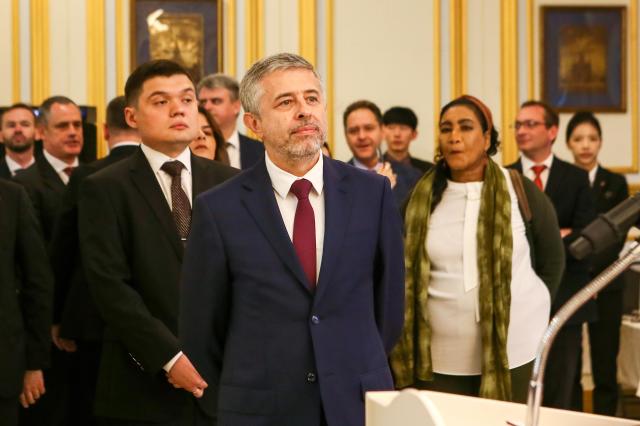
SEOUL, June 12 (AJU PRESS) - The Russian Embassy in Korea held a reception to celebrate Russia Day, the national holiday of the Russian Federation, in central Seoul on Monday.
Envoys from various countries, including China, Saudi Arabia, and Indonesia, participated in the event held at the main hall of the embassy. Lawmakers, scholars, and other distinguished guests were also among the attendees.
"This national holiday commemorates the path our homeland has tirelessly walked for centuries and its steady leap towards higher development. It is a symbol of the solidarity of the Russian people and our unwavering belief in the future," the Russian Ambassador to Korea Georgy Zinoviev said during his welcome speech.
The Russian envoy stressed the important role his country plays in the diplomatic sector: "Russia will continue to counter attempts to undermine peace and security at the global and regional levels and uphold the principles of equality, justice, and the fundamental norms of international law."
Zinoviev also addressed the increased military tension on the Korean Peninsula. "Russia consistently maintains that the key to resolving issues on the Korean Peninsula lies in reducing military tensions and building trust by taking into account the concerns of all parties involved," he said, adding that Russia is closely working with both Pyongyang and Seoul to establish systematic security guarantees.
Park Sae-jin
Experienced journalist and editor at AJU PRESS specializing in multilingual news. I cover international diplomacy, geolpolitics, and policy, consistently delivering highly accurate, compelling reporting for a worldwide audience.
Copyright ⓒ Aju Press All rights reserved.
Related News
-
 President Lee Returns Home After ASEAN and APEC Summits Amid US-China-Russia Contacts
President Lee Jae-myung embarked on his return journey on November 19 after completing a four-day trip to attend the ASEAN (Association of Southeast Asian Nations) and APEC (Asia-Pacific Economic Cooperation) summits.President Lee and First Lady Kim Hye-kyung arrived at Bao'an International Airport in Shenzhen, China, around 4 p.m. local time. They were welcomed by Hu Pan, a member of the Standing Committee of the Guangdong Provincial Party Committee and head of the Organization Department, along with Han Zichang, the ambassador for ceremonial affairs, and Dai Bing, the Chinese ambassador to South Korea. On the South Korean side, they were seen off by Ambassador to China Noh Jae-heon and Consul General in Guangzhou Jang Je-hak.As the honor guard of the People's Liberation Army of China stood at attention, President Lee and First Lady Kim exchanged handshakes with the welcoming officials before boarding Air Force One. President Lee waved to the welcoming officials before entering the private jet.During this trip, President Lee attended five multilateral meetings, including the Korea-ASEAN, Korea-Mekong, ASEAN+3, East Asia Summit (EAS), and APEC summits. He also held bilateral talks with leaders from Thailand, the Philippines, China, and Japan to discuss economic cooperation, regional issues, and peace on the Korean Peninsula.Notably, during his third meeting with Chinese President Xi Jinping since taking office, substantial progress was made in the follow-up negotiations on the Korea-China Free Trade Agreement (FTA) for services and investment, which had been ongoing for eight years and eight months. The two countries also agreed to apply most-favored-nation treatment to Korean content, including online games and films. This is expected to improve conditions for the entry of South Korean content into the Chinese market and could serve as a positive catalyst for easing the Korean ban.During his trip, President Lee also engaged with U.S. President Donald Trump and Russian President Vladimir Putin during welcome dinners and summit meetings. It is reported that he conveyed the South Korean government's position on the Korean Peninsula issue to the leaders of major countries ahead of a trilateral summit involving the U.S., China, and Russia.Upon his return, President Lee is expected to assess the impact of the discussions among the U.S., China, and Russia on the situation on the Korean Peninsula, as well as review the possibilities for resuming dialogue with North Korea and the government's strategies for promoting peace and coexistence on the Korean Peninsula.* This article has been translated by AI.
-
Takaiichi Shinsuke shakes hands with Xi Jinping for 15 seconds and talks with Putin for 30 minutes... 'Wedge diplomacy' ahead of US-China-Russia summit
Japanese Prime Minister Takaiichi Sanae shook hands with Chinese President Xi Jinping for about 15 seconds and spoke with Russian President Vladimir Putin for approximately 30 minutes during the Asia-Pacific Economic Cooperation (APEC) summit that opened in Shenzhen, China, on November 18. This marked the first face-to-face conversation between a Japanese leader and President Putin since Russia's invasion of Ukraine in 2022. Although Takaiichi engaged with the leaders of China and Russia just a day before the first-ever US-China-Russia summit, significant differences remain on key issues with Russia, and no formal meeting schedule has been set with China, leaving the potential for substantial improvement in relations uncertain. First face-to-face meeting between Japan and Russia in seven years The conversation between Prime Minister Takaiichi and President Putin took place immediately after the APEC welcome dinner. The meeting was initiated by the Japanese side, and both parties agreed to continue communication at various levels. This was also the first face-to-face meeting between leaders since former Prime Minister Abe Shinzo in 2019.During the meeting, Takaiichi demanded the immediate release of a Hokkaido Shimbun journalist who was detained on espionage charges by Russian authorities last October. Although he raised the issue again during a foreign ministers' meeting at the end of October without any progress, he decided to address it directly as the leader. According to the Nikkei, Takaiichi also appeared to urge the withdrawal of Russia's recent action that effectively stripped the management rights of Japan Tobacco's (JT) local subsidiary by presidential decree.Since President Putin's visit to the disputed southern Kuril Islands (known as the Northern Territories in Japan) in August, Russia has increased pressure on Japan through the detention of the journalist and the stripping of JT's management rights. Russia maintains that Japan is responsible for the deterioration of Russia-Japan relations due to sanctions imposed after the invasion of Ukraine, insisting that dialogue can only resume if Japan withdraws its 'unfriendly policies'.Despite the ongoing sanctions against Russia, analysts suggest that Russia's willingness to engage in this dialogue reflects its own calculations. The Nikkei forecasts that Russia may use these issues as leverage to demand a policy shift from Japan, including the lifting of sanctions. Additionally, by responding to Japan's request for dialogue without concessions, Russia can project an image of Japan seeking improved relations to the international community.Japan, which aligns its sanctions against Russia and support for Ukraine with the United States and Europe, has limited room for independent concessions. The Japanese government views the significance of this dialogue as restoring communication channels rather than achieving immediate results. According to the Yomiuri Shimbun, a Foreign Ministry official explained that the goal is to establish communication lines to address issues between the two countries. The limitations of communication have become evident, as it took nearly two weeks for a consular visit to the detained journalist, approved through diplomatic channels, to actually occur. The Japanese government hopes that resuming communication between leaders will help prevent accidental military clashes and resolve ongoing issues. Uncertain Japan-China summitWhile a dialogue has been established with Russia, there are no signs of a summit with China during Takaiichi's first visit since taking office. This contrasts with President Xi's plans to hold individual meetings with leaders attending the APEC summit. If the meeting ultimately does not take place, it would break the pattern of Japan-China summits held annually since 2022 during APEC. The two countries have not met at the leader or ministerial level since Takaiichi mentioned the possibility of exercising collective self-defense in response to a Taiwan contingency in a parliamentary response last November.The inability to even hold a meeting stems from the unresolved differences between the two countries regarding the Taiwan contingency response. China has demanded that Takaiichi correct his remarks and insists that Japan must take the initiative to normalize relations. This places the onus on Japan while China appears to be waiting patiently. The Asahi Shimbun analyzes that China is currently maintaining stable relations with the US and Russia and feels no need to compromise economically with Japan, which contributes to its relaxed stance.Japan also finds it difficult to back down. Previous Japanese governments have maintained a strategy of ambiguity regarding whether a Taiwan contingency would warrant the exercise of collective self-defense, stating that it would depend on individual circumstances. The Takaiichi administration has attempted to clarify that its existing position has not changed in response to China's strong backlash, but China has not accepted this. However, retracting the response could limit Japan's actions in a Taiwan contingency. Additionally, with Takaiichi seeking re-election in the ruling Liberal Democratic Party's presidential election next autumn, it becomes even more challenging to make concessions that could provoke backlash from conservative factions. A government official stated, "The resolution is not that simple."Given the difficulty of expecting a formal summit, opinions within the Japanese government were divided on how to approach the handshake with Xi. According to the Yomiuri, one official suggested that while a formal meeting may be difficult, informal conversations could lead to progress, advocating for proactive engagement. Conversely, there were cautious voices warning that approaching too hastily could backfire, given Xi's firm stance. Ultimately, Takaiichi smiled and initiated conversation during the approximately 15-second handshake, but Xi did not respond.Some within the government have assessed that while it was not a formal meeting, the handshake between the leaders represents a step forward. However, communication channels with China are increasingly narrowing. Former Prime Minister Abe Shinzo, who was also considered a hardliner toward China, used former Prime Minister Fukuda Yasuo as a bridge for communication, but Fukuda passed away last month. As a Foreign Ministry official noted, "Improving relations takes years," and there is a prevailing outlook that Japan will have to focus on strengthening ties with allies such as the US for the time being.Meanwhile, a historic first US-China-Russia summit is set to take place on the afternoon of November 19. Japan is coordinating a phone consultation between Takaiichi and President Trump following the summit, aiming to showcase close US-Japan ties by receiving immediate updates on the meeting's outcomes.At the same time, the Yomiuri analyzes that Japan has grown increasingly aware of the need to independently rebuild relations with China and Russia, rather than relying solely on the US. Concerns have been raised that China and Russia may leverage their historical status as allies against Japan during World War II to draw the US into their orbit. The more Japan confronts China and Russia, the greater the motivation for them to involve the US in pressuring Japan. The Japanese government is calculating that by directly addressing these relations, it can reduce that motivation, with a senior government official stating that this approach "drives a wedge into the US-China-Russia engagement."* This article has been translated by AI.
-
Historic Day at APEC: U.S., China, and Russia Leaders Hold Summits
The leaders of the United States, China, and Russia gathered in Shenzhen, China, on November 19 for a day of three consecutive summits. President Donald Trump and Chinese President Xi Jinping are scheduled for a bilateral meeting, followed by a meeting between Trump and Russian President Vladimir Putin, culminating in a trilateral summit involving all three leaders. This diplomatic event marks a rare occasion where the heads of these three major powers, who have been engaged in competition and conflict over global order, come together.The day's agenda begins with the plenary session of the APEC summit. As the host, President Xi will preside over the meeting and is expected to emphasize opposition to protectionism, the importance of free trade, and the shared prosperity of the Asia-Pacific region. Cooperation in advanced technology fields, including artificial intelligence (AI), is also anticipated to be a key message. Amid ongoing U.S.-China tech rivalry, China is expected to stress the need for economic cooperation in the Asia-Pacific region.Following the plenary session, a meeting between President Trump and President Putin is scheduled. However, this encounter is expected to be more of a brief informal meeting rather than a formal bilateral negotiation. While the likelihood of reaching specific agreements on sensitive issues such as the Ukraine war and Western sanctions against Russia is low, the direct dialogue between the two leaders may pave the way for future summits.At 12:30 p.m., a U.S.-China summit will take place at Qilin Mountain Lodge, where Trump and Xi will exchange views primarily on economic issues during a working lunch. Attention will be focused on whether key topics such as tariffs, trade, rare earth supply chains, and controls on advanced technology will be discussed. Particularly, with the recent Jensen Huang incident leading to increased U.S. semiconductor sanctions against China, there is interest in finding common ground on this issue.The day's diplomatic agenda will conclude with a trilateral summit at Qilin Mountain Lodge at 2:30 p.m. This historic diplomatic event will see Trump, Xi, and Putin meet in one place. The meeting is reported to be allocated about one hour. The U.S. and China are competing over the global economy and technological order, while the U.S. and Russia are at odds over the Ukraine war. China and Russia maintain a strategic cooperative relationship but have different interests regarding their relations with the U.S. The mere fact that the leaders of these three countries are gathering is a significant point of interest for the international community.Wang Wen, director of the Chongyang Institute for Financial Studies at Renmin University of China, analyzed that "due to the differing strategic interests of the three countries, it will be difficult to reach significant agreements in the short term," adding that "the greatest significance lies in the fact that the three leaders are sitting down to talk directly." Wu Xinbo, director of the Institute of International Studies at Fudan University and head of the U.S. Research Center, also stated, "This meeting should be seen as the beginning of an important political process," emphasizing its historical significance in that it marks the start of strategic communication and dialogue among the three countries.* This article has been translated by AI.