
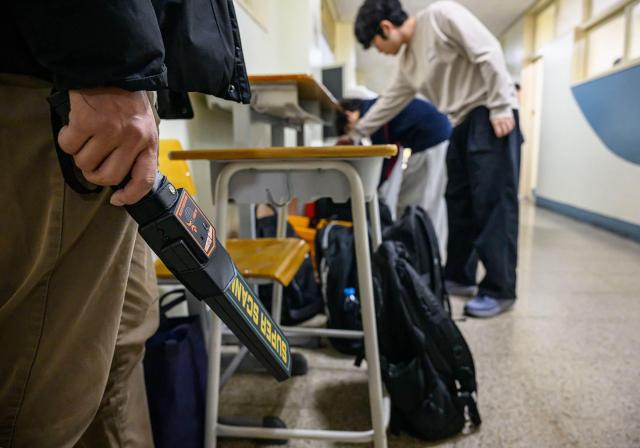
By afternoon, the crackdown had uncovered 22 undeclared smartphones and a miniature camera at a separate test site, while a prominent figure facing allegations of AI-assisted cheating was found dead in a Seoul motel.
The unprecedented security operation turned Thursday's College Scholastic Ability Test (CSAT), or Suneung, into a national exercise in detecting hidden electronics as authorities sought to protect the integrity of an examination that can determine university admissions and career prospects.
The controversy took a tragic turn when Lee Jin-woo, 32, who had earned a perfect score on South Korea's notoriously demanding Law School Admission Test (LEET), was found dead at a motel in eastern Seoul after failing to appear for a promised live demonstration of his test-taking abilities.
Lee had faced allegations that he used artificial intelligence to achieve exceptional scores on last year's CSAT and this year's LEET. He had denied the allegations and pledged to clear his name by solving the Korean-language section of Thursday's exam live before an audience.
His absence from the scheduled broadcast triggered concern over his whereabouts and a police search. He was found in cardiac arrest at a motel in Seoul's Gangdong district at around 1:12 p.m. His death was subsequently confirmed.
Police said they would investigate the circumstances. The cause of death had not been established, and the cheating allegations against him remained unproven.
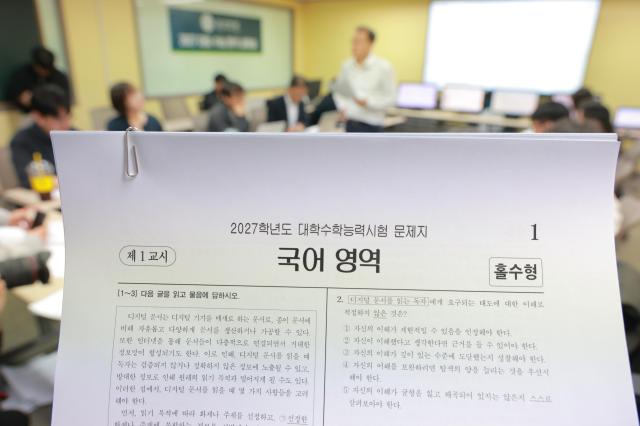
The tragedy unfolded against an extraordinary government campaign against cheating.
President Lee Jae Myung had ordered sweeping measures to prevent AI-assisted fraud, including surprise emergency alerts and rewards for whistleblowers. The government announced plans to offer up to 100 million won for reports leading to confirmed cheating cases and pursue legislation barring serious offenders from taking the exam for up to 10 years.
On Thursday, the crackdown reached virtually every mobile phone in the country.
At 8:30 a.m., 10 minutes before the first examination began, phones nationwide sounded a 10.5-second emergency alarm at maximum volume. Unlike ordinary safety notifications, the highest-priority alerts cannot normally be disabled by users.
The alarms sounded again at 2:21 p.m., after the English section, and at 2:57 p.m., during the Korean history test.
The alerts were not warnings of an earthquake, an air raid or another threat to public safety. They were designed to expose smartphones that candidates had concealed or failed to surrender.
The first alert alone uncovered 22 smartphones at examination centers across nine cities and provinces, according to the Ministry of Education.
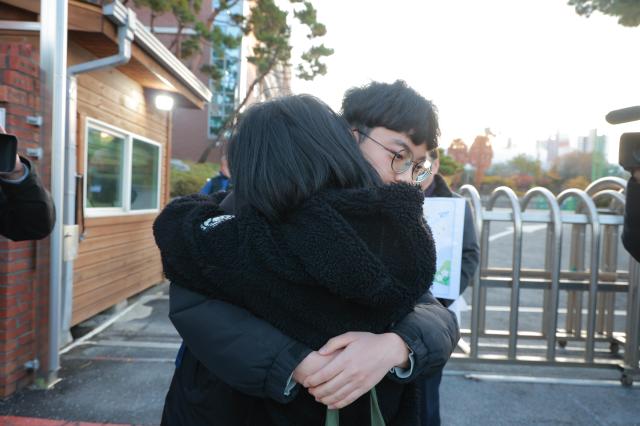
Vice Education Minister Choi Eun-ok said the students involved were referred to examination authorities for further inspection. No additional sophisticated cheating devices had been reported among those 22 cases at the time of the ministry's briefing.
A separate discovery heightened concerns. At a high school examination center in Yongin, south of Seoul, authorities found a miniature camera and an earphone, devices that could potentially be used for covert communication. Police were preparing to investigate, although their use in cheating had not been established.
Officials had also introduced unusually extensive precautions, including stickers to cover clothing buttons and restrictions on personal writing instruments, amid fears that tiny cameras could be concealed in seemingly ordinary objects.
The measures reflected growing anxiety over the ability of AI technology to undermine conventional examination supervision. Small cameras can capture questions while connected devices may enable outside assistance, raising questions about whether traditional bans on phones and electronic equipment remain sufficient.
Yet the alarms also raised questions about the use of a public emergency warning system for examination enforcement, with millions of people receiving alerts intended to detect misconduct among a comparatively small number of test takers.
For students inside examination rooms, meanwhile, the questions themselves remained the immediate challenge.Early assessments suggested that the Korean-language section was easier than last year's exam and the September mock test. EBS teachers cited shorter passages and less complex reading material, although several questions still required careful reasoning.
The mathematics section was assessed as broadly similar in difficulty to last year's, with relatively accessible common questions but more demanding problems in the elective sections. English difficulty was also adjusted after last year's test produced a first-grade rate of just 3.11 percent.
Education authorities said 490,915 students had taken the first Korean-language section, with an absentee rate of 9.97 percent, up from 9.4 percent last year.
Copyright ⓒ Aju Press All rights reserved.
Related News
-
 Perfect LEET scorer a no-show for live Suneung broadcast
SEOUL, November 19 (AJP) - Lee Jin-woo, 32, who reportedly achieved a perfect score on South Korea's Law Education Eligibility Test (LEET), failed to appear for a scheduled public verification session Thursday morning amid allegations of exam cheating. Lee was expected at an admissions research institute in Seoul's Gangnam district by 8 a.m. to solve college entrance exam questions under supervision. He had not arrived as of 8:17 a.m., and his phone was reportedly switched off. Lee has faced cheating allegations and criminal complaints, although the accusations have not been established. Tags: South Korea, LEET, Lee Jin-woo, Exam Cheating, College Entrance Exam, Education
-
 Black pencils, stickered buttons, blaring phones: AI adds to suneung jitters
Students cheer on their senior classmates at Joongdong High School in Gangnam District, Seoul, on the morning of Nov. 18, 2026, a day before the College Scholastic Ability Test (CSAT). AJP Han Jun-gu SEOUL, November 18 (AJP) -The suneung cold snap is back. The cheering squads are in place, and volunteer drivers are standing by to ferry students for free. But the mood is shambolic on the eve of South Korea’s make-or-break college entrance exam, with anti-AI cheating rules still changing a day before 551,864 registered candidates sit the test. Glasses will be inspected. Phones will be surrendered. Clothing buttons will be covered with stickers. Black pencils are the only writing tools students may bring. And at 8:30 a.m. Thursday, 10 minutes before the exam begins, every phone switched on in the country will blare an emergency alert designed to expose any device a candidate failed to hand in. “All this fuss is just making everyone so nervous. Parents are getting all different information and guidelines,” said Oh Eun-ji, 51, a Seoul resident whose daughter at Chungdam High School will sit the College Scholastic Ability Test (CSAT), known as suneung. “I have to double-check my daughter’s wardrobe and have her wear contact lenses instead of eyeglasses tomorrow to lessen her stress before sitting down for the test.” The crackdown follows a scandal over electronic devices in the national tax accountant exam, in which a test-taker came forward as an AI cheat after earning a near-perfect score. This year’s students are bearing the collateral damage, and the sarcasm has spread as fast as the rules. Must South Korea follow India, some asked online, sharing a decade-old photo of military recruitment applicants taking an exam outdoors in their underwear? A motorcyclist joining the launch of volunteer riders on the suneung day hosted by a volunteer group Parents Who Love Schools, outside the Government Complex Seoul in Jongno District, Seoul, Nov. 18, 2026. AJP Yoo Na-hyun The alert reaches furthest. The Ministry of Education and the Ministry of the Interior and Safety said Wednesday that a first message will go out at 8:30 a.m., with another to follow without warning. It cannot be blocked and will sound at maximum volume for 10.5 seconds on every phone that is on, including those of foreign residents, with English text included. “This is a message to prevent cheating on the CSAT,” the unannounced alert will read. “Please do not be alarmed and carry on with your daily lives.” The government said supervisors’ phones will be kept from sounding in exam rooms and that testing will not be disrupted. The stationery rule landed just as abruptly as prior improvised measures. Under an emergency notice issued Wednesday, computer-marking pens, correction tape, erasers and mechanical pencil leads, all previously allowed, will instead be handed out at test centers. The ministry said the change is meant to block miniature cameras and communication devices disguised as ordinary stationery. Candidates who bring the banned items must leave them in bags outside the classroom. Anyone caught merely holding one during the exam will have it confiscated and examined for possible cheating. Inside the rooms, supervisors will put stickers over clothing buttons to block concealed cameras. Students must place their glasses on their desks for inspection, roll up their sleeves and submit to checks of collars, wristwatches and other accessories. The ministry urged candidates to wear buttonless clothes and skip necklaces, rings and hats. A school staff member posts a notice on new set of guidelines and penalties for cheating with smart devices at Yeongdeungpo Girls’ High School in Yeongdeungpo District, Seoul, on the afternoon of Nov. 16, 2026 AJP Yoo Na-hyun The government is adding 8,400 personnel, including 1,800 smart-device specialists and 6,600 corridor supervisors, to about 75,000 existing invigilators. Measures to stop unauthorized communication over nearby Wi-Fi networks are also under consideration. Test centers are struggling to keep up. Some schools had to find thousands of stickers on their own because none were centrally supplied, while newly recruited corridor supervisors were scheduled for online training Wednesday afternoon. Teachers’ groups questioned whether every button and accessory can be checked in the limited time without unsettling candidates. At Eunpyeong High School in Seoul, teacher Cho Min-jin rushed to explain the new rules. “We prepared signature pens, correction tape and erasers as gifts to cheer the students on, but now they can’t be used,” she said. Underscoring the gravity of the matter, President Lee Jae Myung, chairing an emergency video meeting from the Philippines on Tuesday, called exam cheating a “serious crime” that undermines fair competition and public trust. “The fairness and credibility of the CSAT must never be shaken,” he said, demanding zero tolerance and investigations into suspected uploads of exam papers to AI services. Lee ordered a review of whistleblower rewards of at least 100 million won [$75,000) for reporting sophisticated cheating and called for legislation requiring AI companies to hand over records relevant to suspected exam fraud. The ruling Democratic Party is pursuing special legislation that would extend the one-year ban on retaking the CSAT to as long as 10 years for AI-assisted cheating. It also wants tougher penalties to apply to offenses at this year’s exam. The proposals are not yet law. Online, jokers posted jackets covered in dozens of buttons, picturing supervisors spending the whole exam applying stickers, while others proposed handing candidates buttonless T-shirts. One AI-generated image showed Seoul’s Yongsan electronics district celebrating dozens of admissions to Seoul National University. For ordinary students and parents, the well-wishing cheers and prayer rituals went on. Students cheer on their senior classmates at Joongdong High School in Gangnam District, Seoul, on the morning of Nov. 18, 2026, a day before the College Scholastic Ability Test (CSAT). AJP Han Jun-gu At Jungang High School, seniors walked a red carpet Wednesday as younger students clapped and shouted encouragement, beneath a banner reading, “The time you have built up, now the moment to shine.” Younger students at Suwon High School in Gyeonggi Province lined up Tuesday to send off their seniors. “I studied more than seven hours a day, so it’s a relief to think it ends tomorrow,” said Jungang senior Kim Min-jun, laughing. “It’s noisy because of AI, but that actually makes me less nervous.” Oh Jun-young, a senior at Eunpyeong High, was just as unmoved. “I’m worried about the AI issue, but I won’t let it get to me,” he said. “I’ll take the test the way I always have.” A parent praying t Jogyesa Temple in Jongno District, Seoul, on the afternoon of Nov. 9, 2026, 10 days before the College Scholastic Ability Test (CSAT). AJP Han Jun-gu The country, as ever, will bend around the exam. Government offices and businesses have been asked to delay their morning start until 10 a.m., and extra subway services and police transport will help students reach test sites. The Korea Exchange will run regular trading from 10 a.m. to 4:30 p.m., and banks will open from 10 a.m. to 5 p.m. Aircraft takeoffs and landings will halt from 1:05 p.m. to 1:40 p.m. during the English listening test, affecting 130 domestic and international flights. The military will suspend noisy drills, artillery fire and aircraft operations near test centers, and more than 10,000 police officers will guard exam materials and support transportation. This is the last CSAT under the current elective-subject system before a major overhaul in 2028. Total applicants fell by 2,310 from last year, but the 196,473 graduates and equivalency certificate holders among them are the most in 23 years, sharpening the competition. The exam begins at 8:40 a.m. Thursday as scheduled.
-
 OPINION: Suneung has gone haywire, and stickers will not fix it
High school seniors leave Joongdong High School in Gangnam District, Seoul, to cheers from younger students on the morning of Nov. 18, 2026, a day before the College Scholastic Ability Test (CSAT). AJP Han Jun-gu The eve of the suneung – the Korean for the once-a-year Collage Scholastic Ability Test (CSAT) - is supposed to be quiet. Students check the route to their test site, pack their bags and try to sleep early. This year, every feed is dizzy. More than 550,000 candidates, and far more people once their families are counted, spent Wednesday working out which pens they can no longer carry, which shirt has too many buttons and whether their glasses will pass inspection. The mood has turned intimidating after President Lee Jae Myung floated the idea of putting up bounty money for those who report cheats, stirring the police to immediate rummage through the internet. The reward would be at least 100 million won (about $75,000) per case for high-tech cheating, with lighter punishment for accomplices who come forward, and students on online forums warn that the money could invite excessive reports and indiscriminate suspicion. A task force led by the National Police Agency’s investigation chief began a crackdown on Monday, and eight of the 14 reported cases of AI-assisted exam cheating are under investigation. Officers are also checking the authenticity of 13 online items, from cheating confessions and threats to ads for equipment, and have deleted or blocked 40 posts they deemed baseless or conspiratorial. One author had vowed to smuggle miniature gear into the exam to expose its weaknesses. Yet the nominee for police chief said Wednesday that no investigation into specific cheating on the suneung is under way. Nothing has been proven against this exam. Education Minister Choi Kyo-jin inspects a College Scholastic Ability Test (CSAT) site at Yeongdeungpo Girls’ High School in Yeongdeungpo District, Seoul, on the afternoon of Nov. 16, AJP Yoo Na-hyun Even so, trust, the only currency it runs on, is already draining away. Suspicion now reaches everywhere. A high school senior has asked the Constitutional Court to suspend the exam date, arguing that candidates are being made to bear the risk of inadequate safeguards. The first person ever to earn a perfect score on the law school admission test, doubted online, has promised to solve Thursday’s Korean-language section live. On Telegram, a group of about 22,700 members advertises button cameras and camera glasses, the latter for about 800,000 won ($600), though reporters found no proof that any kit was delivered, and it may be a scam. The fuss has a clear origin. The top scorer in this year’s state tax accountant exam missed just one of 160 first-round questions, including a perfect mark in a tax law paper where the average was 30.18. On Nov. 15, that candidate confessed on YouTube to cheating with electronic devices and generative AI, photographing questions with a tiny camera, sending them to AI and reading the answers on a smartphone. The candidate is now a police suspect. The details are damning for the system. The candidate sat in the center of the second row for the first round and the front row for the second, with two invigilators in the room. Phones were not collected, there was no CCTV, and the specialist monitors hired to spot cheating devices were not deployed at the exam. The exam agency failed to find signs of cheating even after suspicions surfaced. It took a confession to expose what a national testing system could not see. A commercially available miniature camera is seen in front of a notice on penalties for cheating with smart devices at a test site in Yeongdeungpo Girls’ High School in Seoul on the afternoon of Nov. 16, 2026, three days before the College Scholastic Ability Test (CSAT). AJP Yoo Na-hyun The alarm had been ringing for months. Smart-glasses cheating was first caught in national qualification exams in May. The state skills agency has since logged 12 such cases this year. Last month, candidates wearing AI glasses were caught at essay exams for the University of Seoul and Yonsei University. Yet the government focused on glasses and left other methods unprepared, and the tax exam was beaten by a camera. What followed was improvisation. Education Minister Choi Kyo-jin told lawmakers he did not think AI cheating could be caught perfectly, and officials stumbled over whether to block signals at test sites. Then, within days, came the black-pencil rule, the button stickers, 8,400 extra personnel and an alert set to blare from every phone in the country. Oversight was lax until it became frantic. Cheating with devices is hardly new. In 2004, police traced CSAT answers sent as numeric text messages and booked more than 100 people. The hardware has long existed. What has changed is the software. A hidden camera could once only carry a question out of the room, and someone outside still had to solve it. Generative AI removes that someone. Cheating has become smarter, cheaper and closer to the perfect crime – unless the cheat confesses. Here lies the bitter irony. South Korea is enjoying a chip bumper year on the back of AI. The country is expected to cross the $1 trillion export milestone this week, and it owes more than 40 percent to semiconductors. Tax revenue is forecast at a record 478.6 trillion won ($358 billion), 63.2 trillion won above the government’s estimate in March, with surging profits at Samsung Electronics and SK hynix doing much of the work. Seoul has been racing to become a top-three AI power, and yet it has neglected the side effects along the way. Family members of test-takers, pray at Jogyesa Temple in Jongno District, Seoul, on the afternoon of Nov. 9, 2026, 10 days before the College Scholastic Ability Test (CSAT). AJP Han Jun-gu Every coin has two sides, and an intoxicated country forgot to turn this one over. The government’s budget for next year set aside no dedicated money for detection gear or extra monitors at the state skills agency, and radio detectors for test sites will arrive next year at the earliest, leaving invigilators to rely on their eyes. Only after the confession did the government and lawmakers move to add 18.2 billion won ($13.6 million) for national qualification exams. That is about 0.03 percent of this year’s revenue windfall. China, meanwhile, has already used signal blockers and had AI services suspend problem-solving functions during exams. At home, convicted exam cheats have usually received fines or suspended sentences. The nation that supplies the memory for the AI age left its own exam halls guarded by the naked eye. Thursday’s measures may well deter some. They cannot win the race. AI glasses now weigh about 50 grams and are nearly impossible to tell from ordinary frames by eye, and smart contact lenses are in development. A sticker covers yesterday’s camera. Meanwhile, every candidate will sit a life-shaping test under the gaze reserved for a potential cheat. Authorities can casually call all this a transition, an experiment, something to learn from as we go. That language suits a software release. It does not suit a day for which students have studied morning and night for years, with their careers, future jobs and dreams at stake. Those who stumble on Thursday cannot simply patch the error. They wait a year. That is the deeper flaw. Because so much rides on one sitting, a single stolen answer is worth a fortune, a single rumor can unnerve a nation and a single bad morning can redirect a life. The single-day suneung must be overhauled. This will not be simple, and South Korea has been here before. The first CSAT was held twice, in August and November 1993, but was cut to once a year after matching the difficulty of the two tests proved too hard. That was a real obstacle, but it belonged to another era. The American SAT is offered several times a year. Three decades on, the question deserves a fresh answer. A teacher of senior students at Eunpyeong High School in Eunpyeong District, Seoul, receives an urgent notice on the Education Ministry’s change to the items candidates may bring into exam rooms on Nov. 18, 2026, a day before the College Scholastic Ability Test (CSAT). Pool photo The question-and-answer format needs the same scrutiny. A multiple-choice item is exactly what a hidden camera and a chatbot handle best. The National Education Commission is reviewing essay-style questions and absolute grading for the CSAT, with a final plan due next March. Essays alone are no cure. The tax exam cheat says AI was also used in the second round, which is essay-based. They also bring their own worries over private tutoring and fair grading. So the country needs what it has lacked this week: time to think. Past governments that pushed absolute grading were repeatedly defeated by public backlash, and a reform drafted in panic will meet the same fate. Once the last bell rings, South Korea should audit what worked, ask what the exam is really for and rebuild it with students at the table. A sliver of the chip windfall would pay for it. At 8:40 a.m. Thursday, 551,864 registered candidates are due to begin with black pencils and years of work behind them. They have kept their side of the bargain. The adults who run this exam now have to keep theirs. *The writer is the managing editor of AJP. **The views expressed are those of the author and do not necessarily reflect the editorial position of AJP.