

Last week, cable channel TV Chosun, citing an anonymous government official, reported that Pyongyang is likely to dispatch engineering forces to Ukraine's Donetsk Oblast, currently occupied by Russian forces, to engage in reconstruction projects there as early as next month.
The news was soon circulated, with some foreign military specialists speculating that such a move could potentially enable Russia to deploy more troops to frontlines areas, thereby prolonging the ongoing war.
A ministry spokesperson here said during a press briefing, "We are carefully monitoring the situation without making any assumptions over the possibility."
According to an assessment released by the U.S.' Institute for the Study of War (ISW) on Thursday (local time), no evidence was found that Pyongyang is preparing to send engineering units to Ukraine. ISW said the claims made by U.S. officials "are inaccurate."
Russia also denied the possibility. The Kremlin spokesman Dmitry Peskov said during a press briefing on Thursday that Russia is "unfamiliar with" the claims, according to Russia's state news agency TASS.
Earlier this month, North Korea and Russia signed a defense pact during President Vladimir Putin's visit to Pyongyang. The pact includes provisions for bilateral military cooperation, stipulating mutual military assistance in case either country faces aggression.
Park Sae-jin
Experienced journalist and editor at AJU PRESS specializing in multilingual news. I cover international diplomacy, geolpolitics, and policy, consistently delivering highly accurate, compelling reporting for a worldwide audience.
Copyright ⓒ Aju Press All rights reserved.
Related News
-
 Korea Exceeds $1 Trillion in Exports, Launches 2026 Trade Week
As Korea surpasses $1 trillion in annual exports for the first time, the government is taking steps to expand overseas markets for small businesses and diversify export markets. This initiative aims to spread the achievements of the export record to small enterprises and discover new export growth engines.The Ministry of Trade, Industry and Energy announced that it will operate Trade Week from the Korea Grand Sourcing Fair (KGSF) held at COEX in Seoul on November 24 until Import Day on December 9.The Korea Grand Sourcing Fair is a prominent export consultation event organized by the Korea International Trade Association since 2009. This year, 1,000 domestic small businesses will participate alongside 160 overseas buyers from 30 countries, conducting over 2,600 export consultations on November 24 and 25.The event will feature promising companies from various sectors, including consumer goods such as K-food and beauty products, as well as household items, health, and digital technology. Opportunities for export consultations and collaborations aimed at entering new overseas markets in Latin America, the Middle East, and Europe will also be provided.In particular, small businesses lacking their own overseas sales networks will receive one-on-one export consultation support from specialized trading companies. For companies wishing to enter the halal market, which has significant growth potential in the Middle East and Southeast Asia, product evaluations by local buyers and tailored consulting will be offered.This Trade Week is significant as it follows Korea's achievement of $1 trillion in annual merchandise exports on November 19, making it the fourth country in the world to reach this milestone after the United States, China, and Germany. Since achieving $100 million in annual exports in 1964, Korea has increased its export scale by 10,000 times over 62 years. Exports from small businesses are also on the rise. According to the Ministry of Trade, Industry and Energy, small business exports reached $107.6 billion from January to October this year, marking a 9.9% increase compared to the same period last year, setting a record high.The ministry plans to use this Trade Week to share the achievement of reaching $1 trillion in exports with businesses and the public while highlighting the overall role of trade, including imports. It aims to expand mutually beneficial cooperation with key trading partners and explore sustainable trade growth strategies.Kang Gam-chan, head of the Trade and Investment Bureau at the Ministry of Trade, Industry and Energy, stated, "Achieving $1 trillion in exports is a result created by the continuous efforts of our companies and the buyers around the world who trust and choose Korean products. We hope this Trade Week will serve as an opportunity to spread these achievements to more companies while expanding cooperation for mutual benefit and shared prosperity with trading partners."* This article has been translated by AI.
-
K-Culture Drives Surge in Foreign Tourism to South Korea
The primary driver of foreign tourists traveling to South Korea remains K-Culture. However, interest has evolved from merely enjoying content on screens to experiencing and consuming it directly in Korea.According to a survey by the Korea Culture and Tourism Institute, 34.5% of respondents cited 'exposure to K-Content' as the top reason for their interest in traveling to Korea, followed by traditional Korean culture at 32.5% and reasonable travel distance and flight time at 26.5%.A global survey released by Airbnb in April confirmed this trend. Among 4,500 travelers from the Asia-Pacific and U.S. regions who have visited or plan to visit Korea, 94% said that 'K-Culture influenced their interest in traveling to Korea,' and 75% identified 'K-Culture' as a key reason for their visit.Demand has also increased for direct experiences, moving beyond just watching dramas, movies, music videos, and K-Pop artists on YouTube and social media. An analysis of data from the global travel platform Klook showed that traffic for K-Pop-related products increased by 68.6% compared to the same period last year. Experience products, such as dance classes taught by professional instructors, saw a 102% increase, while idol makeup and hairstyling products rose by 148%. Tours to visit locations associated with stars also jumped by about 27%.The rise of social media and short-form content is seen as a key factor in this shift from screen content to experiential and fandom tourism. Professor Yoon Hye-jin from Kyonggi University stated, "The influence of online video services (OTT), K-Pop, and short-form videos on platforms like YouTube and TikTok is stimulating a desire to visit Korea much more strongly than traditional advertising. Fandom tourism has become evident, with fans not only attending performances and pilgrimage tours but also celebrating artist-related anniversaries."The K-Wave boom has also opened the wallets of foreign tourists. The Airbnb survey found that travelers visiting Korea for K-Culture spend an average of 435 dollars (about 640,000 won) more than those who do not. A survey by the Ministry of Culture, Sports and Tourism indicated that the percentage of respondents who believe K-Wave positively influences their purchase of Korean products and services increased from 58% to 65% over the past three years. According to the ministry, foreign tourists' card spending in the tourism sector reached 15.94 trillion won (KRW) from January to September this year, a 47.7% increase compared to the same period last year, which saw 10.79 trillion won (KRW).While K-Culture plays a strong role in driving demand for visits to Korea, experts emphasize the need to move beyond reliance on fleeting popularity and focus on sustainability. Professor Yoon noted, "Korean tourism has historically depended on the temporary popularity of content, lacking consideration for sustainability and ecosystem development. While the number of foreign visitors is important, we must now concentrate on increasing the revisit rate of tourists who have visited once."He added, "If the expectations set by videos do not align with the actual experiences in Korea, it could lead to a negative effect that prevents revisits. It is essential to connect content with local tourism, such as food and festivals, and to develop foundational infrastructure like transportation, accommodation, and information systems. The government needs to play a coordinating role to ensure that culture, content, and tourism do not operate in isolation."* This article has been translated by AI.
-
 AJP poll: Korea's year-end rate seen at 3.25% despite stock volatility
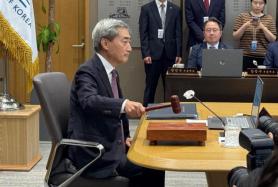
Bank of Korea Gov. Shin Hyun-song bangs the gavel at a Monetary Policy Board meeting at the central bank's headquarters in Seoul on July 16, 2026. Courtesy of the Bank of Korea SEOUL, November 23 (AJP) — The Bank of Korea is expected to bump up its base rate to 3.25 percent at its final rate-setting meeting of 2026 on Thursday, regardless of stock volatility from the AI crash, in a preemptive move ahead of an expected Fed hike in December, an AJP poll showed. All six economists agreed on the year-end rate, which would be the third raise by a quarter of percentage point following two consecutive hikes in the summer. Five expect another quarter-point move in the first quarter of 2027, most likely in February, taking the rate to a peak of 3.50 percent, a firmer consensus than in October's poll, when four of six respondents saw 3.50 percent as the peak. The same five expect the median of board members' six-month-ahead rate projections to rise to 3.50 percent from 3.25 percent in August, signaling another hike after this week. "Stronger growth and sticky underlying inflation justify pre-emptive tightening, although still-weak domestic demand could prevent unanimity," said Park Chong-hoon, chief economist at Standard Chartered in Seoul. Respondents were evenly split on Thursday's vote, with three expecting at least one board member to dissent in favor of a hold and three expecting a unanimous decision. The stock market's slide has not changed their rate call, even as the KOSPI fell 3.31 percent Monday to stand nearly 50 percent below its June record. But currency strength, which has helped ease import-price pressure, and concerns about repayment difficulties among leveraged investors have complicated the case for further tightening. The chip boom has done little for household spending, and the negative wealth effect from falling stocks is now weighing on consumption, said Park Sang-hyun, a senior researcher at iM Securities. He nevertheless expects the rate to peak at 3.50 percent in the first quarter. Real interest rates are already restrictive and financial vulnerabilities are building, making hikes beyond 3.50 percent likely to do more harm than good, said Kim Ji-na, an analyst at Eugene Investment & Securities. UOB was the lone exception on the peak, expecting the BOK to hold at 3.25 percent through 2027 as growth and inflation moderate. An additional hike would come into view only if inflation reaches 3 percent in the first quarter, said Ho Woei Chen, an economist at UOB. Edited and compiled by AJP. Graphics AI assisted. The poll's consensus runs ahead of bond-market expectations. The three-year government bond yield has fallen about 22 basis points since the October meeting, from 3.840 percent to 3.623 percent at Monday's close. The 10-year yield has dropped about 33 basis points from 4.152 percent to 3.827 percent. Bond markets are still pricing in a peak policy rate below 3.50 percent, Yoon Yeo-sam, a bond analyst at Meritz Securities, wrote in a report Monday. The BOK's guidance has nevertheless kept economists leaning toward another hike. When the board held rates last month, Governor Shin Hyun-song said growth and inflation were running stronger than projected in August. He pledged to keep policy tight until inflation settles at the 2 percent target, which he expects around 2028. Shin said the timing and pace of further hikes would depend on third-quarter growth and October inflation. The economy subsequently reported growth of 1.0 percent in the third quarter from the previous three months, well above the BOK's August forecast of 0.3 percent. Consumer and core inflation both ran at 2.8 percent in October. The BOK expects November inflation to remain in the high-2 percent range, citing persistent core price pressure. Minutes of the October meeting showed one board member warning that the surge in nominal growth could prolong core inflation, while another said the board should weigh the timing and size of further hikes. Some members also flagged the broader interest burden of higher rates, a concern that could produce a dissent Thursday. Finance Minister Lee Hyoung-il said Monday that economic growth could reach the high-3 percent range this year. The state-run Korea Development Institute, which raised its 2027 growth forecast to 3.9 percent this month, has also recommended maintaining a tight policy stance. The won weakened 9.7 won to close at 1,345.9 per dollar Monday after briefly slipping past 1,350. Renewed currency weakness would reinforce the case for tightening, Park Chong-hoon said. Thursday's rate projections will be watched as closely as the decision itself for signs of whether the board shares economists' view that one more hike lies ahead in 2027.