

A tropical night is when the lowest temperature does not drop below 25 degrees Celsius after dark.
Many Seoul residents had a sleepless night on Friday as the capital region extended its streak of tropical nights to 33.
According to the Korea Meteorological Administration (KMA), Seoul had already experienced three occurrences of such hot and humid nights before the current streak began on July 21, bringing the total for this year to 36 and breaking the previous record set in 1994 since weather observations began in 1907.
"Cheoseo," which is often considered the end of summer according to the lunar calendar, just passed earlier this week, but there seem to be no signs of the summer heat abating.
The KMA now forecasts that sweltering weather along with tropical nights will persist across the country until early next month, due to the expansion of the Tibetan high-pressure system which brings hot and dry air to the Korean Peninsula.
The prolonged scorching heat has also taken its toll, with the number of heat-related patients exceeding 3,000 so far this year, according to the Korea Disease Control and Prevention Agency.
Copyright ⓒ Aju Press All rights reserved.
Related News
-
 Weather Forecast: Light Rain Expected on Monday Morning After Holiday
As people return to their daily routines on Monday morning, light rain is expected primarily in the metropolitan area. With a temperature difference between day and night reaching up to 15 degrees Celsius, it is advisable to bring outerwear.According to the Korea Meteorological Administration, light rain of less than 0.1 mm is anticipated in the metropolitan area, inland and mountainous regions of Gangwon, northern Chungcheong, and Jeju Island until 9 a.m. tomorrow.Fog with visibility of less than 1 km may occur in the inland areas of Gyeonggi, Gangwon, Chungcheong, Jeonbuk, and Gyeongbuk from early morning to the morning hours.The weather agency forecasts a temperature difference of 10 to 15 degrees Celsius between day and night. Morning lows are expected to range from 14 to 20 degrees Celsius, while daytime highs will fluctuate between 25 and 29 degrees Celsius.Expected morning lows in major cities are as follows: Seoul 18°C, Incheon 18°C, Suwon 18°C, Chuncheon 16°C, Gangneung 18°C, Daejeon 17°C, Cheongju 18°C, Gwangju 18°C, Jeonju 18°C, Busan 21°C, Ulsan 19°C, Daegu 19°C, and Jeju 22°C.Daytime highs are forecasted to be: Seoul 26°C, Incheon 25°C, Suwon 25°C, Chuncheon 26°C, Gangneung 26°C, Daejeon 26°C, Cheongju 26°C, Gwangju 28°C, Jeonju 26°C, Busan 28°C, Ulsan 28°C, Daegu 28°C, and Jeju 27°C.Air quality is expected to be at a 'good' to 'moderate' level across all regions. However, some areas in the central-western region, including Seoul, Incheon, southern Gyeonggi, and Chungnam, may experience a 'moderate' level of fine dust due to the accumulation of domestically generated pollutants from stagnant air and converging air currents.* This article has been translated by AI.
-
 Seoul beats back fine dust, and the next test: ozone
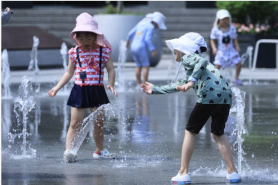
Children have fun in Gwanghwamun, central Seoul on Aug. 3, 2026. AJP Han Jun-gu SEOUL, September 8 (AJP) - Ozone has become a bigger pollution headache than fine dust for South Korea. Its capital has sharply reduced particulate air pollution over the past decade, but ground-level ozone concentrations have risen nearly 50 percent, exposing a new challenge after years of policy focused heavily on fine dust. The annual average ozone concentration in Seoul rose from 0.022 parts per million in 2015 to 0.0326 ppm in 2025, an increase of more than 48 percent, according to the Seoul Metropolitan Government. Over the same period, the annual average concentration of PM10, commonly referred to in South Korea as fine dust, fell 29 percent to 32 micrograms per cubic meter from 45. PM2.5, or ultrafine dust, dropped about 22 percent to 18 micrograms per cubic meter from 23. The divergence has become increasingly visible in the number of high-ozone days. Seoul said ozone advisories were issued on 16 days in 2025, up from just three in 2015, a more than fivefold increase. The figures contrast with the substantial progress Seoul has made in tackling particulate matter over a longer period. PM10 concentrations fell 47 percent to 32 micrograms per cubic meter in 2025 from 60 in 2006, while PM2.5 declined 40 percent to 18 from 30 over the same period. The number of days classified as having "bad" PM2.5 levels also dropped to 32 from 108. But Rep. Kim Ju-young of the ruling Democratic Party warned that improvements in particulate pollution should not be treated as evidence that the broader air-quality problem has been solved. "We should not assume that the air our people breathe has become sufficiently clean and safe simply because fine dust and ultrafine dust levels have improved," Kim, a member of the National Assembly’s Climate, Energy, Environment and Labor Committee, told AJP Tuesday. "If Seoul's ozone concentration has increased by more than 48 percent over a decade, we now need to take a hard look at what has been left in the blind spots of our air-quality policies," Kim said. He called for a shift beyond South Korea's long-standing focus on particulate matter toward tighter management of the pollutants that produce ozone. "With heat waves and intense solar radiation likely to increase because of climate change, potentially making the ozone problem even more serious, the government needs to move beyond an air-quality policy centered on fine dust and systematically manage ozone precursors such as nitrogen oxides and volatile organic compounds," Kim said. "I will also examine the causes of the increase in ozone and the government's response system during this year's parliamentary audit," he added. "The ultimate measure of air-quality policy should not be the numerical level of a single pollutant, but how clean and safe the air people actually breathe is." Ground-level ozone differs from particulate matter because it is generally not emitted directly. It forms through photochemical reactions involving nitrogen oxides, or NOx, and volatile organic compounds, or VOCs, in the presence of sunlight. Vehicles, industrial facilities and the use of solvents and fuels are among the sources of those precursor pollutants. The World Health Organization says ground-level ozone is a major component of smog and excessive exposure can cause breathing difficulties, trigger asthma, reduce lung function and contribute to lung disease. Sunny weather favors its formation, making ozone particularly problematic during hot seasons. Seoul has begun responding to the shift. The city launched intensified seasonal measures targeting high ozone concentrations from May through August this year, including inspections of 1,030 businesses that emit VOCs, such as gas stations, painting facilities and dry cleaners. It is also strengthening checks on vehicle emissions and idling around terminals, depots and logistics centers. The pattern seen in Seoul is not unique. China has confronted a particularly similar problem. Aggressive air-pollution controls introduced from 2013 brought dramatic reductions in particulate matter, but ozone pollution initially worsened. A study using China's national monitoring network found that summertime mean PM2.5 concentrations across eastern China fell by about 50 percent between 2013 and 2019, while surface ozone steadily increased and reached the highest level of the study period in 2019. Researchers have pointed to the complicated atmospheric chemistry linking the two pollutants. A Nature Geoscience study found that PM2.5 fell by roughly 30 to 40 percent across China from 2013 to 2017 while surface ozone worsened, concluding that effective control required simultaneous reductions in pollutants including VOCs and NOx rather than a focus on particulate matter alone. Europe faces a similar challenge despite substantial reductions in emissions that contribute to ozone formation. The European Environment Agency said NOx emissions in Europe fell around 53 percent between 2005 and 2023 and non-methane VOC emissions declined about 35 percent. Yet while peak ozone concentrations decreased, annual mean ozone levels remained stable or increased. The agency warned that climate change is expected to aggravate European ozone pollution because more frequent and intense heat-related weather conditions favor ozone formation. It estimated that exposure to ozone contributed to about 63,000 premature deaths in the European Union in 2023. The United States, meanwhile, provides an example of longer-term ozone improvement alongside falling particulate pollution. U.S. Environmental Protection Agency data show national eight-hour ozone concentrations declined 24 percent between 1990 and 2024, while annual PM2.5 concentrations fell 46 percent between 2000 and 2024. Weather nevertheless remains a critical factor. The EPA notes that ozone forms more readily during warm, sunny and stagnant conditions, while cooler, cloudy or wetter weather suppresses its formation. After adjusting for weather variations, U.S. monitoring data show average warm-season ozone concentrations have fallen by about 10 parts per billion since 2002, demonstrating that reductions in precursor emissions can lower ozone even as meteorological conditions fluctuate. Seoul's experience shows that decades of progress in reducing particulate matter have addressed only part of the city's air-quality challenge. As hotter summers create conditions increasingly favorable to ozone formation, controlling NOx and VOC emissions is likely to become a bigger part of South Korea's effort to reduce the health risks of air pollution.
-
 Extreme-heat days nearly double the average this summer in Korea
A farmer stops for a drink with the mercury nearing 40 degrees during daytime through August. AJP Han Jun-gu SEOUL, August 25 (AJP) -South Korea has endured nearly twice the usual number of heat-wave days so far this year, with record-breaking temperatures and unusually persistent tropical nights pointing to a summer stretching well into September. The nationwide average number of heat-wave days reached 20.1 from the start of the year through Monday, almost double the seasonal average of 10.4 days, according to the Korea Meteorological Administration (KMA) Tuesday. A heat-wave day is defined as one when the daily high reaches 33 degrees Celsius or above. The heat has been particularly intense in the southeastern part of the country. Busan, Ulsan and South Gyeongsang Province averaged 25.6 heat-wave days, followed by Daegu and North Gyeongsang Province with 24.7 days and North Jeolla Province with 22.6 days. The nationwide average daily high in August has reached 32.1 C, 1.9 degrees above the seasonal norm of 30.2 C. Yangsan in South Gyeongsang Province recorded 42.5 C on Aug. 2, the highest temperature measured in South Korea since modern weather observations began in 1904. Children cool off in fountain pool in Gwanghwamun, downtown Seoul. AJP Yoo Na-hyun Other southeastern cities also broke local records. Temperatures reached 41 C in Bukchangwon on Aug. 2 and in Miryang the following day, while Uiryeong climbed to 40.8 C on Aug. 3. Relief has been scarce even after sunset. South Korea recorded an average 16.4 tropical nights through Monday, the second-highest level on record after 16.8 days in 1994. It marks the country's highest tally in 32 years. The KMA defines a tropical night as one when the nighttime low remains at or above 25 C. The prolonged heat is unlikely to disappear with the end of August. The North Pacific high-pressure system covering the Korean Peninsula is strengthening, while the Tibetan high is developing again above it, creating what forecasters describe as a "double heat dome" that traps hot air over the region. Maximum apparent temperatures are expected to hover around 33 C through early September, extending the spell of late-summer heat and likely pushing this year's heat-wave and tropical-night counts still higher. South Korea has already experienced two consecutive years of unusually prolonged heat. The annual number of heat-wave days reached 30.1 in 2024 and 29.7 last year. Tropical nights totaled 24.5 days in 2024 and 16.4 days in 2025. AJP Takeaways South Korea recorded 20.1 heat-wave days through Aug. 24, 2026, nearly twice the seasonal average of 10.4 days. Yangsan reached a record 42.5 C on Aug. 2, while tropical nights climbed to 16.4 days, the second-highest tally on record. A strengthening North Pacific high and returning Tibetan high are forming a "double heat dome," threatening to extend extreme heat into September.