
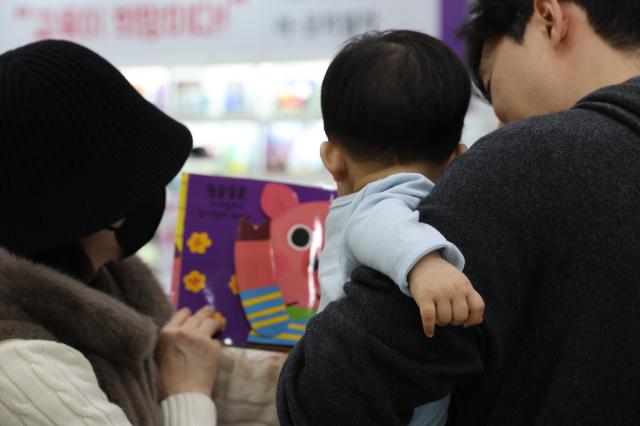
A total of 218,896 babies were born from January through September, up 14.3 percent from 191,593 a year earlier, according to tally from the Ministry of Data and Statistics. It was the largest increase for the period since comparable records began in 1981.
The total fertility rate reached 0.90 in the third quarter, up from 0.81 a year earlier and the highest third-quarter reading since 0.96 in 2018. The measure estimates how many children a woman would have over her lifetime if current age-specific birth rates persisted.
The latest reading strengthens the prospect of an annual rate of at least 0.9 for the first time since 2019, when it stood at 0.92. The annual rate recovered from a record low of 0.72 in 2023 to 0.75 in 2024 and 0.80 in 2025, but still well below the replacement level of about 2.1.
September births rose 12.2 percent to 25,113, extending the run of annual increases to 27 consecutive months. The total was the highest for September in eight years, while the growth rate was the strongest for the month since 2007.
Third-quarter births increased 12.1 percent to 73,091. That was also the fastest third-quarter growth since 2007, when the auspicious “golden pig” year encouraged a surge in births.
The current rebound coincides with the arrival of the relatively large generation born between 1991 and 1995 into their prime marriage and childbearing years. Known as the second “echo boom” generation, they are the children of Korea’s second baby boomers born between 1964 and 1974.
Women in their 30s again led the latest gains. The third-quarter birth rate among women aged 30–34 rose by 8.2 to 82.9 births per 1,000 women. Among those aged 35–39, it increased by 8.7 to 62.0.
First children accounted for 63.5 percent of births, up 1.3 percentage points from a year earlier. The average period between the start of married life and a first birth edged down to 2.41 years from 2.43 years.
The marriage figures, however, offered a less reassuring signal.
Third-quarter registrations fell 0.8 percent to 57,799, the first annual decline in 11 quarters. September marriages dropped 11.7 percent to 16,299 following a 1.2 percent decline in August.
A ministry official attributed part of September’s fall to the Chuseok holiday and couples delaying registration after the government announced that a marriage tax credit would be replaced by a direct subsidy next year. It was too early to conclude that marriages had entered a sustained downturn, the official said.
Registrations for the first nine months remained 3.4 percent higher than a year earlier at 182,173.
September deaths totaled 29,818, exceeding births by 4,705. Across the third quarter, deaths outnumbered births by 15,957 — a smaller natural population loss than the 19,904 recorded a year earlier.
Tags: South Korea, birthrate, fertility rate, population decline, marriage decline, demographic crisis, echo boom generation, childbirth, family policy, Ministry of Data and Statistics

Yuna Ryu covers finance, capital markets and Southeast Asian affairs.
She is drawn to the questions that numbers raise and the stories that data alone cannot answer.
Prior to journalism, she worked at Hyundai Motor Company and the Singapore Chamber of Commerce, focusing on business strategy and international affairs. She has also hosted diplomatic receptions and international conferences as an MC.
Ryu holds a master's degree in Media and Communication from Korea University, where her research focused on neuroscience-based studies of media effects.
Copyright ⓒ Aju Press All rights reserved.
Related News
-
 South Korea's birthrate rises for 23rd straight month
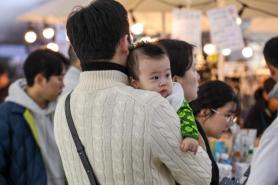
A visitor carries a baby at a baby fair at COEX in southern Seoul on Jan. 16, 2026. AJP Yoo Na-hyun SEOUL, July 29 (AJP) - South Korea's birthrate continued to show signs of recovery in May, with the number of newborns increasing for the 23rd straight month, according to data released by the Ministry of Data and Statistics on Wednesday. Some 23,160 babies were born in May, up 13.6 percent from a year earlier. The country’s total fertility rate, which measures the average number of children a woman is expected to have over her lifetime, also rose to 0.85 from 0.75 a year earlier, while the number of marriages declined from a year earlier. The latest figures extended a steady recovery that has been underway since July 2024. During the first five months of this year, the number of newborns reached 122,694, up 15.2 percent from the same period last year. The increase was led by women in their 30s, the country's largest childbearing age group. The birth rate for women aged 30 to 34 rose to 78.0 births per 1,000 women from 69.7 a year earlier, while that for those aged 35 to 39 increased to 58.0 from 48.1. Among women aged 25 to 29, the rate edged up to 20.6 from 20.1, and for those aged 40 and older it increased to 4.7 from 4.2. By contrast, the rate for women aged 24 and younger fell to 1.9 from 2.3. First-born children accounted for 63.0 percent of all births, up 1.3 percentage points from a year earlier. However, the share of second-born children edged down 0.2 percentage points to 31.7 percent, while that of third-or-later children fell 1.1 percentage points to 5.3 percent. Births rose across the country, with Jeju the only region to record a decline. Seoul recorded 4,227 births, up 17.7 percent, while Gyeonggi Province saw births rise 13.8 percent to 7,075, compared with a 3.1 percent decline in Jeju. Generated by ChatGPT The increase came despite a slowdown in marriages. A total of 20,368 couples married in May, down 6.4 percent from a year earlier, with Incheon the only region to record an increase. Even so, cumulative marriages for the first five months of this year rose 3.9 percent from a year earlier. The total number of divorces stood at 36,240 over the same period, up 0.2 percent on-year. In May, divorces totaled 7,122, down 3.9 percent from a year earlier. Despite the recovery in births, South Korea's population continued to decline naturally. The number of deaths rose 3.8 percent from a year earlier to 29,573 in May. However, the natural population decline, calculated as the difference between births and deaths, narrowed to 6,413 from 8,103 a year earlier, as births grew faster than deaths. Ulsan, Sejong and Gyeonggi Province were the only regions where births exceeded deaths, while all other regions recorded natural population declines.
-
 Church Takes Lead in Promoting Life Respect as Yoido Full Gospel Church Strengthens Support for Low Birthrate
South Korea's total fertility rate saw a slight increase to 0.95 in the first quarter of this year, yet it remains the lowest in the world. In response, Yoido Full Gospel Church is enhancing its support to combat the low birthrate.On July 11, coinciding with World Population Day, the church announced various campaigns aimed at addressing the low birthrate.The initiatives include conducting surveys on perceptions of childbirth and parenting, holding a slogan contest for overcoming low birthrates, implementing policies for childbirth incentives, and presenting awards and encouragement funds to multi-child families.Senior Pastor Lee Yong-hoon has consistently emphasized that "valuing life and nurturing the next generation is the most important mission for the Kingdom of God," advocating for families to have at least three children, with five being encouraged. He has focused not only on financial support but also on fostering a culture within the church that celebrates childbirth and parenting.On July 12, during Sunday service, the church will present awards and encouragement funds to 42 families with five or more children. Families with five children will receive 700,000 won, while those with six or more will receive 1 million won, totaling 33.3 million won in support. Starting next year, the church plans to expand support to families with four children.The church also released findings from its own survey on perceptions of childbirth and parenting. The 'church-specific total fertility rate' among female congregants aged 15 to 49 was calculated at 1.86. The average desired number of children was 2.32, indicating that economic burdens and parenting environments are significant barriers to actual childbirth rates.Additionally, the church held a slogan contest to promote overcoming low birthrates, selecting the slogan 'More than one, many (多) children bring many (多) blessings / More children, more joy, let's share parenting together' as the winner. The winner, Seoyeon Seo, expressed her hope that children would become a strong foundation for leading the next generation, stating, "Children are the strength that supports society."Pastor Lee Yong-hoon remarked on this series of initiatives, saying, "Valuing life and nurturing the next generation is the most important mission for the Kingdom of God," and expressed hope that a culture where childbirth and parenting are seen as blessings will spread further within the church.The church plans to continue expanding childbirth incentive support, enhancing programs for infant care, parent education, and special support for multi-child families, and establishing a shared parenting network.* This article has been translated by AI.
-
 Joo Hyung-hwan Publishes Book on 700 Days of Population Policy Shift, Offers Low Birthrate Plan
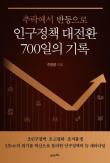
Joo Hyung-hwan, who served as vice chair of the Presidential Committee on Ageing Society and Population Policy, has published a new book detailing 700 days of policy work during his tenure, titled “A 700-Day Record of a Major Population Policy Shift: From Freefall to Rebound.” The book chronicles a shift from narrow low-birthrate measures to a broader population strategy spanning the full life cycle. With pessimism growing that “nothing works” despite years of policies and budget spending that failed to deliver results, Joo diagnoses the limits of past approaches and lays out alternative solutions. When Joo took office in February 2024, the total fertility rate stood at 0.72, the lowest on record. Projections that it could fall to 0.65 this year heightened the sense of a national population crisis. Arguing that the moment required a policy paradigm shift, he pushed to reorganize priorities around three pillars: work, caregiving and housing. For an ultra-aged society, he also called for moving beyond a welfare-centered approach and stressed innovation from an industrial perspective, pointing to areas such as age tech and a dementia-related asset market. A central theme is a move away from short-term fixes toward structural responses. He writes that the government pursued mid- to long-term tasks in parallel, including easing the burden of private education costs, reducing overconcentration in the Seoul metropolitan area and introducing inclusive immigration policies. “The population crisis is not an impossible problem; it is a task we can reverse if we bring together society’s capabilities,” Joo said. He said the book aims to present the process and results of the policy shift, along with remaining challenges. “A 700-Day Record of a Major Population Policy Shift: From Freefall to Rebound” runs 412 pages and was published by 21st Century Books. It is priced at 24,000 won. The publication date is 2026년 3월 20일.* This article has been translated by AI.