
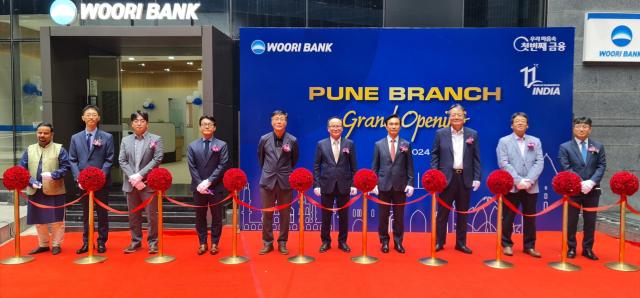
SEOUL, September 12 (AJP) - Woori Bank said Thursday it has opened new branches in Pune and Ahmedabad in Western India.
The Korean lender currently operates three branches in the country -- in Chennai, Gurugram, and Mumbai.
The Pune branch in Maharashtra will focus on providing operational funds to support business expansion for both Korean and Indian companies.
The Ahmedabad branch in Gujarat will concentrate on offering financial services to Indian small and medium-sized enterprises (SMEs) to support their export and import activities.
Woori Bank is already providing financial support to Korean companies in India, including Samsung, Hyundai, LG, and POSCO.
"This is an important opportunity to solidify our strategic position in the Indian market, and we will work closely with local companies," Woori said in a press release.
Copyright ⓒ Aju Press All rights reserved.
Related News
-
 Beware of Bank Impersonation Scams in Vietnam Targeting Personal Information
In Vietnam, financial scams are increasingly using bank reward points and cashback benefits as bait to steal personal information. Notably, fake messages are appearing in text message threads alongside legitimate transaction alerts from banks, prompting heightened caution among financial consumers. According to reports from local media including Thanh Nien on November 26, 2026, customers using Vietnam International Bank (VIB) credit cards in the Khanh Hoa region recently received text messages stating that 12,500 reward points would soon expire, urging them to use the points. The messages appeared in the same text thread where customers typically receive transaction notifications from their bank. While there have been no reported financial losses or data breaches, the use of a familiar bank name has raised concerns about lowering customers' vigilance. Major banks in Vietnam have also issued warnings about similar scam tactics. Vietcombank and the Bank for Investment and Development of Vietnam (BIDV) have alerted customers to the circulation of fake messages regarding credit card reward point usage. Fake Messages Among Legitimate Transaction Alerts... Sender Names Are Not Reliable This type of scam is made possible by smartphones that group messages from the same sender into a single thread. Criminal organizations exploit this feature to insert fraudulent messages among legitimate alerts sent by banks. Clicking on links in these messages leads to fake websites designed to resemble actual bank sites. The criminals request sensitive information such as card numbers, expiration dates, security codes (CVV), online banking passwords, and one-time passwords (OTP) under the pretext of point redemption or identity verification. The information obtained can be misused for unauthorized payments or account access. Some links may also prompt the installation of fake applications containing malware. The National Payment Corporation of Vietnam (NAPAS) reported on November 24 that fraudulent messages using its name have been spreading, and they have notified the relevant authorities. Recently, NAPAS and local banks have been offering various benefits such as cashback to actual card users, increasing the likelihood that consumers may mistake fake alerts for legitimate promotions. However, NAPAS is an organization that manages card technical standards and does not issue cards or manage customers' card transactions directly. Therefore, receiving communications requesting card security verification or point usage in NAPAS's name should raise suspicions of fraud. From Year-End Bonuses to High-Yield Side Jobs... Exploiting Consumer Psychology As year-end bonuses and the Tet holiday approach in Vietnam, consumers should also be wary of scams that promote bonuses, subsidies, and holiday gifts. Criminal organizations disguise themselves as corporate or institutional welfare programs to solicit personal information or recruit participants for high-yield side jobs through social media platforms like Facebook and Zalo. They advertise that individuals can earn income through simple tasks such as liking videos or writing product reviews, initially paying small commissions. Once participants show trust, they are asked for upfront payments or deposits with promises of higher earnings. Ngo Minh Hieu, head of the Vietnam Anti-Fraud Project, warned, "The initial commissions are a means to lure victims into sending larger amounts of money. Just because someone received money does not mean it is a legitimate side job." Local police and financial institutions emphasize that individuals should not determine the authenticity of messages based solely on the sender's name or the appearance of a website. If notified about point expiration or benefit distribution, it is safer to access the bank's official app directly or contact customer service to verify the information instead of clicking on links in the messages. Additionally, they advise against entering card security information, account passwords, or OTPs on unverified sites and not to engage in side jobs that require upfront payments in exchange for promised earnings.* This article has been translated by AI.
-
Jeon Hyun-hee's Youth Startup Financial Support Program Expands with Shinhan Bank's Participation
Jeon Hyun-hee, a lawmaker from the Democratic Party and member of the National Assembly's Political Affairs Committee, signed a memorandum of understanding (MOU) with Shinhan Bank, the Korea Credit Guarantee Fund, and the Korea Technology Finance Corporation on November 26 to support youth startups.According to Jeon's office, this agreement is part of the ongoing 'Youth Startup Financial Ladder' initiative, with Shinhan Bank committing to provide 200 billion won (KRW) in support, raising the total financial support to 900 billion won (KRW).The support is aimed at startups led by individuals aged 17 to 39 that have been in operation for less than seven years, with each company eligible for up to 300 million won (KRW). The program features a 100% guarantee rate for the first three years, exemption from guarantee fees, and low interest rates in the 3% range, which Jeon's office emphasized will alleviate the financial burden on youth startups.Previously, Jeon's 'Youth Startup Financial Ladder' initiative had seen Hana Bank, Woori Bank, and KB Kookmin Bank each provide 200 billion won (KRW), while BNK Busan Bank and BNK Gyeongnam Bank each contributed 50 billion won (KRW). With Shinhan Bank's participation, a total of six banks have established a financial support framework totaling 900 billion won (KRW) for youth startups.Jeon's office noted that this agreement is significant as it marks the expansion of youth startup financial support across major commercial banks. It is seen as a case of productive finance that moves away from collateral-based lending practices, focusing instead on providing funds to innovative companies and future growth drivers, thereby enhancing financial accessibility for young people.Additionally, Jeon announced plans to increase the scale of youth startup financial support to over 1 trillion won (KRW) in the future, while linking it with interest subsidy programs from both the central and local governments to further reduce the financial burden on young entrepreneurs.Furthermore, guarantee institutions such as the Korea Credit Guarantee Fund and the Korea Technology Finance Corporation will work to improve their guarantee systems, moving away from past practices that focused on historical performance, to adequately reflect the technological capabilities, innovation, business ideas, and growth potential of youth startups.Jeon stated, "Young people with good ideas and technologies should not have to give up their entrepreneurial dreams at the threshold of finance," and pledged to continue expanding participation from the financial sector and linking interest support from the central government and local governments to robustly support youth entrepreneurship.* This article has been translated by AI.
-
Bank of Korea Governor Predicts Semiconductor Firms' Operating Profit Nearing 700 Trillion Won
Shin Hyun-song, the Governor of the Bank of Korea, projected that this year the operating profit of domestic semiconductor companies will approach 700 trillion won. While the positive effects of corporate profits from the semiconductor industry's favorable conditions on private consumption are still limited, he assessed that these profits will eventually be returned to the national economy through various channels such as tax revenue, bonuses, dividends, and investments.At a press conference following the monetary policy direction decision meeting of the Monetary Policy Committee on the 26th, Governor Shin stated, "Last year's nominal Gross Domestic Product (GDP) was around 2,600 trillion won, and this year it seems likely to exceed 3,000 trillion won," adding, "National income is also expected to surpass 3,000 trillion won."He anticipated significant changes in the proportions of households and corporations within national income. He explained, "Historically, wages and operating profits have each accounted for half, but this year, operating profits will carry more weight," estimating that households will account for about 40% and operating profits will make up around 60%.He continued, "A significant portion of the operating profit is expected to come from semiconductors, estimated to be just shy of 700 trillion won," noting that more than one-fifth of national income will be derived from the operating profits of semiconductor companies.Governor Shin also noted that there will be a time lag before the concentrated profits of semiconductor companies spread throughout the economy. He explained, "Corporate taxes will enhance fiscal capacity, and bonuses and dividends also come from operating profits," adding, "A considerable portion remains in the short-term money market, which could lead to investments or dividends next year or the year after."He emphasized, "The effect flowing into private consumption is not strong yet, but since it is not money disappearing, but rather returning to the national economy, it is ultimately a matter of time."* This article has been translated by AI.