
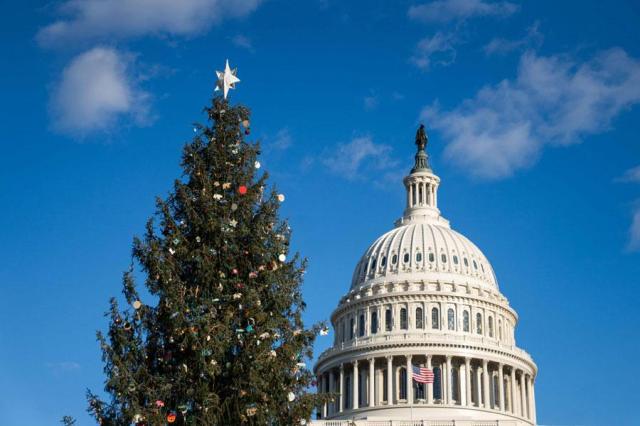
The annual National Defense Authorization Act, which allocates $895 billion for defense and security for fiscal year 2025, passed the Senate with a decisive 85-14 vote after clearing the House last week.
The bill's passage comes amid concerns that U.S. President-elect Donald Trump may seek to reduce troop deployments in South Korea and push for renegotiations on defense spending, urging Seoul to contribute more to the cost for the upkeep of U.S. Forces Korea (USFK) on the Korean Peninsula.
But the act, the backbone of U.S. defense budgets, prohibits the president from unilaterally slashing the number of American troops in South Korea from the current level of 28,500.
The bill now awaits the president's approval to take effect.
Copyright ⓒ Aju Press All rights reserved.
Related News
-
 What does Trump's return to White House mean for South Korea?
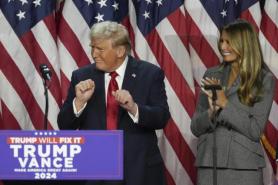
Republican presidential candidate Donald Trump reacts with his wife Melania Trump at an election night party in West Palm Beach, Florida on Nov. 5, 2024. AP-Yonhap SEOUL, November 6 (AJP) - Former President and Republican candidate Donald Trump is making a return to the presidency in a surprising fashion as he achieved an electoral college majority by securing sweeping victories in key battleground states such as Georgia, North Carolina, and Pennsylvania, defeating his Democratic rival and Vice President Kamala Harris. "It's a political victory that our country has never seen before, nothing like this. I want to thank the American people for the extraordinary honor of being elected your 47th President and your 45th President," Trump said, declaring his "magnificent" victory in the election. Trump's return to the White House would have significant ramifications for South Korea, particularly in the realms of foreign policy and regional security. Here are some key areas where his political comeback will impact South Korea. Defense and security During his presidency, Trump often called for South Korea to contribute more to the costs of U.S. military presence on the Korean Peninsula, which could be a point of contention again if he returns. Trump could push for renegotiations on defense spending and troop deployments, which could affect South Korea's defense strategy and military readiness. During his first presidency in 2017, Trump demanded that Seoul pay $5 billion for the upkeep of U.S. Forces Korea (USFK) on the Korean Peninsula, five times the amount Seoul was paying at the time. Despite the current agreement having nearly two years left until its expiry, similar concerns led the two countries to expedite negotiations and sign a defense cost-sharing deal, known as the Special Measures Agreement (SMA) on Monday, just a day before the U.S. presidential election. Nevertheless, Trump could still attempt to break the deal and demand a renegotiation, possibly pushing for an astronomical hike for the upkeep. South Korea has "a money machine. We protect them (South Korea) from North Korea and other people. North Korea is very nuclear, I got along with him (North Korean leader Kim Jong-un) very well," he said in his recent remarks, claiming that South Koreans "don't pay us anything." He also argued that he made South Korea agree to raise the costs, but "Biden then cut it back, and it's a shame." He added, "If I were there now, they'd be paying us $10 billion a year. And you know what? They'd be happy to do it." Relations with North Korea Trump's engagement with North Korea marked a significant departure from traditional American diplomatic approaches, culminating in photo ops with Kim at their first summit in Singapore in 2018. However, inter-Korean relations soon became strained when their follow-up summit in Hanoi the following year ended in failure. But Trump's return again raises expectations for improved relations with North Korea, as he could push to restart direct talks with Kim, potentially providing opportunities for South Korea to engage in dialogue and make progress in inter-Korean relations amid a prolonged stalemate. Yet challenges remain, as his approach remains erratic and unpredictable. Seoul would need to carefully balance its own engagement with North Korea and its security interests, especially if Trump resorts to his signature "America First" approach or resumes harsh rhetoric toward Pyongyang. Due to Trump's inconsistency and unpredictability in his political stances and policies, South Korea would face various challenges in inter-Korean relations. Trump once boasted that his "love letters" with Kim avoided conflict with North Korea. "I got along with him, and we stopped the missile launches from North Korea. Now, North Korea is acting up again, but when we get back, I get along with him," he said during his campaign trail in July. "He'd like to see me back too. I think he misses me..... It's nice to get along with somebody who has a lot of nuclear weapons." When Harris vowed not to "cozy up to" tyrants and dictators like Kim, Trump countered that "getting along" with him is a "good thing," suggesting that he would engage with North Korea if reelected. Republican presidential candidate Donald Trump (right) gives a thumbs-up as vice presidential candidate JD Vance speaks at an election night party in West Palm Beach, Florida on Nov. 5, 2024. AP-Yonhap Global diplomacy Trump's "America First" approach and protectionist policies could also affect multilateral diplomacy, potentially leading to reduced American engagement in global affairs. He has consistently criticized multilateral commitments, saying, "We have long been taken advantage of by other countries. And think of it. Oftentimes, these other countries are considered so-called allies." For this reason, South Korea would have difficulties coordinating with the international community and gaining multilateral backing without U.S. support in maintaining regional peace and stability. This would be critical, especially given the deepening military ties between North Korea and Russia, which led to Pyongyang's recent troop deployment to Moscow to support its war in Ukraine. Throughout his campaign, Trump repeatedly promised he could put an end to global conflicts, including the war in Ukraine, unrest in the Middle East, and prevent another world war from breaking out. He said, "They're dying, Russians and Ukrainians. I want them to stop dying..... I'll have that done in 24 hours." However, it remains to be seen if he could truly "fix" things and make America "great and glorious again," as his campaign slogans envisioned. As U.S. foreign policy is likely to undergo major shifts and overhauls with changes in priorities, South Korea's efforts toward North Korea's denuclearization could falter, requiring Seoul to come up with new diplomatic strategies amid the potential weakening of collective global coordination. Under the previous Trump administration, the U.S. withdrew from several international agreements, such as the Paris Climate Agreement, the Trans-Pacific Partnership, and UNESCO, although he may engage in selective, cost-effective alliances, as long as they align with U.S. interests. Trump's return presents both opportunities and challenges. South Korea will need to thoroughly prepare for potential shifts in key policies including political and economic agendas, while maintaining its strong alliance with the U.S. Meanwhile, South Korean President Yoon Suk Yeol sent a congratulatory message to the U.S. president-elect, who is poised to begin a second term and will become the first since Grover Cleveland in 1892 to return to the White House for a non-consecutive term. "Under your strong leadership, the future of -U.S. alliance and America will shine brighter. Look forward to working closely with you," Yoon wrote on X.
-
 Trump signals massive hike for USFK upkeep if reelected
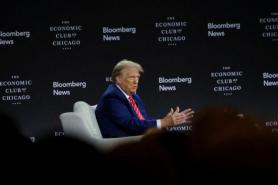
Former U.S. President and Republican presidential candidate Donald Trump speaks during an interview at the Economic Club of Chicago in Illinois on Oct. 15, 2024. AP-Yonhap SEOUL, October 16 (AJP) - Former U.S. President and Republican presidential candidate Donald Trump has implied the possibility of increasing South Korea's contribution for maintaining U.S. troops on the Korean Peninsula, if he wins a second U.S. presidency. Speaking at an interview with the Economic Club of Chicago and Bloomberg News on Tuesday, he claimed that South Korea would be paying US$10 billion annually for the upkeep of U.S. Forces Korea (USFK) if he were still in office. Trump said, "If I were there now, they'd be paying us $10 billion a year. And you know what? They'd be happy to do it." "South Korea, they're wonderful people, extremely ambitious. They have a money machine. We protect them don't pay us anything, and I said, 'This is crazy,'" he added, boasting about the efforts he made during his presidency to push South Korea to increase its contribution. "We have 40,000 troops in harm's way, very serious, because you have North Korea is a very serious power. They have tremendous nuclear power," he said, referring to the 28,500 American soldiers stationed here. "I said to South Korea you got to pay and they agreed to do it. Biden then cut it back, and it's a shame." His latest remarks can be interpreted as similar antics he used to resort to during his presidency. In 2019, Trump had demanded $5 billion a year from Seoul, an amount nearly six times higher than the previous year's defense cost-sharing that Korea had been paying. He is now proposing an exorbitant hike to $10 billion, which is nearly nine times higher than the current cost-sharing agreement between the two countries. After rounds of defense cost-sharing talks, South Korea and the U.S. recently reached an agreement for an 8.3 percent increase, with Seoul shouldering 1.52 trillion won ($1.14 billion) in costs, an arrangement that will remain in effect until 2030.
-
 Biden nominates new USFK chief
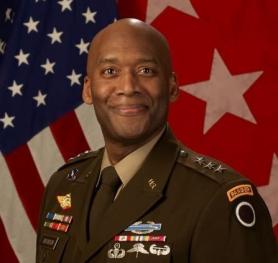
Lieutenant General Xavier T. Brunson. Courtesy of the U.S. Army SEOUL, September 12 (AJP) - Lieutenant General Xavier T. Brunson has been named as a nominee to lead the U.S. Forces Korea, the Pentagon said on Wednesday. U.S. President Joe Biden nominated him to replace General Paul LaCamera who has led the position since July 2021. Brunson's nomination, which comes as LaCamera's tour in Seoul ends, requires approval from the Senate. Brunson currently serves as the Commanding General of I Corps and Joint Base Lewis-McChord (JBLM) in Washington. While the triple-hatted position, which also oversees the Combined Forces and United Nations Command, is usually filled by a four-star general, the African-American general is set to be promoted from his current three-star rank. Majoring in political science at Hampton University in Virginia, Brunson was commissioned as an infantry officer in 1990. He has served in various roles, including deployments to Afghanistan and Iraq. Brunson has two sons and one daughter with his wife, Kirsten, who is a retired colonel.