
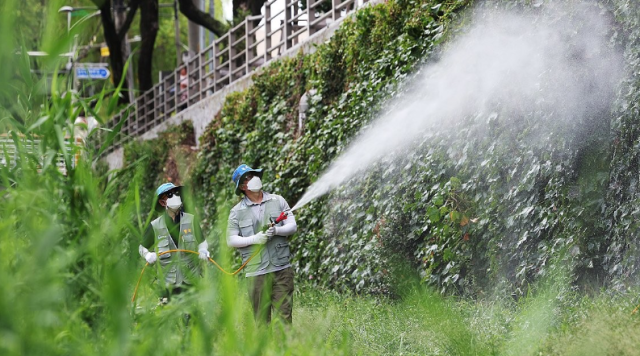
The alert came after the Korea Disease Control and Prevention Agency (KDCA) found that samples of the specific species of mosquitos transmitting the disease were detected for the first time this year in Jeju and South Jeolla Province last week.
Japanese encephalitis is spread by Culex mosquitoes and causes fever, headache, and paralysis, mostly affecting children between the ages of three and 15. In some cases, it can develop to severe brain inflammation, with a mortality rate of 20 to 30 percent.
"Prevention is crucial, as there is no specific treatment available yet for Japanese encephalitis," a KDCA official said.
As a preventive measure, it is advised to avoid outdoor activities at night between April and October, wear long, light-colored clothing, use mosquito repellent, and stay away from strongly scented products.
The vaccine for the disease is available free of charge for children aged 12 months to 12 years.
Copyright ⓒ Aju Press All rights reserved.
Related News
-
 Finance Ministry Advisory Group Visits Space Startup, Emphasizes Policy Based on Field Insights
The government has been urged to become the first customer for domestic space companies that refuel satellites in orbit or repair malfunctioning components. The proposal suggests that if the government secures initial demand for satellite maintenance services and private small launch vehicles, companies can alleviate financial burdens and build the business performance necessary for overseas expansion.On November 19, the Strategic Economic Advisory Group of the Ministry of Finance and Economy visited the space startup Worker in Space in Sejong City to discuss ways to enhance the competitiveness of domestic space companies. The meeting included Park Young-sun, chair of the advisory group, Kim Hae-dong, chair of the space division, and officials from the Korea Aerospace Administration and Korea Aerospace Industries (KAI).Worker in Space is developing robotic satellites for 'in-orbit servicing' that refuel or repair satellites in orbit. During the visit, the company showcased technology for maintaining satellites using robotic arms in an environment that simulated the orbital movement of actual satellites.Participants discussed ways for the government to guarantee initial purchase demand for space maintenance services and private small launch vehicles.In the subsequent discussion, there was consensus on the importance of the government acting as the first buyer to help domestic startups reduce initial financial burdens and enter overseas markets, especially as the global space market rapidly grows, led by private companies like SpaceX. Strategies for early involvement in low Earth orbit satellite communication projects to secure competitiveness were also discussed.The Ministry of Finance and Economy plans to consider the discussions and expert proposals for future strategic industry policy formulation.Chair Park stated, "The space industry is a key strategic industry directly linked to national economic security and a new growth engine. It is important to listen to the voices from the field and connect them to effective policies."* This article has been translated by AI.
-
South Korea Delays Travel Advisory Amid Surge in Crime Against Nationals in Cambodia
In Cambodia, 741 South Koreans have fallen victim to employment scams, kidnappings, and confinement over the past three years. However, the South Korean Ministry of Foreign Affairs determined that these incidents did not constitute a "national crisis or overseas disaster," failing to convene a meeting for a government-wide response. The elevation of the travel advisory was also delayed for nearly two years due to misjudgment of the criteria and repeated internal consultations.On November 5, the Audit Office released the findings of its investigation into the operational status of overseas citizen protection at diplomatic missions.The audit revealed a sharp increase in the number of South Koreans victimized by employment scams and kidnappings in Cambodia, rising from 17 in 2023 to 220 in 2024, and reaching 504 last year. In August 2023, a South Korean university student died after being tortured by local criminals.According to the Audit Office, the Ministry of Foreign Affairs and the South Korean Embassy in Cambodia recognized the escalating violence as early as December 2023 but postponed raising the travel advisory.In April 2024, the embassy proposed issuing a special travel advisory, but the ministry deemed employment scams to be a "constant risk," thus not meeting the criteria for an advisory. When the embassy raised the need for an advisory again in July, no action was taken due to the failure to submit the required adjustment form.In September 2024, a suggestion was made for a pre-explanation to the Cambodian government, which was not part of the regulations. The embassy postponed the explanation due to the ASEAN summit, and the ministry accepted this, leading to another cancellation of the advisory elevation.When the ministry attempted to raise the advisory in April last year, relevant departments expressed the need for careful consideration regarding the entire country, particularly the capital, Phnom Penh. This was interpreted by the responsible department as opposition to raising the advisory, halting the process.Ultimately, the travel advisory was raised in September last year, nearly two years after the onset of employment scam incidents, and just a month after the student’s death was reported in the media.The government-wide response system also failed to operate. Between December 2023 and September 2024, Cambodia saw a monthly average of 8 to 27 victims, totaling 161. In contrast, the ministry activated the Overseas Citizen Protection Headquarters during kidnapping incidents involving South Koreans in Peru in September 2024 and the Philippines in March last year.However, regarding employment scams in Cambodia, the ministry did not consider it a national crisis or overseas disaster, failing even to hold a meeting to discuss activating the Overseas Citizen Protection Headquarters.The Audit Office has requested minor disciplinary actions against three officials from the Ministry of Foreign Affairs who neglected their duties in protecting overseas citizens. Additionally, one official from the South Korean Embassy in Cambodia, who did not actively propose raising the travel advisory, has been notified that their actions will be considered in future personnel evaluations.Delays in adjusting travel advisories were not limited to Cambodia. An analysis by the Audit Office of 54 cases where travel advisories were adjusted based on requests from overseas missions between 2023 and October last year found that 16 cases took more than 15 days to adjust, with 9 cases exceeding 30 days.There were also gaps in the division of roles between overseas missions and the Consular Safety Call Center. Of the 157,859 incidents reported in the past three years, 34.5%, or 54,474 cases, were directly received by overseas missions. Approximately 60% of these were minor issues that could have been handled by the call center through information guidance or interpretation.The Audit Office has instructed the Ministry of Foreign Affairs to establish guidelines for the consultation process, methods, and deadlines for adjusting travel advisories. It also called for regular checks on the communication network between the Consular Safety Call Center and overseas missions, and for specific examples and manuals to be provided to the public regarding the scope of consular assistance.Meanwhile, the Ministry of Foreign Affairs announced that it would review the issues raised by the Audit Office and work on measures to prevent recurrence and improve systems.The ministry stated, "We will prepare necessary improvements for timely travel advisory issuance, clear role division between overseas missions and the Consular Safety Call Center, and clarification of the scope of consular assistance, while closely cooperating with relevant departments and overseas missions to ensure the protection of our citizens abroad."* This article has been translated by AI.
-
Weather Forecast: Fog Advisory for Friday Morning, Rain Expected Until Dawn
On Friday, October 30, the weather across the country is expected to be mostly cloudy, with increased cloud cover in the morning. Rain will continue in the Chungcheong and southern regions until dawn, while dense fog is anticipated in the metropolitan area.According to the Korea Meteorological Administration on October 29, the morning low temperatures on the 30th are forecasted to range from 4 to 13 degrees Celsius, with daytime highs between 17 and 21 degrees. These temperatures are similar to or slightly above the seasonal average, but significant temperature differences of 10 to 15 degrees may occur between day and night, particularly in the Gyeongsang region.Rain will persist in the Chungcheong and southern regions until dawn, with some areas in Jeju experiencing rain until the morning. Expected precipitation amounts are as follows: Daejeon, Sejong, and Chungnam 5-10 mm; Chungbuk around 5 mm; Jeonbuk, Gwangju, and Jeonnam 5-10 mm; Daegu, Gyeongbuk inland, Busan, Ulsan, and Gyeongnam less than 5 mm; and Jeju 5-10 mm.Particular caution is advised for commuters regarding traffic safety. From dawn until 10 a.m., areas in Incheon and parts of Gyeonggi Province are expected to experience dense fog with visibility of less than 200 meters. Fog with visibility of less than 1 kilometer is also anticipated in Seoul, the Gangwon inland, Chungcheong, and Jeolla regions.The morning low and daytime high temperatures for major cities are forecasted as follows: Seoul 8-19 degrees; Incheon 9-19 degrees; Chuncheon 5-18 degrees; Gangneung 11-20 degrees; Daejeon 9-19 degrees; Gwangju 10-21 degrees; Daegu 9-21 degrees; Busan 13-21 degrees; and Jeju 16-20 degrees.The fine dust levels are expected to be at 'good' to 'moderate' levels across most regions of the country.* This article has been translated by AI.