
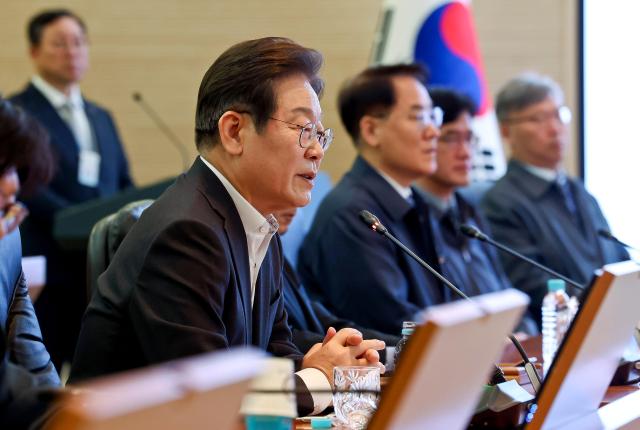
SEOUL, April 18 (AJP) - Lee Jae-myung, a leading presidential contender from the Democratic Party (DP), pledged Friday to relocate the ocean ministry to the southern port city of Busan to strengthen South Korea’s maritime competitiveness.
Through a social media post, Lee said he would move the Ministry of Oceans and Fisheries to Busan to make the city “the undisputed center of South Korea’s maritime leadership” and to ensure “field-oriented policymaking.”
He also vowed to relocate public institutions related to shipping and logistics, establish a specialized maritime court, and provide customized financial support for regional industries, startups, and manufacturers in the southeastern part of the country.
For the Daegu and North Gyeongsang Province, Lee promised to create an industrial belt focused on battery production and build a cluster for next-generation auto parts. He also pledged to promote a bio industry belt in the region and turn it into a national hub for biotech and vaccine development.
Later in the evening, Lee is scheduled to join fellow candidates Kim Kyung-soo, former South Gyeongsang Governor, and Gyeonggi Governor Kim Dong-yeon in the DP’s first televised presidential primary debate. The 80-minute broadcast will feature a broad policy discussion on domestic politics, the economy, foreign affairs, and national security. It will offer candidates an early opportunity to contrast their visions ahead of the June 3 election.
Lee enters the race as the clear frontrunner. According to a National Barometer Survey released Thursday, Lee received 45 percent support in hypothetical three-way matchups against rival conservatives, including former labor minister Kim Moon-soo, former Daegu Mayor Hong Joon-pyo, and former justice minister Han Dong-hoon.
In terms of overall presidential suitability, Lee led with 39 percent, far ahead of other contenders, each polling in the single digits.
Park Sae-jin
Experienced journalist and editor at AJU PRESS specializing in multilingual news. I cover international diplomacy, geolpolitics, and policy, consistently delivering highly accurate, compelling reporting for a worldwide audience.
Copyright ⓒ Aju Press All rights reserved.
Related News
-
 Board Lacks Responsibility, Only Authority: Controversy Over Seoul National University Presidential Election System
"The board has no responsibility, only authority. The rankings from the three-stage election process, divided into the presidential recommendation committee, policy evaluation group, and board, have consistently conflicted, leading to a collapse of trust within the university."On November 23, during the second session of the '7th SNU Innovation Forum' held at the Asia Research Institute of Seoul National University, there was a heated discussion surrounding the upcoming presidential election system, the reform of the vice president system, collaboration for 'Creating 10 Seoul National Universities', and participation of retired faculty in lifelong education. Notably, current President Yoo Hong-rim and the final candidate for the next president, Professor Choi Hae-cheon from the Department of Mechanical Engineering, were present, as panelists and university members discussed the structural limitations of the current election method based on the governance reform proposal presented by the SNU Institutional Innovation Committee.The forum's second session included presentations on: △ Professor Jang Ho-won from the Department of Materials Science and Engineering's research on 'Linking Lifelong Education and Extension of Retirement Age' △ Professor Lee Jong-seob from the Graduate School of Business's research on 'Collaboration Strategies for Creating 10 Seoul National Universities' △ Professor Yoon Ji-hyun from the Law School's presentation on 'Governance Innovation at Seoul National University: Improvement and Reform of the Presidential Election System and Vice President System', followed by a panel discussion featuring Se Eun-young, Director of the Gwanak Student Living Hall (Nursing Faculty), Park Eun-soo, Planning Department Head (Engineering Faculty), Lim Jeong-mook, Faculty Council Chair (College of Agriculture and Life Sciences), and Jeon Sang-jik, Council Member (Music College)."Overwhelming Demand for Direct Election" vs "Consensus on Governance Philosophy Needed"... Surgery on Presidential Election SystemThe main issue of the second session's discussion was undoubtedly the presidential election system and the reform proposal for the vice president system. Earlier, Professor Yoon Ji-hyun from the Law School diagnosed that the current election method, which combines the candidate nomination (election system) with the verification by the presidential recommendation committee and policy evaluation group (mixed appointment and election system), has resulted in conflicting evaluations at each stage.Professor Yoon suggested short-term improvement directions, including: ▲ Reducing the presidential recommendation committee to around 15 members as a deliberative body and extending the verification period to over six months to strengthen the invitation of external personnel and in-depth verification ▲ Reducing the role of the policy evaluation group or transitioning to a mobile voting system for all members ▲ Considering the extension of the presidential term (e.g., 6+3 years) and the introduction of a U.S.-style provost, special vice president, and vice president for financial planning as review tasks.Lim Jeong-mook, the Faculty Council Chair, expressed the strong demand for reform from the faculty community, confirmed during the recent presidential election. He stated, "While there is a minority opinion advocating for an appointment system centered on the board, the majority of faculty believe that the current election process is neither just nor fair. There is an overwhelming call to abolish the presidential recommendation committee and the policy evaluation group or to convert them into a simple election management committee, and to introduce a 'direct election' involving faculty, students, and staff." He also urged for reform of the presidential reappointment system, noting that concerns about interference from the administration arise when the current president seeks reappointment, and many find it unreasonable to have to re-challenge from the first cutoff stage.Professor Jeon Sang-jik pointed out that before adjusting specific rules, a 'principled consensus on university governance' must be established first. He noted, "In the five previous indirect elections, the rankings of the presidential recommendation committee, policy evaluation group, and board have rarely aligned, leading to accumulated distrust. However, beyond simply expanding voting rights, there needs to be an agreement on how much the opinions of internal members are reflected at each stage, whether to clarify the criteria for evaluation entities, and whether to disclose meeting minutes." He added, "The idea of reducing the presidential recommendation committee to around 30 members to enhance deliberation could provoke backlash regarding representation from individual colleges, and inviting external personnel could lead to significant conflicts due to differing perspectives on the university from internal and external committee members," advocating for caution.Choi Hae-cheon, the final candidate for the next president, expressed his commitment to reform during a floor statement. He said, "During the candidate debate, all four candidates agreed that the current presidential election system must change, and I also presented institutional reform as a core pledge. I will faithfully gather the opinions of university members and, after obtaining government approval, will initiate reforms to the presidential election system within 1-2 years after taking office."'Creating 10 Seoul National Universities': User Verification Beyond Charitable Sharing is KeyRegarding the government's 'Creating 10 Seoul National Universities' policy, which has a confirmed budget of 885.5 billion won (KRW) this year, there was a consensus that Seoul National University should play the role of a 'user-centered platform' rather than a 'supplier'. The presenter, Professor Lee Jong-seob from the Graduate School of Business, analyzed 76 collaboration cases with 15 internal institutions of Seoul National University (31 from national universities) and proposed that Seoul National University should perform six major roles, including a joint practice and equipment hub, data platform, and regional innovation talent co-training, and pursue seven institutional improvements, such as special treatment for labor costs for students from other universities.Park Eun-soo, the Planning Department Head, presented three prerequisites to ensure that the collaboration with national universities such as Pusan National University, Jeonnam National University, and Chungnam National University, selected this year, does not remain a slogan. He pointed out, "Previous surveys have remained at the supply-side analysis of internal cases of Seoul National University. We need to directly verify from the user's perspective the areas that national universities will develop independently and the areas where Seoul National University can participate to create synergy."He also emphasized that, in the initial stages of collaboration, Seoul National University should focus on supporting advanced and fundamental research capabilities in which it has strengths, while in the medium to long term, it should maintain global research competitiveness and nurture domestic national universities by clearly establishing principles for budget sharing among participating universities and the government, as well as addressing equipment operation personnel and administrative burdens.Retired Faculty Micro-Degree: "Not Employment Extension, but 'Education for Life and Circular Learning'"There was positive feedback on the proposal to link the expertise of retired faculty with the micro-degree program at the Lifelong Education Center, but a qualitative transformation of the operational model was demanded. Professor Jang Ho-won from the College of Engineering, who presented, reported that survey results showed 82.1% of current faculty (95 respondents) and 80.0% of retired faculty (15 respondents) expressed willingness to participate in lectures, and 63.2% of students also wished to enroll, suggesting pilot course offerings in semiconductor, data science, architecture, health cooking, and nutrition, along with plans for certificates and degrees under the president's name.Se Eun-young, Director of the Gwanak Student Living Hall, identified mismatches between the desired fields of current faculty (focused on engineering and natural sciences) and adult learners (in AI, arts, semiconductors, and care) and proposed three development axes. She emphasized, "To ensure that the educational commitment of emeritus professors does not end with one-time special lectures, a flexible matching system that periodically connects the pool of personnel with course demand and reasonable compensation and administrative support must be established to enable 'extension of roles' beyond mere 'extension of employment'." She added, "For middle-aged and elderly learners, 'education for life' that addresses not only job competencies but also health, care, relationships, and retirement planning is essential," suggesting that graduates participate as mentors for the next cohort and that emeritus professors also engage as learners in courses from other fields, forming a 'mutual circular learning community'.Floor Opinions: "Need for Early Retirement Compensation and Inclusion of Non-Regular Faculty"... Chair Park Tae-kyun: "I Will Connect Through Trust"In the open discussion, suggestions emerged to address institutional blind spots. One participant stated, "Along with discussions on extending retirement age, reasonable compensation for faculty wishing for early retirement and a circulation mechanism for emerging researchers must be established, and the demands of non-regular and administrative members, such as teaching faculty and facility staff, who were excluded from the presidential election policy evaluation group, should also be reflected in pledges." Deputy Minister of Education Lee Jun-jeong also urged, "Rather than adopting a U.S.-style provost system that is disconnected from the reality of Korean universities and focused on rankings, it is necessary to closely examine the uniqueness of Seoul National University and its coordination function in the field."In his closing remarks, Park Tae-kyun, chair of the Institutional Innovation Committee, stated, "To achieve education and governance innovation that reflects the character of Seoul National University, communication that builds understanding and trust among different groups, including faculty, staff, and students, must precede. Based on the criticisms and suggestions made today, we will continue to pursue substantial institutional reforms with the consensus of our members."* This article has been translated by AI.
-
Gwangju Buk District Mayor Shin Soo-jung Charged with Election Law Violations
Shin Soo-jung, the mayor of Gwangju's Buk District, has been referred to the Gwangju District Prosecutors' Office on charges of violating the Public Official Election Act. She is accused of illegally recruiting party members ahead of the June 3 local elections. According to Yonhap News on the 23rd, Mayor Shin was reported to the police for allegedly delivering 8 million won (KRW) to a specific individual in exchange for recruiting 900 party members last January. The police received the complaint and conducted a six-month investigation, concluding that some of the allegations against Shin constituted criminal acts. During the investigation, the police summoned Shin for questioning and seized her mobile phone to verify the facts. Shin has reportedly denied the allegations against her.* This article has been translated by AI.
-
Election Commission Special Investigation Team Expands Probe into Voting Irregularities
The special investigation team of the Election Commission, led by Special Prosecutor Lee Tae-han, has added one more prosecutor to its ranks as it investigates allegations of tampering with voting records at over 40 polling places during the June 3 local elections. The newly joined prosecutor will focus on the investigation into the alleged tampering of voting records and the improper payment of activity fees to Election Commission officials.According to legal sources on the 16th, a prosecutor from the Busan District Prosecutors' Office, who is a graduate of the bar exam's fourth session, began work with the special investigation team today. The number of prosecutors assigned to the team has increased from 18 to 19, which is still one short of the authorized limit of 20 under the special investigation law.Key issues in the investigation of the voting records include how the circumstances at polling places with insufficient ballots were documented after the election and who was involved in that process. The special investigation team is looking into whether the Central Election Commission directed local election commissions to retroactively record voting records, and if this directive was aimed at avoiding accountability for the use of unnumbered ballots or to evade election disputes.The allegations regarding improper activity fees involve claims that the Election Commission unjustly paid fees to its chairman and non-standing committee members. To verify the circumstances of these payments, the special investigation team conducted searches last month at 18 departments of the Central Election Commission and at the residence of former Secretary-General Heo Cheol-hoon. Investigations of suspects are ongoing. According to some reports, more than 10 suspects have been questioned by various investigation teams regarding allegations of voting record tampering and collusion with companies over the past weekend.Separately from the prosecutor additions, discussions regarding the dispatch of investigators are still ongoing. At the end of last month, the special investigation team requested nine investigators from the Serious Crimes Investigation Agency, designating seven of them, while leaving the selection of the remaining two to the agency. When the agency responded that it could only dispatch one investigator of its own choosing, the special investigation team made another request for additional dispatches and is currently awaiting a response.* This article has been translated by AI.